Most people driving toward Glacier National Park’s eastern entrance blow straight through Browning without stopping. That’s a genuine missed opportunity, because one of the most substantial Native American art and history collections in the country — and one of the best museums in Montana you’ll find anywhere in the state — sits right at the junction where Highway 2 meets Highway 89, minutes from the park boundary.
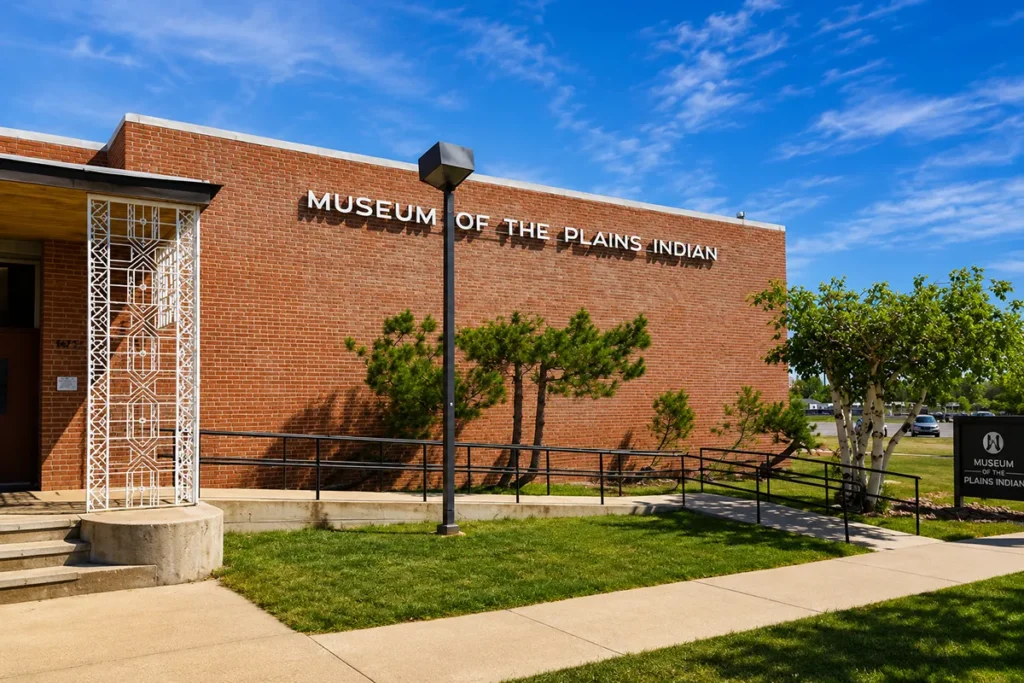
The Museum of the Plains Indian, founded in 1941 and operated by the U.S. Department of the Interior’s Indian Arts and Crafts Board, sits in Browning at the heart of the Blackfeet Nation. It holds historic clothing, horse gear, weapons, and everyday objects from eleven Northern Plains tribes, alongside a rotating contemporary art sales gallery that directly supports living Native artists. This guide covers what’s inside, seasonal hours and admission, photography rules, and how it fits into a Glacier National Park trip.
Liked this article?
Add Roaming Montana as a preferred source so you see more of our articles and guides on Google.
What Makes This Museum Different
Most Montana museums that touch on Native American history do so as one section within a broader state-history narrative — a gallery, a wing, a portion of a larger collection.
The Museum of the Plains Indian does the opposite: it’s built specifically and entirely around the material culture of Northern Plains tribal peoples, with the Blackfeet Nation as its most immediate community and namesake.
That focus lets it go considerably deeper than a general history museum ever could on a single subject.
The museum was founded in 1941 and operates in partnership between the National Park Service and the Indian Arts and Crafts Board, a federal agency under the U.S. Department of the Interior established specifically to promote and protect the economic welfare of Native American craftspeople.
That institutional structure matters practically: part of the museum’s ongoing mission is directly supporting living Native artists’ livelihoods, not just preserving historic objects behind glass.
The collection represents eleven Northern Plains tribal nations: the Blackfeet, Crow, Northern Cheyenne, Sioux, Assiniboine, Arapaho, Shoshone, Nez Perce, Flathead (Salish), Chippewa, and Cree.
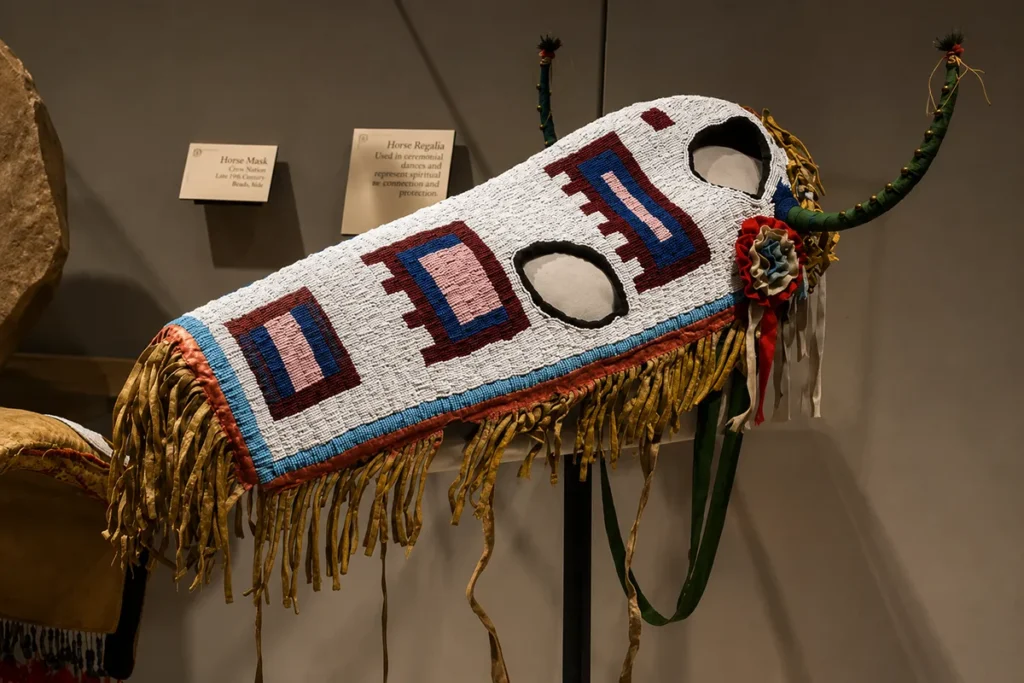
Exhibits center on historic clothing, horse gear, weapons, household implements, baby carriers, and toys — the tangible, everyday material culture of Northern Plains life, alongside more ceremonial and artistic pieces.
Inside the Collection
Three dioramas anchor the permanent exhibit space, presenting scenes of Northern Plains life with a level of physical detail that photographs and text panels alone can’t convey.
Carved wood panels by Blackfeet sculptor John Clarke, a deaf artist known for detailed, naturalistic wildlife and figure carving, are on permanent display, alongside murals by Blackfeet painter Victor Pepion.
A multimedia presentation rounds out the interpretive experience, giving context to the historic objects on display.
One important note before you visit: photography is not permitted inside the museum. I understand why some visitors find this frustrating in an era when documenting every stop is second nature, but I’d encourage you to treat it as a feature rather than a limitation — it keeps the focus on actually looking closely at the beadwork, quillwork, and craftsmanship on display rather than through a phone screen.
The detail in the historic clothing and horse gear here rewards slow, close attention in a way a quick photo pass never would.
Supporting Living Native Artists
Beyond the historic collection, the museum runs a rotating series of promotional sales exhibitions featuring contemporary Native American art and crafts by emerging and established artists.
The small on-site gift shop sells original jewelry and crafts made by Blackfeet and other regional Native artists — genuinely made-by-the-artist pieces rather than mass-produced souvenirs, which is worth knowing if you’re looking for an authentic, meaningful purchase from your Montana trip rather than a generic gift shop trinket.
Buying here puts money directly into the hands of the artists whose work you’ve just spent an hour appreciating in the galleries.
The Honest Context Worth Knowing
I try to be direct about this rather than gloss over it: the Blackfeet Nation’s current reservation boundaries are the result of a long history of treaty negotiations and land cessions through the 19th century that dramatically reduced the tribe’s original territory, which once extended across a far larger area of what’s now Montana, Alberta, and Saskatchewan.
Understanding that history adds real weight to a museum visit here — you’re not just looking at historic artifacts in isolation, you’re standing in the heart of a living nation whose relationship to this specific land has been shaped by forces well beyond its own choosing.
The museum itself, and the broader Blackfeet community around it, continues to actively preserve and practice the culture represented in its galleries; this is not a memorial to a vanished way of life, it’s a living community’s own institution.
The Artists Behind the Permanent Collection
It’s worth knowing a bit more about the two Blackfeet artists whose work anchors the permanent galleries, because their stories add real depth to what you’re looking at.
John Clarke, born in 1881, was deaf from a childhood illness and became one of the most respected wildlife and figure sculptors of his generation, working primarily in wood.
His carvings combine an intimate, almost anatomical understanding of Northern Plains wildlife with a formal sculptural sensibility that earned him recognition well beyond Montana during his lifetime — a genuinely remarkable achievement for a Native artist working in the early-to-mid 20th century, an era when Native artistic traditions were too often dismissed by mainstream American art institutions rather than celebrated.
Victor Pepion, whose murals appear throughout the museum, was a Blackfeet painter whose work captures ceremonial and everyday Blackfeet life with a narrative, almost documentary quality.
Seeing his murals alongside the historic objects in the same building gives you two complementary ways of understanding the same culture — the physical artifacts on one hand, and one Blackfeet artist’s own visual interpretation of his community’s life on the other.
Visiting With Kids and Families
This museum tends to hold kids’ attention better than you might expect from a collection this focused on historic textiles and craftwork.
The dioramas in particular are a good anchor for younger visitors — three-dimensional scenes read more easily for kids than wall-mounted historic garments do, and they give parents a natural way to start a conversation about what daily life looked like for Northern Plains families generations ago.
I’d pair a visit here with some advance context if you’re traveling with school-age kids; even a five-minute conversation in the car about the Blackfeet Nation and Glacier National Park’s location within traditional Blackfeet territory gives the museum visit more meaning than walking in cold.
Quick Questions I Get Asked
Is this museum run by the Blackfeet Nation itself, or by the federal government?
It’s a federal institution, operated by the Indian Arts and Crafts Board under the U.S. Department of the Interior, located within and deeply connected to the Blackfeet Nation, but it isn’t a tribally owned and operated museum in the same way some other Native cultural centers are. It’s worth knowing that distinction going in.
Is it worth stopping if we only have a short window before entering Glacier?
Yes, even a 45-minute visit is worthwhile given how directly it sits on the route to the park’s eastern entrances — this isn’t a detour that requires backtracking.
Can we buy authentic Native-made souvenirs here?
Yes, and I’d actively recommend it over buying from a generic roadside gift shop elsewhere in the Glacier region. The museum’s sales gallery and gift shop feature verified, artist-made work.
Is there anywhere to eat nearby?
Browning has a handful of local dining options, though it’s a small town — if you have specific dietary needs, it’s worth having a backup plan from nearby East Glacier Park Village or Cut Bank.
Most Montana travel content either skips this museum entirely in favor of Glacier National Park itself, or mentions it in a single throwaway sentence as a curiosity near Browning. A few specific gaps:
- Almost nobody explains the museum’s role in supporting living Native artists, treating it purely as a historic collection rather than an active economic and cultural institution.
- The free winter admission policy is rarely mentioned, which matters if you’re planning a shoulder-season or winter Glacier-area trip and assuming a fee applies year-round.
- The photography restriction catches people off guard because it’s almost never flagged in advance, leading to an awkward moment at the door rather than a planned expectation.
- The honest historical context around Blackfeet land history gets skipped entirely in most generic listicle coverage, reducing the museum to a simple “worth a stop” bullet point rather than the deeper, more meaningful visit it can be.
Personal Tips: What I Wish I Knew
- Time your visit around your Glacier itinerary, not as an afterthought. Browning sits directly on the route to Glacier’s eastern side, so this is genuinely easy to fold into a travel day rather than a special separate trip.
- Winter visitors get in free, which makes this a great stop if you’re doing a shoulder-season Glacier trip when the Going-to-the-Sun Road is only partially open and you have extra time to fill.
- Budget 45 minutes to an hour. It’s not a sprawling complex, but the level of detail in the beadwork and horse gear rewards a slower pace than a quick walk-through.
- The gift shop is worth genuine browsing time, not just a five-minute pass on your way out — it’s one of the better places in the Glacier region to find authentic, artist-made Native crafts.
- Call ahead if your visit falls near a federal holiday, since hours can shift around specific dates each year.
How This Fits Into a Glacier National Park Trip
Browning sits right at Glacier National Park’s eastern gateway, which makes this museum one of the easiest, most worthwhile detours you can add to a Glacier itinerary without meaningfully extending your driving day.
If you’re staying anywhere near the park’s east side, our where to stay in Glacier National Park guide covers lodging options that put you within easy striking distance of Browning.
This is also a natural stop if you’re headed toward Going-to-the-Sun Road or planning a day on the best hikes in Glacier National Park — build the museum into your arrival or departure day rather than trying to squeeze it into a hiking-heavy schedule.
And if Indigenous history is a particular interest of your Montana trip, pairing this museum with the Homeland Gallery’s Sovereign Nations exhibit at the Montana Historical Society Museum in Helena gives you both a tribally specific and a statewide framing of the same broader history.
For a wider view of how this fits into Montana’s overall story, our Montana history overview and key historical events in Montana posts provide useful additional context, and our Montana museums guide maps out how this pairs with the state’s other major cultural stops.
Practical Info
| Address | 19 Museum Loop, Browning, MT 59417 (junction of US Highway 2 and 89) |
| Phone | 406-338-2230 |
| Summer hours | Roughly June–September, daily, approximately 9 a.m.–4:45 p.m. [verify current summer hours] |
| Winter hours | Roughly October–May, reduced days, approximately 10 a.m.–4:30 p.m. [verify current winter hours] |
| Admission | Summer: modest fee for adults/children/seniors; free for school groups and Blackfeet tribal members with ID. Winter (Oct–May): free for all. [verify current pricing at doi.gov/iacb] |
| Photography | Not permitted inside the museum |
| Time needed | 45 minutes–1.5 hours |
| Good for | Glacier National Park travelers, Indigenous history and art enthusiasts, anyone building a more complete picture of Montana beyond its scenery |
| Nearby pairing | Eastern Glacier National Park entrance, our Glacier lodging guide |
Final Thoughts
This is one of the most substantial single-subject Native American museums I’ve visited anywhere in the country, and it sits close enough to Glacier’s eastern entrance that skipping it usually comes down to not knowing it’s there rather than any real trade-off in your itinerary.
Give it the hour it deserves — the beadwork alone is worth slowing your Glacier road trip down for. I’ve brought several first-time Montana visitors here over the years specifically because it reframes the rest of a Glacier trip in a way scenery alone doesn’t: you leave with a clearer sense of whose homeland you’re driving through, not just how beautiful it is.
Pin this for your Glacier National Park trip planning, and if you’ve visited during a rotating artist sales exhibition, I’d love to hear what caught your eye in the comments.