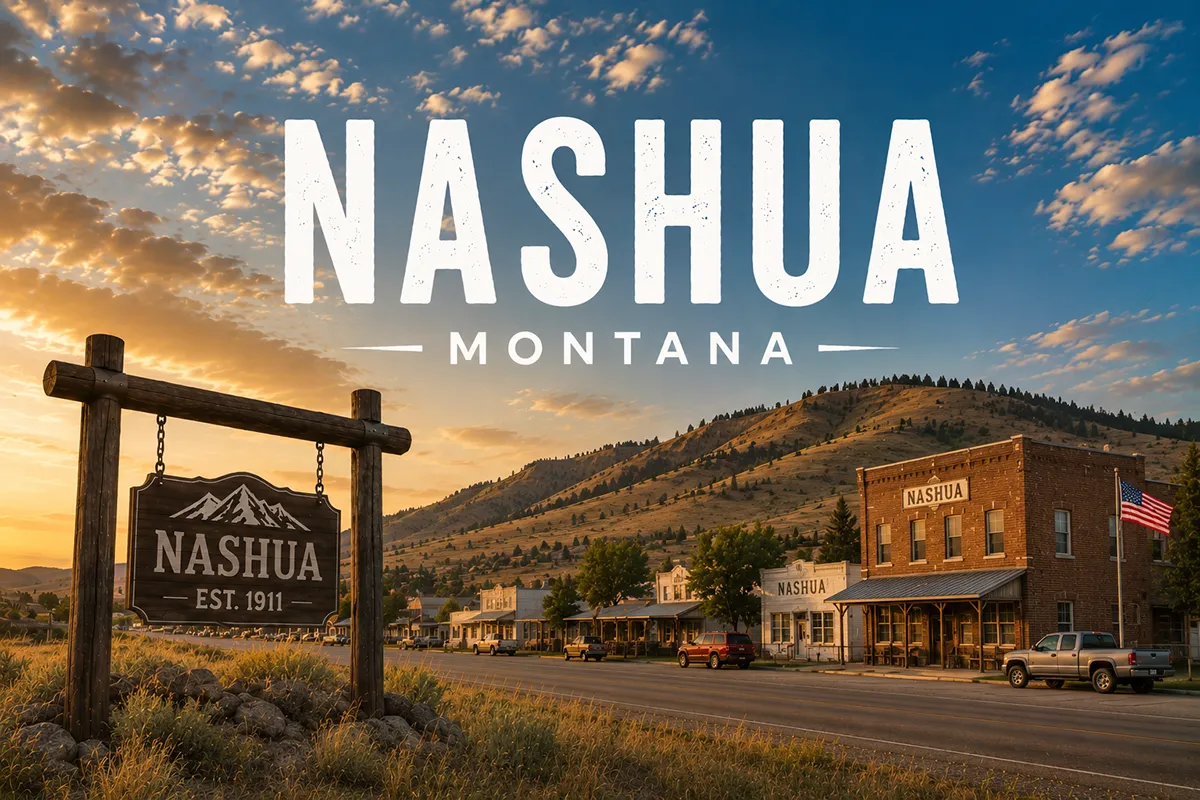
The man who founded Nashua, Montana was a second cousin of Robert E. Lee.
His name was Charles Sargent.
Sargent had been at Fort Union — the legendary upper Missouri fur trade post — in 1866. Twenty years later, in 1886, he returned to the area to homestead near what would become Nashua. He was betting on a specific outcome.
The St. Paul, Minneapolis & Manitoba Railway — soon to be reorganized as the Great Northern Railway under James J. Hill — was pushing west across what is now northern Montana.
Major division points along the line would generate substantial economic activity. Sargent hoped his homestead would be chosen as one of those division points.
He bet wrong.
The Manitoba Road chose Glasgow — about 15 miles west — as the division point instead. Nashua became a smaller station town on the line, established in 1888-1889. The original Great Northern depot was built in 1888. The town slowly grew around it.
The name Nashua is believed to be a Native American word meaning “meeting of two streams” — a reference to the confluence of Porcupine Creek and the Milk River at the town site.
For four decades, Nashua was a quiet Hi-Line agricultural community.
Then the federal government decided to build Fort Peck Dam about 15 miles southeast of Nashua. Construction began in 1933 under President Roosevelt’s New Deal infrastructure programs.
By 1940, when the dam was substantially complete, Nashua had ballooned to over 900 residents — one of the colorful, lively boom towns supporting the largest dam construction project in American history at that time.
After the dam was finished, the population dropped back. Today Nashua has approximately 280 residents.
The 1935 New Deal-era Nashua High School still operates. The 1888 Great Northern depot has been moved and repurposed as a Senior Citizens Center. Queen of Angels Catholic Church, established 1917 as a mission church, still rises with its tall Gothic bell tower against the prairie skyline.
TL;DR
- Nashua (~280) is in Valley County on US Highway 2, 15 miles east of Glasgow and 50 miles west of Wolf Point.
- Founded by Charles Sargent — a second cousin of Robert E. Lee — who homesteaded in the area in 1886 hoping it would become a Great Northern Railway division point.
- The Manitoba Road chose Glasgow as the division point instead; Nashua became a smaller station town established 1888-1889.
- The town’s name is believed to mean “meeting of two streams” — referring to the confluence of Porcupine Creek and the Milk River at the townsite.
- Peak population over 900 in 1940 during construction of nearby Fort Peck Dam (about 15 miles southeast).
- The town serves as an eastern gateway to Fort Peck Dam and Lake recreation.
- The 1935 Nashua High School (a New Deal-era building) is still operating; mascot is the Porcupines.
- Queen of Angels Catholic Church (1917) features a prominent Gothic bell tower visible from miles away.
- Nashua borders the Fort Peck Indian Reservation on the east.
- Best for: Fort Peck Lake/Dam access, Hi-Line corridor stops, railroad heritage, New Deal-era community architecture.
Liked this article?
Add Roaming Montana as a preferred source so you see more of our articles and guides on Google.
Nashua at a Glance
| Population (estimated) | ~280 |
|---|---|
| County | Valley County |
| Region | Northeast Montana (Hi-Line, lower Milk River) |
| Elevation | 2,041 ft |
| Distance to Glasgow (county seat) | ~15 miles west on US-2 (~20 min) |
| Distance to Wolf Point | ~50 miles east |
| Distance to Fort Peck Dam | ~15 miles southeast |
| Distance to Malta | ~70 miles west |
| Distance to Culbertson | ~75 miles east |
| Distance to Dodson | ~85 miles west |
| Distance to Bainville | ~100 miles east |
| Founded | 1888-1889 (Manitoba Road) |
| Peak population | 900+ (1940, Fort Peck Dam boom) |
| Best for | Fort Peck gateway, Hi-Line stops, railroad heritage |
What Makes Nashua Different
The story has two distinct eras: the railroad founding and the Fort Peck Dam boom.
The Sargent Bet
Charles Sargent’s bet on Nashua was a reasonable one for 1886.
The railroad was clearly coming. Division points along major mainlines generated substantial economic activity — switching yards, roundhouses, repair facilities, crew housing, hotels for traveling businessmen. Anyone who owned land at the right spot stood to make significant money.
Sargent was no stranger to the upper Missouri. He had been at Fort Union in 1866 — the legendary American Fur Company post at the confluence of the Yellowstone and Missouri rivers.
Twenty years later, with the homesteading frontier opening, he returned to file a claim near present-day Nashua.
The bet didn’t pay off.
The Manitoba Road’s planning office chose Glasgow — 15 miles west — as the division point. Nashua became a small station town along the line, established in 1888-1889 to handle local agricultural shipping and provide a water stop for steam locomotives.
The Sargent family stayed. By 1903, Nashua had a store, a school, a hotel, and a saloon — the basic infrastructure of a working Hi-Line community.
The Name Origin
The town’s name is believed to derive from a Native American word meaning “meeting of two streams.”
The reference is to the confluence of Porcupine Creek and the Milk River at the townsite. The geography is genuinely distinctive — both streams enter from the north, the Milk continues east toward its eventual confluence with the Missouri, and the townsite sits on a flat bench above the confluence.
For pre-railroad indigenous peoples (Aaniih, Nakoda, Lakota), the confluence had been a recognized landscape feature for centuries.
The Fort Peck Dam Boom
Everything changed in 1933.
President Franklin Roosevelt’s New Deal infrastructure programs included the Fort Peck Dam project — the construction of what would become at the time the largest hydraulic earth-filled dam in the world, located on the Missouri River approximately 15 miles southeast of Nashua.
Construction created enormous labor demand.
The project employed approximately 11,000 workers at peak. New towns sprang up to house them. Existing communities exploded. Nashua became one of the eastern boom towns supporting the dam construction effort.
By 1940, when the dam was substantially complete, Nashua had grown to over 900 residents — more than three times its 1930 population. New commercial buildings filled in along Main Street. A new high school (the 1935 building) opened to handle the surge in school-age children. Queen of Angels Catholic Church expanded its mission operations.
The boom ended when the dam was finished.
By 1950, Nashua’s population had dropped back substantially. By 1960, it was approximately 500. The contemporary population of around 280 represents the long contraction that has affected most Hi-Line communities since the 1940s.
Fort Peck Lake
The completion of Fort Peck Dam created Fort Peck Lake — an enormous reservoir on the Missouri River.
The lake is approximately 134 miles long with a maximum depth of 220 feet. It covers approximately a quarter-million acres. The shoreline is over 1,500 miles long — more than the entire California coastline.
The lake is one of Montana’s most substantive recreational waters. Walleye, sturgeon, smallmouth bass, lake trout, and northern pike all support active fishing. Hunting around the shoreline includes mule deer, white-tailed deer, antelope, sharp-tailed grouse, and waterfowl.
Nashua serves as the eastern gateway to lake and dam recreation.
For broader trip context, see my Montana cities and towns hub and the Fort Peck town guide.
The Top 6 Things to Do In & Around Nashua
1. Fort Peck Dam & Lake Day Trip
The signature regional attraction.
The Fort Peck Dam Interpretive Center and Museum (operated by the U.S. Army Corps of Engineers) is one of the most complete museums detailing the dam’s construction history and the broader Fort Peck area. The lake supports boating, fishing, swimming, and shoreline recreation.
See the Fort Peck town guide for full details.
2. Queen of Angels Catholic Church
The 1917 mission church with its tall Gothic bell tower is one of Nashua’s most architecturally significant buildings.
Brief stop for exterior photography. The church remains active; verify any interior tour availability with the parish office.
3. Nashua High School
The 1935 New Deal-era school building has been recently renovated with a modern facade while preserving its historic core.
The school is the community’s central institution and ongoing point of pride. The mascot is the Porcupines (a reference to the original Porcupine Creek that gives Nashua its name and location).
4. Great Northern Depot / Senior Citizens Center
The original 1888 Manitoba Road / Great Northern Railway depot has been moved and repurposed as the town’s Senior Citizens Center.
Brief stop. The adaptive reuse is itself substantively interesting from a historic preservation perspective.
5. US-2 Hi-Line Drive
Nashua sits midway on the eastern Hi-Line corridor between Wolf Point (east) and Glasgow (west).
The full Hi-Line drive — US Highway 2 from Bainville on the North Dakota border to West Glacier in the west — is one of America’s classic cross-state routes.
See my Montana railroads guide for broader rail-corridor context.
6. Fort Peck Indian Reservation
Nashua borders the Fort Peck Indian Reservation on the east.
The reservation is home to the Assiniboine (Nakoda) and Sioux (Dakota and Lakota) peoples. The Fort Peck Tribes Cultural Center and visitor services provide context for the contemporary communities. See Wolf Point for additional reservation-area attractions.
Where to Stay
Nashua has very limited dedicated lodging.
Most travelers base in Glasgow (20 minutes west) or stay in Fort Peck (~25 minutes southeast).
| Lodging | Vibe | Price | Best For |
|---|---|---|---|
| Glasgow hotels (20 min W) | Full Valley County selection | $100–200 | Most travelers |
| Fort Peck lodging (25 min SE) | Historic dam-town options | $100–180 | Dam-focused visits |
| Wolf Point hotels (1 hr E) | Reservation area options | $100–180 | Eastern travelers |
| Vacation rentals (Nashua area) | Limited | $120–250 | Hunters, anglers |
Where to Eat
- Local Nashua cafes and bar — verify current operations
- Glasgow dining (20 min W) — broader Valley County selection
- Fort Peck restaurants (25 min SE) — including the historic Fort Peck Hotel dining
Getting There & Around
From Glasgow: 15 miles east on US-2, about 20 minutes.
From Wolf Point: 50 miles west on US-2, about 1 hour.
From Fort Peck: ~15 miles northwest on MT-117 / US-2, about 25 minutes.
From Malta: 70 miles east on US-2, about 1.25 hours.
From Culbertson: 75 miles west on US-2, about 1.25 hours.
Cell service: Generally available in Nashua and along US-2. Reduced on surrounding ranch roads and at remote lake access points.
When to Visit
Late spring through fall (May-October): Best for Fort Peck Lake recreation; longest daylight; warmest weather.
Summer (June-August): Peak fishing season; warmest temperatures; full lake access.
Fall (September-October): Outstanding Hi-Line light; cooler temperatures; hunting season; quieter lake.
Winter (December-March): Severe Hi-Line weather; some lake access seasonal; town quieter.
Spring (April-May): Ice-out on Fort Peck Lake; quieter shoulder season; spring fishing.
Personal Tips
Pair Nashua with Fort Peck. Most travelers heading to Fort Peck Dam stop in Nashua only briefly. Combine the Fort Peck Interpretive Center visit, the lake recreation, and Nashua’s railroad heritage into a substantive day trip.
Stop for Queen of Angels Catholic Church. The Gothic bell tower is genuinely striking against the prairie horizon. Five-minute photography stop with substantive architectural value.
Visit the high school exterior. The 1935 New Deal-era building (recently renovated) is one of the more substantive surviving small-town New Deal school buildings in Montana.
Read the Charles Sargent / Robert E. Lee connection. The fact that Nashua was founded by a second cousin of Robert E. Lee — a Civil War-era figure of national significance — adds substantive historical context to what otherwise reads as a routine Hi-Line station town story.
Take the Hi-Line seriously. Tourism marketing focuses heavily on Glacier National Park. The US-2 corridor across the entire state — Nashua included — rewards travelers willing to slow down for the substance.
Fuel up. Hi-Line services are spaced widely apart. Fill up in Glasgow or Wolf Point before extended exploration.
Nashua Quick Facts
| Population (estimated) | ~280 | | Founded | 1888-1889 (Manitoba Road station) | | Town founder | Charles Sargent (second cousin of Robert E. Lee) | | Sargent homesteaded | 1886 | | Sargent earlier presence | Fort Union, 1866 | | Original Great Northern depot | 1888 | | Name origin | Native American “meeting of two streams” | | Streams referenced | Porcupine Creek and Milk River | | By 1903 | Store, school, hotel, saloon | | Queen of Angels Catholic Church established | 1917 (mission church) | | Nashua High School building | 1935 (New Deal era) | | School mascot | Porcupines | | Fort Peck Dam construction | 1933-1940 | | Peak population | 900+ (1940) | | Fort Peck Lake length | 134 miles | | Fort Peck Lake max depth | 220 ft | | Average summer high | 84°F | | Average winter low | -8°F |
Conclusion
Nashua is a 280-person Valley County town with substantively interesting historical bones.
The 1886 Charles Sargent homestead bet, the 1888 Manitoba Road / Great Northern station founding, the 1917 Queen of Angels Catholic Church, the 1933-1940 Fort Peck Dam construction boom that briefly tripled the town’s population, the 1935 New Deal school, and the contemporary eastern gateway position to Fort Peck Lake recreation all add up to genuine character.
The next time you’re driving US-2 between Glasgow and Wolf Point, or heading to Fort Peck Dam, take 30 minutes for Nashua.
Have a Nashua question? Drop it in the comments — I read every one.
Frequently Asked Questions
Is Nashua Montana worth visiting?
Nashua is worth a stop primarily for the 1917 Queen of Angels Catholic Church (Gothic bell tower), the 1935 New Deal-era Nashua High School building, the moved-and-repurposed 1888 Great Northern Railway depot (now the Senior Citizens Center), and its position as the eastern gateway to Fort Peck Dam and Lake recreation — one of Montana’s most substantive outdoor recreation destinations.
Who founded Nashua Montana?
Nashua was founded by Charles Sargent, a homesteader and former Fort Union (1866) resident who was a second cousin of Confederate General Robert E. Lee. Sargent filed his homestead claim in 1886, hoping the location would become a division point on the St. Paul, Minneapolis & Manitoba Railway (soon to be reorganized as the Great Northern Railway). The railroad chose Glasgow instead. Nashua became a smaller station town on the line, established in 1888-1889. By 1903, the town had a store, school, hotel, and saloon.
What does Nashua mean?
The town’s name is believed to derive from a Native American word meaning “meeting of two streams.” The reference is to the confluence of Porcupine Creek and the Milk River at the townsite. The geography was a recognized landscape feature for centuries among indigenous peoples (Aaniih, Nakoda, Lakota) before European-American settlement.
When was Nashua Montana founded?
Nashua was founded in 1888-1889 as a station town on the St. Paul, Minneapolis & Manitoba Railway (later the Great Northern Railway). The original depot was built in 1888. By 1903, the town had a store, school, hotel, and saloon. The town experienced its peak population of over 900 residents in 1940 during construction of the nearby Fort Peck Dam, but population has declined to approximately 280 today.
How far is Nashua from Fort Peck Dam?
Nashua is approximately 15 miles northwest of Fort Peck Dam — about a 25-minute drive via MT-117 and US-2. The town served as one of the eastern boom communities supporting Fort Peck Dam construction from 1933 to 1940. The Fort Peck Dam Interpretive Center and Museum (operated by the U.S. Army Corps of Engineers) is one of Montana’s most substantive interpretive facilities and a logical pairing with a Nashua visit. See the Fort Peck town guide for full details.
What is Fort Peck Lake?
Fort Peck Lake is the reservoir created by the 1933-1940 construction of Fort Peck Dam on the Missouri River in northeastern Montana. The lake is approximately 134 miles long with a maximum depth of approximately 220 feet and covers about a quarter-million acres of water. The shoreline measures over 1,500 miles — longer than the entire California coastline. The lake supports active fishing for walleye, sturgeon, smallmouth bass, lake trout, and northern pike, plus hunting around the shoreline for mule deer, white-tailed deer, antelope, sharp-tailed grouse, and waterfowl. Nashua is the lake’s eastern gateway community.
What is Queen of Angels Catholic Church in Nashua?
Queen of Angels Catholic Church is a 1917 mission church in Nashua, Montana, distinguished by its tall Gothic-style bell tower that competes with the town’s grain elevators for visual dominance on the prairie skyline. The Sisters of Charity worked with the Great Falls diocese to establish an adjacent one-room school to support the congregation. In 1953, Rev. A.J. Schuh wrote an appeal to the major newspaper The Catholic Worker seeking support for a rectory to provide a more permanent foundation for the church’s Nashua work. The church remains active and well-maintained — one of Nashua’s most architecturally significant buildings.