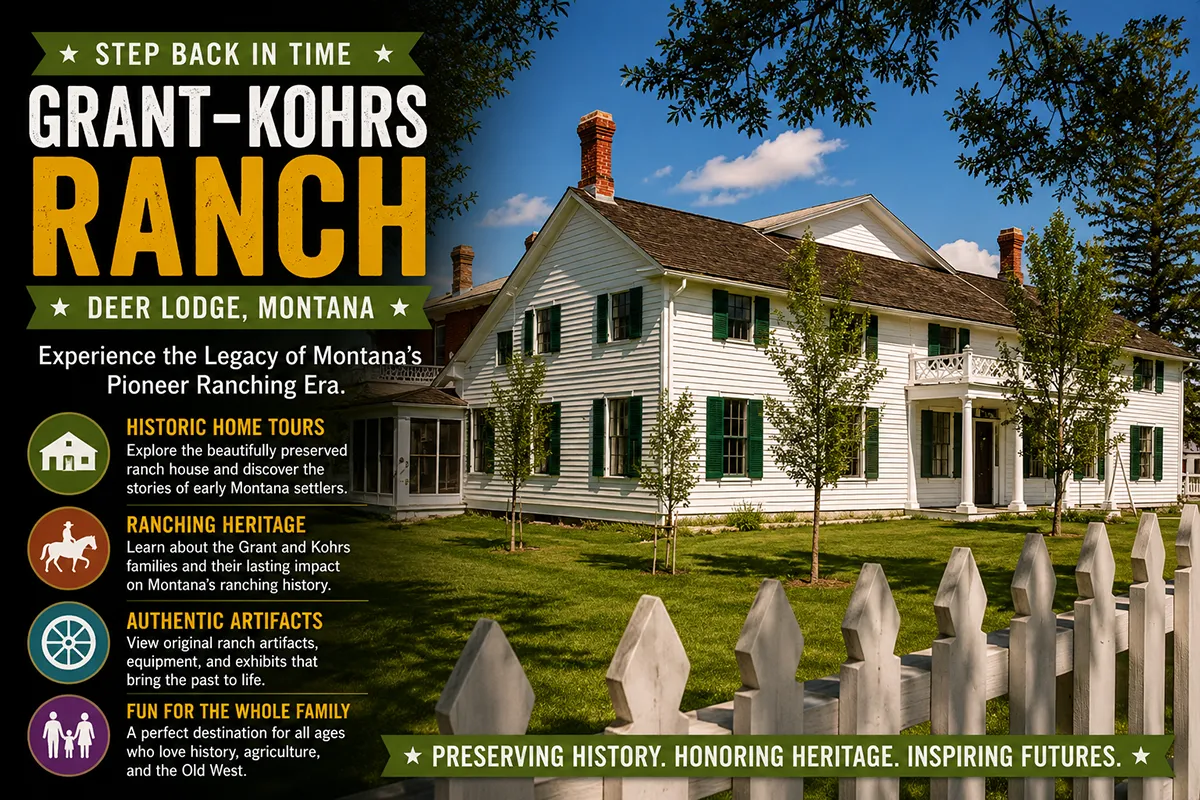
At its peak, one ranch controlled grazing rights across 10 million acres spanning four states and part of Canada. Its actual headquarters still stands today, and you can walk through it for free.
- Grant-Kohrs Ranch National Historic Site preserves the real headquarters of Conrad Kohrs’ 19th-century cattle empire in Deer Lodge
- The National Park Service still operates it as a living ranch, with draft horses, on-site blacksmithing, and real cattle
- 88 historic buildings sit across 1,618 acres, and admission is completely free
- The site’s history connects directly to the brutal winter of 1886-87, which wiped out much of Montana’s open-range cattle industry
- This is one of the best museums in Montana that most visitors drive right past on I-90 without realizing it’s there
Liked this article?
Add Roaming Montana as a preferred source so you see more of our articles and guides on Google.
A Ranch Founded By a Métis Fur Trader
Most people assume Grant-Kohrs Ranch started with Conrad Kohrs, the cattle baron whose name it carries. It didn’t.
Johnny Francis Grant, a Métis fur trader, began wintering cattle in the Deer Lodge Valley in the mid-1850s. He’d found something valuable: the valley’s lush vegetation and surrounding high mountains created ideal winter grazing conditions, catching snow that would otherwise bury the grass below.
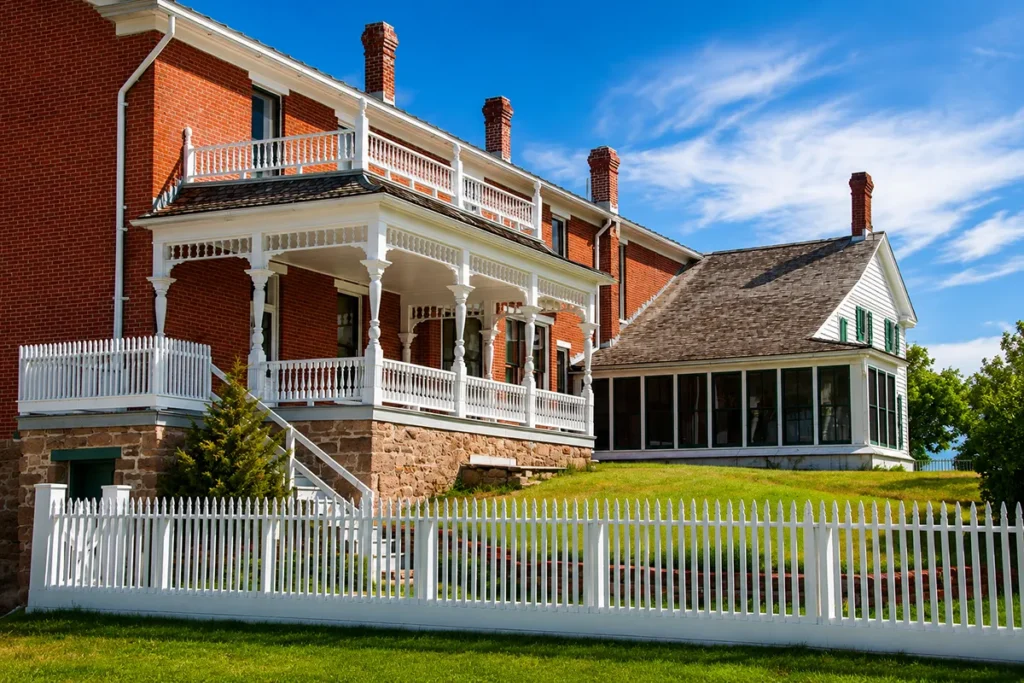
Grant built a two-story home here in 1862 for his large Métis family. Traders settled around him, forming a small community called Cottonwood — the town that would eventually become Deer Lodge.
Grant’s success didn’t last. When gold miners flooded the area, he found himself at a real disadvantage. He spoke French; the newcomers spoke English, and he was repeatedly taken advantage of in contracts he couldn’t fully navigate. In August 1866, he sold his ranch to Conrad Kohrs for $19,200 and returned to Canada.
Conrad Kohrs Builds a Cattle Empire
Conrad Kohrs was a German immigrant, born in 1835, who became a U.S. citizen at 22. He chased the California gold rush, then arrived at Montana’s gold camps in 1862 before eventually turning to ranching instead.
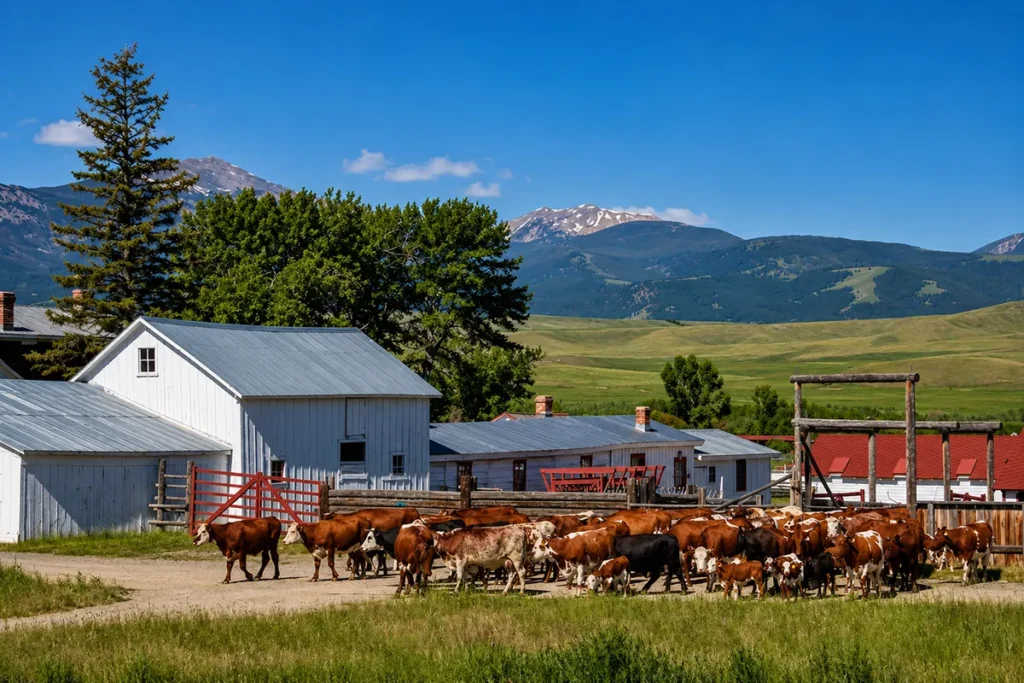
Kohrs partnered with his younger half-brother, John Bielenberg, and together they built something genuinely enormous. At its peak, their operation grazed herds across roughly 10 million acres of open range spanning four states and part of Canada.
Kohrs handled the business and political side of ranching. He served as both a territorial and state senator, and as president of the Montana Stockgrowers Association. That earned him the nickname Montana’s Cattle King.
Bielenberg worked the field side. He became known for his Shorthorn and Hereford cattle, along with his Thoroughbred and draft horses. His “Big Circle” horses were reputed to cover twenty miles of rough country in half a day — a genuinely useful trait when your cattle are scattered across a territory this size.
How the Cattle Actually Got Here
Understanding the logistics helps explain just how demanding this business really was.
Cattle couldn’t be moved more than 10 or 12 miles a day without losing condition. A drive from Texas to Montana could take up to five months. Kohrs bought two-year-old steers in Texas and drove them north to fatten on Montana’s rich grasses before selling.
Unlike Wyoming, Montana never saw the open violent range wars between cattle operations that marked other Western cattle states. That’s a small but telling detail about how this particular slice of frontier history actually played out here.
The Winter That Nearly Ended It All
The winter of 1886-87 remains one of the harshest on record in Montana history. It’s a story worth knowing before your visit, because it directly shaped what this ranch — and the entire Montana cattle industry — looked like afterward.
Ranchers relying on open range lost devastating numbers of cattle. Estimates range from a third to as much as 90 percent of herds destroyed, depending on the region and source. Eastern Montana saw temperatures hover between 30 and 40 degrees below zero for weeks on end.
By the summer of 1887, many Montana ranchers had gone out of business entirely. Those who survived — Kohrs and Bielenberg among them — quickly bought up newly vacant land, consolidating their holdings even further.
If you want the fuller picture of just how brutal that winter was across the state, our harsh Montana winter of 1886 guide covers it in more depth.
A House Wired for Electricity Before Electricity Arrived
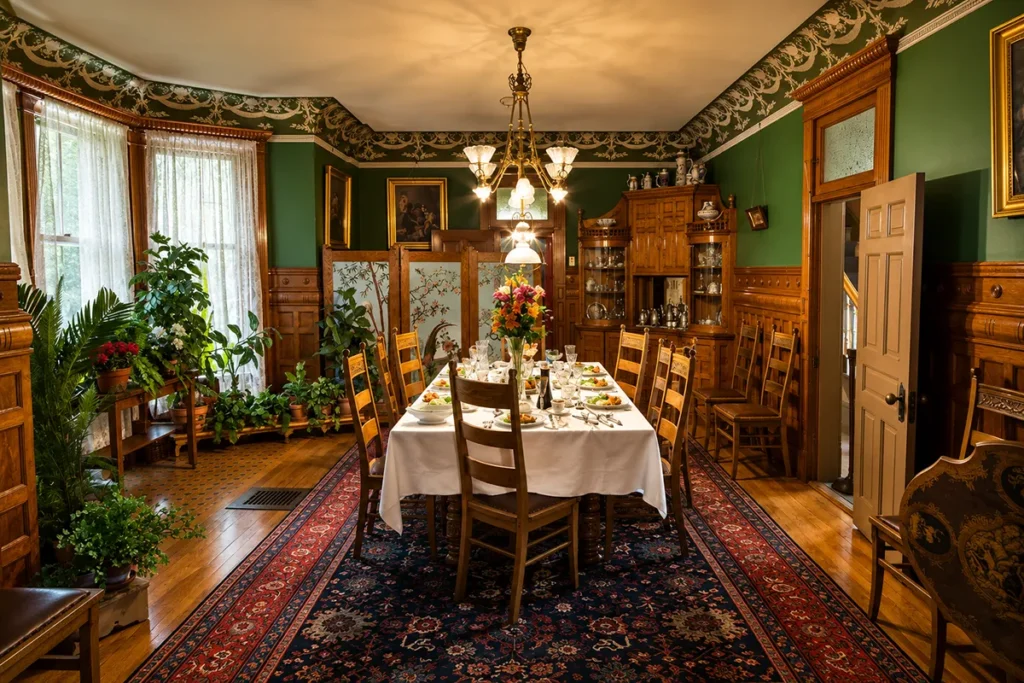
One small detail from the ranch’s history has always stuck with me. When the Kohrs family built a brick addition onto the main ranch house in 1890, they had the entire house wired for electricity.
The electricity itself didn’t actually reach Deer Lodge until 1892. For two years, the house sat fully wired and waiting for power that hadn’t arrived yet — a strange, specific kind of frontier optimism.
Augusta Kohrs: The Ranch’s Overlooked Caretaker
Conrad Kohrs’ wife, Augusta, spent her entire adult life at this ranch, from 1868 until her death in 1945. Her role rarely gets the attention it deserves.
Augusta wasn’t just managing the household. Corporate documents show her name directly as a partner and shareholder in the various companies that operated the ranch over the decades.
After Kohrs and Bielenberg both died in the early 1920s, it was Augusta who became a key caretaker of the operation, guiding the ranch’s Trustees as they downsized the home property and its remaining holdings.
Her granddaughter later noted that Augusta’s legacy extends well beyond the comfortable ranch house that now sits as the centerpiece of this historic site.
What It’s Like to Visit Today
The National Park Service doesn’t run this as a static museum. It’s a genuinely working, living history ranch.
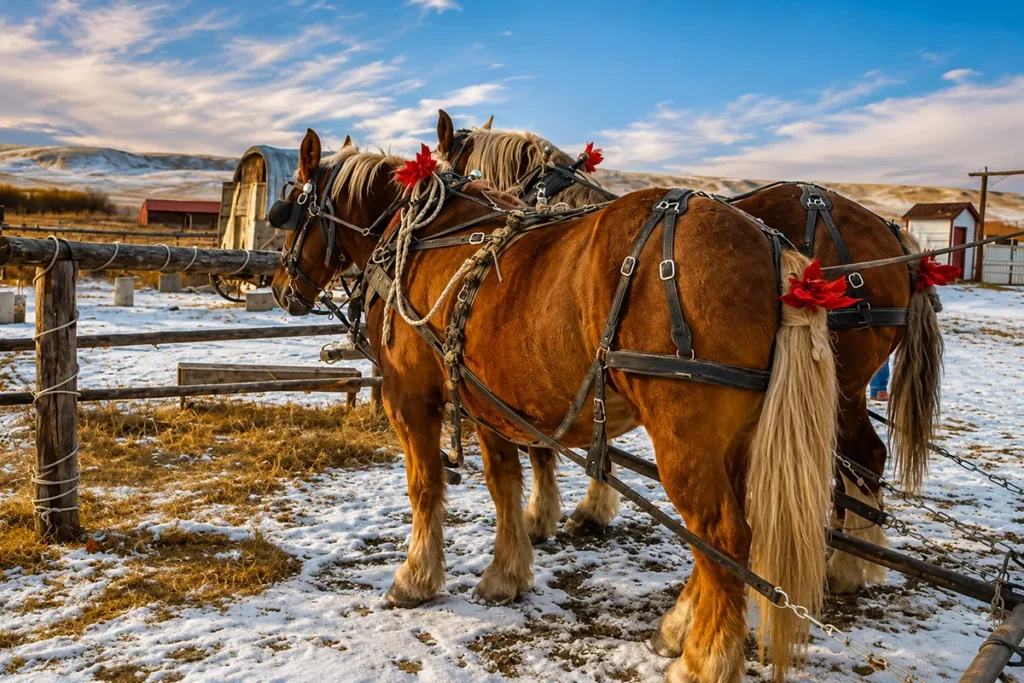
Draft horse teams still hay the land using period-appropriate methods. An on-site blacksmith still makes horseshoes for the ranch’s working horses. Staff keep operations as close to 19th-century practice as realistically possible.
Across the 1,618-acre property, 88 historic buildings survive. That’s an extraordinary number of original structures preserved in one place, giving you a far more complete picture than a typical single-building historic home museum.
Seasonal ranger-led programs add real texture to a visit: chuckwagon demonstrations, cowboy talks, blacksmith demonstrations, and wagon tours. Kids ages 5 to 15 can work through a Junior Ranger activity booklet and earn a badge, plus try roping lessons and meet the ranch’s horses, cows, and chickens.
Roughly seven to ten miles of walking trails wind through the property if you want to get beyond the immediate ranch buildings. A self-guided brochure works well if you’d rather explore at your own pace than join a ranger tour.
Visiting With Kids
This is one of the more genuinely engaging historic sites in Montana for families, precisely because it’s not just a look-but-don’t-touch museum.
Kids can meet real horses, cows, and chickens on the property. Roping lessons and the Junior Ranger program give younger visitors an active role rather than a passive walk-through experience.
I’d plan a half-day rather than a quick stop if you’re traveling with kids. Between the ranger programs, the animals, and the trail system, there’s genuinely enough here to fill a relaxed morning or afternoon.
Quick Questions I Get Asked
Is this the same as a typical dude ranch or guest ranch?
No — this is a National Park Service historic site, not a working vacation destination. There’s no overnight lodging, and the “working ranch” element is preserved specifically for historical demonstration rather than commercial operation. If you want an actual guest ranch stay, our Montana ranches guide covers those separately.
How is this different from a typical historic house museum?
Scale is the biggest difference. Most historic house museums preserve one building. This site preserves 88 of them across 1,618 acres, giving you a full working ranch complex rather than a single restored home.
Is the site accessible for visitors with mobility limitations?
The visitor center and core areas are generally accessible, though some outbuildings and trail sections have the uneven, unpaved ground typical of a working ranch property. Call ahead if accessibility is a specific concern.
Do we need to book ranger-led programs in advance?
Individual visitors typically don’t need reservations for standard programs, but the Park Service does recommend groups call ahead. Program schedules shift seasonally, so check current offerings before you arrive if a specific activity matters to your visit.
Most Montana travel content mentions this ranch as a quick “worth a stop” line, if at all. A few specific gaps show up repeatedly:
- Johnny Grant’s role as the ranch’s actual founder gets erased. Most guides jump straight to Conrad Kohrs, losing the more complicated, ultimately unjust story of how Grant lost his own ranch.
- Augusta Kohrs rarely gets mentioned at all, despite her documented role as a genuine business partner and the ranch’s caretaker for decades.
- The direct connection to the winter of 1886-87 gets treated as background trivia rather than the defining event it actually was for this specific ranch and the entire regional industry.
- The “living ranch” element gets undersold. This isn’t a preserved-in-amber museum; it’s an actively operating historic ranch, and that distinction genuinely changes the visit.
- The completely free admission rarely gets emphasized, even though it makes this one of the best-value stops in southwestern Montana.
Personal Tips: What I Wish I Knew
- Check the seasonal program schedule before you go. Chuckwagon demonstrations, blacksmith work, and wagon tours run seasonally, not year-round, so a winter visit will look very different from a summer one.
- Call ahead if you’re bringing a group. The Park Service specifically suggests reservations for group visits.
- Budget at least two hours, more if you want to walk any of the trail system or catch a ranger program.
- Combine this with Deer Lodge’s other historic sites. The Old Montana Prison Complex and the Montana Auto Collection sit nearby, both worth pairing with a ranch visit for a full Deer Lodge history day.
- Bring the kids’ Junior Ranger booklet request seriously. It’s a genuinely well-designed program, not just a throwaway activity sheet.
How This Fits a Southwest Montana Road Trip
Deer Lodge sits right off I-90, making this one of the easiest historic sites in the state to fold into a longer road trip rather than a dedicated detour.
Exit at I-90’s exit 184 and follow signs a half-mile to the property, or take exit 187 for a drive through downtown Deer Lodge first, since the ranch sits at the north end of town either way. Our Deer Lodge guide covers the rest of what’s worth seeing in town.
If ranching history is a particular interest of your Montana trip, our Montana ranches guide covers the state’s other notable ranch properties, several working as guest ranches today rather than historic sites. Our Montana museums guide maps how this stop connects to the rest of the state’s cultural landscape.
Practical Info
| Address | 266 Warren Lane, Deer Lodge, MT 59722 |
| Phone | 406-846-2070 |
| Summer hours | Memorial Day–Labor Day, 9 a.m.–5:30 p.m. |
| Rest of year | 9 a.m.–4:30 p.m. |
| Closed | Thanksgiving, Christmas, New Year’s Day |
| Admission | Free |
| Time needed | 2–4 hours |
| Good for | Families, ranching and cattle history enthusiasts, road trippers on I-90, budget-conscious travelers |
| Nearby pairing | Old Montana Prison Complex, Montana Auto Collection, our Deer Lodge guide |
Final Thoughts
Grant-Kohrs Ranch tells a genuinely complicated story — a Métis founder pushed out by circumstance, a German immigrant who built an empire, a wife whose decades of work rarely made it into the official record, and a brutal winter that reshaped an entire regional industry. All of it sits preserved across 88 real buildings, and you can walk through every bit of it for free.
Most visitors I’ve talked to expected a quick, forgettable stop off the interstate and left having spent most of a day here instead.
That gap between expectation and reality is exactly why this ranch deserves more than a passing mention on your Montana itinerary — it rewards curiosity in a way a lot of bigger, more heavily marketed attractions simply don’t.
Pin this for your Southwest Montana trip planning. If you’ve watched the blacksmith demonstration or caught a chuckwagon program, I’d love to hear how it compared to what you expected in the comments.