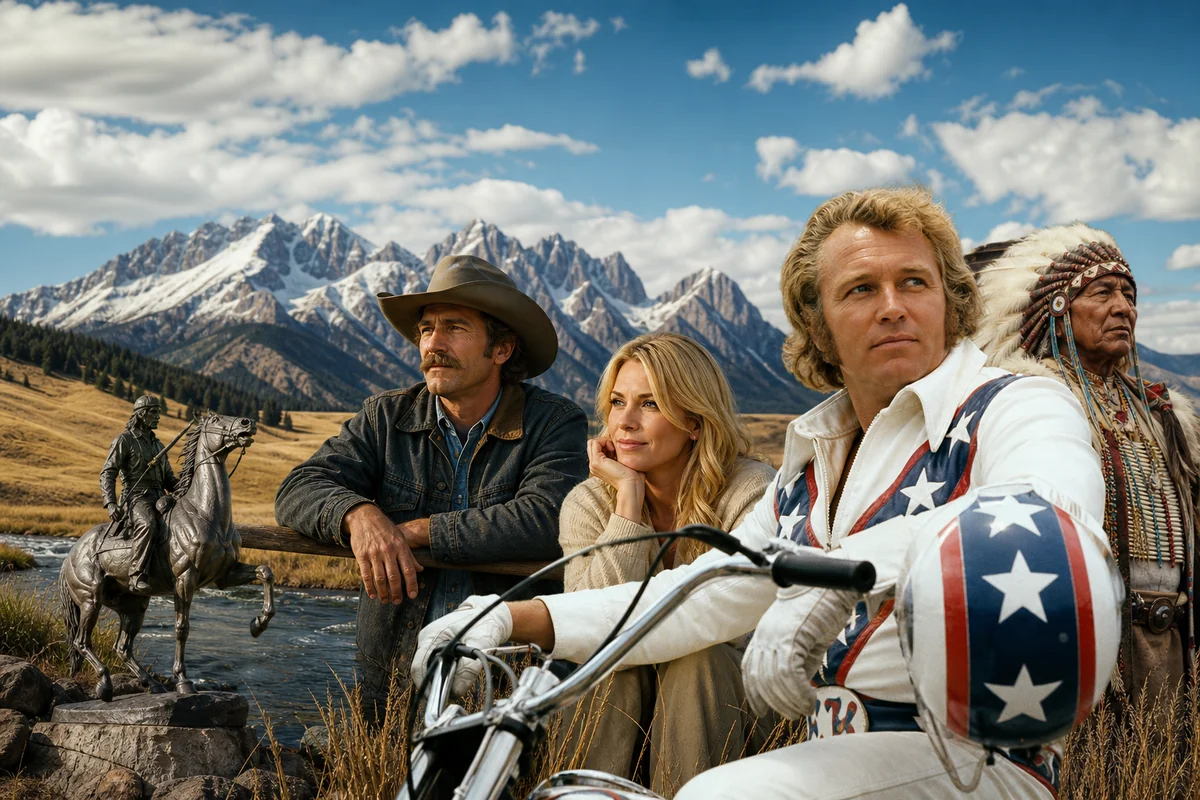
I was standing in a tiny museum in Butte last September when a docent casually mentioned that Evel Knievel used to work the copper mines beneath my feet — and suddenly Montana’s famous residents stopped being names on Wikipedia.
They became real people shaped by the same mountains, prairies, and frontier weather that visitors experience today. That mental shift is exactly what I want to give you in this post.
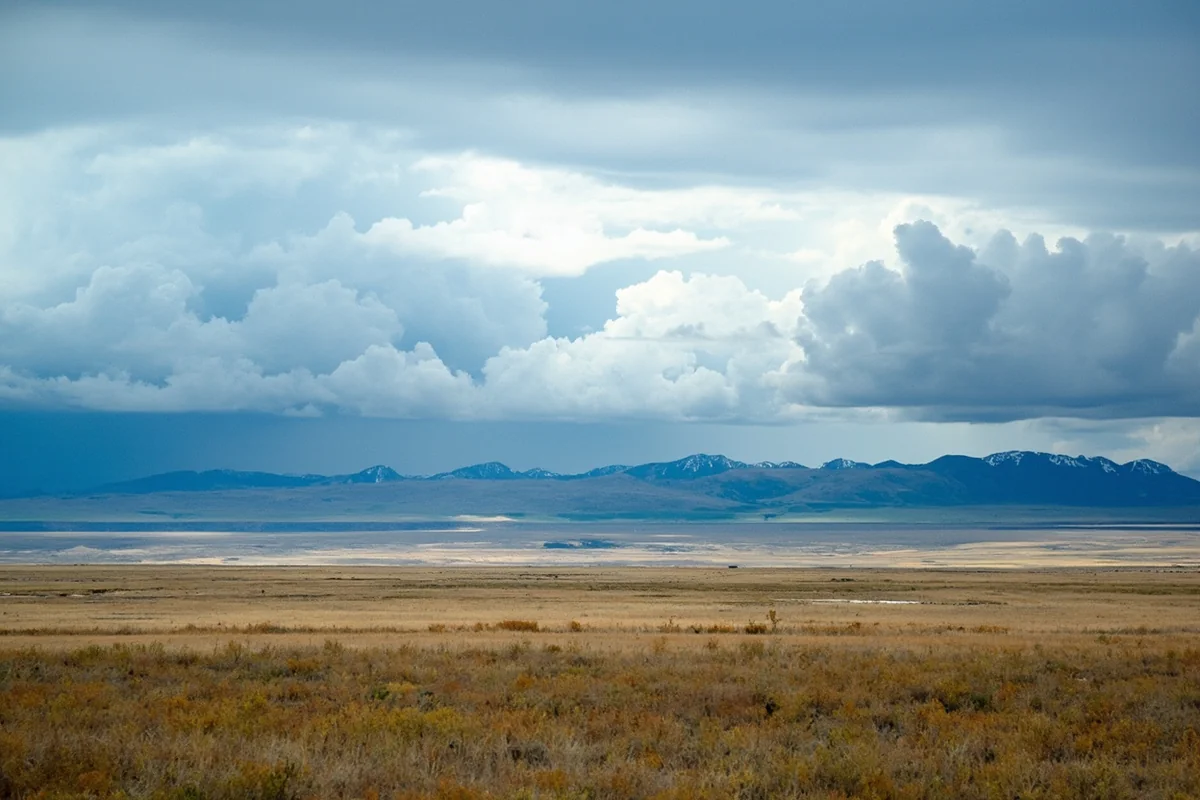
- Montana — population under 1.2 million — has produced an outsized share of American icons: Oscar-winning actors, Pulitzer Prize novelists, NBA-championship coaches, vaccine pioneers, and the first woman ever elected to Congress.
- This guide profiles 35 famous Montanans — born here, raised here, or famously transplanted — with the exact towns where you can trace their legacy.
- The most-overlooked Montanan in most “famous people” lists is Maurice Hilleman, a Miles City farm boy who developed more than 40 vaccines and is credited with saving more lives than any other scientist of the 20th century.
- You’ll also find planning notes for a self-guided “Famous Montanans” road trip across eastern and western Montana, plus answers to the questions I’m asked most often.
Liked this article?
Add Roaming Montana as a preferred source so you see more of our articles and guides on Google.
Why Montana Produces So Many Famous People
Before I dive into names, it’s worth pausing on the math. Montana has fewer residents than the city of San Antonio, yet it has contributed Oscar winners, Senate Majority Leaders, paleontologists who redefined dinosaur science, and the bassist of one of the most influential rock bands of the 1990s.
During years of traveling Big Sky Country, I’ve come to believe the answer lies in the environment itself. Growing up where you can see 100 miles in any direction changes how you think. The isolation forces self-reliance. The winters build character whether you want them to or not. The vastness either swallows people whole or pushes them to make something equally vast — a film, a vaccine, a 75-foot motorcycle jump.
Locals I’ve talked to from Billings to Kalispell share a common trait: not easily impressed, but genuinely curious. That combination seems to produce people who achieve remarkable things without losing their grounding.
For more on what makes the state singular, see 27 things Montana is known for and 23 unique ways Montana stands out.
Hollywood Stars Born Under the Big Sky
Montana’s contribution to film is wildly disproportionate to its population. Here are the actors and directors who were born — or raised — under that big sky.
Gary Cooper — Helena’s Original Movie Star
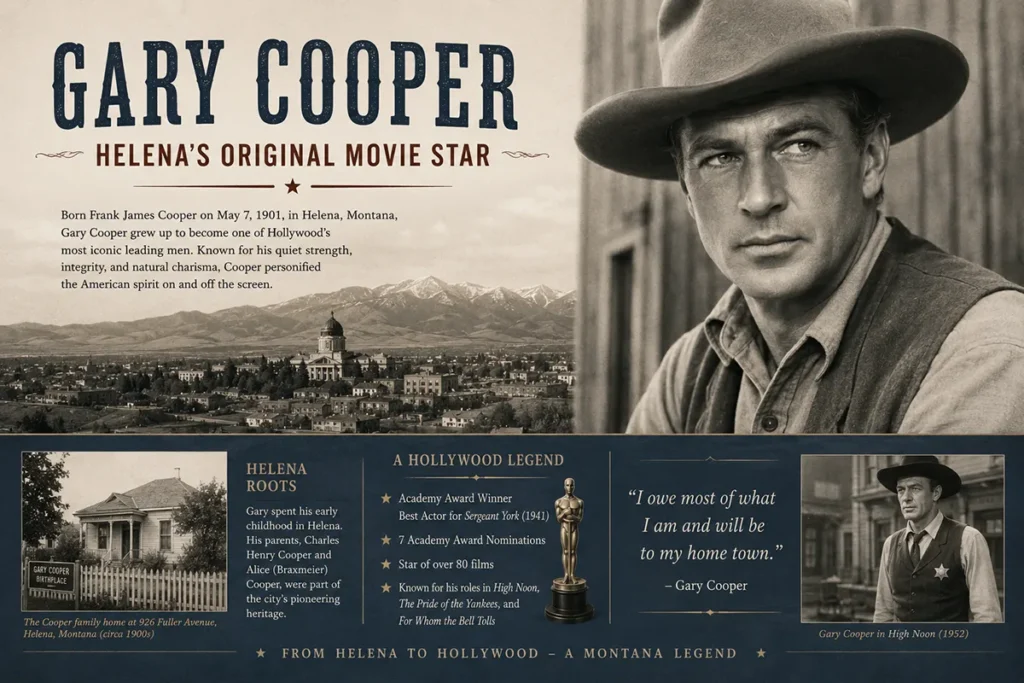
Gary Cooper, born Frank James Cooper in Helena in 1901, remains Montana’s most iconic contribution to old Hollywood. He grew up on a ranch outside town before family travels took him to England and eventually to Los Angeles.
Cooper won two Academy Awards for Best Actor (Sergeant York and High Noon) and earned three additional nominations.
His taciturn, principled screen presence — the unblinking gaze, the words used only when necessary — feels like a direct projection of the landscape he grew up in.
I once watched High Noon the same week I drove the Rocky Mountain Front, and the resemblance was uncanny.
Myrna Loy — The Honorary Oscar From Radersburg
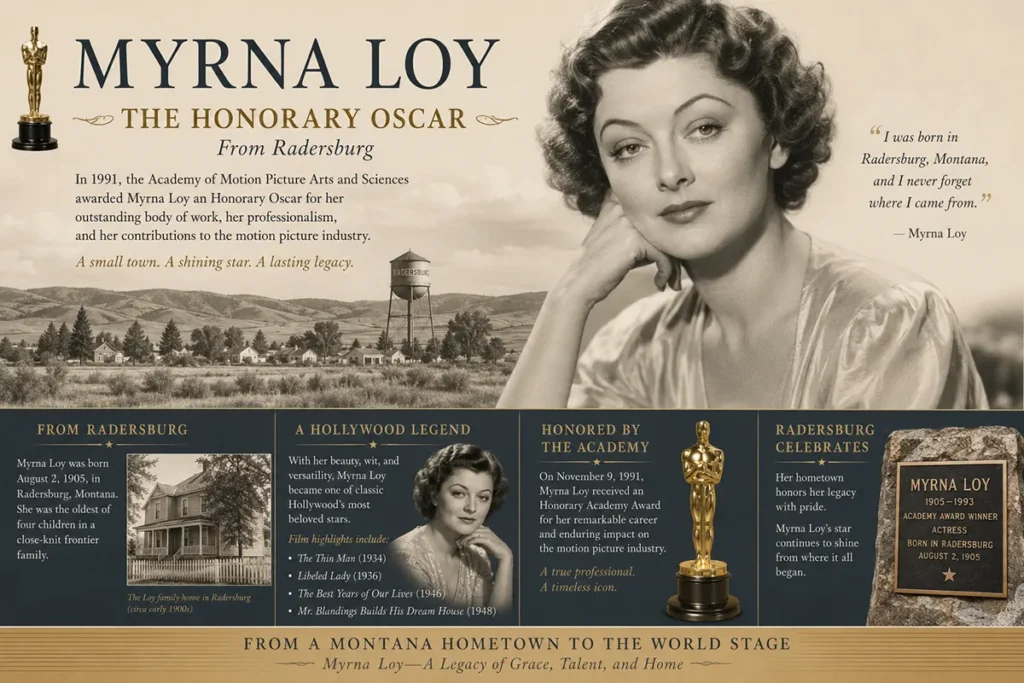
Myrna Loy was born in Radersburg in 1905, a tiny town about an hour south of Helena. She became one of the highest-paid actresses of the 1930s and 1940s, famous for the Thin Man series opposite William Powell and for The Best Years of Our Lives. The Academy awarded her an Honorary Oscar in 1991 for her body of work.
Most “famous people from Montana” lists either skip her or bury her at the bottom. She belongs in the top tier. Her hometown is little more than a wide spot in the road today, which makes her trajectory all the more remarkable.
David Lynch — The Director From Missoula
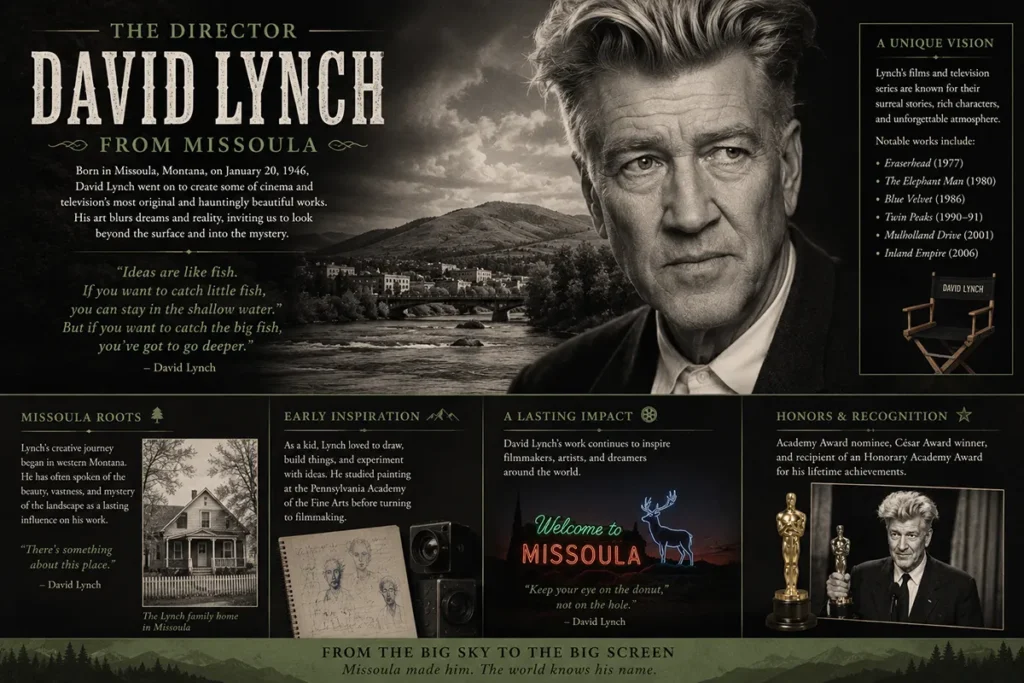
This is the omission that most other Montana lists make, and the one that costs them the most credibility: David Lynch was born in Missoula in 1946. His family moved away when he was young, but his birthplace is firmly Montana.
Lynch’s films — Blue Velvet, Mulholland Drive, Twin Peaks, The Elephant Man — reshaped American cinema. He received the Academy Honorary Award in 2019 for his contributions to film.
I sometimes wonder, walking around downtown Missoula on a foggy fall morning, whether the city’s blend of small-town normalcy and atmospheric weirdness left some early fingerprint on him.
Michelle Williams — Kalispell to Five Oscar Nominations
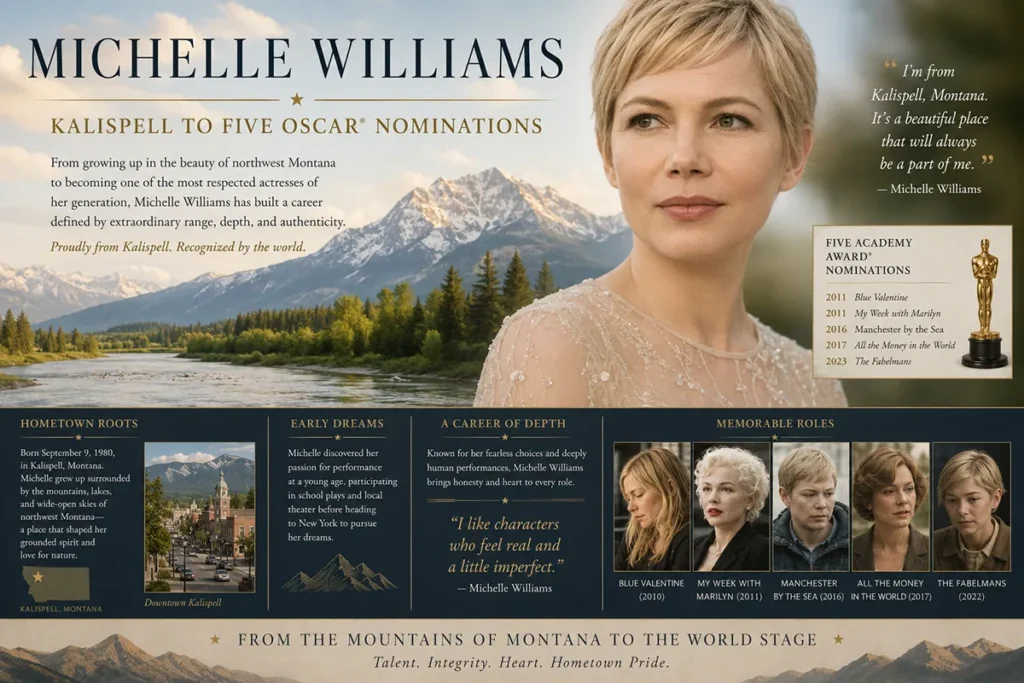
Michelle Williams was born in Kalispell in 1980 and grew up in the Flathead Valley before moving to Hollywood at 15. She has earned five Academy Award nominations for Brokeback Mountain, Blue Valentine, My Week with Marilyn, Manchester by the Sea, and The Fabelmans.
The Flathead Valley is one of the most beautiful places in Montana, and there’s something in Williams’s screen performances — a quiet emotional depth — that feels connected to wide-open spaces.
Locals are happy to point out the area where she lived as a kid; ask politely and you’ll learn more than you’d expect.
Brad Bird — Kalispell’s Animation Genius
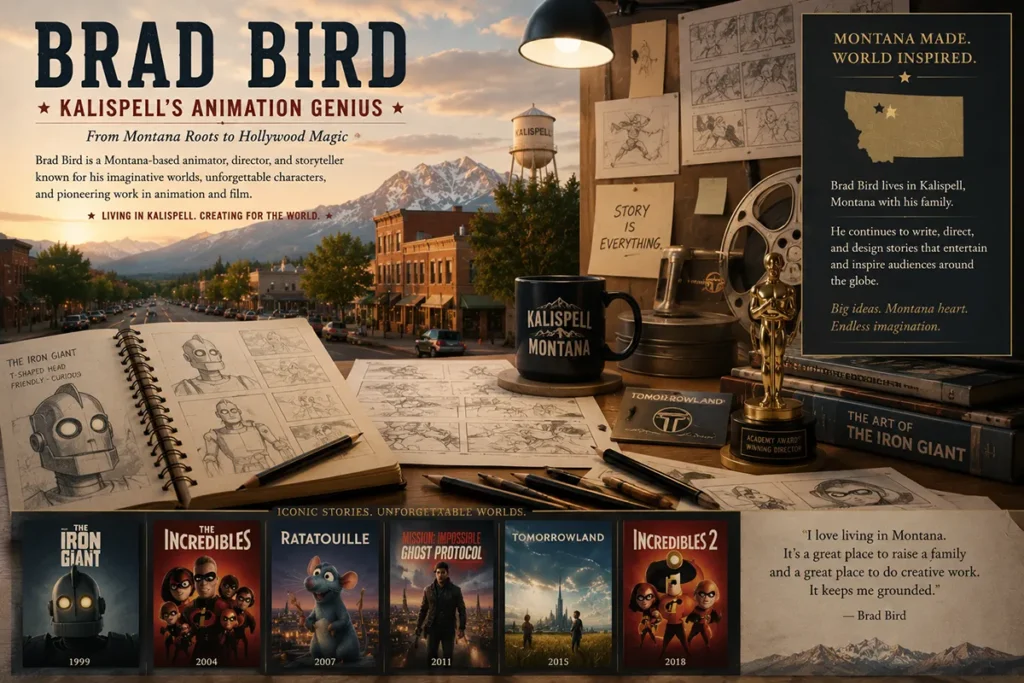
Pixar director Brad Bird was born in Kalispell in 1957. He’s responsible for some of the most beloved animated films of the last 25 years: The Iron Giant, The Incredibles, Ratatouille, The Incredibles 2. He’s won two Academy Awards for Best Animated Feature.
Two Pixar-defining filmmakers and one of the great Oscar-nominated actresses (Margaret Qualley, below) all from the same small Montana town is the kind of fact that makes you raise an eyebrow. Whatever Kalispell is doing with its school district, keep doing it.
Lilly Gladstone — Kalispell, Browning, and the Oscars
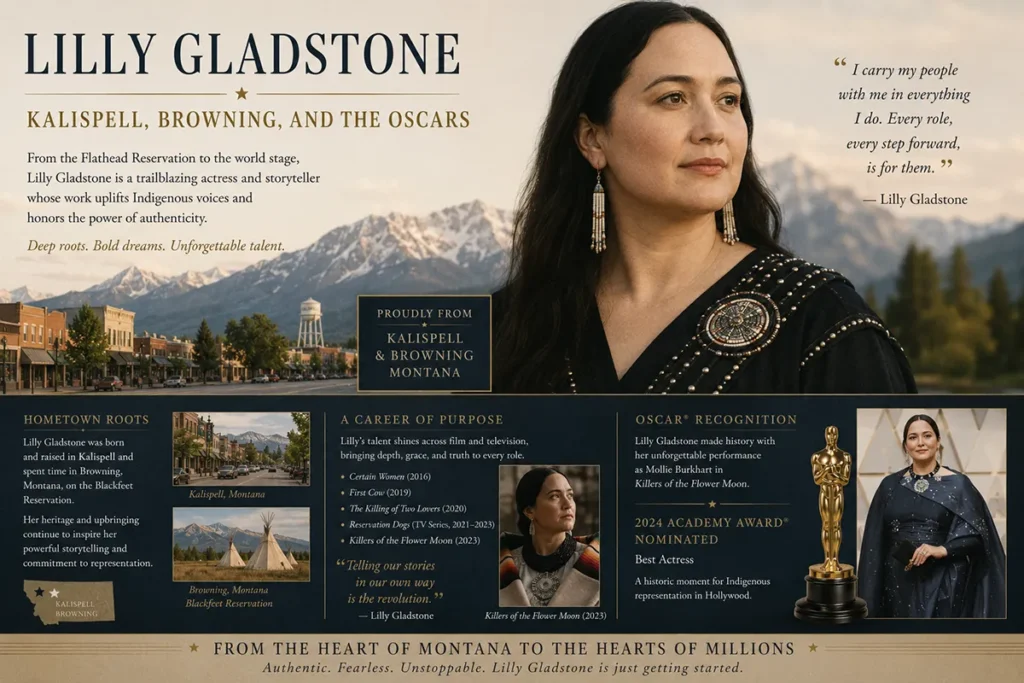
Lilly Gladstone was born in Kalispell in 1986 and raised on the Blackfeet Reservation near Browning. She studied acting at the University of Montana in Missoula.
Her performance in Killers of the Flower Moon (2023) earned her a Best Actress Academy Award nomination, making her the first Native American actress ever nominated in that category.
She also became the first Native American to win the Golden Globe for Best Actress in a Drama. I’ve followed her career since Certain Women, the 2016 film shot largely in Montana, and her rise feels like one of the most meaningful Hollywood stories of this decade.
Margaret Qualley — The Next Generation
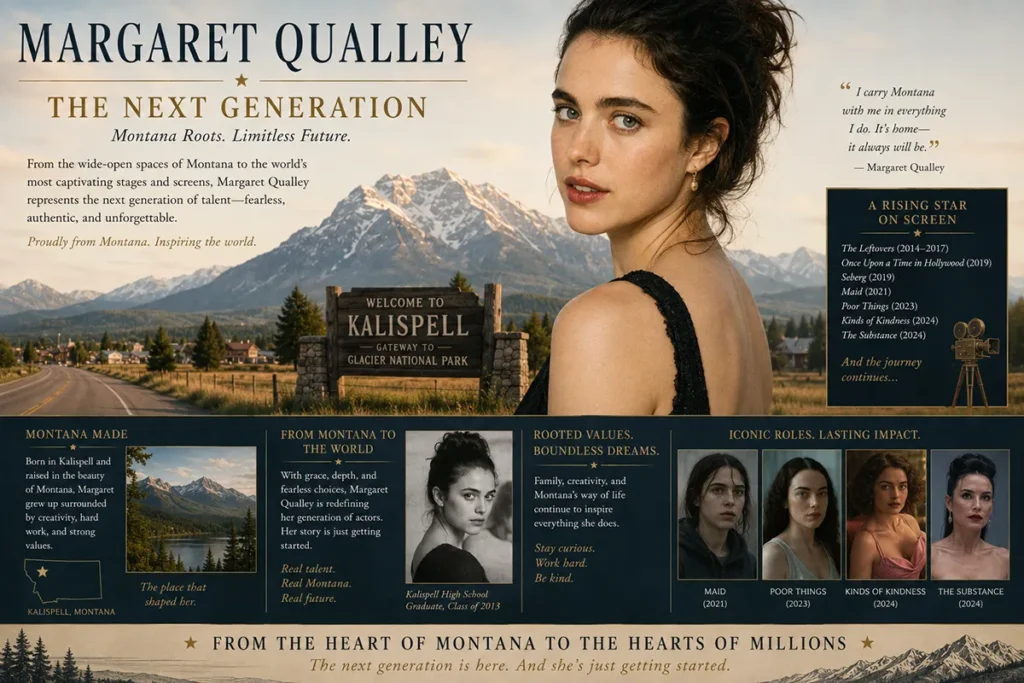
Margaret Qualley was born in 1994 to actress Andie MacDowell while the family lived in Montana. She was raised partly in Bozeman before moving away as a teenager.
Her recent roles — Once Upon a Time in Hollywood, Maid, Drive-Away Dolls, The Substance, Sanctuary — have put her on the short list of the most interesting young actors working today.
Jesse Tyler Ferguson — Missoula’s Modern Family Star
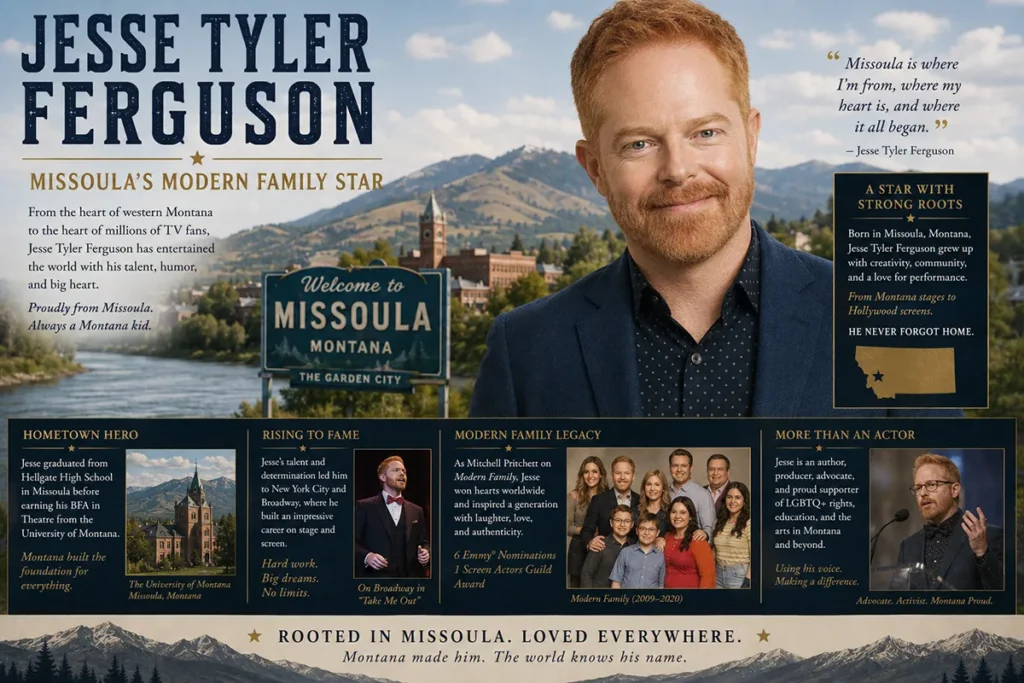
Jesse Tyler Ferguson was born in Missoula in 1975. He’s best known for playing Mitchell Pritchett on Modern Family, a role that earned him five consecutive Primetime Emmy nominations. He also won a Tony Award in 2022 for his role in Take Me Out on Broadway.
Dana Carvey — From Missoula to SNL
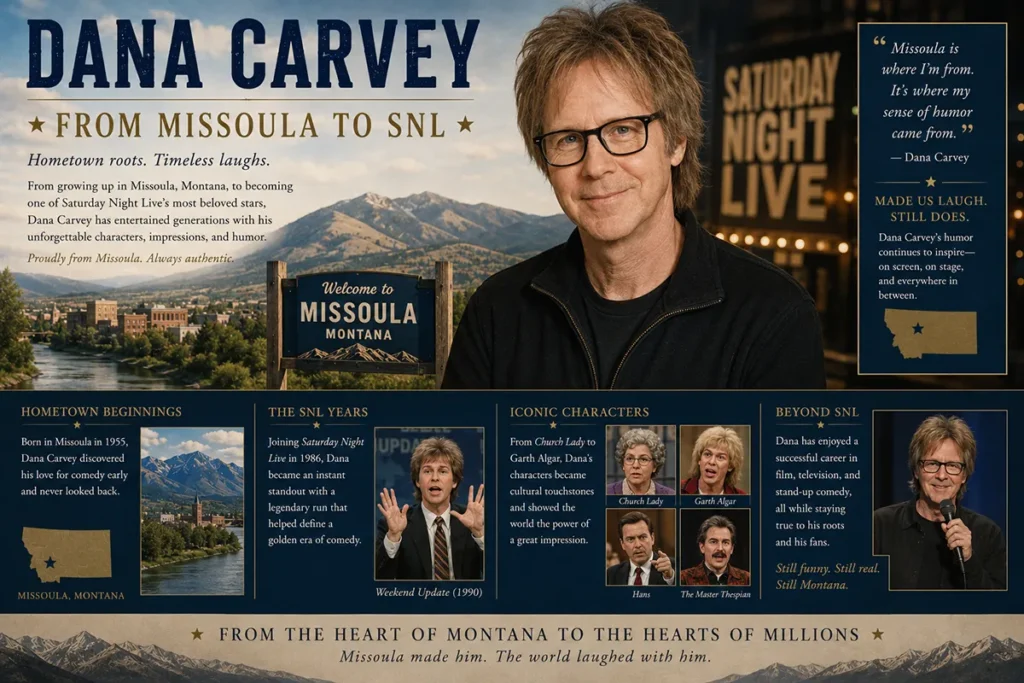
Though born in Missoula in 1955, Dana Carvey moved to California as a young child. Montanans still proudly claim the SNL legend who gave us Wayne Campbell, the Church Lady, and a thousand other characters. He returned to Montana periodically throughout his career to perform and to fish.
Dirk Benedict — Helena to The A-Team
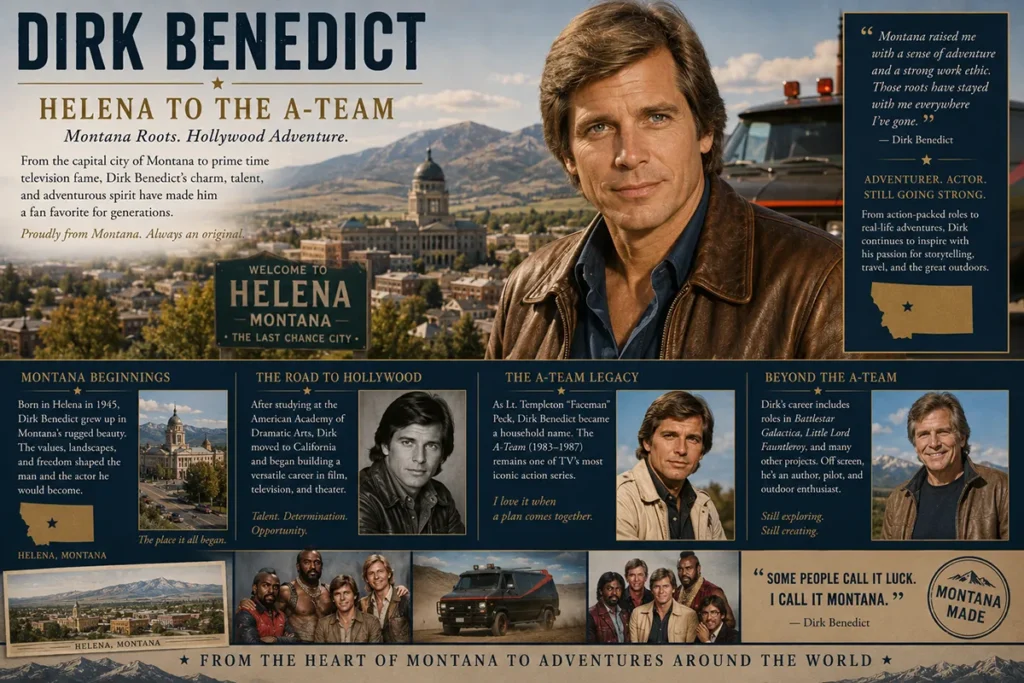
Dirk Benedict was born in Helena in 1945 and grew up in nearby White Sulphur Springs. He achieved 1980s TV stardom as Faceman in The A-Team and Starbuck in the original Battlestar Galactica.
He’s written openly about how his Montana upbringing — hunting, fishing, working outdoors — shaped his approach to physical roles in Hollywood.
Martha Raye — Butte’s Comedy Bombshell
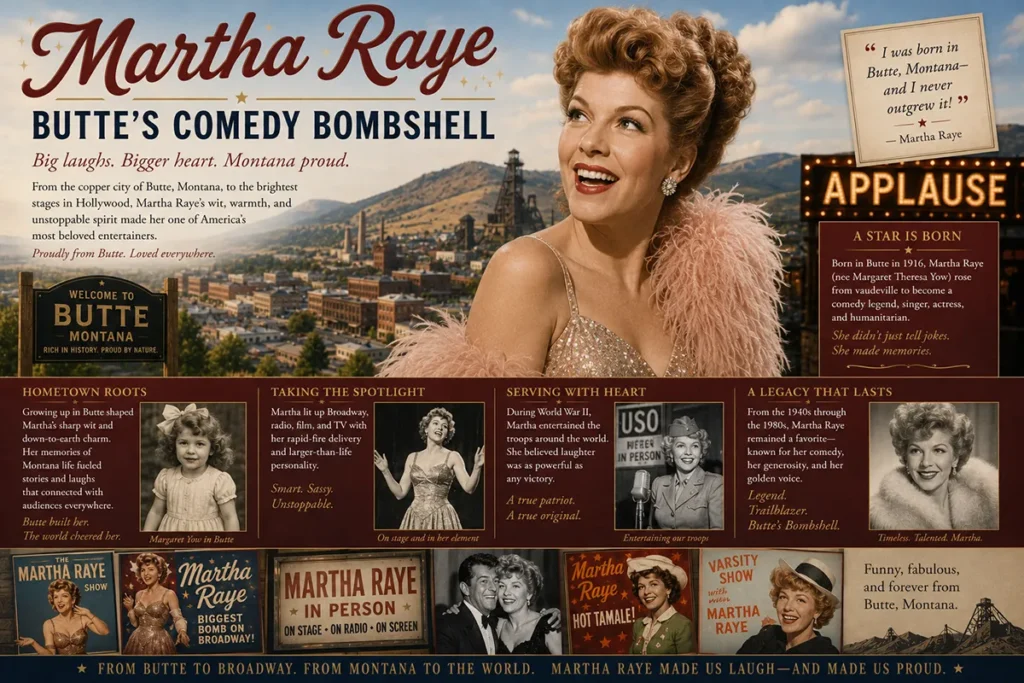
Martha Raye was born in Butte in 1916. She became one of America’s first true triple-threat performers — a comedian, singer, and actress whose career spanned vaudeville, film, radio, and television.
Her tireless work entertaining U.S. troops in three wars (WWII, Korea, Vietnam) earned her the Presidential Medal of Freedom in 1993 and a permanent place in military history.
The U.S. Army gave her an honorary rank of lieutenant colonel — almost unheard of for an entertainer.
Steve Reeves — Glasgow’s Hercules
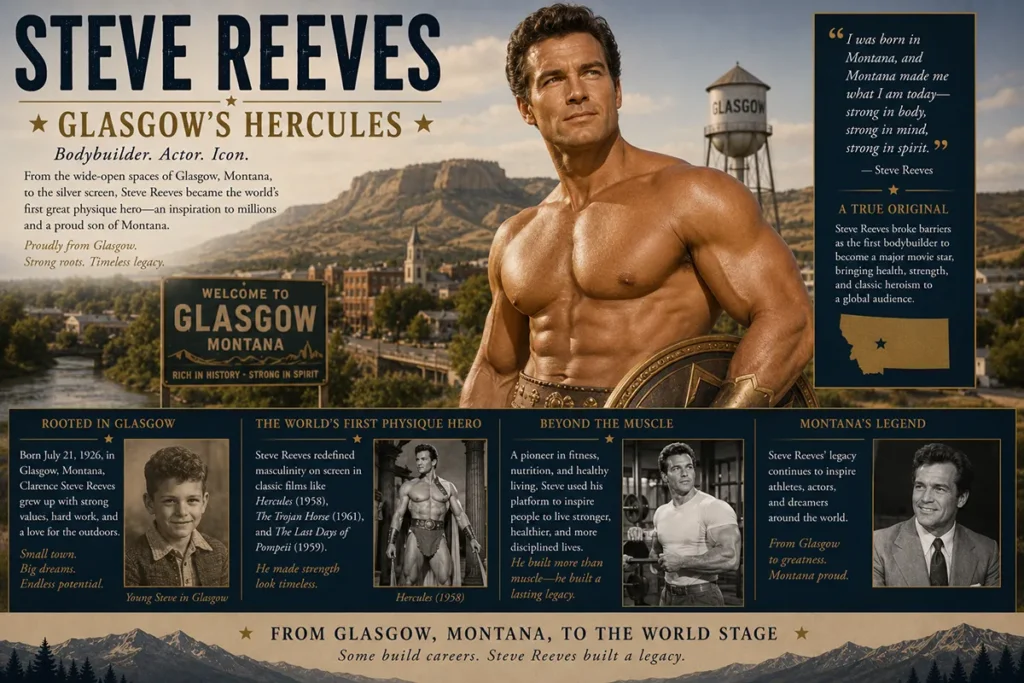
Steve Reeves was born in Glasgow in 1926. He won Mr. America in 1947, Mr. World in 1948, and Mr. Universe in 1950, then transitioned to acting, becoming the most iconic sword-and-sandal star of the late 1950s.
His title role in 1958’s Hercules launched an entire genre of Italian peplum films and made him an international sex symbol. He’s a regularly cited inspiration for both Arnold Schwarzenegger and Sylvester Stallone.
Bud Luckey — The Billings Animator Who Created Woody
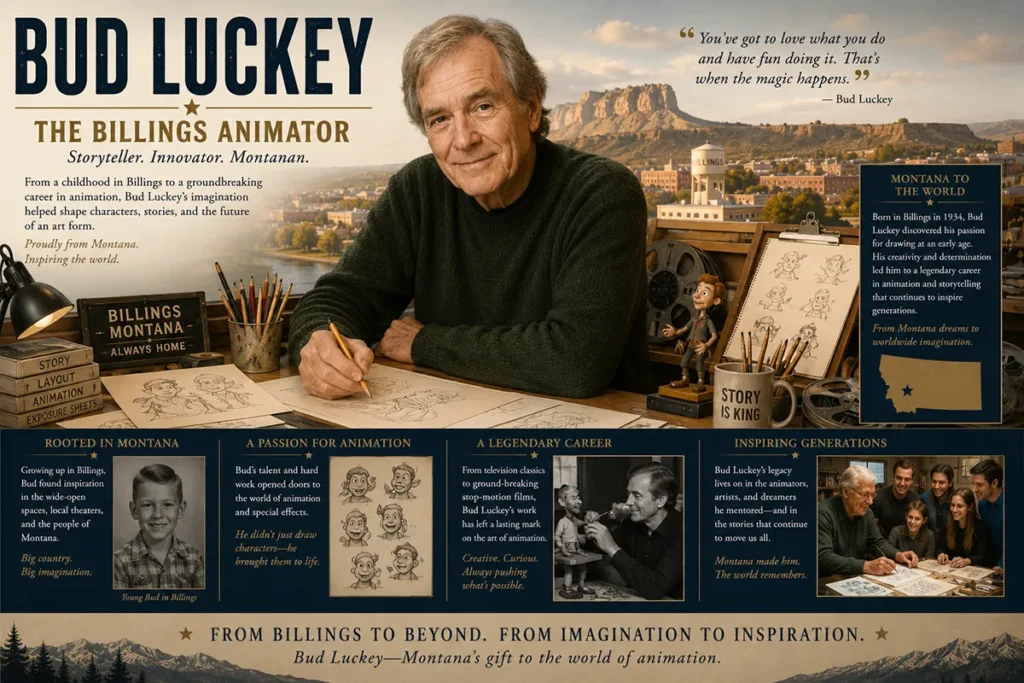
Bud Luckey was born in Billings in 1934. As a senior animator at Pixar, he designed the character of Woody from Toy Story and voiced characters in The Incredibles, Toy Story 3, and Cars.
His animated short Boundin’ earned an Oscar nomination in 2003. Few Billings residents realize the cowboy in the Pixar pantheon was designed by one of their own.
Literary Giants from Big Sky Country
Montana has produced an extraordinary number of significant writers, which makes sense the moment you sit on a riverbank here and watch the light move. For deeper coverage, see Montana authors and best books on Big Sky Country.
A.B. Guthrie Jr. — The Pulitzer Prize Winner (Setting the Record Straight)
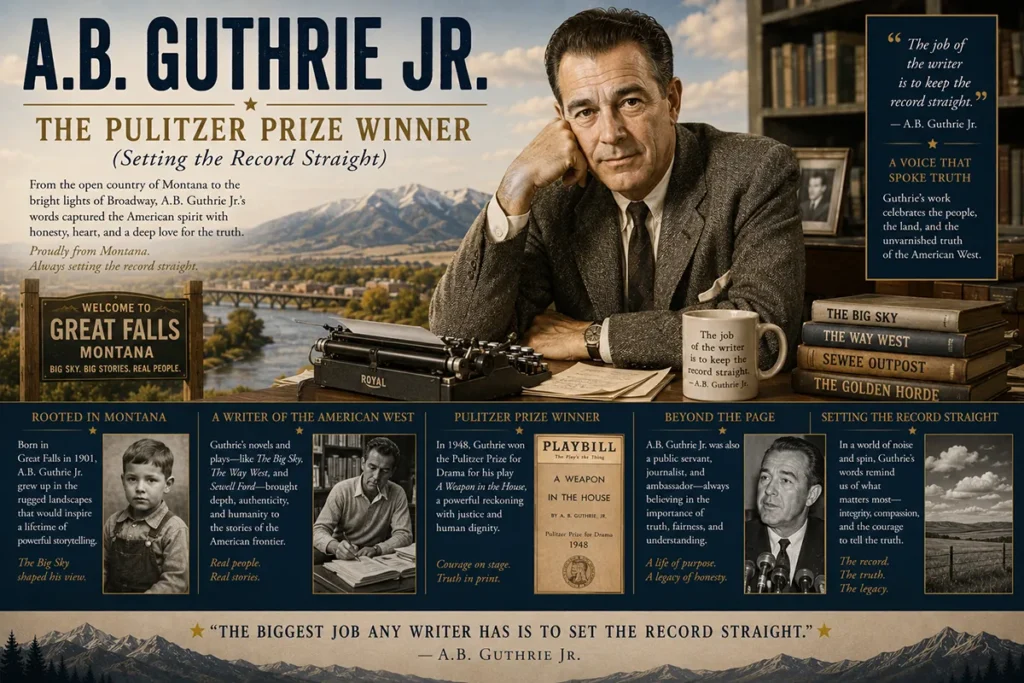
A.B. Guthrie Jr. lived in Choteau for decades and shaped how Americans imagine the Western frontier. Important correction commonly mangled by other Montana sites: his Pulitzer Prize for Fiction came in 1950 for The Way West, not for The Big Sky. The Big Sky (1947) is the more celebrated novel and gave Montana its enduring nickname, but it didn’t win the Pulitzer.
I spent an afternoon at the A.B. Guthrie Memorial along Highway 287 north of Choteau. The view from there — the Rocky Mountain Front stretching into infinity — explains everything about his prose.
Norman Maclean — A River Runs Through It
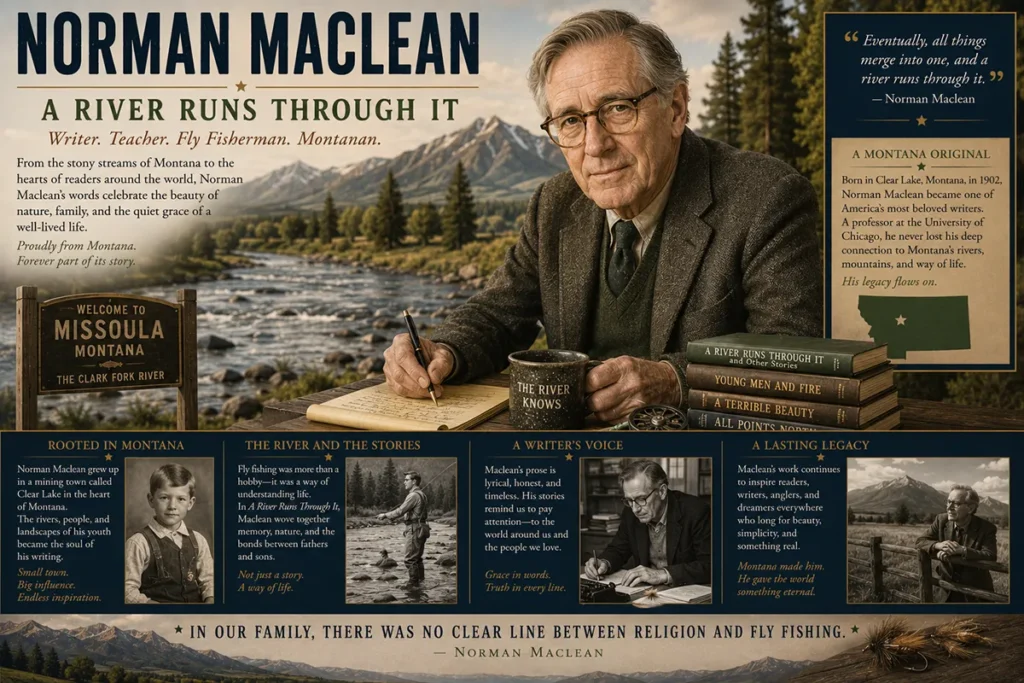
A River Runs Through It may be the single piece of writing most responsible for Montana’s mystique among travelers. Norman Maclean grew up in Missoula at the turn of the 20th century, and the Blackfoot River where he and his brother learned fly fishing has become a quiet pilgrimage site.
Robert Redford’s 1992 film adaptation is on our list of movies filmed in Montana, and seeing the book and the river back to back changed how I look at light on water.
Dorothy M. Johnson — The Writer Behind the Westerns You’ve Seen
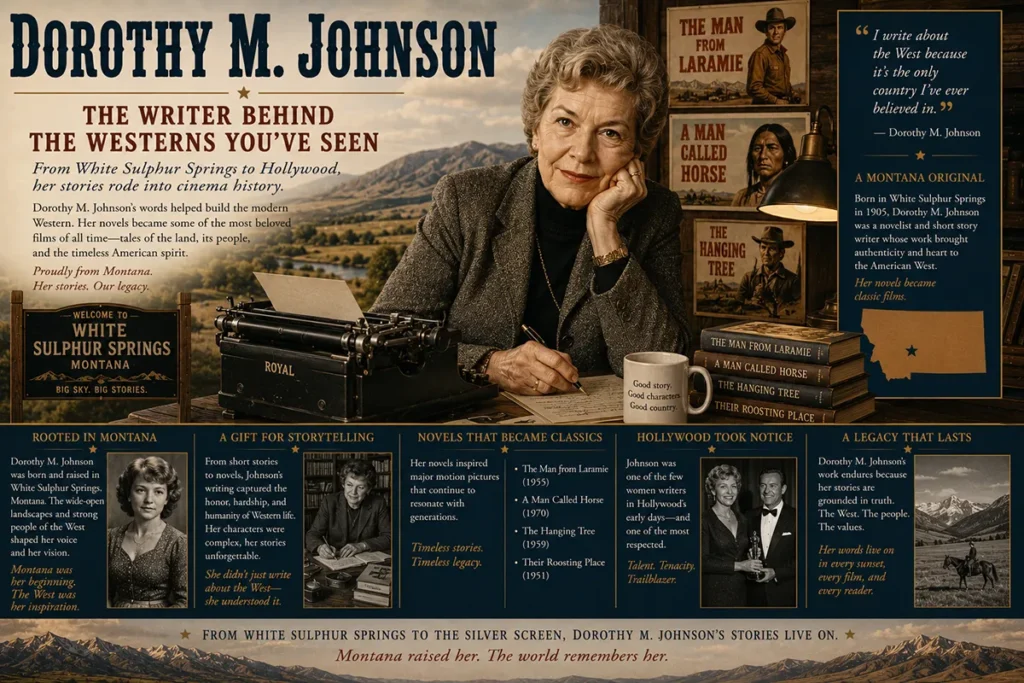
You might not recognize her name, but you’ve seen her work. Dorothy M. Johnson, raised in Whitefish, wrote short stories that became some of Hollywood’s most enduring Westerns: The Man Who Shot Liberty Valance, A Man Called Horse, and The Hanging Tree.
James Welch — Native American Literary Pioneer
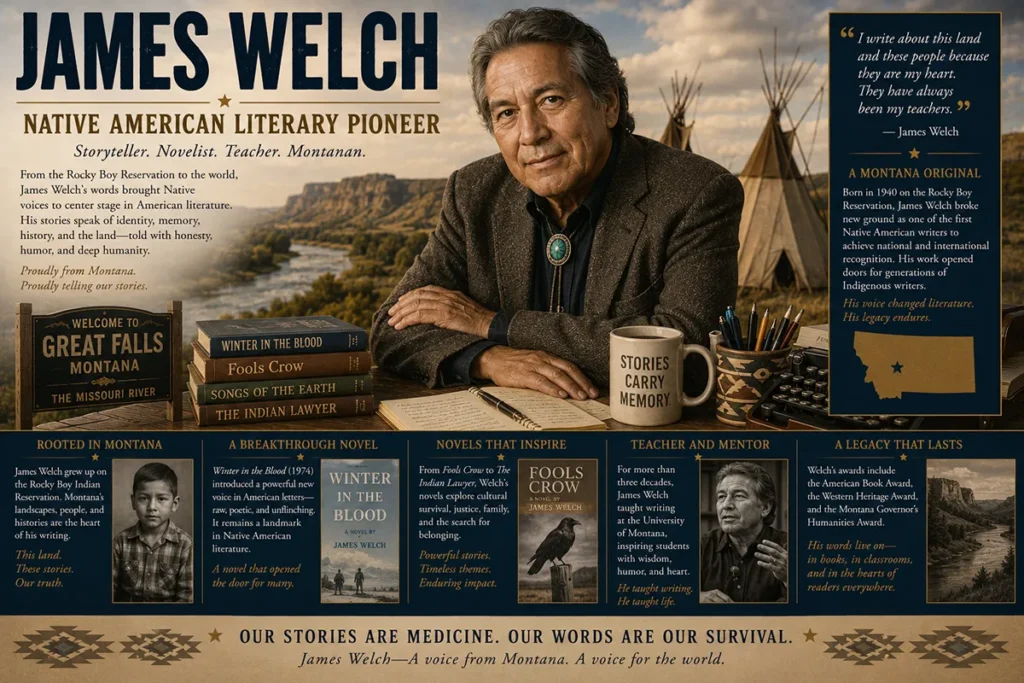
James Welch, born in Browning on the Blackfeet Reservation in 1940, became one of the most important Native American novelists in American history.
Winter in the Blood and Fools Crow opened doors for an entire generation of Indigenous writers. His work captures something essential that tourist brochures don’t touch — the complexity of a place with deep Indigenous history overlaid with settler colonialism.
Ivan Doig — The Two Medicine Country Voice
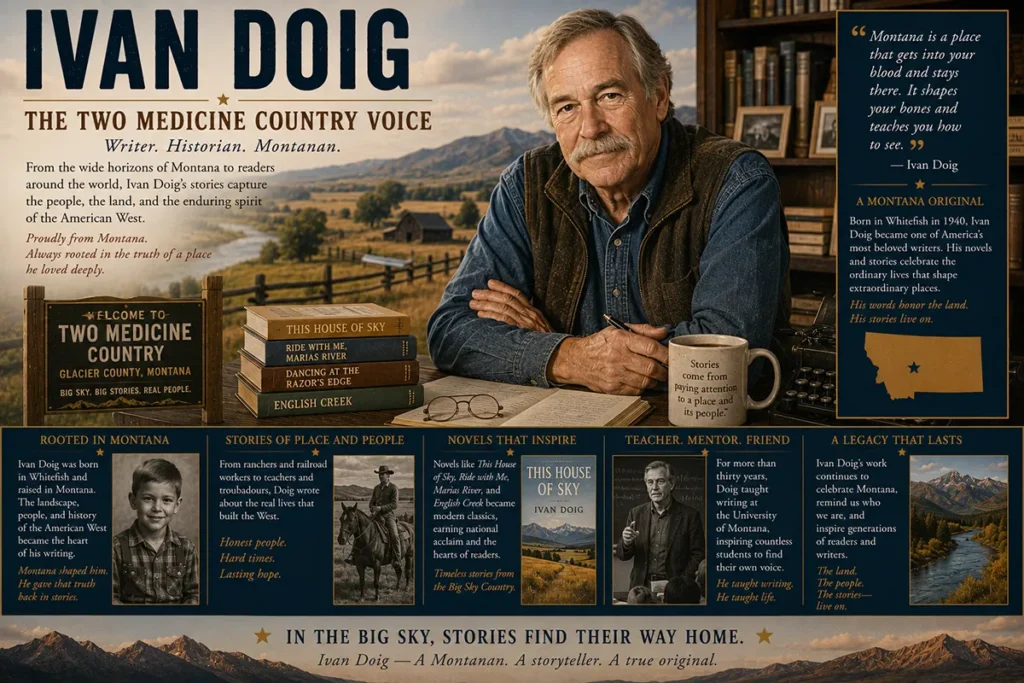
Ivan Doig grew up on sheep ranches and in small towns along the Rocky Mountain Front in northwest Montana.
His memoir This House of Sky and his novels (English Creek, Dancing at the Rascal Fair, The Whistling Season) are among the most beloved works of Montana literature. He’s the writer most often handed to people who say, “I want to understand Montana.”
Thomas McGuane — Livingston’s Resident Literary Lion
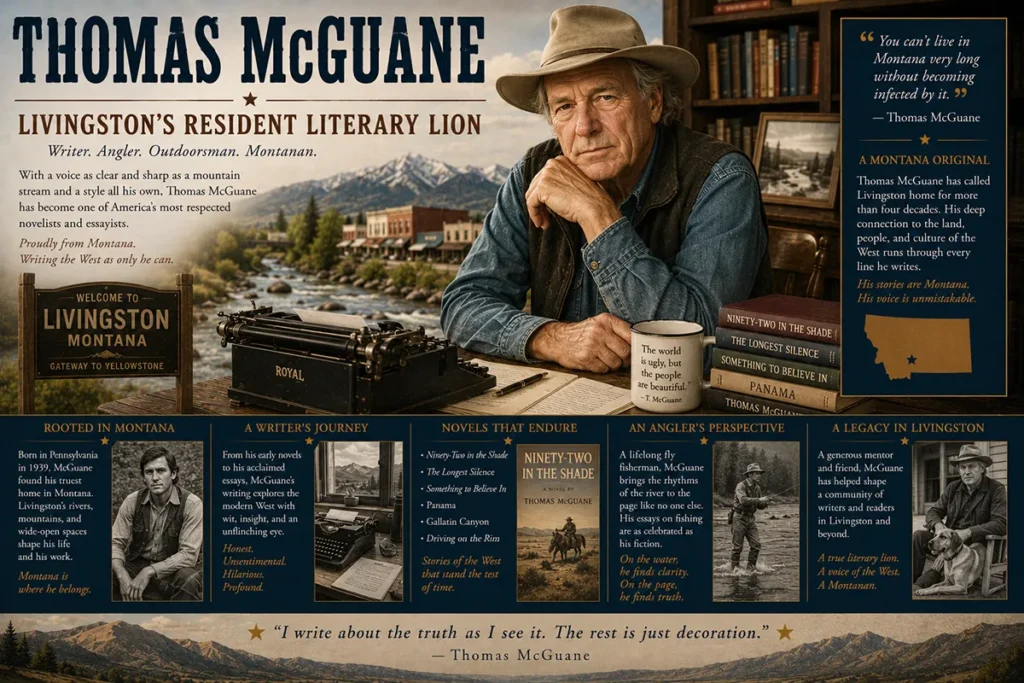
Thomas McGuane has lived in Montana since the 1960s and ranches near McLeod, south of Livingston. He’s written novels (Ninety-Two in the Shade, Driving on the Rim), screenplays, and consistently excellent fly-fishing essays.
McGuane represents the best of Montana’s transplant writers — gone all-in on the place rather than visiting it for atmosphere.
Musicians Who Carry Montana’s Sound
Jeff Ament — Pearl Jam’s Bassist From Big Sandy
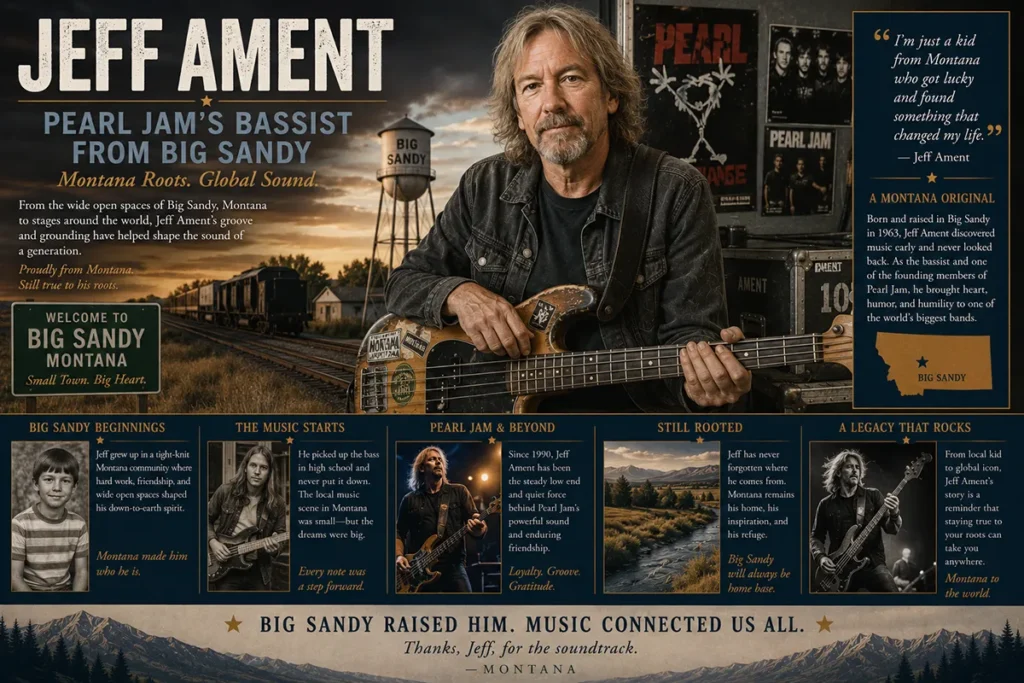
Pearl Jam co-founder Jeff Ament was born in Havre in 1963 and grew up in Big Sandy, Montana — population under 700.
During a road trip through north-central Montana, I stopped in Big Sandy specifically to see what shaped one of the most influential bassists of the 1990s.
The answer? A whole lot of nothing, in the best way possible. Ament has spoken about how growing up isolated in rural Montana made music his lifeline to the larger world.
He’s funded skateparks across Montana — more than two dozen by recent counts — and remains a hands-on advocate for rural communities here.
Colin Meloy — Helena’s Indie-Folk Storyteller
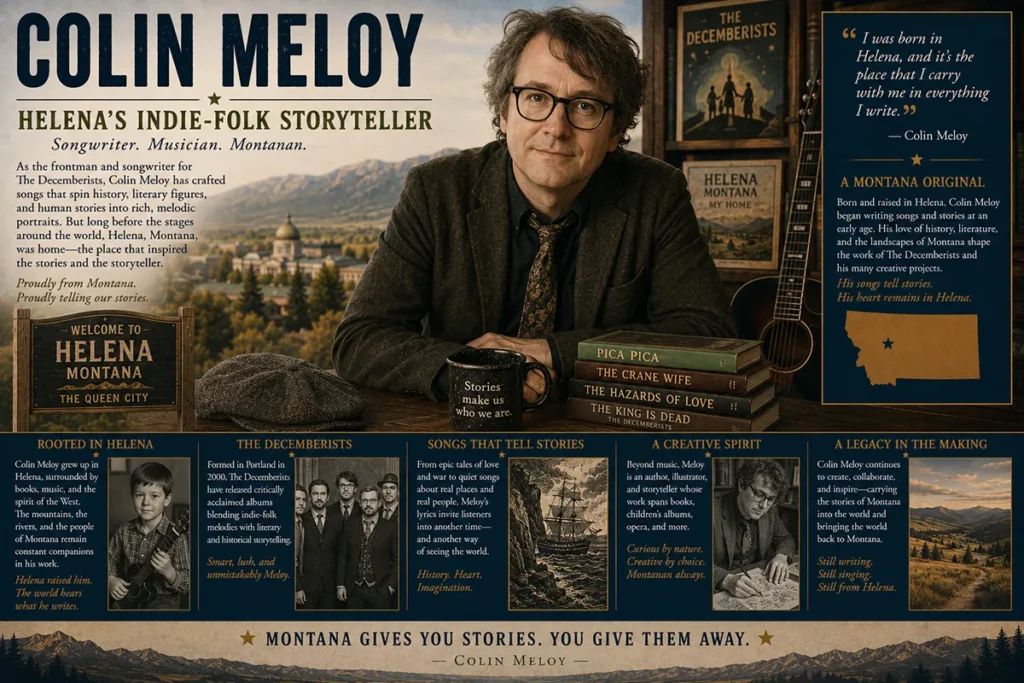
Colin Meloy, frontman of The Decemberists, grew up in Helena before heading to Missoula for college. The Decemberists’ baroque folk-rock won them a #1 album on the Billboard 200 with The King Is Dead in 2011.
Meloy is also a bestselling children’s author (the Wildwood series, illustrated by his wife Carson Ellis).
Nicolette Larson — Helena’s Country-Rock Voice
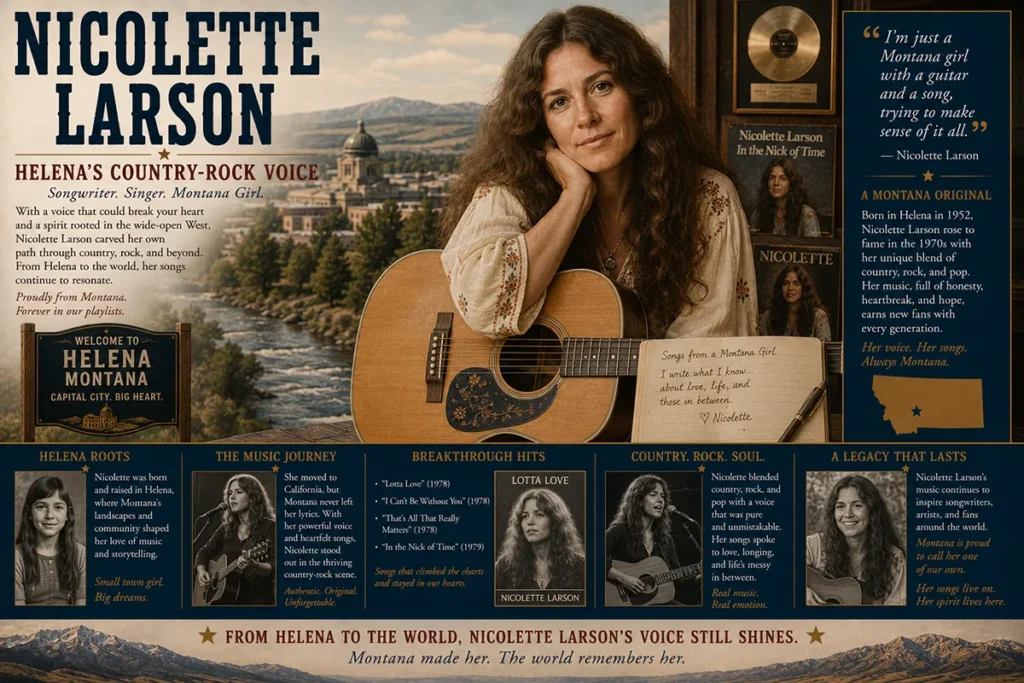
Helena-born Nicolette Larson became a defining voice of late-1970s California country-rock, collaborating with Neil Young, Linda Ronstadt, and others.
Her hit “Lotta Love” remains a classic. She died too young in 1997, but her clear, unornamented voice carried something of Montana clarity into the soft-rock canon.
Reggie Watts — Comedy and Loop-Pedal Genius From Great Falls
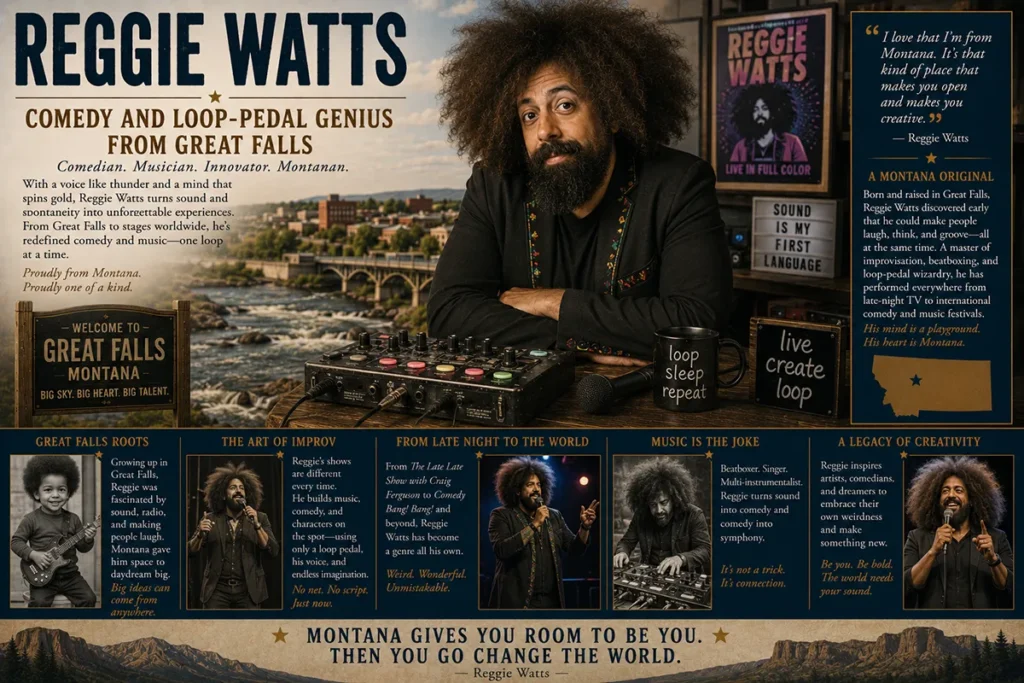
Reggie Watts spent his childhood and teenage years in Great Falls before moving to Seattle and eventually to Los Angeles.
He’s best known as the bandleader on The Late Late Show with James Corden and for his genre-defying live performances combining looping, improv, and stand-up.
His Montana years come through in his interviews — there’s a sincerity under the absurdism that feels distinctly midwestern-western.
Sports Legends and Daredevils
Evel Knievel — Butte’s Daredevil
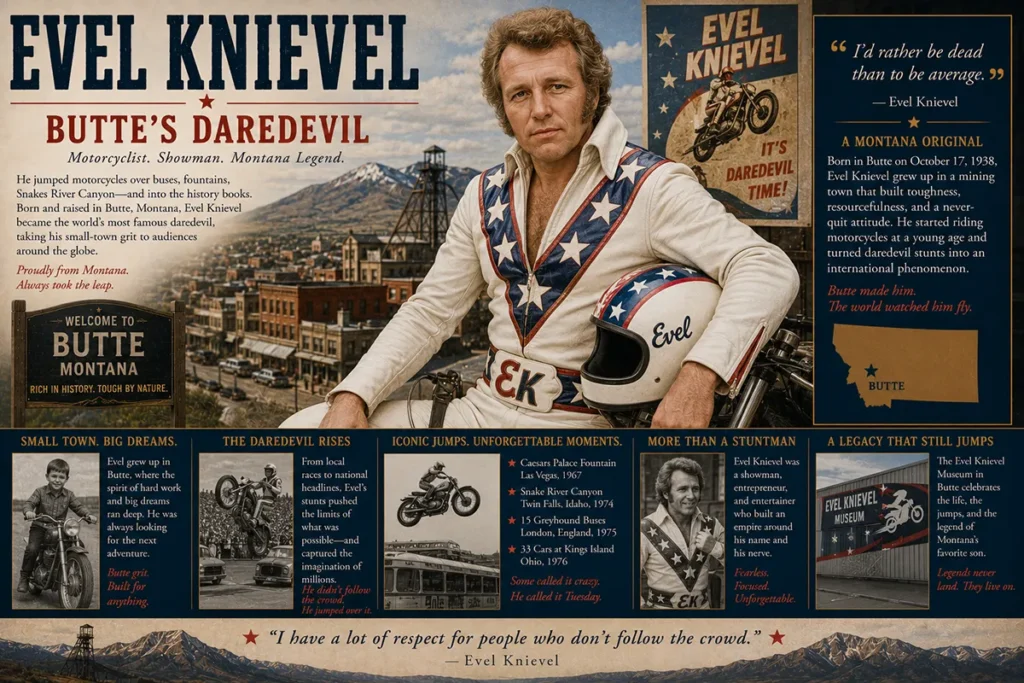
No famous Montanan captures the state’s independent streak like Robert Craig “Evel” Knievel, born in Butte in 1938. His early years in Butte’s copper mines and rough streets shaped his unfussy fearlessness.
Knievel attempted more than 75 ramp-to-ramp motorcycle jumps over his career, breaking dozens of bones in the process — his most famous stunts at Caesars Palace and Snake River Canyon made him a permanent American icon.
Butte still celebrates its wild native son with murals, references in bars, and the annual Evel Knievel Days festival each July.
Robbie Knievel — The Second-Generation Daredevil
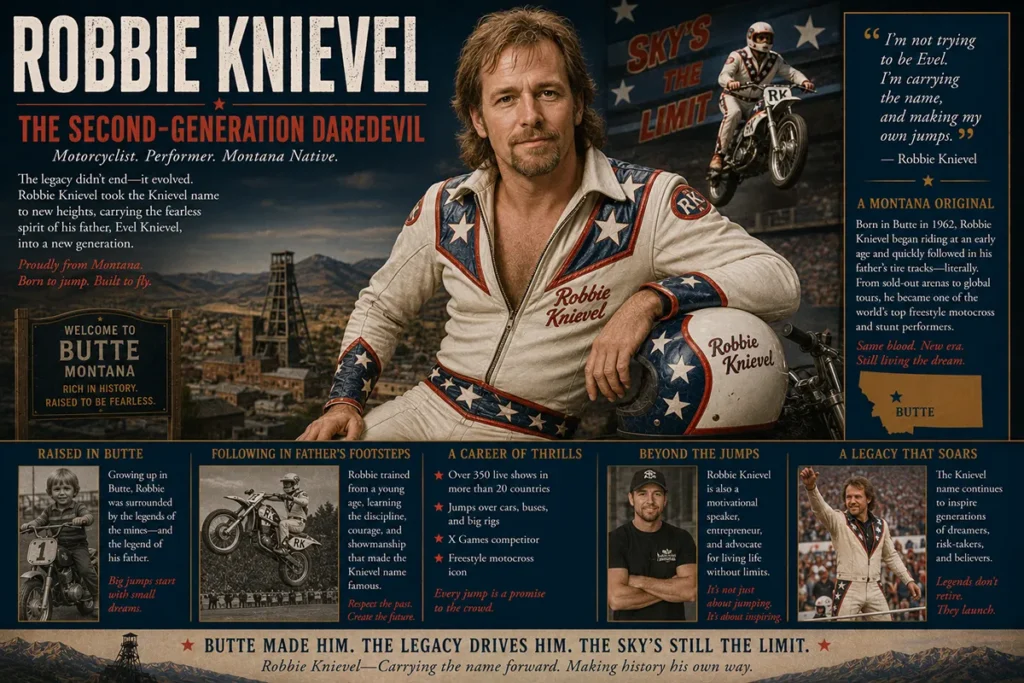
Evel’s son Robbie was also born and raised in Butte. He went on to set 20+ world records of his own, including a 230-foot jump over the fountains at Caesars Palace in 1989 — a stunt his father had infamously crashed two decades earlier.
Robbie passed away in 2023, but he carried the family name into the next generation.
Phil Jackson — Deer Lodge to 13 NBA Championships
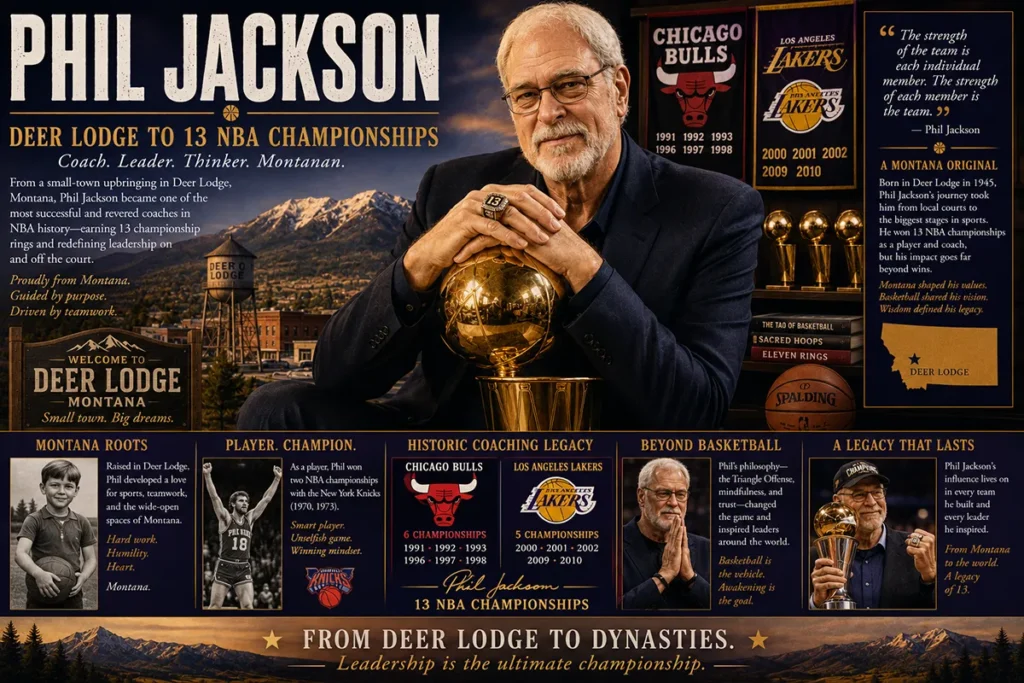
Phil Jackson was born in Deer Lodge in 1945 to Pentecostal minister parents. He won two NBA championships as a player with the New York Knicks and went on to win 11 more as head coach of the Chicago Bulls and Los Angeles Lakers — the most of any coach in NBA history.
Visiting Deer Lodge (also home to the Old Montana State Prison historic site), I tried to picture young Phil dreaming of basketball glory in this small town surrounded by mountains.
His later coaching philosophy — mindfulness, team unity, “the triangle” — reads like a translation of Montana values into a basketball playbook.
Dave McNally — Billings’ World Series Pitcher
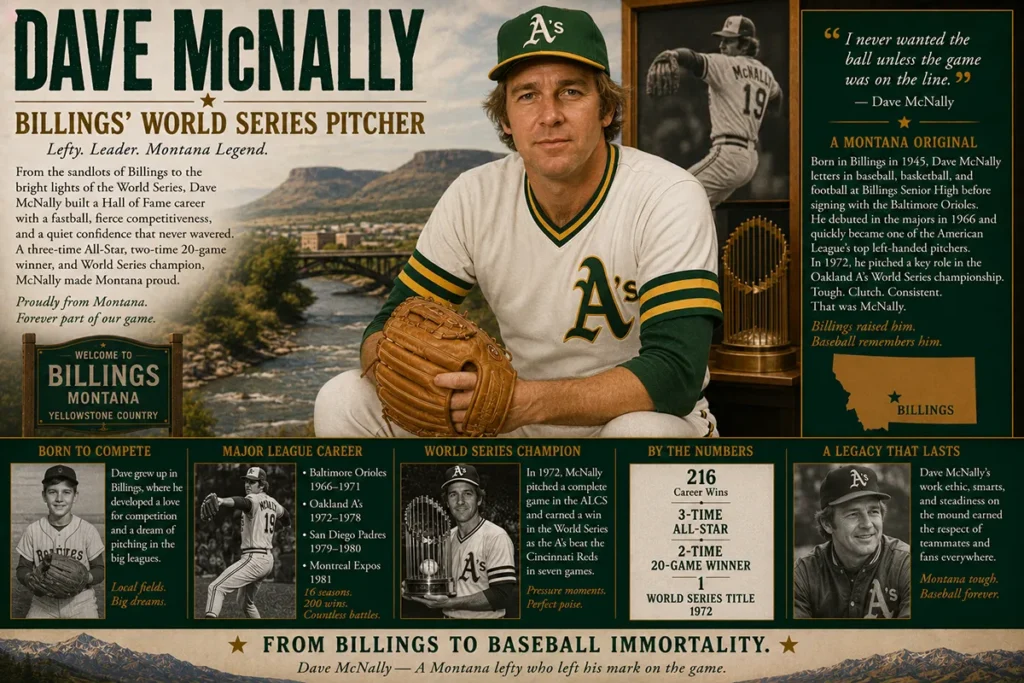
Billings native Dave McNally won four consecutive World Series games and helped the Baltimore Orioles to back-to-back World Series titles in 1966 and 1970.
He was a four-time All-Star and one of only a handful of pitchers in MLB history to hit a grand slam in the World Series.
More importantly, he was one of the two players whose 1975 grievance opened the door to modern free agency, fundamentally reshaping professional sports.
Ryan Leaf — Great Falls’ Cautionary Tale Turned Comeback
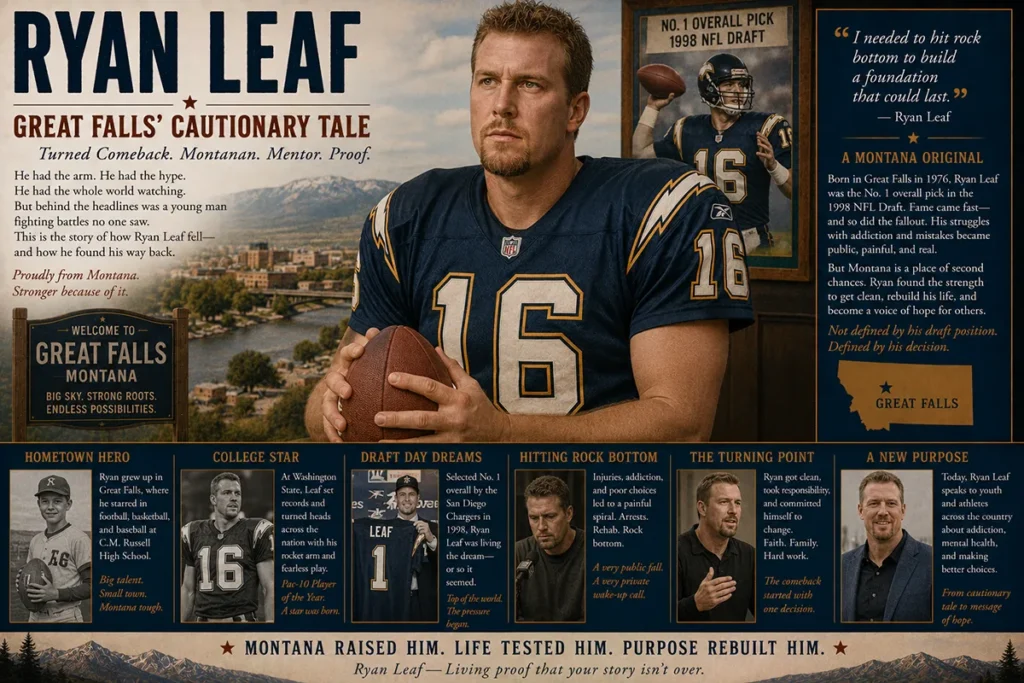
Not every Montana sports story has a tidy arc. Ryan Leaf, born in Great Falls, was selected second overall in the 1998 NFL Draft behind Peyton Manning and became one of professional football’s most discussed busts.
He has since rebuilt a public life as an advocate for mental health and addiction recovery. That second act — owning the failure and using it — feels deeply Montanan to me.
Political Trailblazers and Public Servants
Jeannette Rankin — The First Woman in Congress
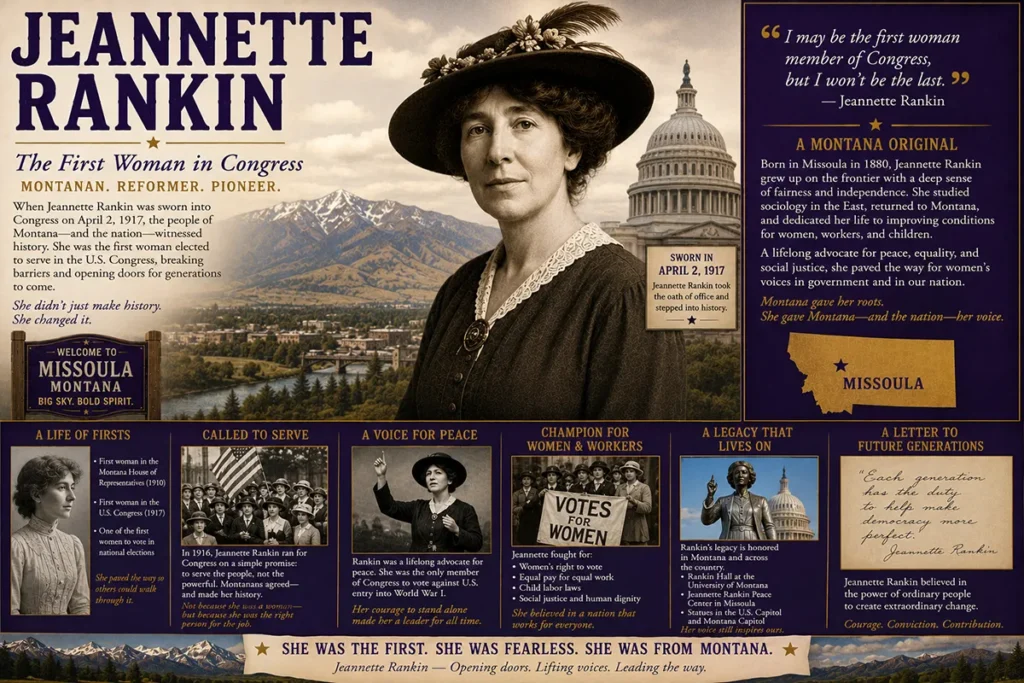
Jeannette Rankin of Missoula became the first woman elected to the United States Congress in 1916 — four years before women could even vote nationally. She remains the only member of Congress to vote against U.S. entry into both World Wars.
The Jeannette Rankin Peace Center in Missoula preserves her legacy, and I spent a moving afternoon there during my last visit. Her bronze statue stands in the U.S. Capitol’s Statuary Hall as one of Montana’s two representatives.
Mike Mansfield — The Longest-Serving Senate Majority Leader
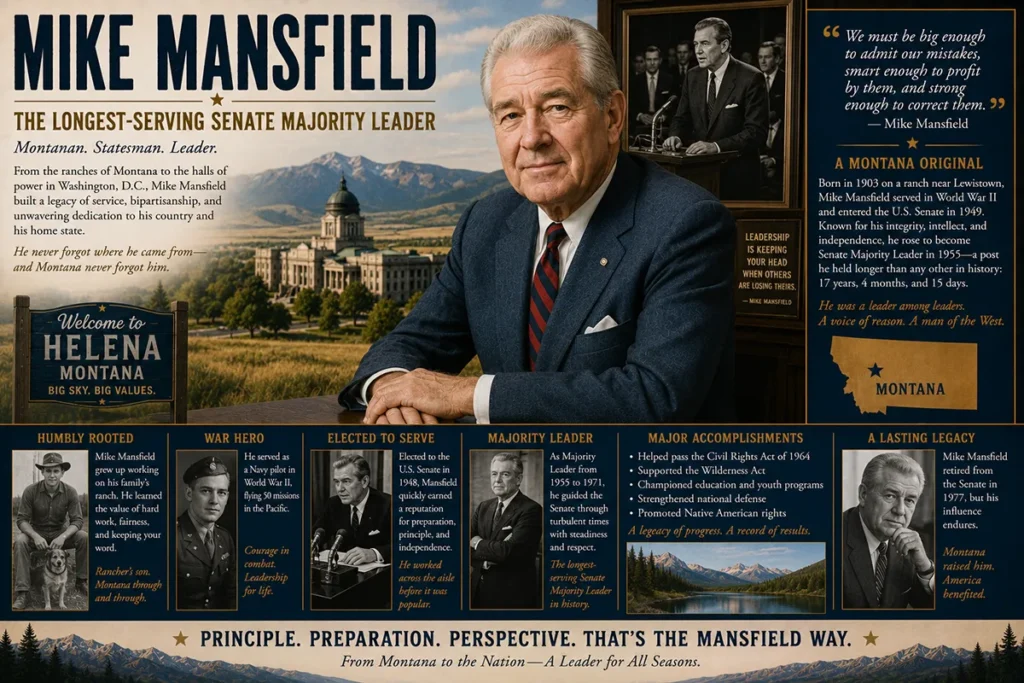
Mike Mansfield served as Senate Majority Leader for 16 years (1961–1977), longer than anyone in American history. Raised in Great Falls, Mansfield later represented Montana in Congress for 34 years before serving as U.S. Ambassador to Japan from 1977 to 1988.
His leadership style — quiet, principled, consensus-building — felt deeply Montanan. His tenure overlapped with civil rights, Vietnam, and Watergate, and his steady hand is often cited as a reason the Senate functioned at all through those years.
Brian Schweitzer — The Bolo-Tie Governor
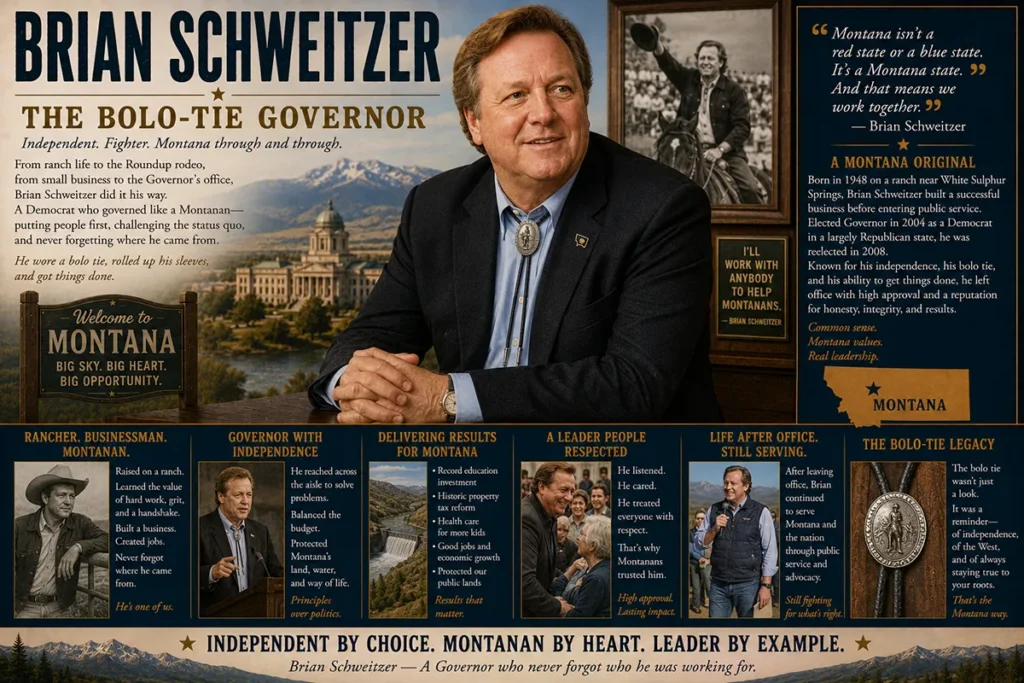
Brian Schweitzer served as Montana’s governor from 2005 to 2013 and became one of the most colorful political figures the state has produced in recent decades.
His trademark bolo ties, blunt humor, and ability to talk equally fluently with cattle ranchers and Beltway journalists made him a national Democratic figure for a stretch.
Scientists and Innovators
This is the section every other “famous people from Montana” list shortchanges or skips. It shouldn’t be.
Maurice Hilleman — The Miles City Farm Boy Who Saved Millions
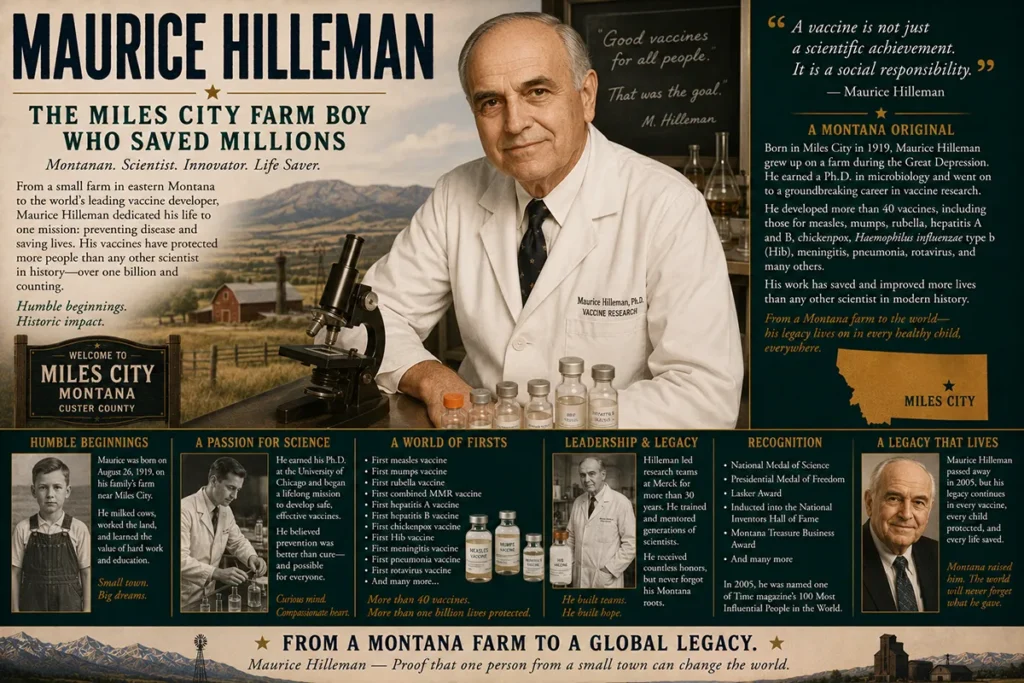
Born on a farm outside Miles City on August 30, 1919, Maurice Hilleman developed more than 40 vaccines over his career — including those for measles, mumps, rubella (the MMR), chickenpox, hepatitis A, hepatitis B, meningitis, and pneumonia.
Eight of the 14 vaccines on the standard U.S. childhood immunization schedule are his.
Robert Gallo described him as “the most successful vaccinologist in history.” Conservative estimates credit Hilleman’s work with saving roughly eight million lives every year.
He is, by any reasonable measure, the most consequential Montanan of the 20th century — and one of the most important Americans of any era.
Almost no other Montana travel guide mentions him. If you’re planning a stop in eastern Montana, see our notes on things to do in Miles City and pay quiet respects to the farm country that produced him.
Jack Horner — Shelby’s Dinosaur Detective
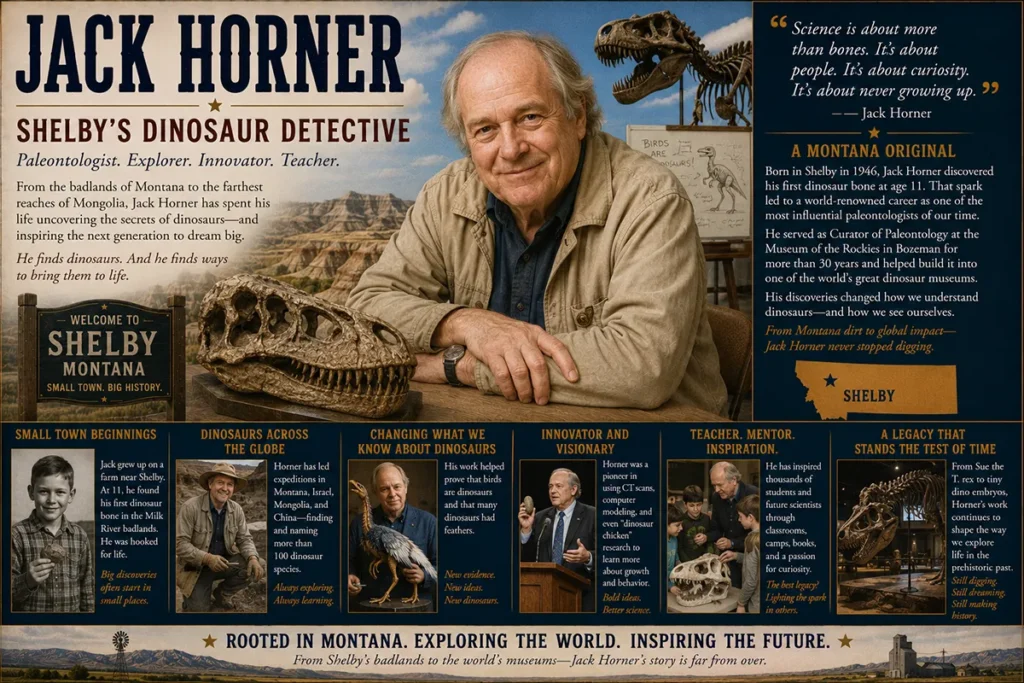
Born in Shelby in 1946, John “Jack” Horner became one of the most influential paleontologists of the modern era.
His discoveries of dinosaur nesting grounds, embryos, and parenting behavior — much of it in Montana’s Two Medicine Formation — overturned long-held assumptions about how dinosaurs lived.
He served as the technical advisor on the Jurassic Park films, and Sam Neill’s character Dr. Alan Grant was modeled largely on him.
Horner’s longtime base, the Museum of the Rockies in Bozeman, holds one of the largest collections of T. rex specimens in the world. It’s worth a half day even if you’ve never thought about dinosaurs since you were eight.
Broadcasters, Artists, and Frontier Figures
Charles M. Russell — The Cowboy Artist
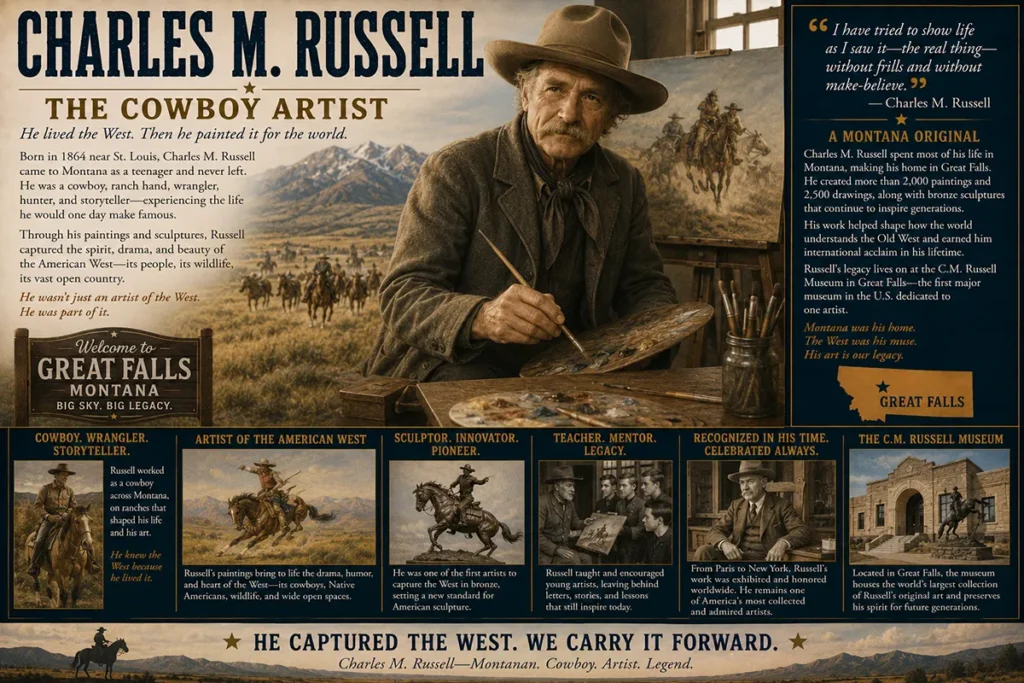
No artist captured Montana’s spirit like Charles M. Russell, though he was technically born in St. Louis. Russell moved to Montana as a teenager, worked as a cowboy, and became the definitive visual chronicler of the American West.
The C.M. Russell Museum in Great Falls holds the world’s largest collection of his work, and I consider it one of Montana’s essential cultural stops.
Standing in front of his massive paintings of buffalo hunts and Plains Indian life, you understand why his work transcends “Western art” into genuine American masterpiece territory.
His preserved log-cabin studio on the museum grounds shows how simply he lived despite his fame.
Chet Huntley — Cardwell’s Network News Anchor
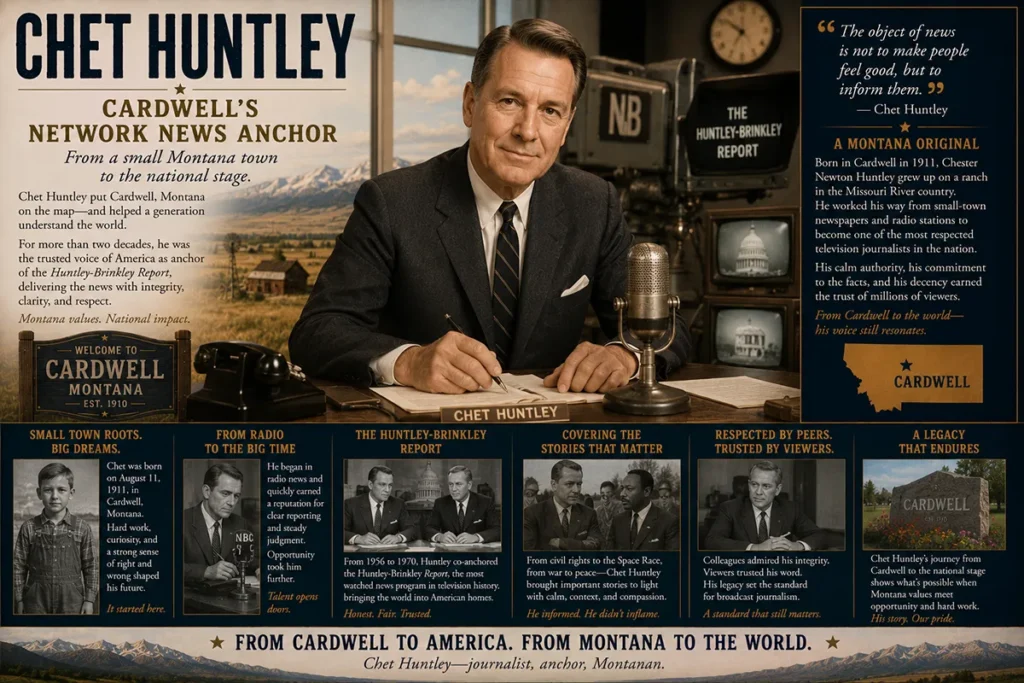
Chet Huntley, born in tiny Cardwell, Montana, in 1911, became one of the most authoritative voices in 20th-century American journalism.
The Huntley-Brinkley Report on NBC News, which he co-anchored from 1956 to 1970, was for years the most-watched news broadcast in the country.
Late in life he founded the Big Sky Resort south of Bozeman — a major piece of Montana’s modern tourism economy that exists because of him.
William A. Clark and Marcus Daly — The Copper Kings
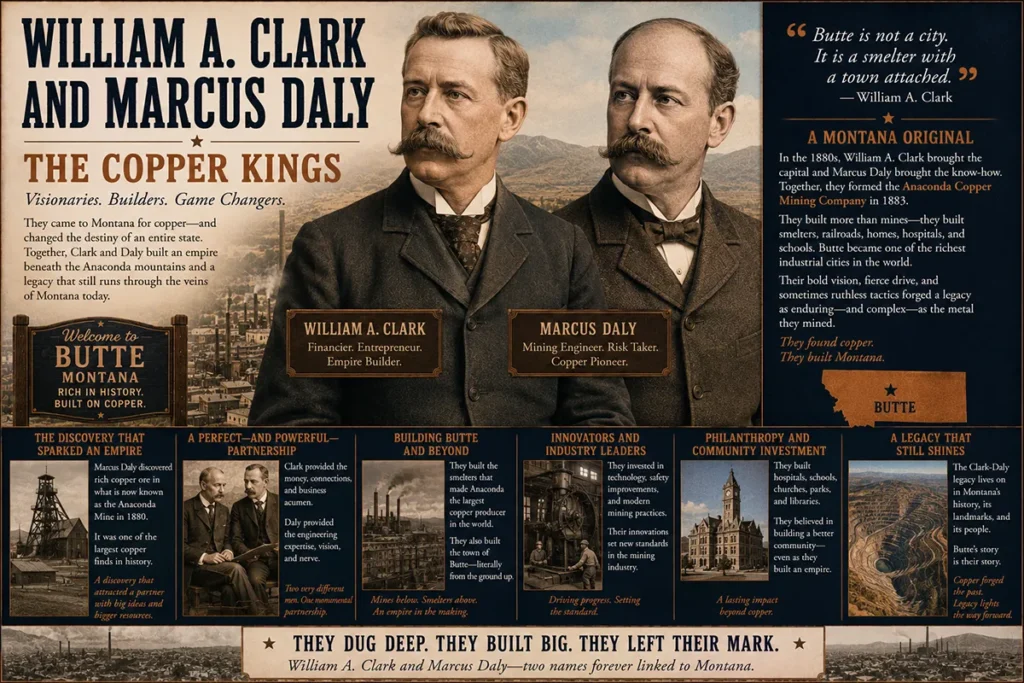
No history of famous Montanans is complete without the two men whose rivalry built Butte: William Andrews Clark and Marcus Daly.
Clark, U.S. Senator and one of the wealthiest Americans of the Gilded Age, and Daly, the Anaconda Company founder, transformed Montana into the world’s leading copper producer in the late 1800s.
Their feud reshaped the state’s politics, geography, and economy in ways still visible today — see our Montana history and Montana gold rush guides for the full picture.
Plenty Coups — The Last Great Crow Chief
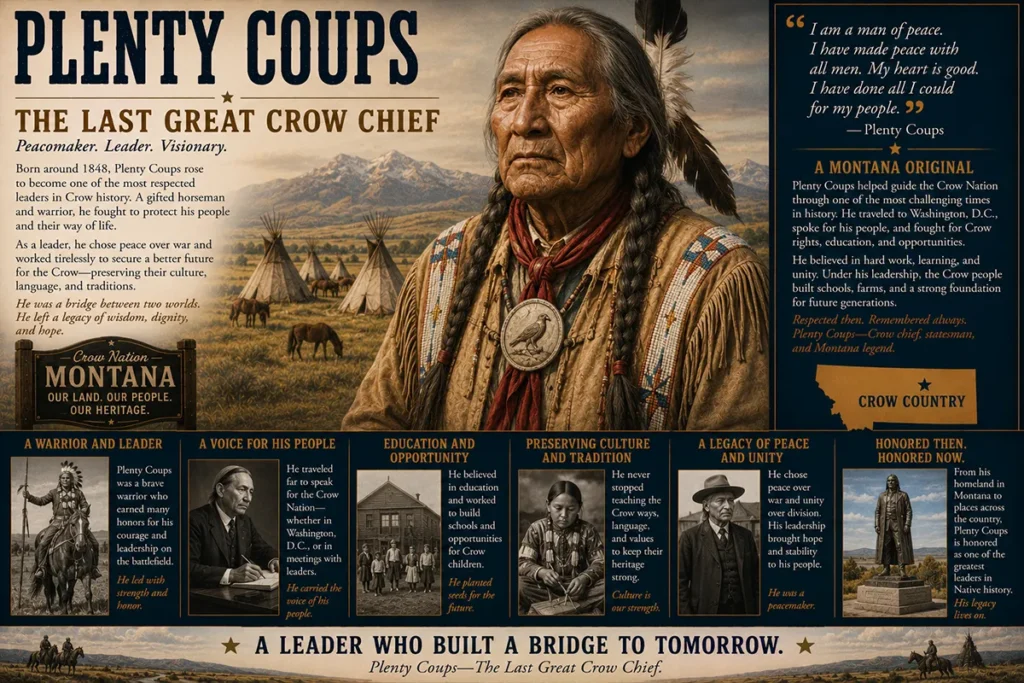
Chief Plenty Coups (1848–1932) led the Apsáalooke (Crow) Nation through the late 19th and early 20th centuries — one of the most consequential periods in the tribe’s history.
He represented all Native American tribes at the dedication of the Tomb of the Unknown Soldier in 1921.
Chief Plenty Coups State Park, south of Billings near Pryor, preserves his home and remains one of the most underrated historical sites in the state.
Calamity Jane — The Frontier Legend
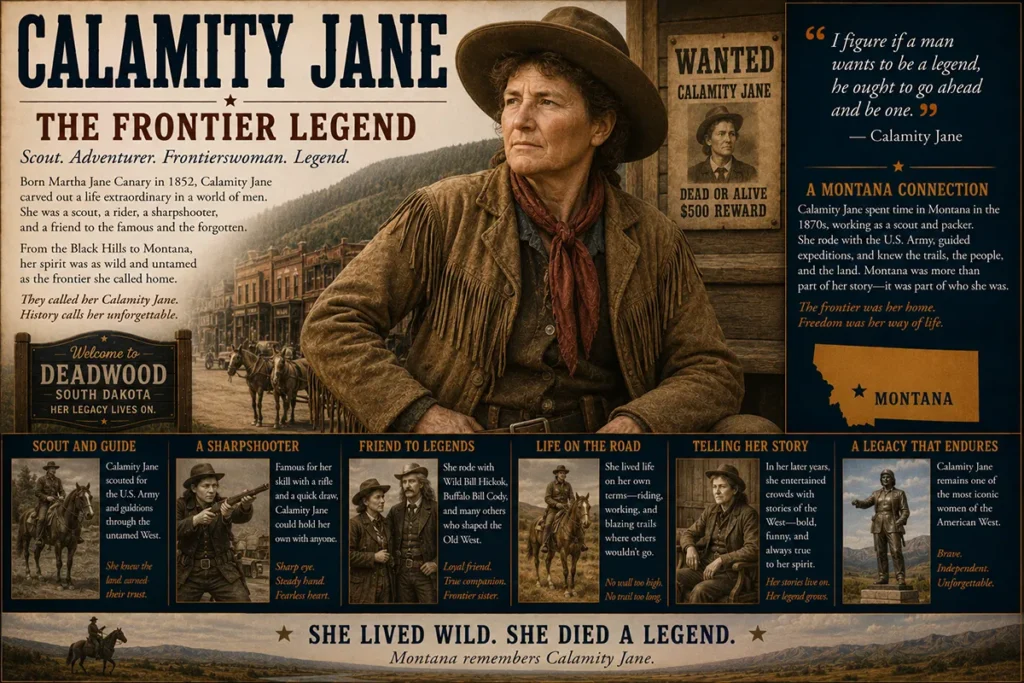
Martha Jane Canary — “Calamity Jane” — lived in mining camps and ranching communities across Montana in the late 1800s, including stints around Livingston and Billings.
Her real biography is messier and more interesting than the legend; the legacy of pioneers and key historical events guides cover the broader frontier era she belonged to.
Celebrities Who Chose Montana
Montana has become a refuge for the rich and famous seeking privacy and natural beauty. I won’t share specific addresses — Montanans value privacy, and so should visitors — but it’s worth noting these names chose Montana for the same reasons you might visit.
David Letterman — The Choteau Rancher
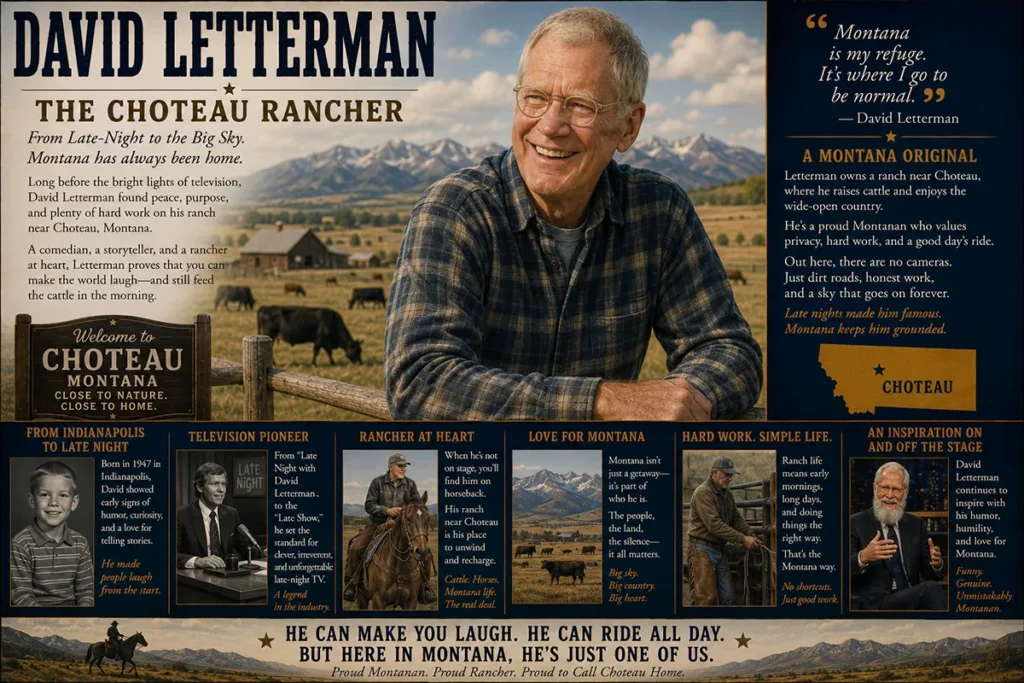
Late-night legend David Letterman has spent much of his year at his ranch outside Choteau for more than two decades.
He’s been generous with the local community, funding scholarships and conservation projects, and he keeps a low enough profile that you might pass him at the grocery store without realizing.
John Mayer — Paradise Valley
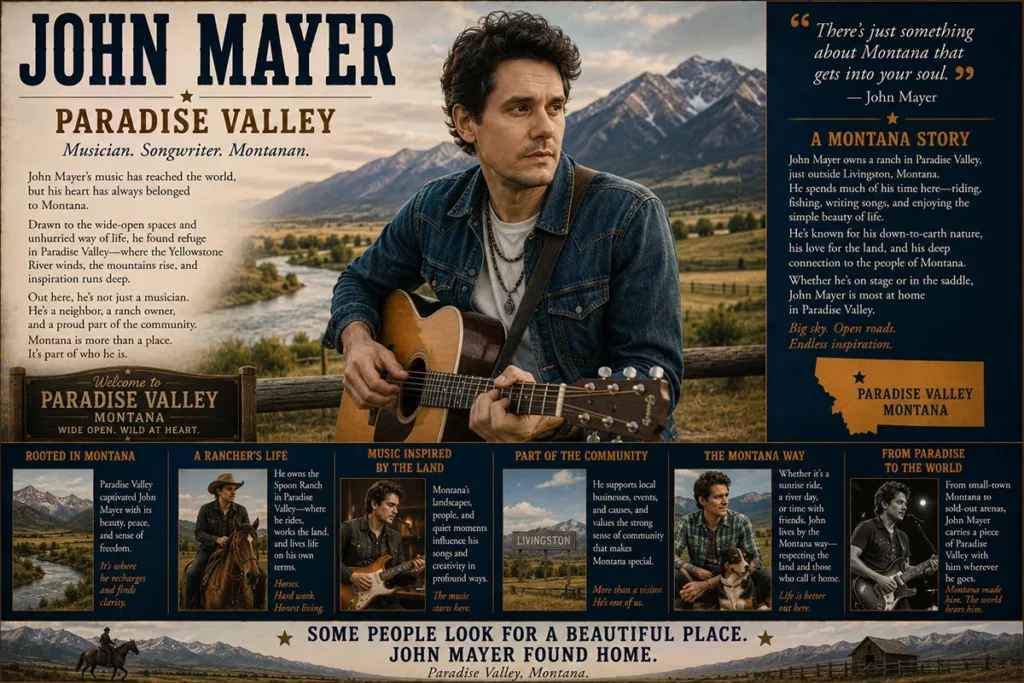
Grammy-winning musician John Mayer famously chose property in the Paradise Valley near Livingston as a home base for years. Locals describe him as a genuine community member rather than a distant celebrity.
Dennis Quaid — Paradise Valley Rancher
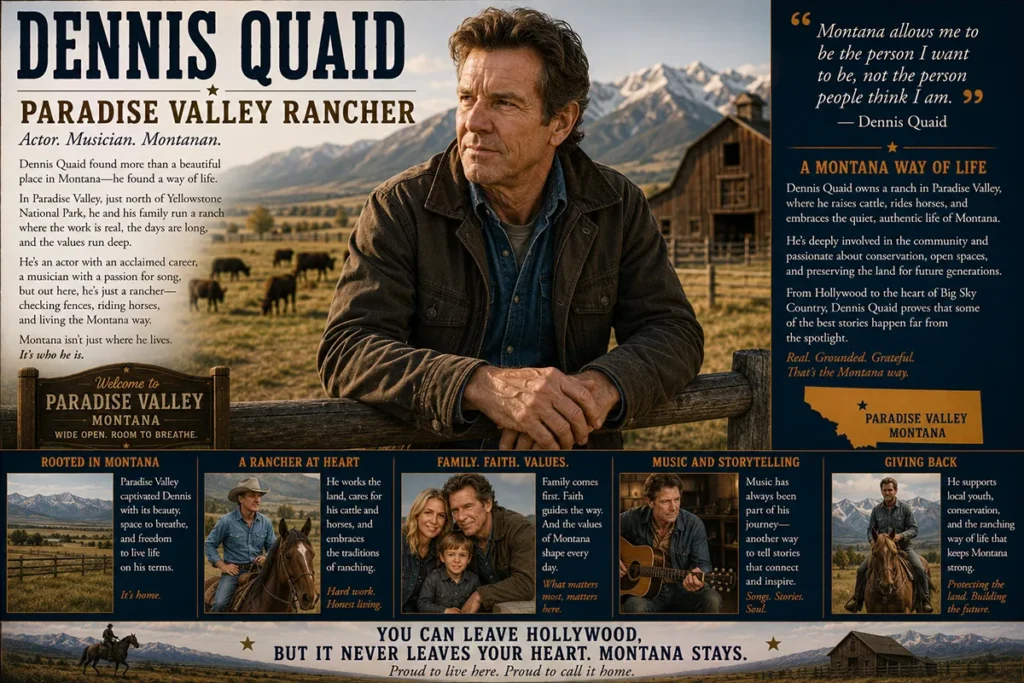
Actor Dennis Quaid has owned land in Paradise Valley for years and spends significant time there. He’s been outspoken about how Montana shaped his approach to fatherhood and his music career.
Bill Pullman — The Whitehall Rancher Who Taught Film at MSU
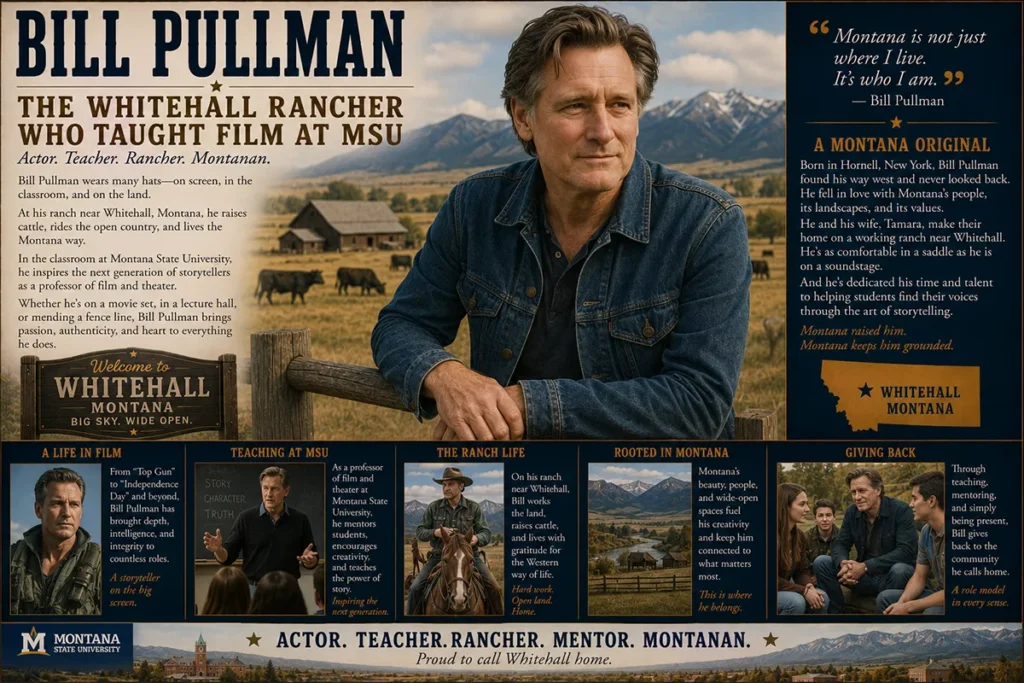
Actor Bill Pullman (Independence Day, While You Were Sleeping, The Sinner) taught film and photography at Montana State University in Bozeman before his acting career took off, and he still owns a ranch near Whitehall. He remains an active part of Montana’s arts community.
Kevin Costner and the Yellowstone Effect
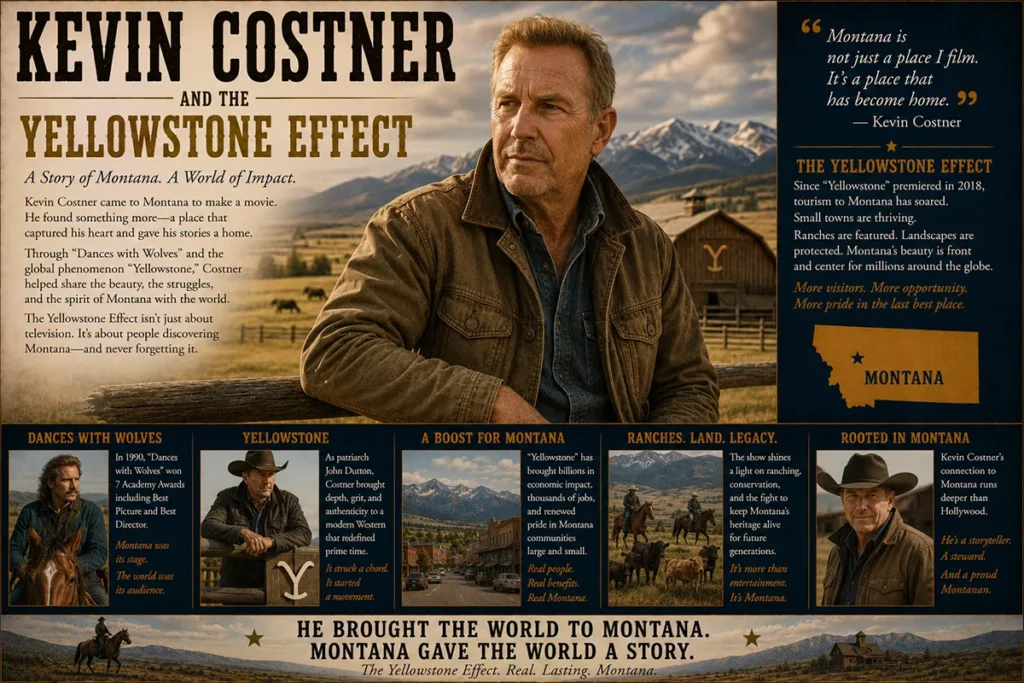
The TV show Yellowstone — much of it filmed in Montana — has driven unprecedented attention to the state. Kevin Costner and several cast members own Montana property.
The show’s run has done for Montana real estate what A River Runs Through It did for fly fishing thirty years ago.
If you’re interested in movies filmed in Montana, the state has a long history as a backdrop for Western entertainment — but Yellowstone has been a cultural moment of a different scale.
Visiting Sites Connected to Famous Montanans
If you want to actually trace these people’s footsteps, here’s where to go.
| Famous Person | Town | What to See |
|---|---|---|
| Gary Cooper | Helena | Montana Historical Society, Cooper family ranch area |
| Myrna Loy | Radersburg | Historic Radersburg townsite |
| David Lynch | Missoula | Birthplace plaques, downtown Missoula |
| Michelle Williams | Kalispell | Flathead High School, downtown Kalispell |
| Lilly Gladstone | Browning | Blackfeet Reservation, Museum of the Plains Indian |
| C.M. Russell | Great Falls | C.M. Russell Museum and Studio |
| Norman Maclean | Missoula | Blackfoot River fishing spots, downtown Missoula |
| Evel Knievel | Butte | Knievel grave, Evel Knievel Days (July), Butte uptown murals |
| Jeannette Rankin | Missoula | Jeannette Rankin Peace Center |
| A.B. Guthrie Jr. | Choteau | A.B. Guthrie Memorial, Rocky Mountain Front views |
| Phil Jackson | Deer Lodge | Old Montana Prison, local heritage sites |
| Jack Horner | Bozeman | Museum of the Rockies T. rex collection |
| Maurice Hilleman | Miles City | Range Riders Museum, Custer County |
| Charles Russell + Mansfield | Great Falls | Russell Museum, Mansfield Library archives |
| Plenty Coups | Pryor (south of Billings) | Chief Plenty Coups State Park |
| Steve Reeves | Glasgow | Valley County Pioneer Museum |
Personal Tips — What I Wish I Knew the First Time
A few things that would have saved me time when I first started chasing famous Montana connections in person.
The C.M. Russell Museum in Great Falls is much better than I expected and deserves at least three hours, not the 45 minutes I gave it on my first pass. Buy the combined ticket that includes the original studio cabin — that’s where it clicks.
The Museum of the Rockies in Bozeman is the single best dinosaur museum I’ve ever visited, and the connection to Jack Horner is more direct than you’d guess. Time it around the planetarium show.
Don’t try to visit Evel Knievel’s grave on a busy summer weekend — uptown Butte is best on weekday mornings when you can park easily and walk. Evel Knievel Days in late July is fun but loud and crowded.
If you want to feel A.B. Guthrie’s Montana, you have to be on the Rocky Mountain Front. The A.B. Guthrie Memorial north of Choteau is a small pull-off — easy to miss — but the view does the work. Bring a thermos.
Plenty Coups State Park near Pryor is one of the most quietly moving places in Montana. There’s almost never anyone else there. Go in the morning.
Practical Info Box
Best time for a “Famous Montanans” road trip: Mid-June through mid-September. Some smaller museums (Russell, Plenty Coups) reduce hours after Labor Day; verify before driving long distances.
Major museum stops to plan around:
- C.M. Russell Museum, Great Falls — [verify current admission and hours]
- Museum of the Rockies, Bozeman — [verify current admission and hours]
- Old Montana Prison Complex, Deer Lodge — [verify current admission and hours]
- Jeannette Rankin Peace Center, Missoula — donation-based, limited hours
Drive times (approximate): Billings → Bozeman ~2:15, Bozeman → Helena ~1:45, Helena → Great Falls ~1:30, Great Falls → Choteau ~1:00, Missoula → Kalispell ~2:15.
What to bring: Layers (even in summer), reusable water bottle, a paper Montana road atlas as cell service backup, and an open afternoon for the unplanned stops — the small-town museums in Glasgow, Shelby, and Miles City have surprised me more than once. For a full itinerary framework, see our Montana trip planning guide and best time to visit Montana.
Planning Your Famous Montanans Tour
Here’s how I’d structure the trip if I were starting over.
Eastern Montana route (4–5 days): Start in Billings (Dave McNally country, Bud Luckey’s birthplace). Drive south to Plenty Coups State Park near Pryor. Head east to Miles City (Maurice Hilleman territory). Loop back via Glasgow (Steve Reeves) and Big Sandy (Jeff Ament) before finishing in Great Falls for the Russell Museum and the Mansfield connection.
Western Montana route (4–5 days): Begin in Missoula (Jeannette Rankin, Norman Maclean, David Lynch birthplace, Jesse Tyler Ferguson, Dana Carvey). Drive north into the Flathead Valley for Kalispell (Michelle Williams, Brad Bird, Lilly Gladstone, Margaret Qualley) and Whitefish (Dorothy M. Johnson). Loop south through Helena (Gary Cooper, Myrna Loy, Dirk Benedict, Colin Meloy, Nicolette Larson) and end in Deer Lodge for Phil Jackson and the Old Prison.
Single-day “Famous Montanans Day” near Bozeman: Museum of the Rockies (Jack Horner) → drive to Butte (Evel Knievel, Martha Raye) → finish with dinner in uptown Butte. About 200 miles total. One of the best concentrated culture days you can have in Montana. For broader trip context, see our list of Montana cities and towns and our Montana bucket list.
What Famous Montanans Reveal About the State
After years of traveling Montana and researching its famous residents, I notice patterns. The state’s famous people tend to share certain qualities: independence, authenticity, physical courage, and a willingness to go their own way even when the cost is high.
The isolation matters. Growing up where your nearest neighbor might be miles away, where winters can kill the unprepared, where the landscape dwarfs human concerns — those conditions produce a certain type of person. Not better, necessarily, but different.
I’ve also noticed that Montana’s famous residents often keep a connection to the state long after achieving success elsewhere. Jeff Ament funds skateparks in Big Sandy.
Lilly Gladstone speaks about the Blackfeet Reservation in every major interview. Letterman quietly funds Choteau-area scholarships. There’s a gravitational pull here that success doesn’t erase.
For a sense of how locals and visitors alike try to describe that pull, our collection of Montana quotes is a useful companion to this guide.
A Final Thought Before You Go
Famous people make good headlines, but Montana’s real significance lies in what it does to ordinary people. The same forces that shaped Evel Knievel’s fearlessness and Jeannette Rankin’s moral courage work on everyone who spends time here.
When I left that Butte museum thinking about a young Evel Knievel working underground before he ever jumped a motorcycle, I understood something new about Montana.
This state doesn’t just produce famous people — it produces people who refuse to accept limits. That spirit infuses everything here, from the vast landscapes to the small-town diners to the locals who’ll tell you their own remarkable stories if you take time to listen.
Pin this post for your trip planning, and if there’s a famous Montanan you think I should add to the next update, drop their name in the comments — I’m always learning. For more context on the state itself, browse our About Montana hub and our list of things to do in Montana.
Frequently Asked Questions
Who is the most famous person from Montana?
Gary Cooper, Evel Knievel, and David Lynch are typically cited as Montana’s most internationally famous natives. In terms of historical impact, however, the strongest case belongs to Maurice Hilleman of Miles City, whose 40+ vaccines are estimated to save roughly eight million lives every year.
What famous actors were born in Montana?
Gary Cooper (Helena), Myrna Loy (Radersburg), Michelle Williams (Kalispell), David Lynch (Missoula, director), Brad Bird (Kalispell, director), Lilly Gladstone (Kalispell), Margaret Qualley (raised partly in Bozeman), Jesse Tyler Ferguson (Missoula), Dana Carvey (Missoula), Dirk Benedict (Helena), Martha Raye (Butte), and Steve Reeves (Glasgow) are among the most prominent.
Where was Evel Knievel born?
Evel Knievel was born in Butte, Montana, in 1938. Butte celebrates him every July with Evel Knievel Days, and his gravesite at Mountain View Cemetery is a popular pilgrimage stop for fans.
Is David Lynch really from Montana?
Yes. David Lynch was born in Missoula, Montana, on January 20, 1946. His family moved several times during his childhood, but his birthplace is firmly Montana.
Which Pulitzer Prize did A.B. Guthrie win?
A.B. Guthrie Jr. won the 1950 Pulitzer Prize for Fiction for The Way West (1949) — not for his better-known novel The Big Sky (1947). The Big Sky is the novel that gave Montana its nickname, but The Way West is the one that brought home the Pulitzer.
Which celebrities currently live in Montana?
Among those who keep significant homes in Montana: David Letterman (near Choteau), Bill Pullman (near Whitehall), Dennis Quaid and John Mayer (Paradise Valley), Kevin Costner and other Yellowstone cast members, and writer Thomas McGuane near McLeod. Many keep a low profile, and locals appreciate it when visitors do the same.
What is the best time of year to visit famous Montana landmarks?
Mid-June through mid-September is the easiest window — most museums are at full hours and roads are open. Winter visits work well for indoor stops like the C.M. Russell Museum, Museum of the Rockies, and Old Montana Prison, but smaller small-town museums often reduce hours or close from November through April.
Did any U.S. presidents have connections to Montana?
Theodore Roosevelt is the strongest presidential link — he spent significant time in Montana during his ranching and hunting years, and the wilderness areas he helped protect remain core to the state’s outdoor identity today.
Sources
- https://tandempress.wisc.edu/artist/david-lynch/
- https://wcftr.commarts.wisc.edu/index.php/exhibits/photos-and-flat-graphics-slide-shows/gary-cooper-personal-name-file/
- http://archive.umt.edu/montanan/f09/Jam%20Session.php
- https://socialwelfare.library.vcu.edu/woman-suffrage/rankin-jeannette-1880-1973/
- http://plainshumanities.unl.edu/encyclopedia/doc/egp.sr.032
- https://americanhistory.si.edu/collections/search/object/nmah_1001261
- https://college.berklee.edu/people/john-mayer
- https://magazine.bsu.edu/2017/12/22/modern-family-star-jesse-tyler-ferguson-coaches-ball-state-acting-students/
- http://plainshumanities.unl.edu/encyclopedia/doc/egp.fil.042
- https://yayimages.com/11538362/los-angeles-premiere-of-the-number-23.html
- https://commons.wikimedia.org/wiki/File:Jesse_Tyler_Ferguson_69th_Annual_Peabody
- https://commons.wikimedia.org/wiki/File:John_Mayer_performing_in_Atlanta,Georgia