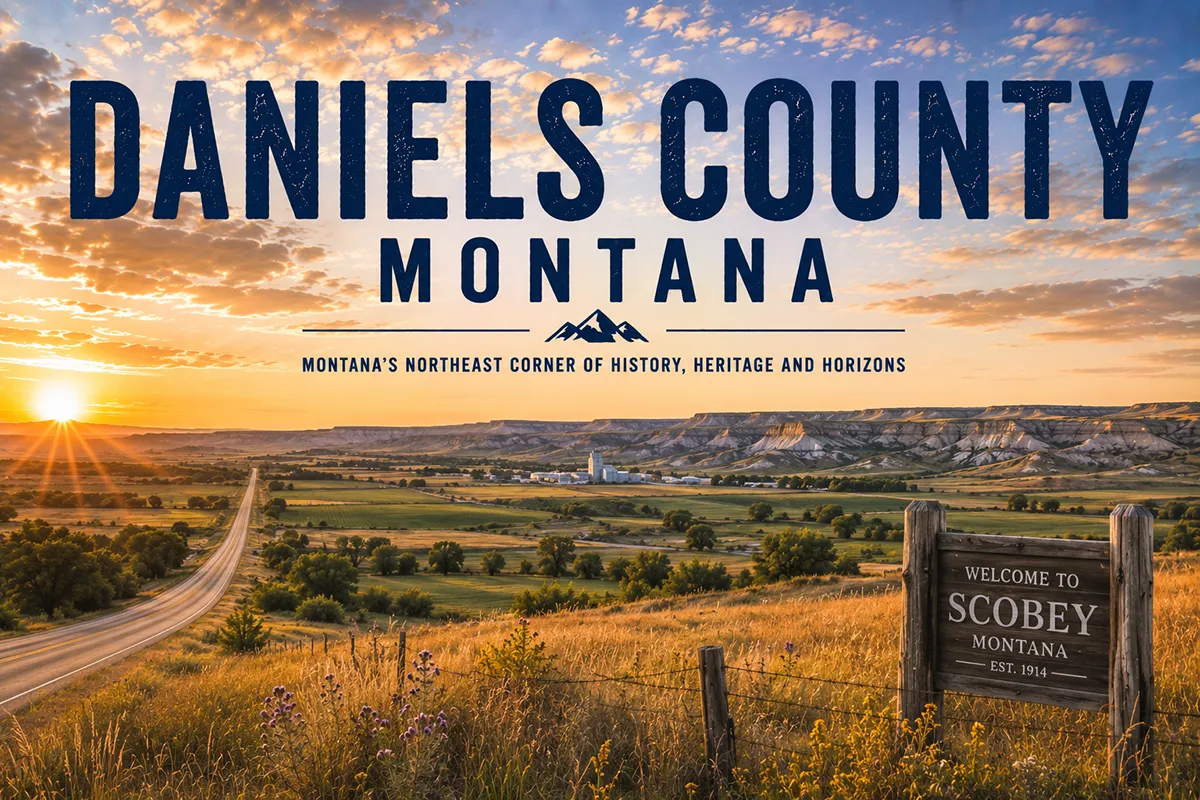
There are towns in northeastern Montana where you have to actively choose to stop.
Scobey is one of them. It’s not on a major interstate. The turn north from US Highway 2 puts you on Montana Highway 13 for 47.5 miles before you reach downtown. Nobody passes through Scobey on the way to somewhere else.
But the travelers who make that turn — especially the last weekend of June — find a Montana that the glossy travel guides reliably miss.
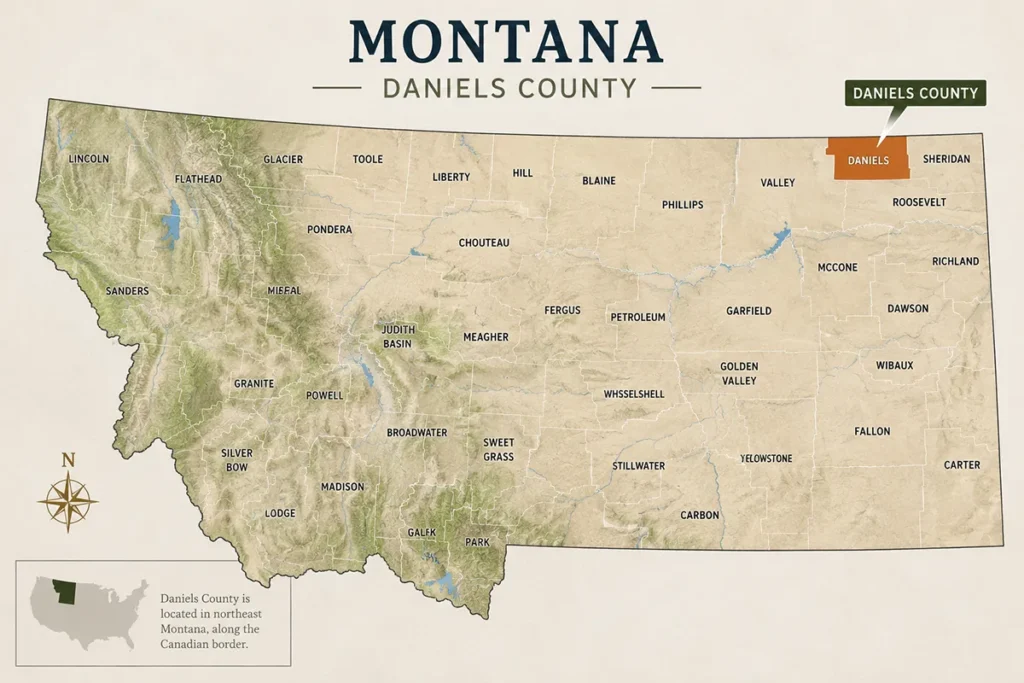
- Daniels County covers 1,426 square miles in Montana’s extreme northeast corner, bordering Saskatchewan to the north
- The county seat is Scobey (~1,000) — a genuine Hi-Line wheat and cattle town named by county founder Mansfield Daniels for his friend Major Charles Scobey
- The Daniels County Museum and Pioneer Town features 35 restored historic buildings on 20 acres just west of downtown Scobey — one of the most complete living-history town museums in Montana
- ⚠️ Pioneer Town is not free to wander — it’s private property with guided tours (Memorial Day–Labor Day); most visitors assume it’s an open-air park and are surprised
- Pioneer Days (last full weekend in June) is the county’s signature event — Threshman’s Breakfast, antique car parade, and the nationally renowned Dirty Shame Show
- The Dirty Shame Show at the Rex Theatre is an internationally recognized variety show — Dixieland band, high-energy dance, comedy, and sing-alongs — that has performed for dignitaries and draws visitors from across North America
- Whitetail deer and upland bird hunting draws hunters from around the country — Daniels County is one of Montana’s most productive hunting destinations
- Scobey was historically one of the largest grain shipping points in the world during the early-20th-century wheat boom
- The Four Buttes area west of Scobey offers scenic prairie and butte country with fishing on Butte Creek
- ⚠️ The Scobey port of entry connects to Saskatchewan — worth knowing for road trip planners crossing into Canada
Liked this article?
Add Roaming Montana as a preferred source so you see more of our articles and guides on Google.
Daniels County at a Glance
Daniels County was formed in 1920, carved from portions of Sheridan and Valley counties.
It’s named for Mansfield A. Daniels — a Montana politician instrumental in pushing for the county’s creation.
Daniels also named the county seat after his close friend Major Charles Scobey, a figure in northeastern Montana’s early settlement.
The county sits on the Hi-Line bench land immediately south of the Canadian border. The terrain is flat to gently rolling shortgrass prairie, wheat fields, and rangeland as far as you can see in most directions.
The Poplar River runs roughly east through the middle of the county before entering the Fort Peck Reservoir and eventually the Missouri. Butte Creek drains the western portions.
Population is around 1,628 — concentrated almost entirely in Scobey, with a scattering of small communities across the county.
The economy runs on wheat, barley, and cattle — the same three things it has run on since the homestead era.
For broader Montana context, see the complete guide to all 56 Montana counties.
Scobey: The County Seat
Scobey (~1,000) sits at the intersection of Montana Highway 13 and a few county roads that go south and west into the plains.
It’s a complete small town in the way that many Hi-Line communities no longer are. Gas, groceries, a hardware store, restaurants, a golf course, a public swimming pool, a motel or two, and a museum complex that puts much larger towns to shame.
At its commercial peak in the 1910s and 1920s, Scobey was reportedly one of the largest grain shipping points in the world.
That’s a striking claim for a town of 1,000 people. But context makes it credible.
The Great Northern Railway’s Hi-Line ran right through this region, and the early-20th-century wheat boom turned the entire northeastern Montana bench into a massive grain production zone. Scobey had multiple grain elevators, implement dealers, and a commercial street that reflected genuine prosperity.
The bust came in waves — drought, grasshoppers, the Great Depression, farm consolidation. The town pulled back but didn’t disappear.
What Scobey has today is something many towns that went through those cycles lost: genuine civic identity. The Pioneer Town, the Dirty Shame Show, the annual fair — these are locally produced, locally sustained, and locally proud.
Banjo’s Club 109 is the go-to for food and a cold beer in Scobey. The Banjo Burger is locally famous.
The Scobey Golf Course opened in 1926 — almost as old as the town’s incorporation. Nine holes, doubles as a bar and lunch spot. Call 406-487-5322 for current rates and rentals.
The community swimming pool is a point of local pride — a legitimate outdoor pool that serves the county’s families through the summer.
For the full Scobey visitor guide, see Scobey, Montana.
Daniels County Museum and Pioneer Town
The Daniels County Museum and Pioneer Town is the most significant cultural attraction in northeastern Montana that most Montana travelers have never visited.
On 20 acres just west of downtown Scobey, 35 historic buildings have been restored and arranged to recreate a working turn-of-the-century Montana town.
The buildings were collected from across Daniels County and beyond — some moved from farms, some from abandoned townsites, some built on-site using salvaged period materials. The collection includes:
- One-room country schoolhouse (fully furnished)
- Blacksmith shop
- General store
- Post office
- Law office
- Doctor’s office
- Dress shop
- Two churches
- Average and wealthy family homes, side by side
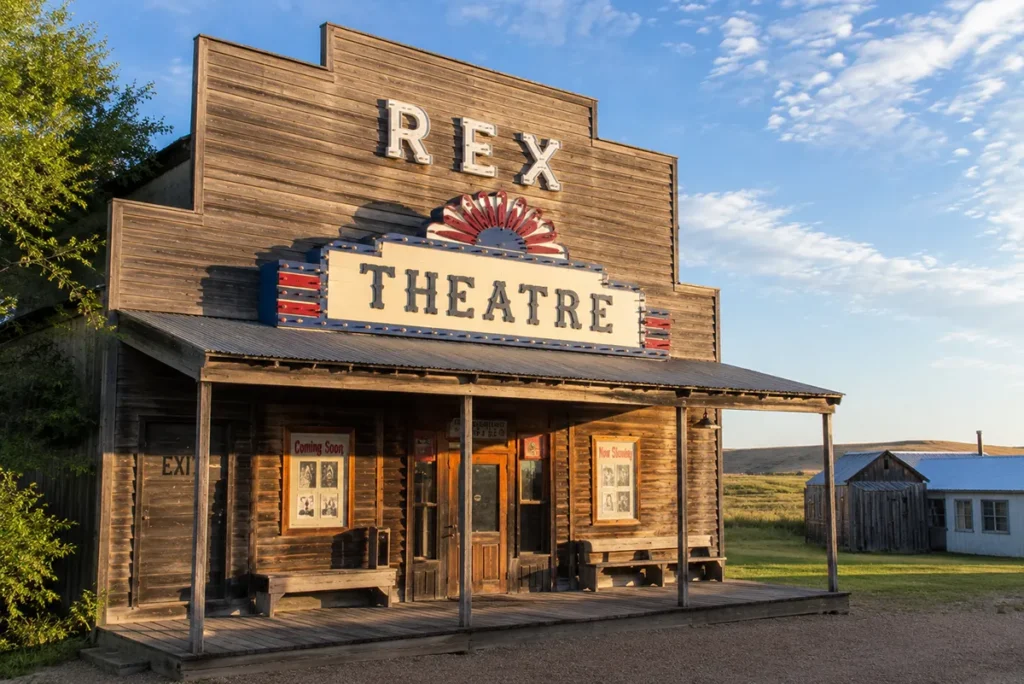
- The Rex Theatre
Antique cars, tractors, and agricultural machinery fill the spaces between buildings. The printed walking tour available at the entrance gives context for each structure. Informational plaques inside each building explain the original occupants and period details.
The result is a complete narrative environment — not a single exhibit building, but an entire townscape.
Critical logistics note: Pioneer Town is private property. During most of the operating season (Memorial Day weekend through Labor Day weekend), visits require a guided tour. You cannot simply park and wander at will.
This surprises many visitors who assume an outdoor museum complex allows self-guided access.
Call ahead or plan around the guided tour schedule before driving 47 miles off the highway to find the gate locked.
During Pioneer Days (last full weekend in June), the complex opens up and the guided-tour requirement is relaxed — that’s the best time to explore freely.
[Verify current tour hours, pricing, and schedule before your visit — contact the Daniels County Chamber at scobey@nemont.net]
Pioneer Days: The County’s Crown Event
Pioneer Days runs the last full weekend of June and is the reason many people first hear about Scobey.
The event starts early Saturday morning with the Threshman’s Breakfast — served from the original cook cars that fed harvest crews during the wheat boom.
Pancakes and sausage from the same wheeled kitchens that rolled through Daniels County grain fields a century ago. It’s a working piece of agricultural history, not a demonstration.
The afternoon brings the Pioneer Days Parade — antique cars, trucks, and tractors alongside a wagon train with horses and buggies. In a county that runs on agriculture, the parade’s machinery collection alone tells you more about regional history than most exhibits.
Children’s street games and an art show fill the rest of the afternoon.
Then comes the Dirty Shame Show.
The Dirty Shame Show
The Dirty Shame Show is the most famous thing in Daniels County and one of the least-explained by travel content.
It runs at the Rex Theatre during Pioneer Days — five shows over the course of the weekend, performed by the Dirty Shame Belles and the Dirty Shame Dixieland Band.
The format: high-energy dance routines, Dixieland band performances, comedy skits, sing-alongs, and variety show segments in the tradition of vaudeville and the frontier saloon show. The non-alcoholic Dirty Shame Saloon serves cold drinks and popcorn to the audience.
The show is described as “internationally renowned” on both the city and the museum’s official materials. It has performed for foreign dignitaries. Travel features from across North America have covered it.
What makes it worth the drive is not spectacle — the production is community-made, not Broadway. It’s the specificity.
The Dirty Shame Show is made by Scobey people, for Scobey people and whoever shows up, in a 1913 building that started life as a grain storage facility, in a town that built its identity around surviving the agricultural boom-bust cycle.
That context makes even a simple comedy skit carry more weight than a polished touring production.
[Verify current show dates and ticket prices at cityofscobey.com or scobeymt.com]
The Rex Theatre
The Rex Theatre deserves its own moment.
The building was constructed in 1913 as a grain storage facility. Within months, it was moved to Main Street and converted into a movie theater.
That rapid transformation reflects how quickly Scobey’s commercial scene was developing during the wheat boom years.
The theatre’s original seats, curtain, walls, and ceiling are intact. It’s one of the most authentically preserved small-town movie theaters in Montana.
During Pioneer Days, the Rex hosts the Dirty Shame Shows. The rest of the year, it serves as a community gathering space within the Pioneer Town complex.
Standing in those original wooden seats, watching performers in period costume on a stage framed by 1913 materials, gives the show a physical authenticity that modern venues simply can’t replicate.
Daniels County Fair
The Daniels County Fair runs in late July — typically the third or fourth weekend.
The fair includes a demolition derby, live concerts, livestock shows, 4-H activities, carnival rides, and commercial vendors. It draws the county and surrounding communities for a full weekend of events at the fairgrounds on 106 Railroad Avenue East.
The fair is genuinely local — not a regional event that happens to be in a small town, but a county event where the 4-H exhibitors and the demolition derby drivers are neighbors.
[Verify current dates at scobey@nemont.net]
Hunting in Daniels County
Hunting is the other major reason people come to Daniels County — and it’s a significant one.
The county holds excellent populations of whitetail deer in the agricultural corridors along creeks and coulees, with mule deer in the more open rangeland.
Pronghorn antelope are present across the open prairie. Ring-necked pheasants, sharp-tailed grouse, Hungarian partridge, ducks, and geese make Daniels County a legitimate upland and waterfowl destination as well.
The county has hundreds of miles of state land available for public hunting. Much of the most productive habitat, however, is on private agricultural land.
Ask permission before crossing fence lines. Most landowners are reasonable when approached respectfully.
Out-of-state hunters specifically seek Daniels County for whitetail deer. The combination of agricultural edge habitat, creek corridors, and limited pressure compared to more accessible counties creates conditions for consistently large bucks.
Contact Montana Fish, Wildlife & Parks (fwp.mt.gov) for current season dates, license requirements, and state land access maps.
The Four Buttes Area
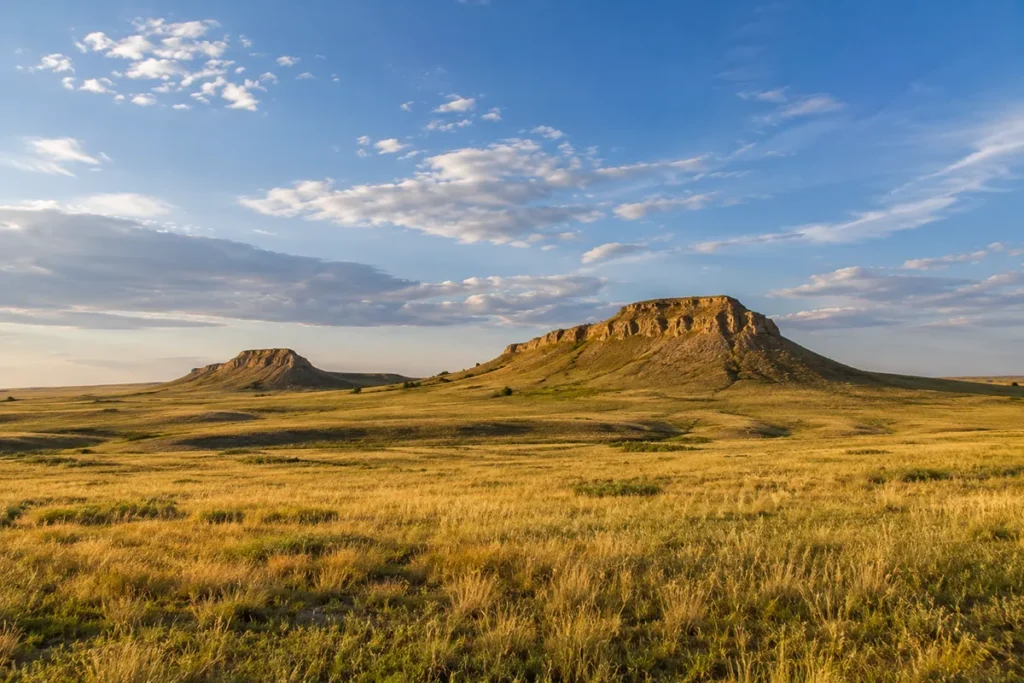
West of Scobey along Butte Creek, the landscape transitions from flat wheat plain to something more varied — the Four Buttes area, where distinctive buttes rise from the surrounding grassland and creek-bottom habitat provides fishing and wildlife viewing.
The buttes are modest by Rocky Mountain standards — rising a few hundred feet above the surrounding plain — but in the context of the flat northeastern Montana bench, they’re striking landmarks.
Butte Creek holds fish — primarily northern pike and some other warm-water species. Fishing access requires checking landowner permissions on this mostly agricultural drainage.
The Four Buttes area is one of Daniels County’s best-kept scenic secrets. Most visitors never get there because there’s no formal trailhead or campground to anchor the visit. But for travelers willing to drive gravel and stop where the landscape tells them to, the area delivers genuine northeastern Montana character.
Grain Country: Understanding the Agricultural Heritage
To visit Daniels County well, it helps to understand what the wheat economy meant here.
The Hi-Line homestead boom of 1909–1918 brought tens of thousands of settlers to the Montana plains, lured by railroad promotions promising productive dryland farming on cheap land. The Great Northern Railway built grain elevators, opened townsites, and sold the dream of agricultural prosperity.
Scobey was one of the boom’s success stories — for a time.
During peak years in the 1910s, the grain elevators in Scobey shipped extraordinary volumes of wheat and barley east. The claim that Scobey was “one of the largest grain shipping points in the world” reflects genuine historical reality during those years, not local boosterism.
Then the drought years of the 1920s and 1930s broke the dream for thousands of homesteaders. Farm abandonment across northeastern Montana was widespread. The people who stayed — and the families whose descendants still farm here — did so through genuine hardship.
The Pioneer Town museum exists precisely to preserve this history. The cook cars at the Threshman’s Breakfast are the same equipment that fed harvest crews during the boom years. Walking through those 35 buildings is a physical encounter with the full arc of that story — the prosperity, the bust, the survival.
That context makes Pioneer Town more than a nostalgic attraction. It’s a serious historical record of a specific American agricultural moment.
See Montana history and key historical events in Montana.
The Canadian Border
Daniels County’s northern boundary is the Saskatchewan province line.
The Scobey Port of Entry (portal to Coronach, Saskatchewan) is an official Canada-US border crossing — open daily with standard customs and immigration procedures. [Verify current crossing hours at cbp.gov before relying on it for cross-border travel.]
For road trip planners considering a loop through southwest Saskatchewan, the Scobey crossing adds routing flexibility that most travelers don’t know about.
The border here is the 49th parallel — the same invisible line that runs across all of northern Montana. But standing at the crossing in Daniels County, with wheat fields stretching in both directions across a landscape that makes no distinction between countries, the geopolitical border feels particularly arbitrary against the physical one.
What I Wish I Knew Before Visiting Daniels County
Pioneer Town is not a walk-in attraction. The building on the edge of town looks like an open-air museum park. It isn’t. Guided tours run Memorial Day through Labor Day. Call or check online before making the drive specifically for Pioneer Town outside of Pioneer Days.
Pioneer Days is the ideal visit window. The last full weekend of June, the complex opens up, the parade runs, and the Dirty Shame Show plays five times. If you can only come once, come then.
Book Dirty Shame Show tickets in advance. The Rex Theatre has limited seating. Pioneer Days weekend fills the town and the show sells out. Contact the Daniels County Chamber well in advance for summer weekend dates.
Scobey’s grain history is worth understanding before you arrive. Walk through Pioneer Town with the context that this county shipped more wheat per capita than almost anywhere in the world during its peak. It changes what you see in those buildings.
Hunting requires early landowner contact. The best whitetail habitat is on private agricultural land. Plan your access before you arrive — cold-calling during season is less reliable than establishing a relationship with landowners in advance.
The drive from US-2 takes about an hour. Turn north on Montana 13 at a small junction west of Wolf Point. It’s 47.5 miles to Scobey on a good paved road. Add this to your driving math when planning the day.
Fuel up before leaving Scobey. Services don’t exist in meaningful quantities between Scobey and the surrounding county roads. Fill your tank before heading out to the Four Buttes area or the border.
Practical Info
| County seat | Scobey |
| Area | 1,426 sq mi |
| Population | ~1,628 (2022 est.) |
| Tourism region | Missouri River Country |
| Formed | 1920 |
| Main highways | Montana Highway 13 (north from US-2) |
| Pioneer Town | 7 blocks west of Main on 2nd Ave, Scobey |
| Pioneer Town season | Memorial Day–Labor Day (guided tours) |
| Pioneer Days | Last full weekend in June |
| Daniels County Fair | Late July [verify at scobey@nemont.net] |
| Canada border crossing | Scobey Port of Entry to Coronach, SK [verify hours] |
| Nearest US-2 junction | ~47.5 miles south of Scobey via MT-13 |
| Nearest city | Wolf Point (~60 miles southwest) or Plentywood (~45 miles east) |
| Nearest major airport | Billings Logan International (BIL) — ~4 hours |
| Cell service | Decent in Scobey; variable in rural county |
| Gas/services | Scobey is the only full-service hub |
Getting to Daniels County
From US Highway 2: Turn north on Montana Highway 13 at a junction west of Wolf Point. Drive 47.5 miles north to Scobey.
From Plentywood (Sheridan County): Head west on Montana Highway 5 approximately 45 miles.
From Glasgow (Valley County): Head north and east via county roads — approximately 70 miles.
By air: There is no scheduled air service to Daniels County. The nearest commercial airports are in Billings (BIL) at roughly 4 hours and Williston, North Dakota (XWA) at roughly 2.5 hours. Rental cars are essential.
See Montana airports and Montana transportation guide.
Towns in Daniels County
- Scobey — county seat; Pioneer Town, Dirty Shame Show, full county services
- Flaxville — small community southwest of Scobey; farming community with basic services
- Peerless — tiny community in western Daniels County
Adjacent Counties
- Sheridan County to the east — Plentywood
- Roosevelt County to the west — Wolf Point, Fort Peck Reservation
- Valley County to the southwest — Glasgow, Fort Peck Lake
- Saskatchewan, Canada to the north
Plan Your Daniels County Trip
Daniels County is not a county you visit by accident. It asks for intention.
The payoff for that intention is a Montana experience that almost no travel content has told you to expect.
A living-history museum that genuinely recreates a lost world. A variety show that earned international recognition through community effort. A landscape so open and quiet that standing in a wheat field at sunset feels like a genuine encounter with the full scale of the American plains.
A one-night trip timed to Pioneer Days covers all the main attractions. Arrive Friday afternoon, walk downtown Scobey and visit the Pioneer Town if guided tours are available, eat at Banjo’s. Saturday morning for the Threshman’s Breakfast and parade, afternoon for the Dirty Shame Show, overnight in Scobey or drive back to US-2.
Add a second day for the Four Buttes drive, Butte Creek, and the border country north of town.
For trip planning help, see Montana trip planning guide and best time to visit Montana. For historical context, see Montana history. Back to the complete Montana counties guide.