The third full weekend of May, Miles City doubles in population.
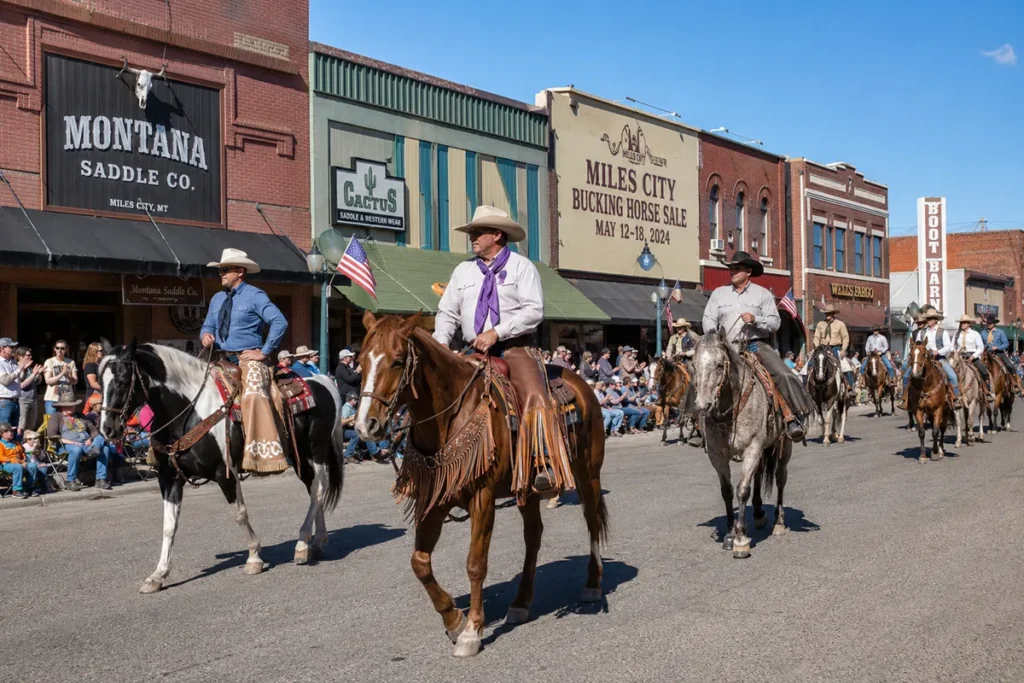
Cowboys come from five states and Canada. Stock contractors fly in from across the country. The bars on Main Street stay open until the last person standing goes home. The parade on Saturday morning has more horses than cars.
The World Famous Bucking Horse Sale is the anchor event. But Custer County is worth visiting any time of year.
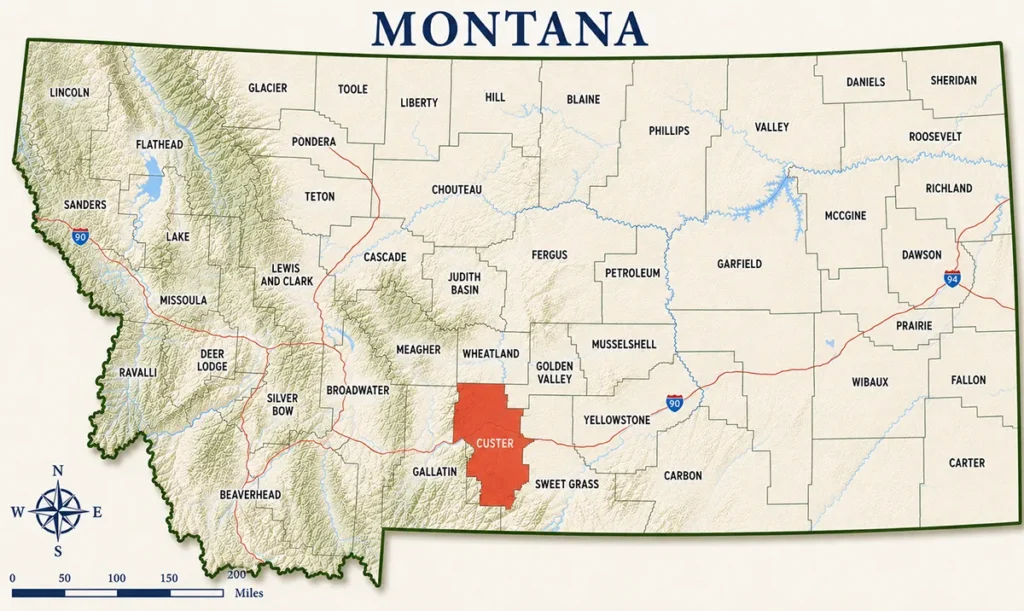
- Custer County covers 3,783 square miles along the Yellowstone River in southeast Montana
- The county seat is Miles City (~8,400) — self-proclaimed “Cow Capital of the West” and one of the most authentically western towns in Montana
- Custer County was created from Big Horn County in 1877, the same year as the Battle of Little Bighorn — named to honor Lt. Col. George Armstrong Custer
- The World Famous Miles City Bucking Horse Sale (third full weekend of May) is the most significant rodeo stock event in North America — stock contractors come here to buy the bucking horses used in PRCA rodeos nationwide
- The Range Riders Museum holds the life’s work of L.A. Huffman — one of the most important documentary photographers in American history, who captured the final years of the open-range cattle era from Miles City
- Fort Keogh was established in 1876 after the Little Bighorn and became one of the world’s largest horse remounting stations during World War I
- The Yellowstone River flows through the county — undammed, wild, and excellent for catfish, walleye, and paddlefish
- Pirogue Island State Park offers 269 acres of river-bottom habitat and 2.8 miles of trail just outside Miles City
- RoamingMontana has a full top things to do in Miles City guide alongside this county post
Liked this article?
Add Roaming Montana as a preferred source so you see more of our articles and guides on Google.
Custer County at a Glance
Custer County was created in 1877, carved from Big Horn County in the immediate aftermath of the Battle of Little Bighorn.
It was named to honor Lt. Col. George Armstrong Custer — more commonly known by his Civil War brevet rank of Major General. The county’s creation that same year reflected the military and political atmosphere following the 1876 battle.
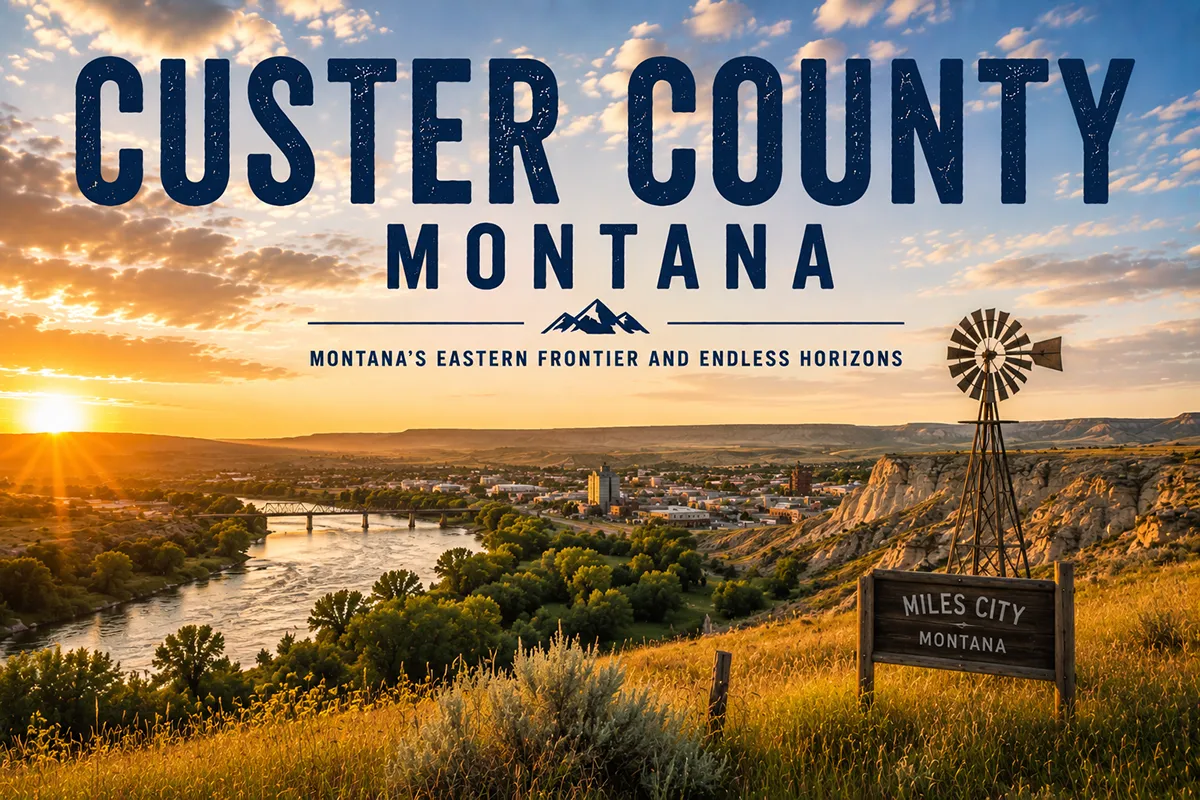
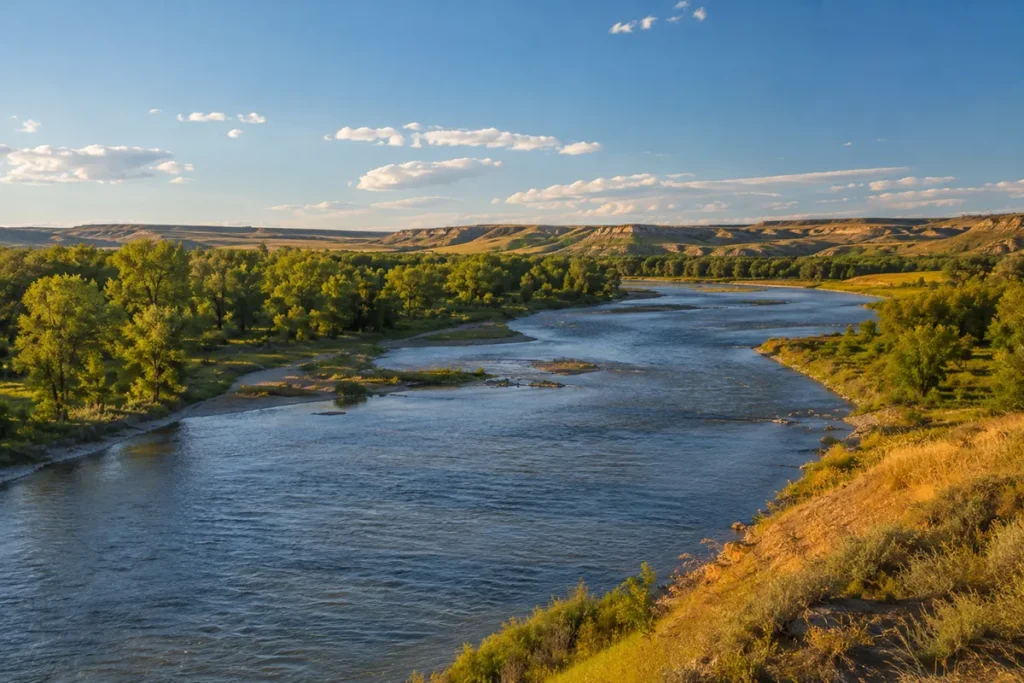
The county covers 3,783 square miles of southeast Montana along the Yellowstone River valley. Terrain is classic eastern Montana: rolling shortgrass prairie, coulees, cottonwood river bottoms, and wide open horizons in every direction.
The Yellowstone River runs east-west through the northern portion of the county. The Tongue River enters from the south. Both drain into the Missouri River system downstream.
Population is around 12,032. Miles City provides the services, culture, and identity for a huge stretch of surrounding southeast Montana.
For broader Montana context, see the complete guide to all 56 Montana counties.
Miles City: The Cow Capital
Miles City earned its western credentials the hard way.
The town grew from the merchants and tradespeople who followed Colonel Nelson Miles after he established Fort Keogh in 1876. The sutlers — civilian merchants who supplied military posts — set up just east of the fort.
When Fort Keogh relocated two miles west, the residents picked up most of the town and followed.
The early town was called Milestown. The first official plat and the first post office both registered it as “Miles City” — and Miles City it stayed.
Through the 1880s, the Yellowstone valley became one of the most intensively ranched regions in North America. Texas longhorns came north up the cattle trails. Scottish and English investors poured money into eastern Montana ranch operations. The cattle economy made Miles City the commercial hub of the entire region.
Then the winter of 1886-87 came.
The die-up changed everything. The open-range era ended. Ranching became more careful, more managed, less speculative. Miles City survived and adapted — and its identity as a genuine working ranch community has held for 150 years.
Today Miles City is a city of 8,400 with a university campus, an airport, good restaurants, and a downtown that still looks like a western town rather than a western-themed attraction.
For the full guide, see Miles City, Montana and top things to do in Miles City.
The World Famous Bucking Horse Sale
There is nothing else quite like it in Montana. Possibly nothing like it anywhere.
The Miles City Bucking Horse Sale started in 1951 as a practical event: give PRCA stock contractors a place to source and auction the rankest bucking horses in the country. Miles City, sitting at the heart of eastern Montana horse country, was a natural fit.
Seventy-plus years later, the auction is still the commercial foundation. But the Bucking Horse Sale has grown into a four-day cultural event that brings the genuine ranching West into contact with the competitive rodeo world in a way that happens nowhere else.
The events:
The Thursday night concert opens the weekend — major country headliners and the beginning of what becomes a four-day party.
Friday brings the trade show, bucking bull sale, wild horse race, and the Orin Muri Permit Challenge (up-and-coming bronc riders competing for their PRCA cards).
Saturday starts at 6 a.m. with the Cowboy Breakfast at the Range Riders Museum. The parade follows at 9:30 a.m. — a true western parade where horses outnumber motorized vehicles and the Miles City Caledonian Society bagpipe band is a legitimate crowd favorite. The afternoon brings the main event: the Open Bucking Horse Sale and Futurity, where stock contractors bid on horses being bucked out in front of them in real time. The PRCA Xtreme Broncs Match in the evening puts 32 of the world’s top-ranked saddle bronc riders against some of the rankest stock anywhere.
Sunday wraps with another round of racing, the PRCA match finals, and the wild horse race.
Wild horse race — a three-person team (mugger, holder, and rider) has to saddle and ride a completely unbroken horse from a standing start. Sixteen teams compete across the weekend. It is exactly as chaotic as it sounds.
What attending actually looks like:
Main Street closes to traffic Friday and Saturday evenings. Multiple bands set up along the strip. Open container rules apply inside the street-long venue. Miles City’s bars — the Montana Bar, the Bison Bar, the Bison Bar’s back room — overflow.
The whole town is warm to visitors during Bucking Horse Sale weekend. Locals spot newcomers immediately. Newcomers are welcomed anyway. Everyone is a friend.
Logistics:
The Sale is held the third full weekend of May at the Custer County Fairgrounds at 42 Garryowen Road.
Miles City hotels fill months in advance. Book in February for May dates. Billings is 145 miles west on I-94 if local lodging is sold out.
[Verify current ticket prices and schedule at buckinghorsesale.com]
Range Riders Museum and L.A. Huffman
The Range Riders Museum is the institutional memory of eastern Montana ranching.
The main collection covers the full sweep of southeastern Montana history: frontier artifacts, saddles, weapons, Native American items, pioneer household goods, and an extraordinary archive of material documenting the ranching era from the 1870s onward.
But the reason serious visitors come from across the country is Laton Alton Huffman.
L.A. Huffman (1854–1931) arrived in Miles City in 1878 as the post photographer at Fort Keogh. He spent the next decade documenting what he immediately understood was a vanishing world — the last great bison herds, the open-range cattle drives, the Native peoples of the Yellowstone valley, and the landscape itself before it was fenced and subdivided.
His photographs are among the most important documentary records of the American West in existence.
He was the first photographer to develop film in the field on the open plains, working from a wagon laboratory.
His images — technically remarkable for their era and historically irreplaceable — captured the Yellowstone country at a moment that lasted only a decade before the die-up, the fences, and the railroad remade everything.
The Range Riders Museum holds the largest permanent collection of Huffman’s work. If you have any interest in the American West’s photographic history, this alone justifies the stop.
The museum also holds work by Evelyn Cameron (1868–1928) — a British-born naturalist and photographer who homesteaded near Terry and documented ranch life across eastern Montana with glass-plate cameras for three decades.
Her work is the counterpart to Huffman’s — where he photographed the cowboys and cattle, Cameron documented the homesteaders, the women, and the daily life of settlement.
[Verify current museum hours and admission at rangeridersmuseum.com]
Fort Keogh
Fort Keogh was established in 1876 by Colonel Nelson Miles in the immediate aftermath of the Battle of Little Bighorn.
It was named for Captain Myles Keogh — one of Custer’s officers killed at the Little Bighorn, whose horse Comanche was the only U.S. cavalry survivor of the battle found alive on the field.
Fort Keogh sat two miles west of the civilian settlement that became Miles City. When the fort relocated slightly in its early years, the town followed.
The fort played a significant role in the Indian Wars campaigns of the late 1870s. But its most remarkable chapter came four decades later.
During World War I, Fort Keogh became one of the largest horse remounting stations in the United States. The wide, flat Yellowstone valley grasslands were ideal for conditioning horses for military service.
At peak operation, Fort Keogh held over 60,000 horses at a time.
Today Fort Keogh operates as the USDA Fort Keogh Livestock and Range Research Laboratory — an active agricultural research station on the original fort site. A historical marker near the entrance marks the site’s military history.
The proximity of Fort Keogh to Miles City, and the horse culture it generated over decades, is the direct context for the Bucking Horse Sale — the horses made the cowboys, and the cowboys made the culture.
The Yellowstone River
The Yellowstone River is one of the longest undammed rivers in the lower 48 states.
It enters Custer County from the west and flows east through Miles City before continuing toward North Dakota, where it joins the Missouri River.
The river is wide, strong, and generally clear. It carries serious fishing value — channel catfish and flathead catfish, walleye, sauger, paddlefish in season, and occasional northern pike in the slower backwaters.
Paddlefish season is worth specific mention. The Yellowstone River near Miles City supports one of the better paddlefish populations accessible from the road system in Montana. The season and access points shift year to year. [Verify current season and access with Montana Fish, Wildlife & Parks at fwp.mt.gov]
Several fishing access sites are marked along the Yellowstone near Miles City. Boat fishing and shore access are both available.
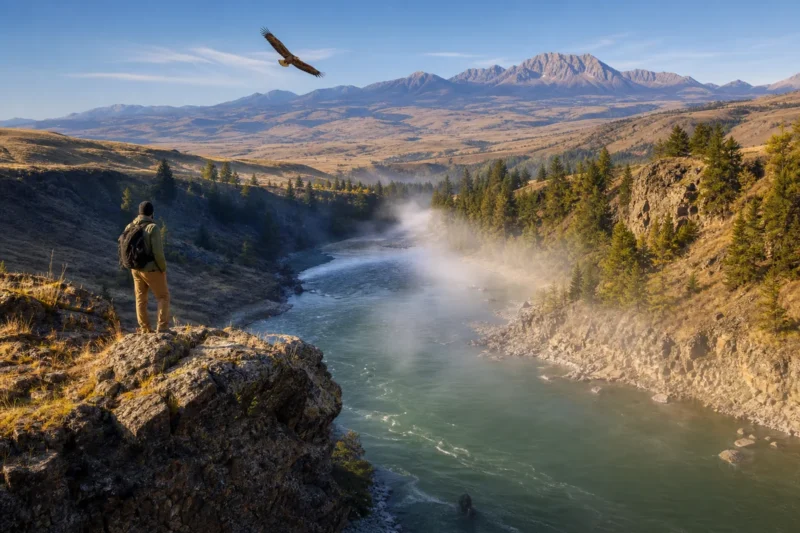
The river corridor also provides some of the best birdwatching in southeastern Montana — great blue herons, white pelicans, bald eagles, osprey, and various shorebirds and waterfowl along the cottonwood bottoms.
Pirogue Island State Park
Pirogue Island State Park sits just west of Miles City on 269 acres of Yellowstone River island habitat.
The park has 2.8 miles of designated hiking trails through cottonwood and willow river-bottom forest. It’s one of the more accessible birding spots in eastern Montana — the island location concentrates migrating birds during spring and fall, and the year-round residents include great horned owls, bald eagles, and a rotating cast of raptors.
The park is open year-round during daylight hours. Access is from the north bank near Miles City — the park office number is 406-853-2824 for current conditions.
No camping is available, but the trails are peaceful in a way that feels genuinely removed from the highway even though you’re minutes from town.
The 1886–87 Die-Up
The winter of 1886-87 reshaped the entire Montana cattle industry — and Custer County was at its epicenter.
The summer of 1886 had been dry, leaving inadequate grass reserves. When January brought a blizzard of extraordinary severity across the plains, cattle in open-range operations had no feed, no shelter, and nowhere to go.
Estimates of cattle losses across Montana range from 50 to 90 percent. Some operations were completely wiped out. The largest ranching empires in southeastern Montana collapsed overnight.
“A hard winter and we are ruined,” one rancher wrote at the time.
The die-up forced the end of the open-range system. Ranchers who survived began fencing, growing hay for winter feed, and reducing herd sizes to what the land could sustainably support.
Miles City survived because its commercial infrastructure served more than just cattle. But the event permanently marked the region’s memory — the reason Miles City’s ranching culture carries a certain seriousness beneath the celebration is because the community remembers what it cost to build what they have.
See Montana history and the harsh Montana winter of 1886 for the full story.
Waterworks Art Museum
The Waterworks Art Museum (Custer County Art Center) in downtown Miles City offers year-round contemporary and western art exhibitions.
The museum hosts the Quick Draw Art Show during the Bucking Horse Sale — artists have exactly 30 minutes to create a piece, which is then immediately auctioned to attendees. It’s one of the more entertaining art events in Montana, particularly given the cowboys and stock contractors in the audience.
The Custer County Art Center also runs year-round classes and community programs.
Tongue River Reservoir
About 20 miles southeast of Miles City along the Tongue River, the Tongue River Reservoir provides boating, fishing, and camping in a quiet southeast Montana setting.
The reservoir holds walleye, largemouth and smallmouth bass, and yellow perch. It’s a reliable local fishing destination and a popular weekend spot for Miles City residents.
Camping is available at the state recreation area. [Verify current fees and facilities at stateparks.mt.gov]
The Tongue River Winery near Miles City produces Montana fruit wines — red and white, sweet and dry, grape and fruit varieties. Open most days. [Verify current hours at tongueriverwinery.com]
What I Wish I Knew Before Visiting Custer County
Book Bucking Horse Sale lodging in February. May dates fill completely within months of opening. Miles City has limited hotel inventory. If you’re coming from outside the region, book as early as possible or plan to stay in Billings and drive.
The Range Riders Museum deserves more time than you’ll give it. Most visitors allocate an hour and leave wishing they’d had two. The Huffman collection alone is worth a focused visit. Go when the museum opens.
The Yellowstone near Miles City fishes differently by season. Spring runoff muddies the water; summer and fall produce clearer conditions and better fishing. Paddlefish season is a specific event — check current regulations before targeting them.
Pirogue Island is underused. Most travelers drive past it. The island trail on a fall morning with migrating birds moving through the cottonwoods is one of the quieter pleasant experiences in eastern Montana.
Fort Keogh is a working USDA research station, not a public museum. The site is visible from the road and marked with a historical sign. Don’t plan to walk the grounds — it’s an active federal facility.
The 1886 die-up context matters. Understanding that catastrophic winter gives you the lens to understand why Miles City’s ranching culture is what it is — careful, proud, with a long memory for hard times.
Miles City is further from Billings than it feels on the map. It’s 145 miles on I-94 — a straight two-hour drive, not a quick detour. Build in a full day at minimum.
Practical Info
| County seat | Miles City |
| Area | 3,783 sq mi |
| Population | ~12,032 (2022 est.) |
| Tourism region | Southeast Montana |
| Formed | 1877 (from Big Horn County) |
| Main highways | I-94 (east-west), US-12, MT-59 |
| Bucking Horse Sale | Third full weekend of May, Custer County Fairgrounds |
| Range Riders Museum | [Verify hours at rangeridersmuseum.com] |
| Pirogue Island State Park | West of Miles City — 406-853-2824 |
| Miles City Airport | Scheduled service to Billings and Glendive |
| Nearest major airport | Billings Logan International (BIL) — 145 miles west |
| Best season | May (Bucking Horse Sale); May–Oct for outdoor activities |
| Yellowstone River fishing | Year-round; paddlefish seasonal [verify at fwp.mt.gov] |
| Cell service | Good in Miles City; variable in rural county |
Getting to Custer County
From Billings: I-94 east — 145 miles, about 2 hours.
From Glendive: I-94 west — 70 miles, about 1 hour.
From Sheridan, Wyoming: US-212 north through Broadus — about 150 miles, 2.5 hours.
By air: Miles City Airport (MLS) has scheduled service to Billings and Glendive. Billings Logan International (BIL) is the nearest major airport with full commercial service.
See Montana airports and Montana transportation guide.
Towns in Custer County
- Miles City — county seat; all visitor services, Range Riders Museum, Bucking Horse Sale
- Forsyth — wait, Forsyth is in Rosebud County, not Custer. Let me correct: Forsyth is the county seat of Rosebud County (adjacent east)
- Broadus — that’s Powder River County (south)
- Kinsey — small community northwest of Miles City on the Yellowstone
- Hathaway — small community along I-94 east of Miles City
Adjacent Counties
- Yellowstone County to the west — Billings, Montana’s largest city
- Rosebud County to the east — Forsyth, Northern Cheyenne Reservation
- Treasure County to the northwest — Hysham
- Prairie County to the northeast — Terry
- Powder River County to the south — Broadus
- Big Horn County to the southwest — Hardin, Crow Reservation
Plan Your Custer County Trip
Custer County is the kind of place where a one-night I-94 stop turns into a two-day visit if you let it.
A strong two-day trip any time of year: Day one — Range Riders Museum (half-day minimum), downtown Miles City walk, Yellowstone River access at sunset. Day two — Pirogue Island State Park in the morning, drive south along the Tongue River corridor to the reservoir.
In May, build the whole trip around the Bucking Horse Sale. Arrive Thursday for the opening concert, stay through Sunday for the PRCA match. It is four days of genuine Montana character that doesn’t exist anywhere else.
For planning help, see Montana trip planning guide and best time to visit Montana.
For historical depth, see Montana history and key historical events in Montana. Back to the complete Montana counties guide.