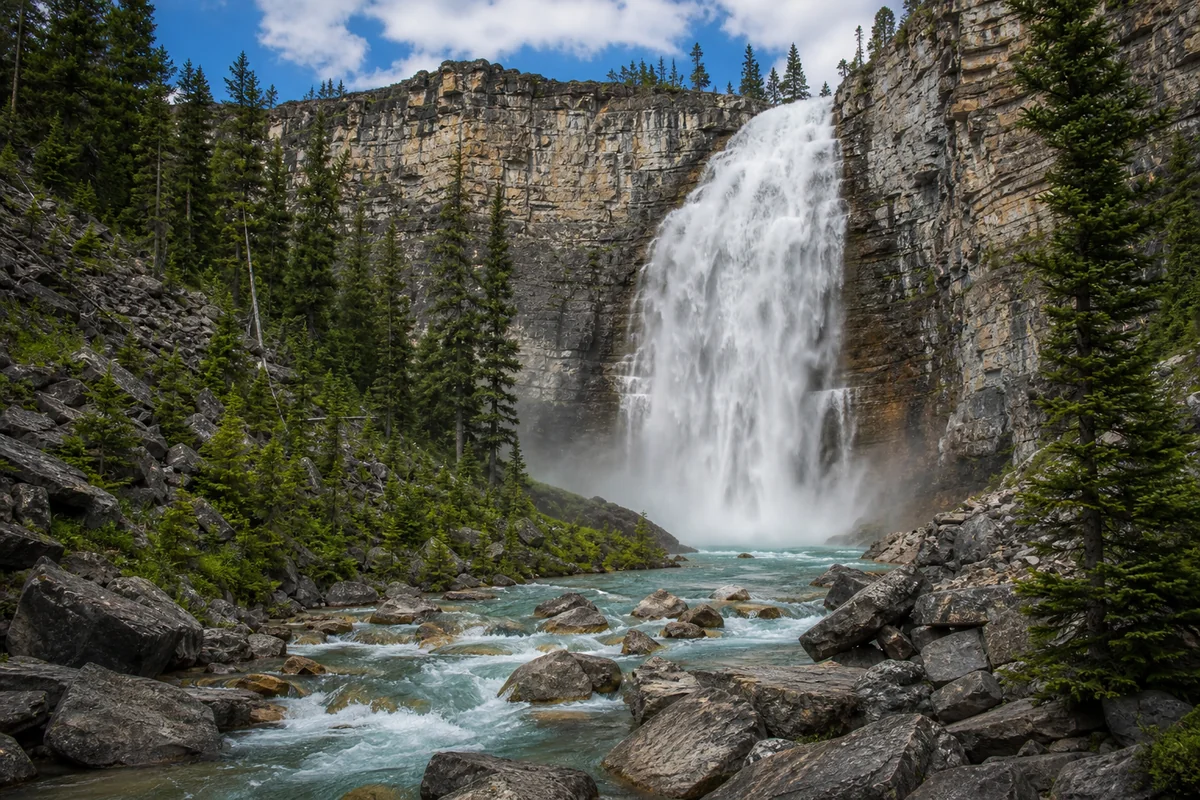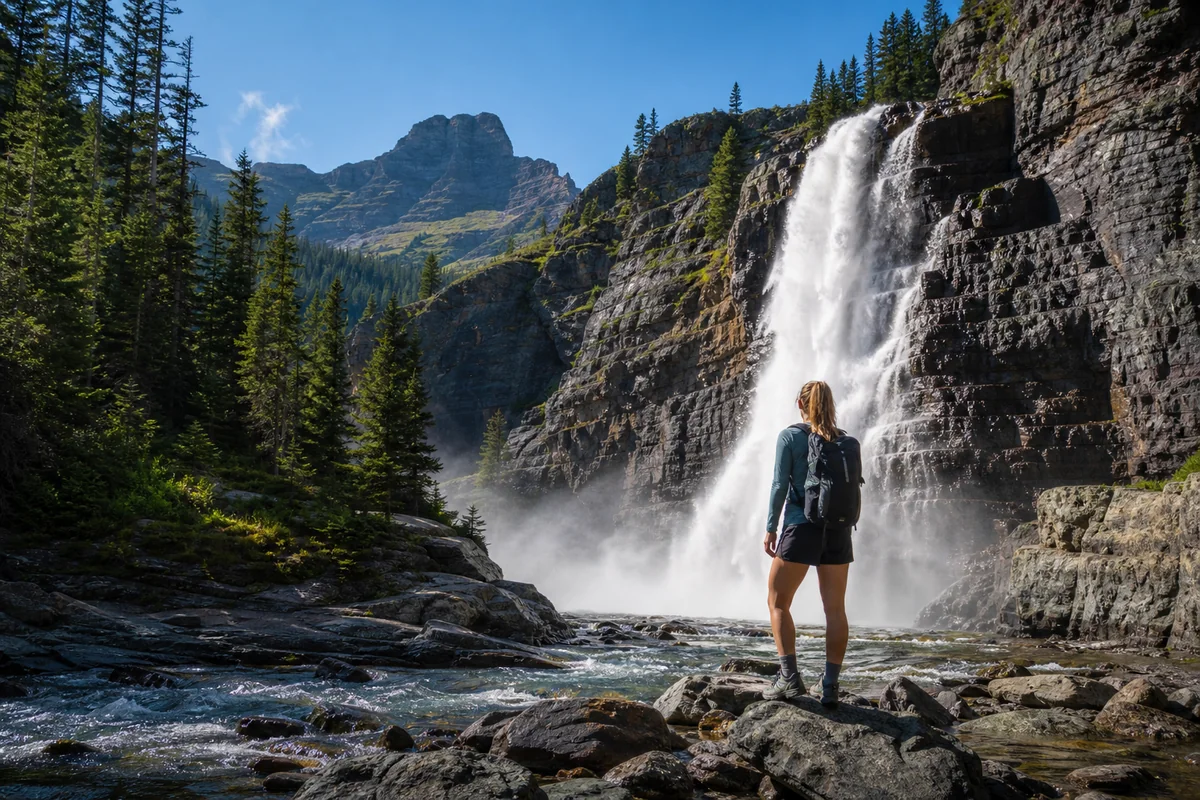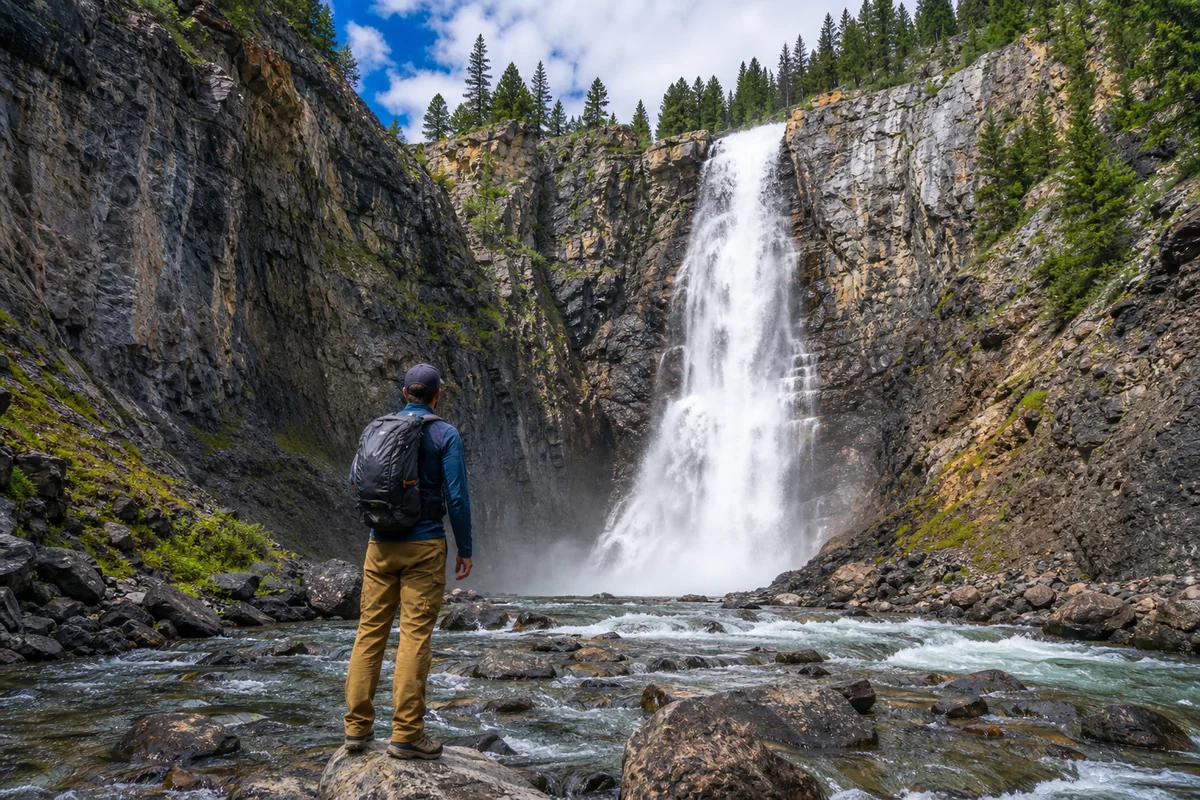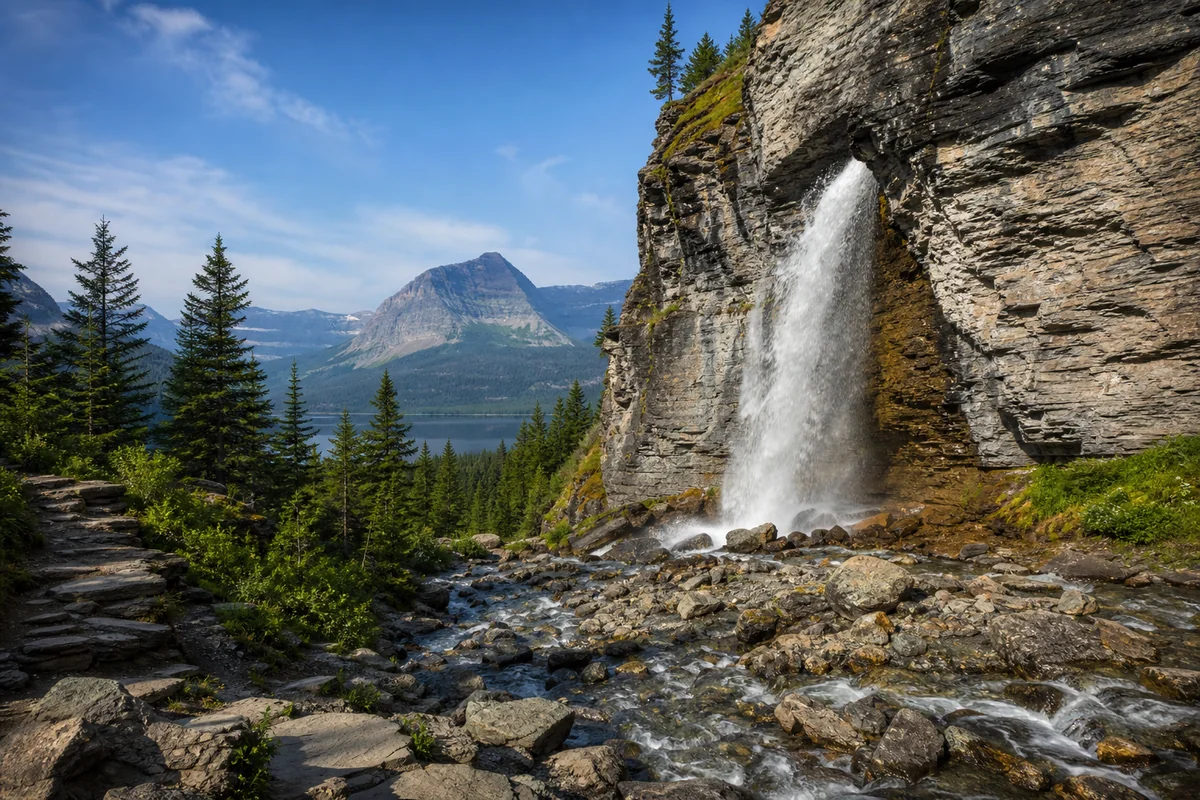
The first time I stood at the base of Running Eagle Falls, I watched water pour directly out of solid rock—a sight so unexpected that I actually laughed out loud in disbelief.
This isn’t your typical Montana waterfall, and that’s precisely what makes it one of the most fascinating stops in Glacier National Park.
Among all the stunning Montana waterfalls I’ve explored over the years, Running Eagle Falls holds a special place for its geological quirk and the powerful story behind its name.
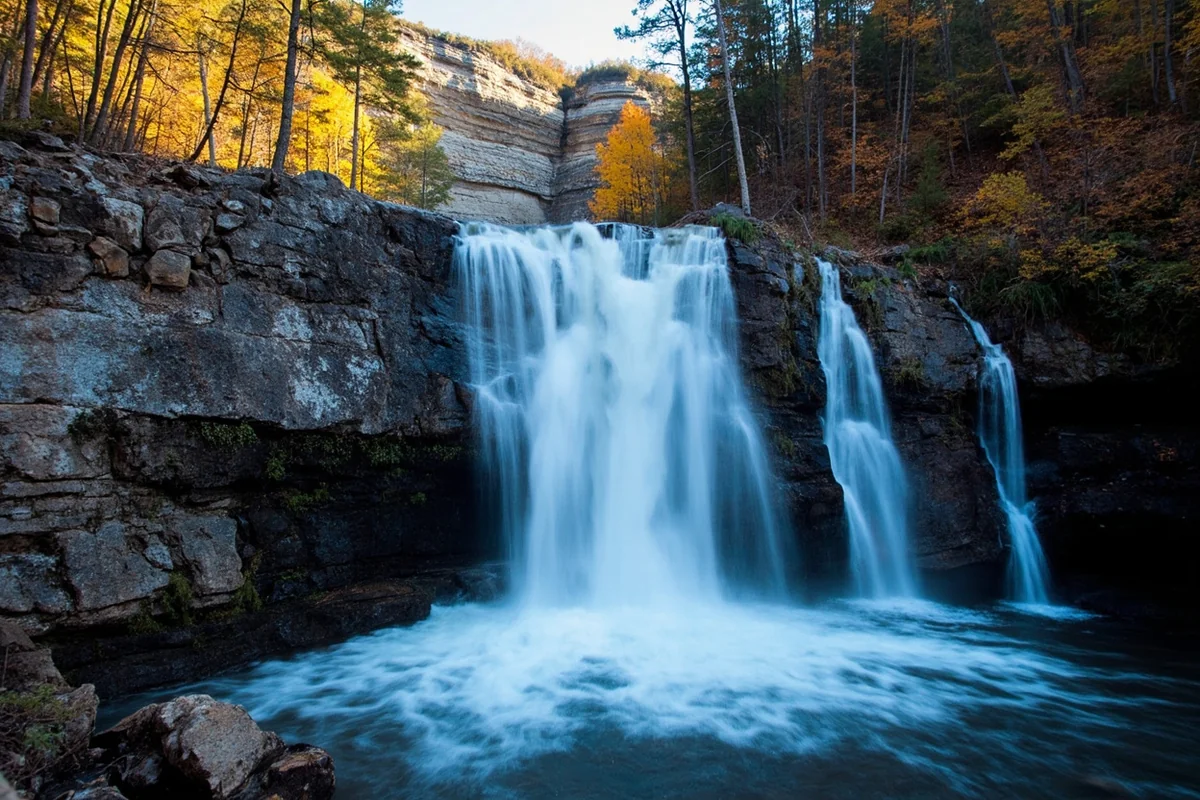
- Running Eagle Falls is a rare “trick falls” that appears to flow from inside a cliff face during low water periods
- The 0.6-mile round-trip trail is flat, accessible, and takes about 20-30 minutes
- Located on the Two Medicine Road in Glacier National Park, about 4 miles from the Two Medicine entrance
- Best visited in early summer (June-July) to see the double waterfall effect, or late summer/fall to witness the underwater spring emergence
- Named after a legendary Blackfeet warrior woman—the history alone is worth the visit
- No special hiking gear needed; the trail is paved and suitable for most visitors
Liked this article?
Add Roaming Montana as a preferred source so you see more of our articles and guides on Google.
What Makes Running Eagle Falls Unlike Any Other Waterfall
During my visit last summer, a park ranger told me something that completely changed how I viewed this waterfall. “Most people think they’re just seeing a pretty cascade,” she said. “But they’re actually witnessing a geological phenomenon that’s incredibly rare in North America.”
Here’s what’s happening: Running Eagle Falls is technically two waterfalls occupying the same space at different times of the year. During high water periods in late spring and early summer, Dry Fork Creek flows over the top of the cliff in a traditional waterfall formation. The cascade drops approximately 40 feet in a powerful rush of snowmelt.
But as water levels drop through summer and into fall, something magical happens. The upper falls slows to a trickle and eventually disappears. Meanwhile, water that has seeped through the porous limestone emerges from an underwater spring partway down the cliff face, creating the illusion that water is pouring directly from solid rock.
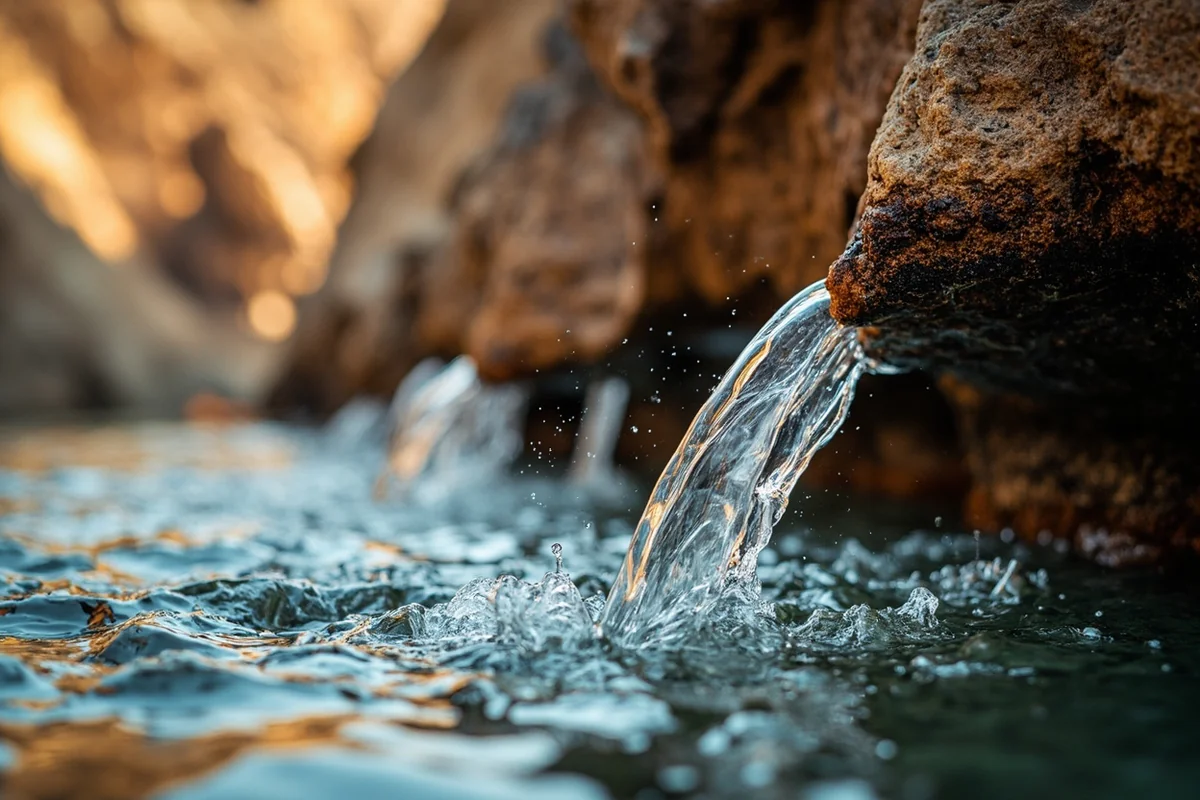
I’ve visited Running Eagle Falls in both conditions, and honestly, I can’t decide which version I prefer. The early summer double cascade is dramatic and photogenic. But there’s something almost mystical about watching water materialize from stone in September.
If you’re chasing waterfalls across the park, you might also enjoy the dramatic Saint Mary Falls on the east side, which offers a completely different experience but equally stunning views.
The Powerful Story Behind the Name
Running Eagle Falls wasn’t always called by this name. Early European visitors knew it as “Trick Falls” for obvious reasons—the water appears to play a trick on your eyes. But the official name honors one of the most remarkable figures in Blackfeet history.
Pitamakan, whose name translates to “Running Eagle,” was a legendary Blackfeet warrior woman who lived in the late 18th and early 19th centuries. After losing her husband in battle, she took up the warrior’s path herself—a virtually unprecedented choice for a woman of her time.
According to Blackfeet oral histories, Running Eagle led numerous successful raiding parties and earned the highest war honors typically reserved for men. She was the only woman in Blackfeet history to receive a man’s name for acts of bravery in battle.
When I learned this story during my first visit, the waterfall took on an entirely different significance. This isn’t just a pretty natural feature—it’s a memorial to a woman who defied every expectation of her era.
The Blackfeet Nation considers the Two Medicine Valley, where Running Eagle Falls is located, to be sacred land. The name “Two Medicine” itself refers to two medicine lodges that were built here during important ceremonies. Knowing this context makes the entire area feel more meaningful.
Getting to Running Eagle Falls: Practical Directions
Running Eagle Falls sits within the Two Medicine region of Glacier National Park, which is often overlooked by visitors focusing on the Going-to-the-Sun Road corridor. That’s actually good news for you—fewer crowds and more authentic wilderness experiences.
| Starting Point | Distance to Trailhead | Drive Time |
|---|---|---|
| East Glacier Park Village | 12 miles | 20 minutes |
| St. Mary Visitor Center | 32 miles | 45 minutes |
| Browning, MT | 32 miles | 40 minutes |
| Kalispell, MT | 90 miles | 2 hours |
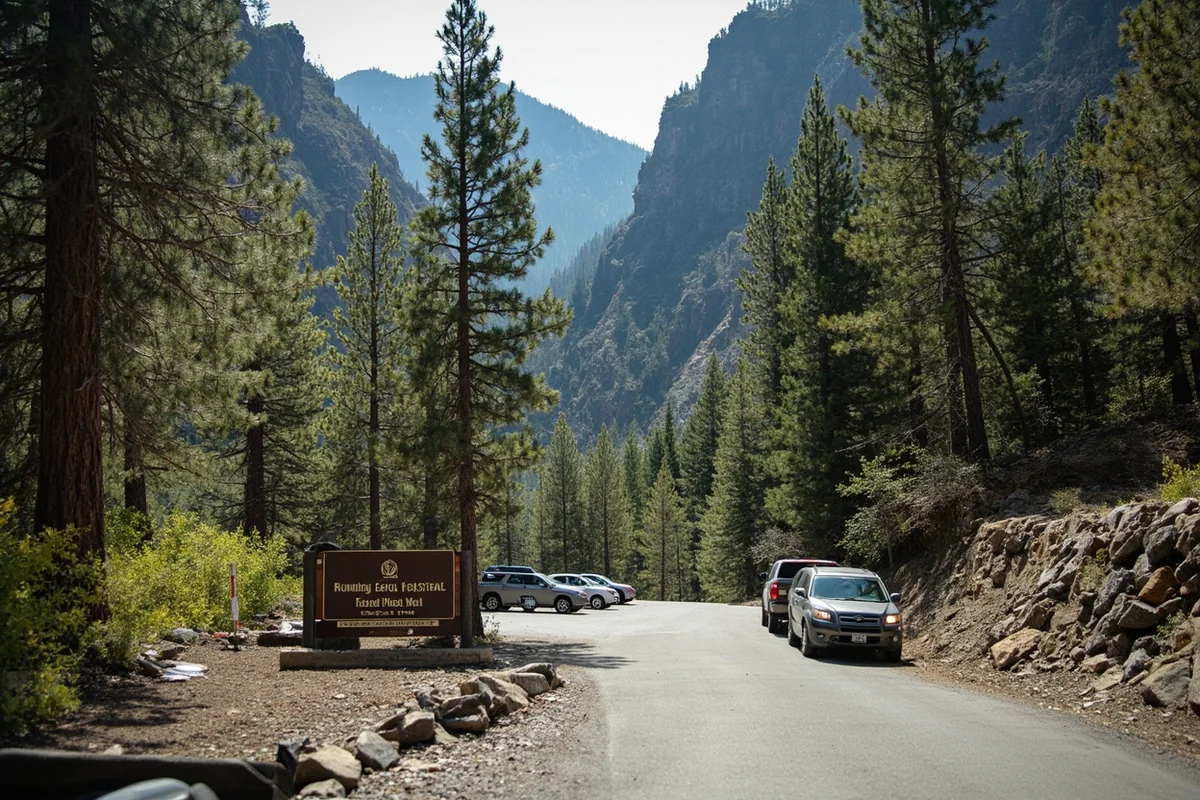
From Highway 2, take Two Medicine Road south into the park. You’ll pass the Two Medicine entrance station where you’ll need to show your park pass or purchase entry. About 4 miles past the entrance, watch for the Running Eagle Falls parking area on your left.
The parking lot accommodates roughly 20-25 vehicles. On a recent trip in late July, I arrived around 9 AM and found plenty of spaces. By 11 AM, the lot was nearly full. My advice: arrive early or late in the day.
The Trail: What to Expect Step by Step
Let me walk you through exactly what you’ll encounter on this trail, because one of my biggest frustrations with other guides is vague descriptions that leave you guessing.
The First 0.1 Miles: Through the Forest
From the parking area, the paved trail immediately enters a beautiful mixed forest of lodgepole pine, subalpine fir, and Engelmann spruce. The path is wide enough for two people to walk side by side comfortably.
Within the first minute of walking, I noticed the temperature drop noticeably. The forest canopy provides welcome shade on hot summer days. The ground is soft with fallen needles, and the scent of pine is everywhere.
The Middle Section: Following the Creek
Around 0.15 miles in, you’ll start hearing Dry Fork Creek before you see it. The trail parallels the water for much of its length, and during my June visit, the rushing sound was almost thunderous from snowmelt.
Watch for interpretive signs along this section. One explains the geology of the area, including how ancient seabeds became the limestone that creates the “trick” effect at the falls. Another discusses the wildlife you might encounter.
Speaking of wildlife, I’ve spotted white-tailed deer near this section on multiple visits. A ranger also warned me about occasional black bear sightings, though I’ve never personally encountered one here. Still, standard bear awareness applies—make noise, carry bear spray, and never approach wildlife.
The Final Approach: Bridge and Viewing Area
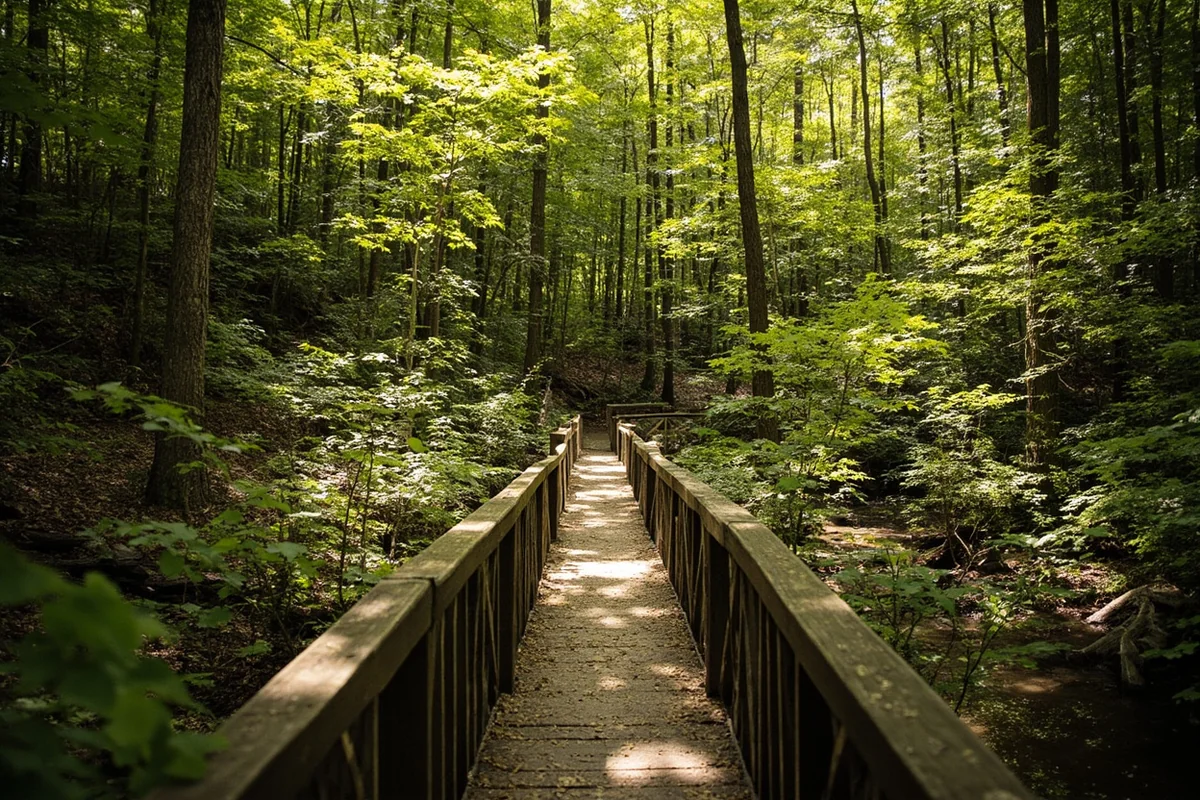
At approximately 0.25 miles, you’ll cross a wooden footbridge over Dry Fork Creek. This bridge offers a great perspective upstream and is worth a moment’s pause.
The trail continues another short distance to the waterfall viewing area. There’s a wooden fence at the end for safety, and you’ll find yourself facing the falls from maybe 50 feet away.
Total hiking time for me: about 12 minutes at a leisurely pace. My hiking partner, who was recovering from knee surgery, completed it in about 20 minutes with frequent rest stops. This truly is one of the most accessible waterfall trails in all of Glacier National Park.
When to Visit: Seasonal Considerations
The timing of your visit dramatically affects what you’ll see at Running Eagle Falls. I’ve photographed this waterfall in three different seasons, and each experience was remarkably different.
Late Spring to Early Summer (Late May through June)
This is prime time to see the full double waterfall effect. Snowmelt from the surrounding peaks swells Dry Fork Creek, sending water cascading over the top of the cliff while the underwater spring simultaneously pushes water from lower in the rock face.
During a mid-June visit, the volume was so intense that mist from the falls reached the viewing platform. I got my camera’s protective cover legitimately wet from 50 feet away. The roar of the water made conversation difficult.
Downsides: Two Medicine Road typically doesn’t open until late May or early June, depending on snow conditions. Check the park’s website before making the drive.
Mid to Late Summer (July through August)
As water levels drop, you’ll witness the transition phase. The upper falls begins to weaken, and the lower spring flow becomes more prominent. By late August, you might see just a trickle over the top cliff with most water emerging from the rock face.
This is also peak tourist season, so expect more company on the trail. However, the Two Medicine area remains less crowded than Logan Pass or Many Glacier.
Early Fall (September through Early October)
For the pure “trick falls” experience—water appearing to emerge from solid rock—visit in early autumn. By this time, the upper falls may be completely dry, leaving only the mysterious spring flow.
I captured some of my favorite photographs in late September when golden larch needles lined the trail and the falls had that ethereal spring-fed quality. Fewer visitors mean you might have the viewing area entirely to yourself.
Time of Day Matters Too
The falls face roughly east-southeast. In my experience, late morning (around 10 AM to noon) provides the best lighting for photography. Early morning visits put the falls in shadow, while late afternoon can create harsh contrast.
That said, I’ve enjoyed overcast days here too. The soft light brings out subtle colors in the rock face that get washed out in direct sun.
Photography Tips From My Experiences
Over multiple visits, I’ve refined my approach to photographing Running Eagle Falls. Here’s what works:
- Bring a polarizing filter: The wet rocks and water create significant glare. A polarizer cuts through this and reveals the true colors of the limestone.
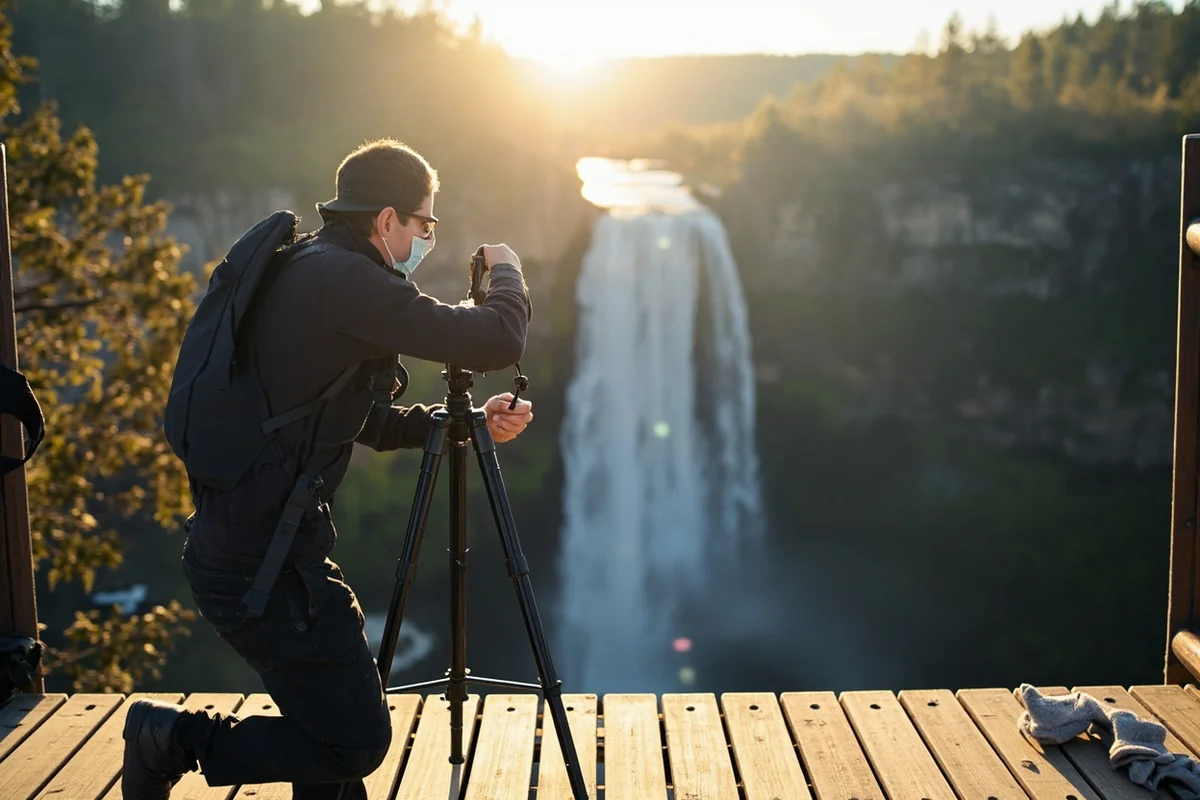
- Use a tripod for long exposures: That silky water effect requires shutter speeds around 1/4 second or longer. The viewing platform is stable enough for tripod use.
- Include the surrounding cliff face: The waterfall looks most impressive when you show the scale of the rock formation around it.
- Move around the viewing area: The fence line offers several different angles. I prefer the far left corner, which shows more of the lower rock face where water emerges.
- Don’t forget vertical compositions: The falls suit portrait orientation well, especially during high water when the cascade is tall and dramatic.
Combining Running Eagle Falls With Other Two Medicine Attractions
Running Eagle Falls takes maybe 30-45 minutes for a complete visit, including photography time. That leaves most of your day free for other Two Medicine area adventures. Here’s how I typically structure a day here:
Morning: Running Eagle Falls
Arrive at the trailhead around 8:30 AM, right as the light improves. Complete the waterfall visit by 9:30 AM.
Mid-Morning to Afternoon: Boat Tour and Upper Two Medicine Lake
The historic boat tour on Two Medicine Lake is one of Glacier’s hidden gems. The Sinopah boat has been operating since 1927, and the ride offers spectacular views of Rising Wolf Mountain and other peaks. The boat drops you at the head of the lake, from where you can hike to Twin Falls or Upper Two Medicine Lake.
Alternative: Appistoki Falls Hike
If you want another waterfall fix, the trail to Appistoki Falls begins at the same parking area as the Two Medicine boat dock. It’s a 1.2-mile round trip with about 200 feet of elevation gain. I’ve combined this with Running Eagle Falls for a “two waterfalls in one morning” itinerary.
Evening: Pray Lake and Sunset
Pray Lake, just off the main road before you reach the Running Eagle Falls parking area, offers incredible sunset possibilities. The lake reflects Rising Wolf Mountain perfectly in calm conditions.
For waterfall enthusiasts exploring other regions of Montana, the Morrell Falls near Seeley Lake provides a great contrast—a much longer hike but equally rewarding views.
Accessibility and Who Can Enjoy This Trail
Running Eagle Falls is officially classified as an accessible trail, and from my observation, that designation is accurate. The paved surface is smooth and free of significant obstacles. The grade never exceeds 5%, which meets ADA accessibility standards.
During my last visit, I watched families with strollers, visitors using wheelchairs, and elderly hikers with walking canes all complete the trail without apparent difficulty. The viewing area at the end has enough space for wheelchair access, though it can get crowded during peak hours.
That said, I should mention a few considerations:
- The pavement does have some minor cracks and uneven sections after winter damage
- No restrooms exist at the trailhead (the nearest facilities are at the Two Medicine campground)
- Benches along the trail are limited—I counted just two on my last visit
- The viewing area has a gravel surface, which may be slightly more challenging for wheelchair users
For visitors who struggle with longer hikes, Running Eagle Falls offers a genuine wilderness waterfall experience without the typical physical demands. It’s one of the few places in Glacier where someone with mobility limitations can stand before a thundering cascade and feel fully immersed in the park’s grandeur.
Wildlife You Might Encounter
The Two Medicine Valley supports abundant wildlife, and even a short walk to Running Eagle Falls offers potential sightings.
On my visits, I’ve personally seen:
- White-tailed deer (most common, often grazing near the parking area at dawn)
- Columbia ground squirrels (constantly scurrying across the trail)
- Clark’s nutcrackers (noisy gray birds collecting pine seeds)
- Various woodpecker species drumming in the forest
Other visitors have reported black bears, moose, and mountain goats in the broader Two Medicine area, though not typically on this short trail. The ranger I spoke with recommended driving slowly on Two Medicine Road for the best wildlife viewing opportunities.
Bear spray is always recommended in Glacier National Park, even on short trails. I carry mine on every hike, no exceptions.
What to Bring: A Practical Packing List
Because the Running Eagle Falls trail is so short and accessible, you don’t need extensive gear. However, I’ve learned from experience that a few items significantly improve the visit:
- Camera or smartphone: The falls are incredibly photogenic
- Polarized sunglasses: Cuts the glare from wet rocks and water
- Light jacket: The falls create mist and the forest canopy keeps temperatures cool
- Water bottle: Even short hikes benefit from hydration
- Bear spray: Standard equipment for any Glacier trail
- Snacks: Not necessary for the short walk, but nice if you’re combining with other activities
- Binoculars: Great for spotting birds and distant wildlife
What you don’t need: hiking boots (regular walking shoes are fine), trekking poles, backpacks with frame systems, or any technical gear.
Nearby Dining and Services
The Two Medicine area is more remote than other Glacier access points, which means limited immediate services. Here’s what I’ve found:
The Two Medicine Campstore, located at the campground about 2 miles past Running Eagle Falls, offers basic snacks, drinks, and souvenirs. Their huckleberry ice cream is legitimately delicious—I make a point to stop on every visit.
For actual meals, East Glacier Park Village (about 20 minutes east) has several restaurants. Two Medicine Grill serves solid American comfort food. The Whistle Stop is more upscale but worth it for their bison dishes. Serrano’s offers Mexican cuisine that’s surprisingly good for a town of 300 people.
Accommodations in the immediate area include the historic Glacier Park Lodge in East Glacier, the Two Medicine Campground for tent and RV camping, and various vacation rentals in the surrounding communities.
Comparing Running Eagle Falls to Other Glacier Waterfalls
Having spent considerable time exploring Glacier’s waterfalls, I can offer some comparisons that might help you prioritize your visits.
Running Eagle Falls vs. St. Mary Falls
Both are east-side waterfalls, but they differ significantly. St. Mary Falls requires a 1.7-mile hike from the trailhead (3.4 miles round trip), while Running Eagle is just 0.6 miles total. St. Mary has more volume and a more classic “postcard waterfall” appearance. Running Eagle has the unique geological story. I recommend both if time allows.
Running Eagle Falls vs. Virginia Falls
Virginia Falls is often combined with St. Mary Falls on a single hike (4.2 miles round trip total). Virginia is taller and more dramatic. Running Eagle is more accessible and has the mysterious “trick” element. If you can only do one, I lean toward Running Eagle for its uniqueness, but Virginia is stunning.
Running Eagle Falls vs. McDonald Falls
McDonald Falls on the west side of the park is a roadside waterfall requiring almost no walking. Running Eagle requires slightly more effort but rewards you with a more intimate experience and far fewer crowds.
If you’re specifically interested in waterfalls within Glacier, the Ptarmigan Falls offers another excellent option on the east side, while Redrock Falls provides dramatic scenery in the Many Glacier area.
Common Mistakes to Avoid
After multiple visits and conversations with other hikers, I’ve compiled a list of common errors that diminish the Running Eagle Falls experience:
Arriving Without Checking Road Conditions
Two Medicine Road closes seasonally, typically from late October through late May. I’ve encountered disappointed visitors in the park who didn’t check ahead. Always verify road status before driving out.
Rushing Through
Yes, the trail is only 0.3 miles each way. But that doesn’t mean you should speed walk to the falls, snap one photo, and leave. Take time to read the interpretive signs. Watch the water patterns for several minutes. Look for wildlife. Absorb the atmosphere.
Skipping the Research on the Dual Waterfall Phenomenon
Understanding what makes Running Eagle Falls geologically special enhances the experience exponentially. Don’t just see it—understand what you’re seeing.
Forgetting About Other Two Medicine Attractions
Running Eagle Falls alone doesn’t justify a visit to this remote corner of the park. Plan to spend at least half a day exploring the broader Two Medicine area.
Not Bringing Bear Spray
Even on short, heavily trafficked trails, bears occasionally appear. Being unprepared isn’t worth the risk.
Historical Context: How Running Eagle Falls Has Changed
While researching this waterfall, I found historical photographs from the early 1900s that show Running Eagle Falls looking remarkably similar to today. The fundamental geology hasn’t changed, and the waterfall continues its seasonal dance between upper cascade and spring-fed flow.
What has changed is accessibility. The paved trail we enjoy today was installed in the 1970s as part of an effort to make certain park features more available to visitors with mobility challenges. Before that, a rough path required more effort.
The Blackfeet people, of course, knew this waterfall long before any European explorer arrived. Their connection to the Two Medicine Valley spans thousands of years, and Running Eagle Falls was certainly significant to them before it ever received its current name.
Today, the waterfall serves as both a natural attraction and a living memorial to Pitamakan, ensuring her remarkable story continues reaching new generations of visitors.
My Personal Verdict: Is Running Eagle Falls Worth Your Time?
After everything I’ve shared, let me give you my honest assessment.
Running Eagle Falls absolutely deserves a visit, but perhaps not as a standalone destination. If you’re only passing through the area briefly with time for just one activity, the full Two Medicine Lake experience (boat tour plus short hike) might provide more overall value.
However, if you have half a day or more for the Two Medicine area, Running Eagle Falls should be on your list. The ease of access, the geological uniqueness, and the powerful historical significance make it special.
For waterfall enthusiasts specifically chasing Montana cascades, Running Eagle Falls offers something genuinely different from the classic plunge waterfalls you’ll find elsewhere. That “trick” effect—water emerging from solid rock—simply doesn’t exist at most other falls.
I also appreciate that Running Eagle Falls remains relatively uncrowded compared to attractions along the Going-to-the-Sun Road. Even during my July visits, I’ve had moments of solitude at the viewing platform.
If you’re building a broader Montana waterfall trip, consider combining this with other accessible options like Memorial Falls near Great Falls or Kootenai Falls in the northwest corner of the state. Each offers a completely different character and experience.
For more challenging waterfall hikes, Ousel Falls near Big Sky and Holland Falls in the Swan Valley provide excellent backcountry experiences.
Final Practical Tips Before You Go
Let me leave you with a few last pieces of advice based on my cumulative experience:
- Download the Glacier National Park app for offline maps and updated information
- The nearest gas stations are in East Glacier Park Village or Browning—don’t arrive with an empty tank
- Cell service is extremely limited in the Two Medicine area; plan accordingly
- The park entrance fee is $35 per vehicle (as of my last visit) and valid for 7 days
- America the Beautiful passes are accepted and represent excellent value if you visit multiple federal lands
- Consider visiting on weekdays for smaller crowds
Running Eagle Falls rewards those who approach it with curiosity and patience. Take time to understand the geology, honor the history, and simply stand in the presence of this remarkable natural phenomenon.
The water has been finding its way through that limestone cliff for thousands of years, emerging mysteriously from stone as if by magic. When you stand there watching, you become part of that timeless audience, connected to everyone who has marveled at this spot before you—including the legendary warrior woman whose name the falls now carries.
Frequently Asked Questions
How long is the hike to Running Eagle Falls in Glacier National Park?
The Running Eagle Falls trail is an easy 0.6-mile round trip hike that takes most visitors about 20-30 minutes to complete. The paved, wheelchair-accessible path makes it one of the most family-friendly waterfall hikes in Glacier National Park, perfect if you’re traveling with kids or limited on time.
Why is Running Eagle Falls also called Trick Falls?
Running Eagle Falls earned the nickname ‘Trick Falls’ because it changes appearance depending on the season. During spring runoff and high water, a powerful upper falls cascades over the cliff, but in late summer when water levels drop, the upper falls disappears and water flows only through a hidden cave opening in the rock face below.
What is the best time of year to visit Running Eagle Falls Montana?
I recommend visiting Running Eagle Falls in late May through early July when snowmelt creates the most dramatic double waterfall effect. If you visit in August or September, you’ll see the unique ‘trick’ version where water emerges from the cave, which is equally fascinating but less powerful.
Do I need a park entrance pass or reservation to see Running Eagle Falls?
Yes, you’ll need a Glacier National Park entrance pass which costs $35 per vehicle for a 7-day pass or $80 for an annual pass. Running Eagle Falls is located in the Two Medicine area, which typically doesn’t require the additional vehicle reservation that Going-to-the-Sun Road needs during peak summer months.
How do I get to Running Eagle Falls trailhead from East Glacier?
From East Glacier, drive north on Highway 49 for about 4 miles, then turn left onto Two Medicine Road and continue approximately 7 miles to the trailhead. The total drive takes around 20-25 minutes, and you’ll find a well-marked parking area on the left side of the road before reaching Two Medicine Lake.
Is Running Eagle Falls worth visiting compared to other Glacier National Park waterfalls?
Running Eagle Falls is absolutely worth the stop, especially because of its unique geological feature and minimal hiking effort required. While it’s not as tall as some Glacier waterfalls, the short accessible trail and fascinating seasonal transformation make it an ideal addition to your Two Medicine Valley itinerary alongside spots like Aster Falls or Appistoki Falls.
What should I bring for the Running Eagle Falls hike?
Pack bear spray since you’re in grizzly country, even for this short hike. I also recommend bringing a camera with good zoom capabilities, water shoes if you want to explore the rocky creek bed, and layers since the Two Medicine area can be 10-15 degrees cooler than surrounding valleys.
Sources: