There are exactly two ways to reach Ekalaka, Montana.
You can drive south from Baker on Montana Highway 7 for 35 miles. Or you can drive north from the Wyoming border on the same road.
Either way, you’ve made a deliberate choice. Ekalaka is the southern terminus of Highway 7 — beyond it, the pavement stops. Nobody passes through Carter County on the way to somewhere else.
That’s the whole point.
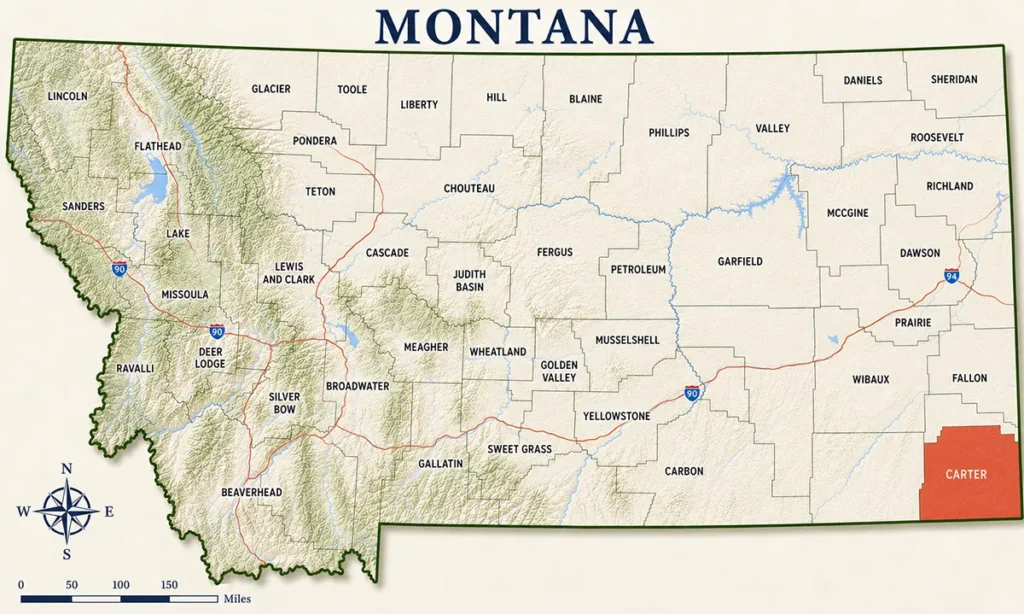
- Carter County covers 3,340 square miles in Montana’s extreme southeast corner, bordering South Dakota and Wyoming
- Population is around 1,382 — one of the most sparsely populated counties in the United States
- The county seat is Ekalaka (~400–450), Montana’s most isolated county seat — 35 miles from the nearest town, 160+ miles from Billings
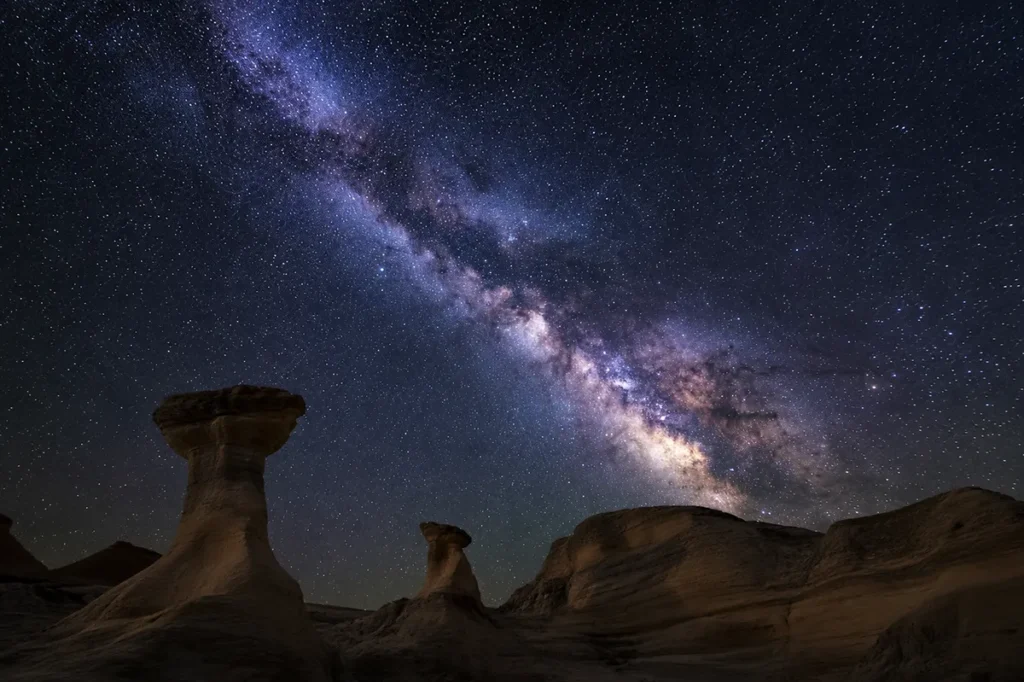
- Medicine Rocks State Park — 330 acres of 80-foot sandstone formations, petroglyphs, and ponderosa pine; an International Dark Sky Sanctuary; praised by Teddy Roosevelt in the 1880s
- Carter County Museum — Montana’s first county museum (1936) and first to display dinosaur fossils; houses complete Triceratops and Anatosaurus skeletons
- The Annual Dino Shindig in late July is named Montana’s Event of the Year and draws paleontologists from around the world
- The Long Pines unit of Custer Gallatin National Forest offers rare ponderosa pine hiking east of Ekalaka
- The Church of Hank Williams is one of Montana’s most genuinely unusual local institutions — open to the public, unique to Carter County
- ⚠️ Cell service is essentially nonexistent throughout most of the county — download everything before leaving Baker
- ⚠️ Fill your tank in Baker — no guaranteed fuel between Baker and Ekalaka, and none south of Ekalaka
Liked this article?
Add Roaming Montana as a preferred source so you see more of our articles and guides on Google.
Carter County at a Glance
Carter County was established in 1917, carved from the eastern portion of Custer County.
It’s named for Thomas Henry Carter — a Montana territorial delegate, U.S. Senator, and Postmaster General in the late 1800s and early 1900s.
The county sits in Montana’s extreme southeast corner. Terrain is classic shortgrass prairie and eroded badlands, broken by occasional pine-covered ridges and the dramatic sandstone formations at Medicine Rocks.
Seventy-five million years ago this region was a shallow inland sea. That’s why the Carter County badlands have produced some of the best-preserved dinosaur fossils in the American West.
Today the county runs almost entirely on cattle ranching and oil pipeline infrastructure. The pipeline revenue contributes over 90% of the county’s tax base — the primary reason such a small population can sustain county government services.
Population density is roughly one person per 2.4 square miles.
For broader Montana context, see the complete guide to all 56 Montana counties.
The Logistics of Getting Here
This section matters more for Carter County than almost anywhere in Montana.
From Baker: Head south on Montana Highway 7 for 35 miles to Ekalaka. Baker has gas, food, and lodging — fill up here before leaving.
From Miles City: Take US-12 east to Baker (~75 miles), then Highway 7 south (~35 miles). Total roughly 110 miles, about 1.5–2 hours.
From Billings: I-90 east to US-212 east to Baker, then Highway 7 south. Roughly 160 miles, 2.5–3 hours.
Fuel situation: Baker is the last guaranteed fuel stop heading south. Ekalaka has fuel [verify current hours before relying on it]. There is no fuel south of Ekalaka before Wyoming.
Cell service: Essentially nonexistent from Baker south. Download offline maps, save contacts, and tell someone your itinerary before leaving Baker.
Road conditions: Highway 7 is paved and well-maintained normally. The internal dirt road at Medicine Rocks State Park can become impassable in rain — check weather before entering.
Medicine Rocks State Park
Medicine Rocks was a place of “big medicine” where Plains Indian hunting parties conjured spiritual power.
The Lakota called it Inyan oka-lo-ka — “Rock with a Hole in it.” Sioux, Arikara, Cheyenne, and Crow peoples all used this site as a gathering place, spiritual landmark, and medicine ground for centuries.
The sandstone formations are unlike anything else in Montana.
Weathering has carved the soft rock into Swiss-cheese pillars, arches, tunnels, and spires — some reaching 80 feet above the prairie floor. Walking between them feels genuinely enclosed, which is disorienting in the middle of open plains.
Theodore Roosevelt, working as a rancher in the region in the 1880s, called it “as fantastically beautiful a place as I have ever seen.”
What to know before you visit:
The park covers 330 acres and sits 14 miles north of Ekalaka on Highway 7. Open year-round, 7 a.m. to 10 p.m.
The main hiking trail is a 0.75-mile loop — short, but slow. The formations demand stopping every 50 feet. I’ve taken 90 minutes on a trail that should take 20.
Look closely at the rock faces for petroglyphs, pictographs, and tipi ring remnants. The surfaces also hold carved initials and dates from settlers, cattle drivers, and travelers going back to the 1800s. The Carter County Museum in Ekalaka maintains a complete list of recorded inscriptions.
Twelve primitive campsites are available first-come, first-served. Vault toilets, water pumps, picnic tables, and grills are on-site. Pack in, pack out — no trash collection.
Wildlife includes mule deer, pronghorn antelope, sharp-tailed grouse, and Woodhouse’s toad — a species that reaches the northern edge of its range here.
Dark Sky Sanctuary: Medicine Rocks holds an official International Dark Sky Sanctuary designation. On a clear, moonless night, the Milky Way is a physical band of light overhead. The park hosts regular summer stargazing events including the “Dinosaurs & Dark Skies” program. See Montana night sky for broader stargazing context.
[Verify current entry fees at stateparks.mt.gov]
Carter County Museum
The Carter County Museum in Ekalaka is the most significant paleontology museum in eastern Montana that most people have never visited.
Founded in 1936, it was the first county museum in Montana. It was also the first museum in the state to display dinosaur fossils.
The fossil collection is the centerpiece. Complete and partial skeletons include a Triceratops and an Anatosaurus (a duck-billed hadrosaur) — both excavated from the Carter County badlands.
The surrounding badlands continue to produce discoveries. Seventy-five million years ago the shallow inland sea here created ideal conditions for fossil preservation, and the erosion cycle keeps exposing new material.
The museum also houses Native American artifacts, pioneer-era items, and materials documenting Carter County’s settlement history.
Museum curator Dr. Nathan Carroll has deep expertise in the county’s paleontological record. If you’re visiting around the Dino Shindig, the museum is the organizational hub for all events.
[Verify current museum hours and admission at cartercountymt.com]
The Annual Dino Shindig
The Dino Shindig is Carter County’s biggest moment of the year — and has been named Montana’s Event of the Year by the state’s Office of Tourism.
It runs several days in late July, centered in Ekalaka.
The event brings leading paleontologists for public lectures, hands-on fossil-sorting activities, and guided digs in the surrounding badlands. Adults and families both participate — dedicated kids’ programs run alongside the professional scientific content.
In the evenings, Ekalaka turns into something genuinely surprising. Cowboys and paleontologists share the same bar. Rodeo and science occupy the same town on the same day.
The “Dinosaurs & Dark Skies” event at Medicine Rocks coincides with the Shindig each year — extending the programming into the park for evening stargazing and geology walks.
Logistics:
Lodging in Ekalaka is extremely limited. Most Shindig visitors book in Baker (35 miles north) and commute daily. Book Baker accommodations early — they fill during Shindig week.
Register for dig days early. Participation slots fill. [Verify current registration details and ticket prices at cartercountymt.com]
The Long Pines: Custer Gallatin National Forest
Most visitors to Carter County focus entirely on Medicine Rocks and the museum.
The Long Pines unit of the Custer Gallatin National Forest, east of Ekalaka near the South Dakota border, offers something different — a genuine ponderosa pine forest rising from the surrounding plains.
The Long Pines look anomalous from a distance, like a dark ridge materializing from shortgrass country. Up close, the forest has the character of the Black Hills — ponderosa pine on the ridges, ponderosa and juniper in the draws, prairie openings with long views.
The unit has hiking, dispersed camping on adjacent BLM land, and quality mule deer and elk hunting. Roads into the Long Pines east of Ekalaka vary in condition — high clearance is helpful. [Verify current access with the Sioux Ranger District before your trip.]
Few travelers outside hunting communities know the Long Pines exist. That’s your advantage.
Church of Hank Williams
The Church of Hank Williams in Ekalaka is one of Montana’s most genuinely local experiences.
It’s housed in a former auto repair shop. The congregation revolves around country music, cold beer, and a non-denominational spiritual outlook that is specific to Ekalaka and cannot be replicated anywhere else.
The church hosts weddings and funerals. It has a beer-crushing system that processes thousands of cans quarterly. It is open to the public.
I’ll leave the finer details for you to discover in person. But know this: it exists, it’s real, and it is the kind of institution that only grows in a place as isolated and self-reliant as Carter County.
If you’re the kind of traveler who comes to Montana for the unexpected, put this on your list.
Ekalaka: The County Seat
Ekalaka has a population of roughly 400–450 and is the most isolated county seat in Montana.
The town was founded in 1885 by David Harrison Russell, a hide trader who settled near a spring in the Russell Creek Valley. He named the town for his wife Ijkalaka — an Oglala Lakota woman and niece of Chief Red Cloud.
Her name means “Restless” or “Moving About” in Lakota. Russell married her in 1874 at Fort Laramie. The original settlement was known as “Puptown” — a reference to coyotes that gathered around the camp.
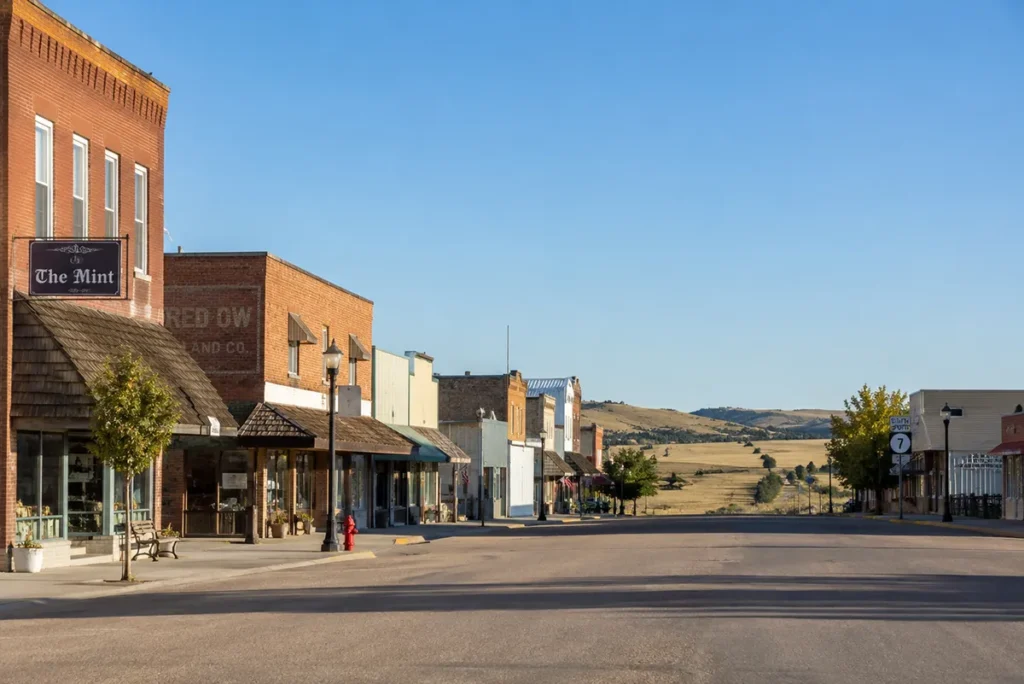
Today Ekalaka has a school, a post office, a bar, a gas station [verify hours], a small grocery, and the Carter County Museum. That is the full commercial inventory.
The town also has Camp Needmore — a restored Civilian Conservation Corps camp from the 1930s, available for group use and events. [Verify current access through Carter County.]
For the full Ekalaka visitor guide, see Ekalaka, Montana.
Wildlife and Hunting
Carter County is one of Montana’s most productive hunting destinations for those willing to make the drive.
The combination of vast BLM land, the Long Pines forest unit, shortgrass prairie, and eroded badland draws creates exceptional habitat for mule deer, pronghorn antelope, and elk.
Mule deer are particularly abundant. The mix of pine ridges and prairie edges in the Long Pines produces large bucks consistently. Pronghorn populations are high across the open county prairie.
Non-hunters find good wildlife viewing throughout the county. Pronghorn are visible from the highway almost any time. Mule deer move at dawn and dusk near the park and forest edges. Sharp-tailed grouse are active in the meadows near Medicine Rocks in spring.
Check current BLM unit boundaries and licensing requirements through Montana Fish, Wildlife & Parks at fwp.mt.gov before your trip.
What I Wish I Knew Before Visiting Carter County
Plan for self-sufficiency. Carry water, food, a physical map, and more fuel than you think you need. This is standard operating procedure for remote Montana — not alarmism.
Budget a half-day minimum for the museum. I planned an hour my first visit and stayed three. The paleontology collection is extraordinary and the staff knows the material deeply. Don’t rush it.
Medicine Rocks is better in morning or late afternoon. Midday flattens the Swiss-cheese texture that makes the formations so dramatic. Morning light on the east-facing pillars is exceptional.
The Dark Sky designation is serious. On a clear, moonless night at Medicine Rocks, you’ll see more stars than almost anywhere in the lower 48. Plan to be outside well after dark if you camp here.
Book Dino Shindig accommodations in Baker, not Ekalaka. Ekalaka’s lodging fills completely during the Shindig. Baker has a better range of options and is only 35 miles away.
The drive south on Highway 7 is part of the experience. Stop the car between Baker and Ekalaka. Get out. Look at the horizon in every direction. There is nothing blocking the view for 30–50 miles. That feeling exists very few places anymore.
The Church of Hank Williams is not a tourist trap. It’s locally real and locally serious. Approach it with genuine curiosity, not ironic detachment.
Practical Info
| County seat | Ekalaka |
| Area | 3,340 sq mi |
| Population | ~1,382 (2022 est.) |
| Tourism region | Southeast Montana |
| Formed | 1917 |
| Main highway | Montana Highway 7 (north-south) |
| Medicine Rocks | 14 miles north of Ekalaka / 25 miles south of Baker on Hwy 7 |
| Park hours | Year-round, 7 a.m.–10 p.m. |
| Carter County Museum | Downtown Ekalaka [verify hours at cartercountymt.com] |
| Dino Shindig | Late July annually [verify at cartercountymt.com] |
| Last reliable fuel | Baker, 35 miles north of Ekalaka |
| Nearest city | Miles City (~110 miles via Baker) |
| Nearest major airport | Billings Logan International (BIL) — ~160 miles |
| Cell service | Essentially none south of Baker |
| Camping | Medicine Rocks — 12 primitive sites, first-come, first-served |
| Best season | May–October; late July for Dino Shindig; fall for hunting |
Getting to Carter County
From Miles City: US-12 east to Baker (~75 miles), then Highway 7 south to Ekalaka (~35 miles). Allow 1.5–2 hours.
From Billings: I-90 east to US-212 east to Baker, then Highway 7 south. Roughly 160 miles, 2.5–3 hours.
From Rapid City, SD: US-212 west through Belle Fourche and Hammond into Baker. Roughly 150 miles to Ekalaka. Allow 2.5 hours.
By air: Billings Logan International (BIL) has regular commercial service. Rental car is essential — there is no public transportation to Carter County.
See Montana airports and Montana transportation guide.
Towns in Carter County
- Ekalaka — county seat; Carter County Museum, Church of Hank Williams, Medicine Rocks access
- Alzada — tiny community near the Wyoming border on US-212; fuel [verify availability]
Adjacent Counties
- Fallon County to the north — Baker, primary services hub for Carter County visitors
- Powder River County to the west — Broadus
- Custer County to the northwest — Miles City
- Harding County, South Dakota to the east
- Crook County, Wyoming to the south
Plan Your Carter County Trip
Carter County is not for every traveler — and that is exactly right.
If you want proximity to airports, chain restaurants, and reliable connectivity, this is not your county.
If you want to stand at the base of 80-foot sandstone formations that Plains Indians considered sacred medicine ground — Carter County delivers.
If you want to dig through badlands sediment for dinosaur bone fragments with a real paleontologist guiding your technique, sleep under some of the darkest skies in the country, and eat breakfast in a county seat of 400 people that still feels like the frontier — this is the only place in Montana that gives you all of that.
Plan two full days minimum: one for Medicine Rocks including an evening for stargazing, one for the Carter County Museum and surrounding badlands. Add a third day if you’re attending the Dino Shindig or exploring the Long Pines.
For broader context, see Montana history and key historical events in Montana.
For trip logistics, see Montana trip planning guide and best time to visit Montana. Back to the complete Montana counties guide.