I’ve driven the Beartooth Highway from both ends, in both directions, in three different seasons.
It’s still the best road I’ve ever been on in North America.
But Carbon County is not just the Beartooth. It’s a county with deep mining scars, genuine immigrant history, a nationally significant Native American artist, and a ski hill that skiers describe the way food people talk about a restaurant nobody else knows yet.
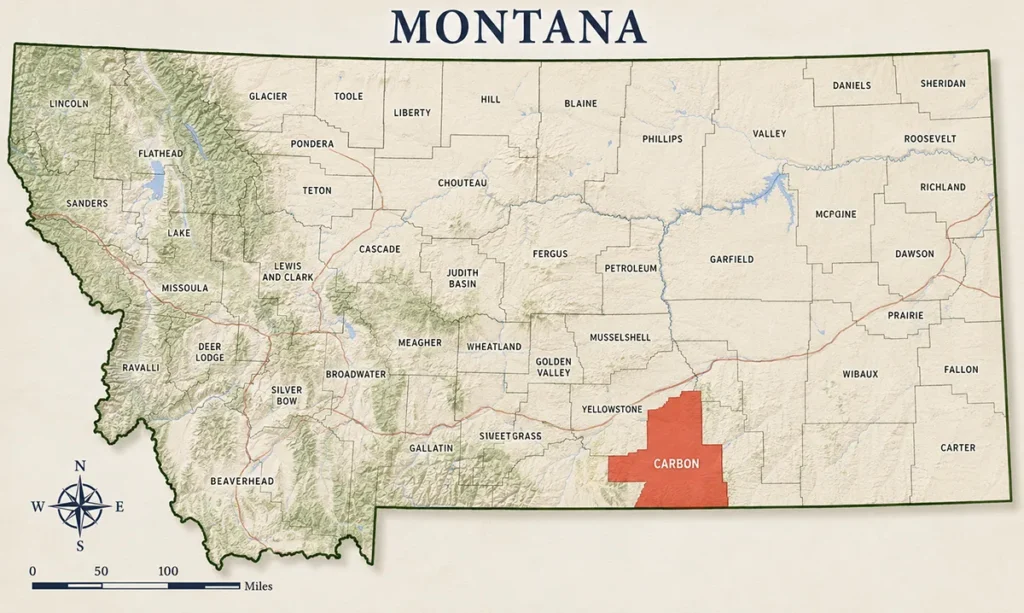
- Carbon County covers 2,062 square miles in south-central Montana, bordering Wyoming to the south
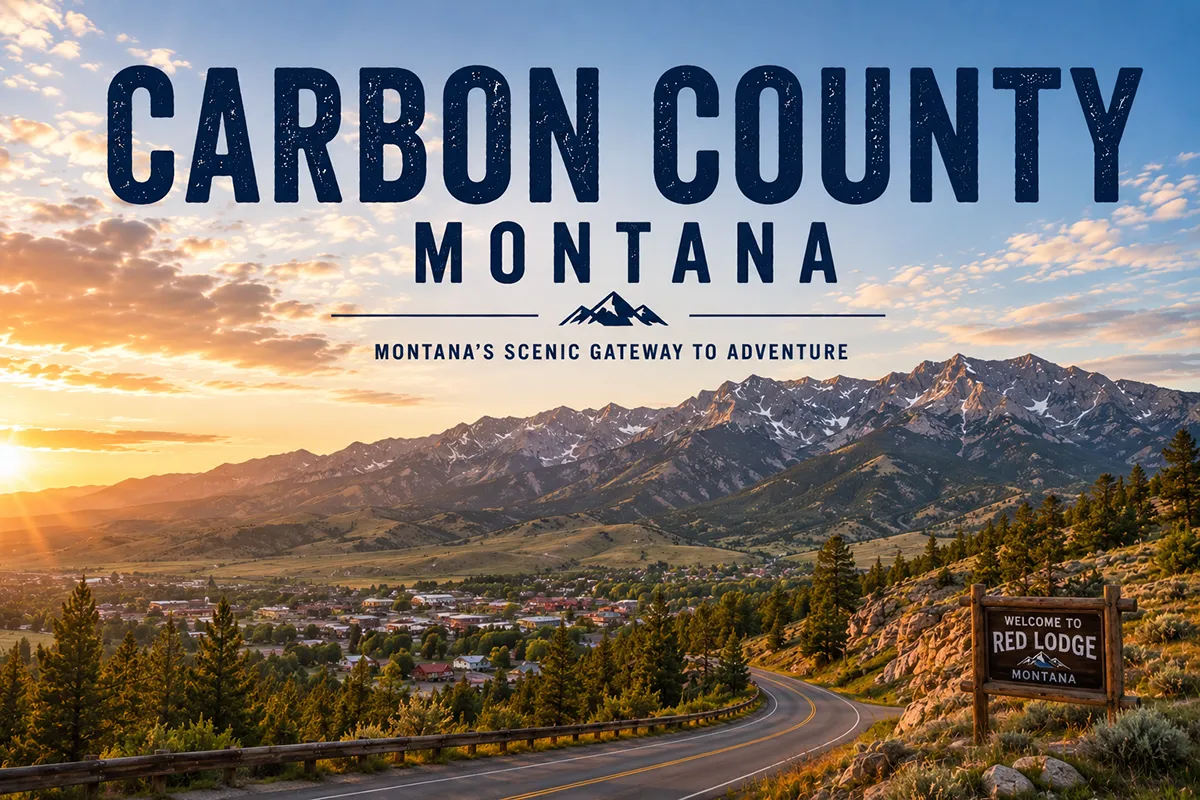
- The county seat is Red Lodge (~2,100) — a former coal-mining town turned full-service mountain destination
- The Beartooth Highway (US-212) runs 68 miles from Red Lodge to Yellowstone’s northeast entrance, climbing to 10,947 feet at Beartooth Pass — open Memorial Day to mid-October only
- Red Lodge Mountain offers 2,350 feet of vertical drop with far less crowding than Montana’s major ski resorts
- The Smith Mine Disaster of 1943 killed 74 miners — the deadliest mine accident in Montana history — with a historical site just outside town
- The Festival of Nations each August celebrates the multi-ethnic immigrant heritage that built Red Lodge
- Kevin Red Star — one of the most important Native American painters in the country — maintains a gallery in Red Lodge
- The Absaroka-Beartooth Wilderness is the largest designated wilderness in Montana, accessed directly from Carbon County trailheads
- Bearcreek’s Bear Creek Saloon runs actual pig races on weekends — a quirky Montana experience worth the short detour
- ⚠️ RVs and trailers over 40 feet are warned against driving Beartooth Pass; tight switchbacks below the summit require full lane use
Liked this article?
Add Roaming Montana as a preferred source so you see more of our articles and guides on Google.
Carbon County at a Glance
Carbon County was established in 1895, named directly for the coal seams that drove its early settlement.
Coal was discovered in the Rock Creek valley in the 1860s. By the 1880s, the Northern Pacific Railway had extended a branch line to the area, and Red Lodge grew rapidly as a company coal town.
Miners came from Finland, Croatia, Slovenia, Scotland, Italy, Ireland, and a dozen other countries — a demographic mix that still shapes the town’s identity today.
The coal industry collapsed after World War II. Red Lodge reinvented itself around the mountains that had always surrounded it.
Today the county covers 2,062 square miles between the Beartooth Range to the south and the Pryor Mountains to the northeast. The Clarks Fork of the Yellowstone River drains most of the county northward.
Population is around 11,179 (2022 estimate). For the full Carbon County context within Montana, see all 56 Montana counties.
The Beartooth Highway
The Beartooth Highway (US-212) begins at the south end of Red Lodge and doesn’t stop climbing for a very long time.
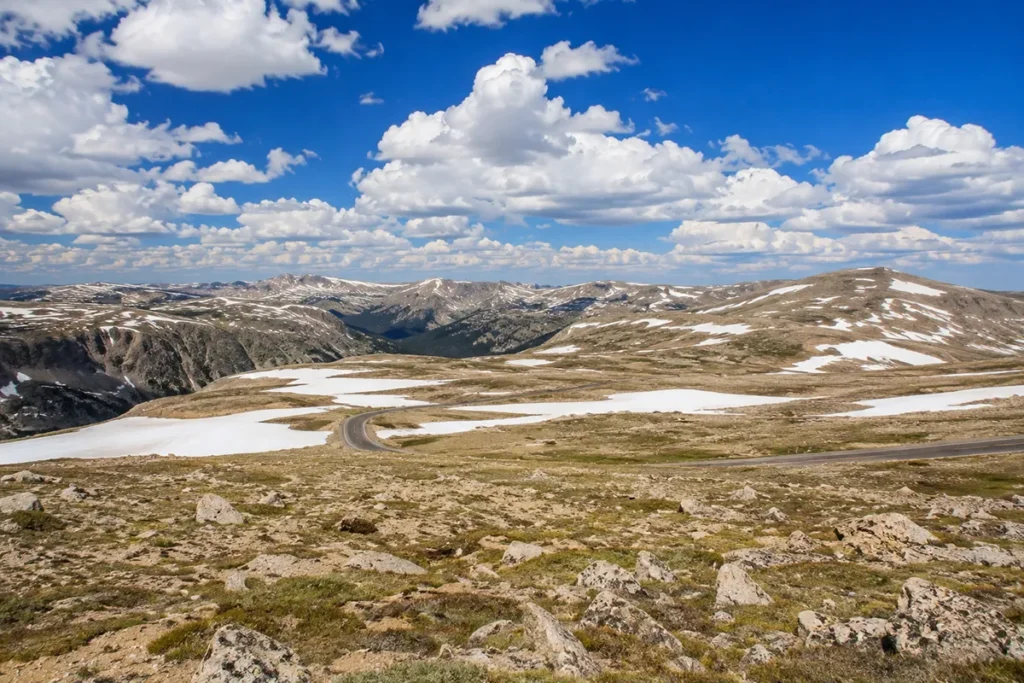
In the first seven miles, the road gains several thousand feet on a series of switchbacks so dramatic that first-time drivers often pull over just to look at where they’ve been. By the time you reach Beartooth Pass at 10,947 feet, you’re on the largest high-altitude plateau in the contiguous United States.
Charles Kuralt called it “the most beautiful drive in America.” Having driven Trail Ridge Road, Going-to-the-Sun Road, and most of the other contenders, I’d say he wasn’t wrong.
The key stops:
Rock Creek Vista Point sits at around 9,000 feet, about 21 miles from Red Lodge. The 360-degree views take in the Rock Creek Valley, Hell Roaring Plateau, and Silver Run Plateau all at once. It’s the first major “stop and just stand there” moment on the drive.
Beartooth Pass at 10,947 feet is the highest point on the highway and the highest paved road in the Northern Rockies. Even on a clear July day, it can feel genuinely cold up here. Snow persists in sheltered spots year-round.
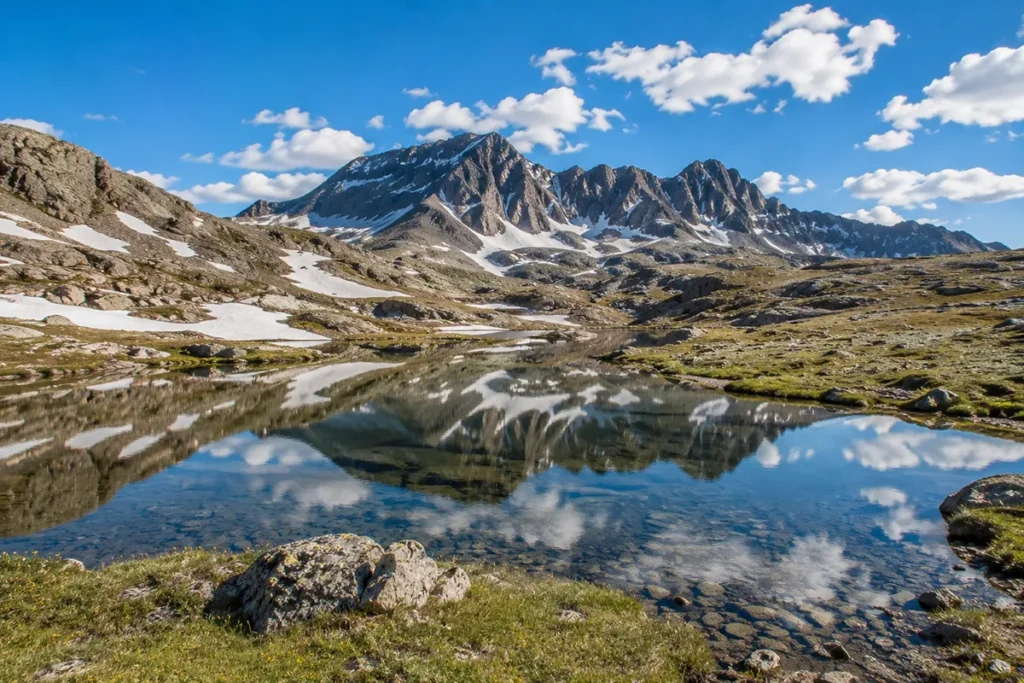
Island Lake, 38 miles from Red Lodge, sits in a glacially carved bowl above treeline. The short hike from the trailhead to the lakeshore is one of the most accessible above-treeline experiences in Montana.
Top of the World Store, around 35 miles in, offers gas (at altitude prices), food, and the only lodging on the plateau — basic cabin rooms and RV sites. It’s the only fuel stop between Red Lodge and Cooke City.
The Wyoming section: The highway briefly dips into Wyoming before returning to Montana near the Cooke City end. Most people don’t notice the state line crossing. The views don’t care either way.
Practical driving notes:
The highway is open Memorial Day weekend through mid-October, weather permitting. Temporary closures happen throughout the season — check road conditions at 511.mt.gov before you go.
Snow can fall on the plateau any month of the year. I’ve been caught in a June snowstorm at Beartooth Pass in shorts and a light jacket. Bring layers regardless of what the valley forecast says.
Vehicles over 40 feet are warned against driving over the pass — the switchbacks below the summit require full-lane use and create real hazard for oncoming traffic with large rigs.
Allow three hours minimum for the one-way drive if you want to stop at viewpoints. The full round-trip from Red Lodge and back is a solid full-day commitment when done properly.
The highway connects to Yellowstone’s northeast entrance at Cooke City. If you’re routing through Yellowstone, see Yellowstone wolf watching and Lamar Valley for what awaits on the other side.
Red Lodge: The County Seat
Red Lodge sits at 5,555 feet in the Rock Creek valley, directly below the Beartooth Range.
It’s small enough (population ~2,100) to feel like a mountain town but developed enough to serve as a genuine base — with a full range of lodging from historic hotels to vacation rentals, a strong restaurant scene by rural Montana standards, and a walkable downtown that retains most of its original 1890s and 1900s commercial architecture.
Broadway Avenue is the main street and the right place to start. The Carbon County Arts Guild occupies the old train depot and shows work by regional artists year-round.
The Carbon County Historical Society & Museum covers the town’s coal mining origins, immigrant heritage, and rodeo culture — the basement features a walk-through coal mine exhibit that gives a visceral sense of what the work actually looked like.
Kevin Red Star’s gallery is one of the most significant art stops in Montana that most visitors walk past without knowing it. Red Star is an internationally recognized Apsáalooke (Crow) painter whose large-scale, bold-color depictions of Indigenous peoples and traditional life have appeared in museums across the country.
He’s from Lodge Grass on the Crow Reservation and maintains a gallery in downtown Red Lodge. Walking in and seeing his work on the walls — not reproductions, actual paintings — is worth the trip alone.
The Yellowstone Wildlife Sanctuary (formerly the Beartooth Nature Center) is a nonprofit that cares for animals that can’t be returned to the wild. Mountain lions, black bears, wolves, bison, bobcats, and bald eagles are among the residents.
It’s one of the better wildlife encounter facilities in Montana because the focus is genuinely on the animals rather than entertainment.
The Pollard Hotel (1893) is the historic lodging option in Red Lodge — a three-story brick hotel that hosted Buffalo Bill Cody, Calamity Jane, and Liver-Eating Johnston in its frontier days. It’s been thoughtfully restored and remains one of the more atmospheric places to sleep in this part of Montana.
For the full Red Lodge visitor guide, see Red Lodge, Montana.
Red Lodge Mountain Ski Area
Red Lodge Mountain sits six miles from downtown in the Beartooth Range.
The stats: 2,350 feet of vertical drop, base elevation 7,100 feet, top elevation 9,416 feet. The longest run stretches 2.5 miles. More than half the terrain is rated intermediate.
What the stats don’t tell you: the lines are short, the lift tickets cost less than half of what you’d pay at Big Sky, and the locals treat it like a private mountain.
I skied Red Lodge on a Tuesday in February when the powder was a day old and I never waited more than two minutes at any lift. The back side has steeps that would qualify as black diamond terrain anywhere in the country.
The tradeoff is infrastructure — Red Lodge Mountain doesn’t have the resort village or the amenity density of Whitefish or Big Sky. But if you’re skiing for the skiing rather than the scene, it delivers.
[Verify current lift ticket prices and season dates at redlodgemountain.com.] See Montana ski resorts for the full state comparison.
The Smith Mine Disaster
On February 27, 1943, an explosion ripped through the Smith Mine near Bearcreek, east of Red Lodge.
Seventy-four miners died. It remains the deadliest mine accident in Montana history.
The mine was producing coal at maximum wartime capacity when methane ignited underground. Most of the miners were killed instantly by the blast and the carbon monoxide that followed. Some survived the initial explosion only to succumb while waiting for rescue that came too late.
The community was devastated. Many of the dead were from the same immigrant families — Slovenian, Croatian, Finnish, Italian — that had built Red Lodge two generations earlier.
The historical site is about 5 miles east of Red Lodge on Montana Highway 308. A historical marker and the ruins of the mine buildings are visible from a roadside pullout.
Most visitors to Carbon County never stop here. It’s one of the most meaningful fifteen minutes you can spend in the county.
The Festival of Nations
The Festival of Nations, held each August in Red Lodge, is one of Montana’s most underappreciated annual events.
The festival celebrates the specific immigrant communities that built Carbon County’s coal towns: Finnish, Slavic, Scandinavian, Scottish, Italian, Irish, and others. Each night of the eight-day festival honors a different national heritage, with traditional food, music, dance performances, and cultural displays.
It’s not a generic “multicultural fair.” It’s a specific commemoration of the people who came to dig coal in a Montana mountain valley and built a community that outlasted the mines.
Red Lodge hosts this festival because the demographics actually reflected this history. In the early 1900s, the town’s neighborhoods were informally divided by ethnicity — the Finnish section, the Slavic section, the Scots section. The Festival of Nations is the living continuation of that identity.
[Verify current festival dates at redlodge.com]
The Absaroka-Beartooth Wilderness
The Absaroka-Beartooth Wilderness is the largest designated wilderness in Montana — roughly 943,626 acres spanning Carbon and Park counties.
Trailheads accessing the wilderness are within a short drive of Red Lodge in multiple directions. The Beartooth Plateau itself is largely wilderness.
Popular entry points from Carbon County include the West Fork of Rock Creek trail system (close to town, good for day hikes and mountain biking), Mystic Lake Trail (a highly regarded backpacking destination), and the Lake Fork Trail.
The wilderness sits within the Custer Gallatin National Forest. Permits are not currently required for most backcountry use, but group size limits apply.
Wildlife in the wilderness includes grizzly bears, mountain lions, bighorn sheep, mountain goats, moose, and elk. Bear spray is non-negotiable.
Bearcreek and the Bear Creek Saloon
Bearcreek is a small community about six miles east of Red Lodge on Highway 308.
It has fewer than 100 residents. It has one bar. That bar runs pig races.
The Bear Creek Saloon hosts pig races on weekend evenings in summer. Guests bet on numbered pigs — proceeds go to local scholarships. It is exactly as entertaining as it sounds, and the bar serves food and drinks in a setting that makes no pretense of being anything other than what it is.
I was skeptical the first time someone told me to go. I’ve been back twice.
Bearcreek is also the closest community to the Smith Mine Disaster site — which means you can combine historical solemnity and pig races in the same afternoon in a way that feels very specifically Montanan.
[Verify current Bear Creek Saloon race schedule and season dates before your visit.]
What I Wish I Knew Before Visiting Carbon County
The Beartooth Highway closes without much warning. Even in July, a late spring storm can close the road for a day or two. Check 511.mt.gov the morning you plan to drive it. Don’t assume clear valley weather means a clear pass.
Summer snow on the plateau is real. I wore shorts to Beartooth Pass in late June once. The temperature was 38°F and it was snowing lightly. Bring a jacket regardless of the calendar date.
Large RVs and trailers should think twice. There’s a reason the signage at the Cooke City end recommends against vehicles over 40 feet. The switchbacks below the summit are narrow and require full-lane use. If you’re towing something substantial, research the specific turns before committing.
Red Lodge Mountain is better than its reputation suggests. The ski area doesn’t get the marketing spend of Montana’s bigger hills, and most out-of-state skiers walk past it on their way to Big Sky. That’s their loss. Less than an hour from Billings, uncrowded, and genuinely good terrain.
Visit the Smith Mine Disaster site. It takes 15 minutes and adds enormous context to everything else you see in Red Lodge. The immigrant neighborhood museum exhibits, the Festival of Nations, the mining architecture downtown — it all connects once you’ve stood at the mine ruins.
Kevin Red Star’s gallery is real and open to the public. It’s not a commercial gallery in the usual sense — it’s the studio-gallery of one of the most important Native American painters working today. Treat it accordingly.
The Festival of Nations fills up Red Lodge. If you’re planning to visit in the second week of August, book accommodation well in advance. The town gets genuinely busy during the festival week.
Practical Info
| County seat | Red Lodge |
| Area | 2,062 sq mi |
| Population | ~11,179 (2022 est.) |
| Tourism region | Yellowstone Country |
| Formed | 1895 |
| Main highways | US-212 (Beartooth Hwy), US-310 |
| Beartooth Highway open | Memorial Day weekend – mid-October |
| Beartooth Pass elevation | 10,947 ft |
| Red Lodge Mountain | 2,350 ft vertical; open December–March approx. |
| Nearest major airport | Billings Logan International (BIL) — ~60 miles north |
| Best summer season | June–September |
| Best ski season | December–March |
| Cell service | Good in Red Lodge; none on Beartooth Plateau |
| Gas on Beartooth Hwy | Red Lodge (start) and Top of the World Store only |
| RV/trailer warning | Vehicles over 40 ft warned against Beartooth Pass |
Getting to Carbon County
From Billings: US-212 south through Laurel and Bridger — about 60 miles, roughly 1 hour to Red Lodge.
From Bozeman: US-90 east to Laurel, then US-212 south — about 100 miles, roughly 1.5 hours.
From Yellowstone (northeast entrance): Drive east on US-212 over Beartooth Pass into Red Lodge — 68 miles, allow 2.5 to 3 hours for the full scenic drive.
By air: Billings Logan International (BIL) is the closest airport with regular commercial service. Car rental is available at the airport.
See Montana airports and Montana transportation guide.
Towns in Carbon County
- Red Lodge — county seat, full visitor services, Beartooth Highway start
- Bearcreek — small community east of Red Lodge; Smith Mine Disaster site nearby; Bear Creek Saloon pig races
- Bridger — small agricultural town on US-310 northwest of Red Lodge; gateway from Billings corridor
- Fromberg — small community in the Clark Fork valley; agricultural
Adjacent Counties
- Stillwater County to the northwest — Columbus
- Park County to the west — Livingston, Gardiner, Yellowstone gateway
- Big Horn County to the northeast — Hardin, Crow Reservation
- Big Horn and Park counties, Wyoming to the south
Plan Your Carbon County Trip
The Beartooth Highway pulls most of the oxygen out of a Carbon County trip planning conversation — and it should be a priority.
But a trip built only around the drive misses what makes Red Lodge itself worthwhile: the immigrant history, the ski area, the Kevin Red Star gallery, the Smith Mine site, and the genuine mountain-town character that survived the coal industry’s collapse.
A strong three-day itinerary: Day one — arrive in Red Lodge, walk Broadway, visit the Historical Museum and Kevin Red Star’s gallery.
Day two — full Beartooth Highway drive to Cooke City and back, with stops at Rock Creek Vista Point and Island Lake.
Day three — morning at Red Lodge Mountain (winter) or Mystic Lake trailhead (summer), afternoon at Smith Mine Disaster site and Bearcreek.
For trip planning help, see best time to visit Montana and Montana trip planning guide. For ski season context, see Montana ski resorts. Back to the complete Montana counties guide.