In January 1864, Sheriff Henry Plummer was hanged on the gallows of the town he’d been elected to protect. The vigilantes who hanged him believed — with strong evidence — that he had been secretly leading a road-agent gang responsible for over 100 murders along the gold trails between Bannack and Virginia City.
Plummer’s last words, depending on which version you believe, were either a plea for mercy or a request for a glass of water. He’s buried somewhere in Bannack’s cemetery. Nobody’s quite sure where.
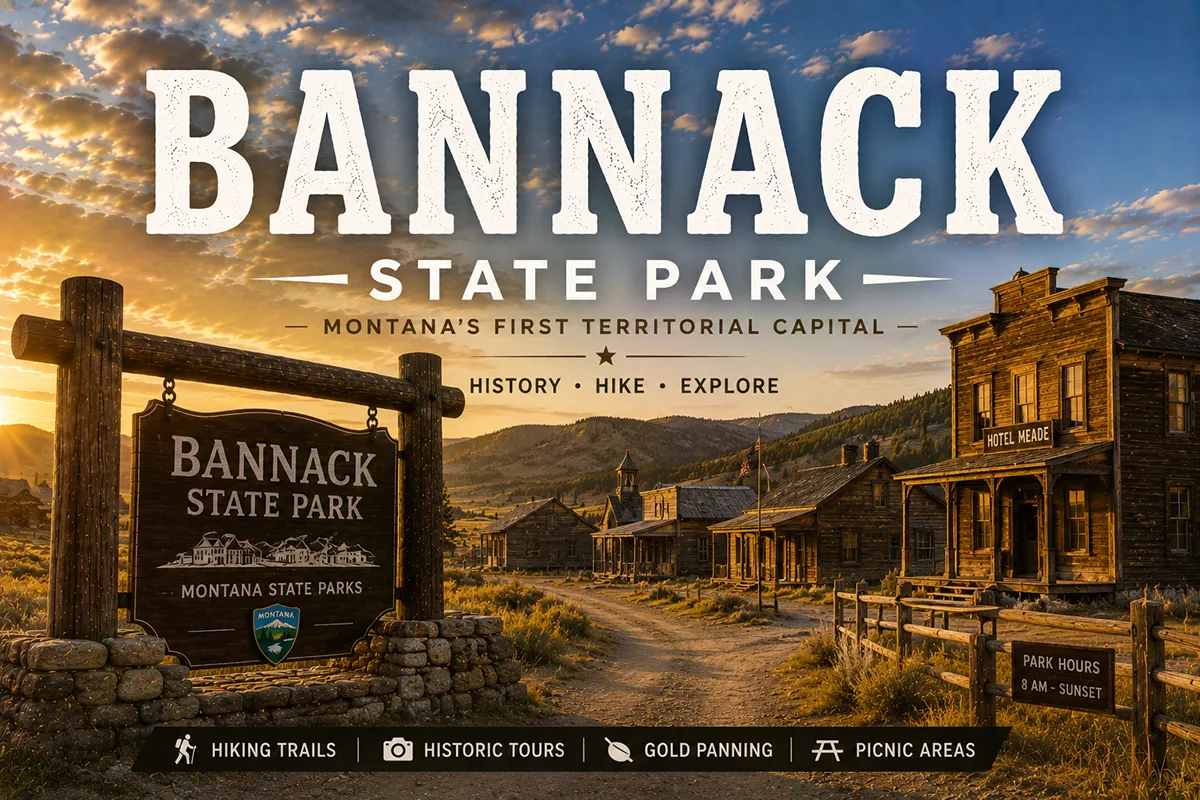
TL;DR: Bannack State Park preserves Montana’s first territorial capital — the gold-rush boomtown that, in 1862, sparked the migration that would become the state of Montana. Over 60 original buildings still stand along the deserted main street, including the Hotel Meade, the 1877 Methodist Church, Masonic Lodge No. 16 (the oldest in Montana), the schoolhouse, the jail, and the gallows. The town’s centerpiece story is Sheriff Henry Plummer — possibly the most consequential lawman-turned-outlaw in American Western history. Bannack Days, the third weekend of July, brings the town back to life with reenactors. Ghost Walk in late October offers a darker version. It’s open year-round, you can walk into most buildings, and in winter the dredge pond becomes an ice rink.
I’m Robert Hayes, and I’ve been driving Montana’s back roads chasing ghost-town history for two decades. Bannack is the one I return to most often. Virginia City has more shops; Nevada City has more reconstructed buildings.
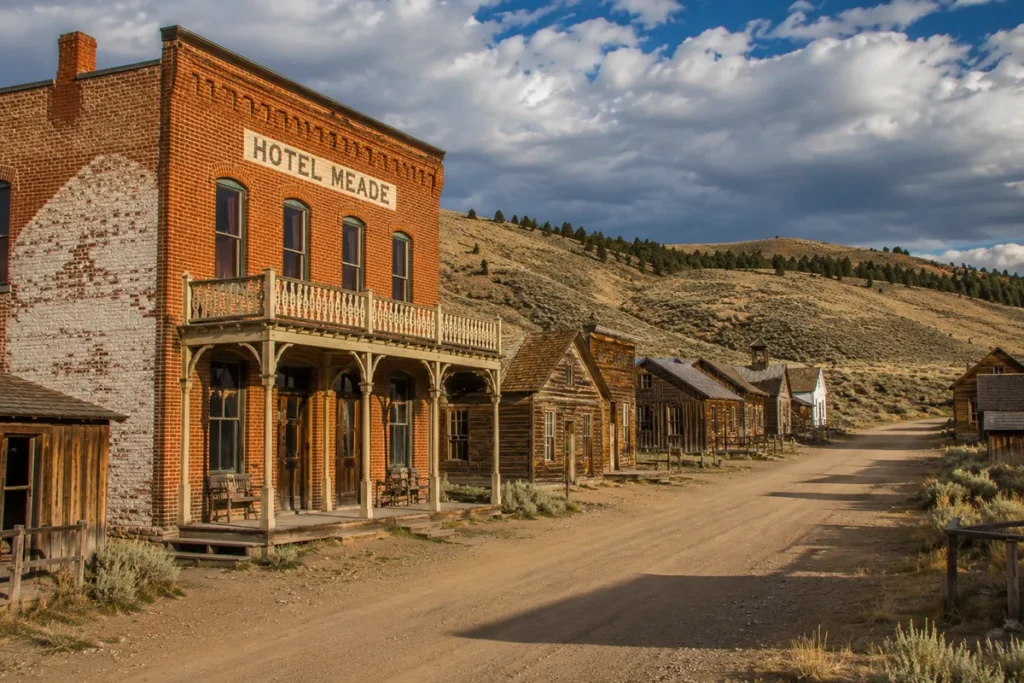
But Bannack has the largest collection of original structures still standing in something close to their 1860s state — and the historical density of what happened here in two short years is unmatched anywhere in Montana.
This is the deep-dive on Bannack. For the broader landscape of Montana’s state parks, see my Montana state parks pillar guide.
For the federal NPS site that pairs with Bannack on a southwest Montana history trip, Big Hole National Battlefield is 60 miles north and covers the 1877 Nez Perce flight — the other foundational southwest Montana story.
Liked this article?
Add Roaming Montana as a preferred source so you see more of our articles and guides on Google.
Quick Stats
| Stat | Detail |
|---|---|
| Park size | 1,529 acres |
| Elevation | 5,837 feet |
| Location | 25 miles west of Dillon, southwestern Montana |
| Original buildings standing | 60+ |
| Founded | July 28, 1862 (gold strike) |
| Population at peak (1863) | 3,000+ |
| Territorial capital status | 1864 (briefly, then moved to Virginia City) |
| Last resident | 1970s |
| Visitor center | Open Memorial Day–Labor Day |
| Day-use fee [verify 2026] | $8/vehicle (non-resident); free for residents with park pass |
| Camping | 28 sites + tipi rental |
| Year-round access | Yes |
| Major events | Bannack Days (3rd weekend in July), Ghost Walk (Oct. 23–24, 2026) |
How Bannack Came to Be
On July 28, 1862, a prospector named John White and his small party struck gold on Grasshopper Creek in what was then part of the Idaho Territory.
The strike was substantial, the news traveled fast, and within months thousands of miners were pouring in from every direction — from California where the easy gold had played out, from Colorado where the rush had peaked, and from the East where the Civil War was tearing the country apart.
By the spring of 1863, Bannack had a population of over 3,000 people. By 1864, when the Montana Territory was officially created, Bannack was its first capital.
The capital designation would last less than a year — gold strikes in nearby Alder Gulch made Virginia City the bigger boomtown, and the territorial government followed the money — but Bannack’s place as Montana’s founding city was already cemented.
For the broader context of how this gold rush shaped the state, see my Montana gold rush guide and Montana’s key historical events.
What’s remarkable about Bannack is how much of it survived. The town never died completely — small populations stayed through the 1880s, the dredge mining era of the early 1900s, and into the mid-20th century. The last permanent resident didn’t leave until the 1970s.
Montana acquired the site as a state park in 1954, and the preservation work since then has been careful and minimal — the goal has been arrested decay rather than reconstruction. What you walk through today is the actual town, not a recreation.
The Henry Plummer Story
You can’t understand Bannack without understanding the Plummer story. It’s the centerpiece of every interpretive ranger talk for good reason.
Henry Plummer arrived in Bannack in 1862, already with a complicated past — he’d been a sheriff in California, convicted of murder, pardoned, and had drifted to the Pacific Northwest.
In Bannack he was elected sheriff in 1863, a position that gave him intimate knowledge of who was carrying gold and which routes they were taking out of town.
Within months, road-agent attacks along the trails between Bannack, Virginia City, and the Salt Lake Valley exploded. Miners carrying gold out were ambushed, robbed, and frequently murdered.
The pattern was unmistakable: the road agents always seemed to know which travelers had gold and when they were leaving. The death toll has been variously estimated at 100+ over an eighteen-month period — though that number has been challenged by modern historians.
In December 1863, a group of citizens organized as the Montana Vigilantes. Operating outside formal law — Montana wasn’t yet a territory and had no functioning court system — the vigilantes captured, interrogated, and hanged suspected road agents over the following weeks. Their investigation led them to Plummer.
On January 10, 1864, the vigilantes arrested Sheriff Plummer along with two of his deputies, marched them to the gallows Plummer himself had ordered built, and hanged them. Within a few weeks, the vigilantes had hanged a total of 22 suspected road agents across the territory.
The story has been argued ever since. Some historians believe Plummer was guilty; others believe he was framed by the vigilantes themselves to consolidate power. The cemetery on the hill above town contains his unmarked grave, somewhere — the exact location was lost.
Where to engage with the story on-site:
- The original gallows (reconstructed on the original site) stand at the edge of town
- The visitor center exhibit lays out the timeline and evidence
- The jail, where Plummer briefly held some of his own accomplices, still stands
- Plummer’s own house — a small cabin — survives
The 2002 publication of Frederick Allen’s A Decent, Orderly Lynching is the definitive modern treatment of the story if you want to read deeper before your visit.
The Buildings to See
Most travelers underestimate how much time Bannack takes to walk properly. There are over 60 standing buildings.
Plan three to four hours minimum if you want to actually explore rather than just walk past them. The visitor center sells a 20-page guidebook for $2 that gives the history of each building — buy it. It’s genuinely essential.
Hotel Meade. The two-story brick building dominating Main Street. Originally the Beaverhead County Courthouse (built 1875), later converted to the Hotel Meade in 1890. The brick construction is unusual for Bannack — most buildings are wood — and the interior staircase and front parlor are among the most photographed spaces in the park.
Masonic Lodge No. 16. The oldest Masonic Lodge in Montana, chartered in 1862. The lodge building has the unusual layout common to early Montana Masonic halls — schoolroom downstairs, lodge meeting room upstairs. It’s a two-for-one historic site.
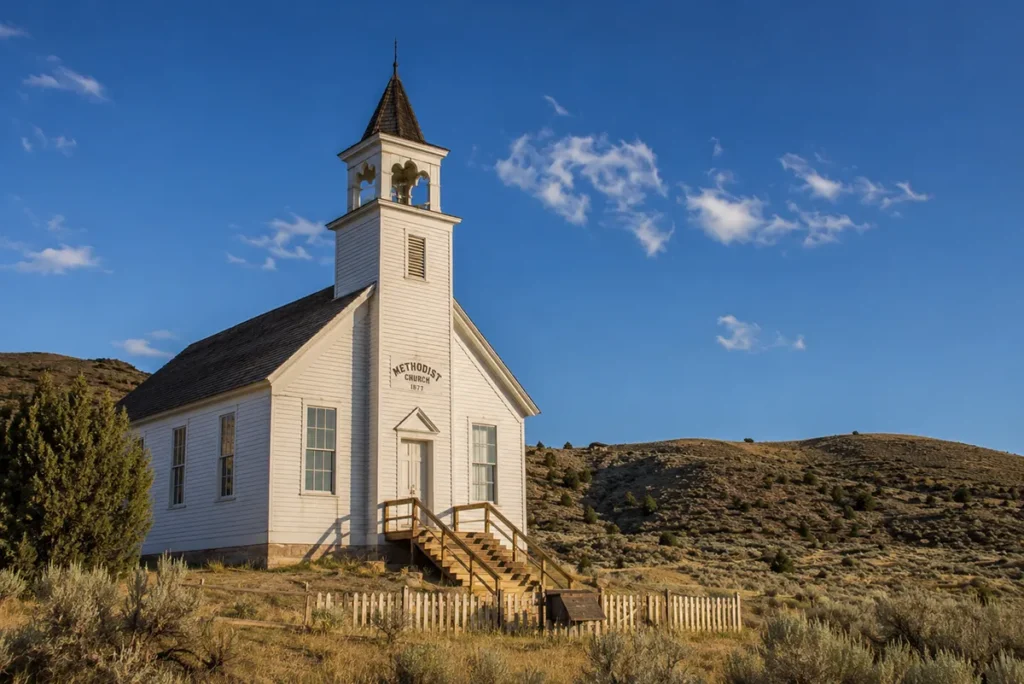
Methodist Church. Built in 1877, this is one of the oldest preserved church buildings in Montana. The original bell still hangs in the steeple. The interior is sparse and bright — exactly as it would have been on Sundays in the 1880s.
Schoolhouse. The one-room school served Bannack’s children from the 1870s well into the 20th century. Original desks, blackboard, and teaching materials remain. The schoolhouse closed in 1951.
Jail. The small log jail where Plummer briefly held some of the men he was secretly working with. Three small cells, original iron bars.
Gallows. Reconstructed on the original location at the edge of town. The five-fingered cottonwood that originally served as the hanging tree is gone, but the location is the historical site where Plummer and his deputies were hanged.
Skinner’s Saloon. Run by Cyrus Skinner, one of Plummer’s alleged road-agent accomplices. Skinner was later hanged by the vigilantes in nearby Hellgate (now Missoula).
The Bachelor Cabins. A row of small one-room log cabins where single miners lived. Furnished interiors give a clear sense of how cramped 1860s mining life actually was.
The Cemetery (Boot Hill). On the rise above town. Plummer’s unmarked grave is here. Several other graves are clearly marked with the original wooden boards.
The Dredge Pond and Mill Ruins. At the far end of the property, evidence of the early 1900s dredge mining operation that extracted whatever gold had been left behind by the placer miners. In winter, this pond becomes the ice rink (more on this below).
The Trails: Road Agent Rock and Bird’s Eye View
Most visitors don’t realize Bannack has hiking trails. Both are short and worth the time.
Bird’s Eye View Trail. A short climb up the hill behind town with sweeping views down onto Main Street. The trail follows part of the original wagon road that connected Bannack to the Salt Lake Valley for supplies. This is the photo angle every Bannack visitor should have.
Road Agent Rock. A loop trail named after the road agents (highway robbers) who reportedly used the rocky outcrop as a lookout point for spotting incoming travelers. The hike is moderate; the historical resonance is heavy.
Pick up the interpretive brochure at the visitor center before hiking either.
Bannack Days: The Third Weekend in July
If you’re planning your trip around an experience, Bannack Days is the one. Every third weekend in July, the park hosts a full reenactment weekend — gunfights staged in the streets, gold panning demonstrations, blacksmiths working open fires, period-dressed merchants and miners walking the boardwalks, live music in the saloon. The Hotel Meade serves period food. The schoolhouse runs 1880s-style lessons.
The honest tradeoffs:
- This is when Bannack is full of people, by Bannack standards — meaning instead of the usual 20–30 visitors on a quiet day, you’ll see hundreds. It’s not Disneyland-crowded, but it’s not the empty-ghost-town experience either.
- Camping in the park fills up months in advance. Book by April for July dates.
- Dillon hotels and the surrounding RV parks fill up too.
- The reenactors are genuine history enthusiasts. Many have been doing this for decades. The depth of period accuracy is impressive.
My honest take: If you want to see Bannack truly empty, visit any other weekend. If you want to understand what 1860s Bannack actually felt like — sound, motion, smell — Bannack Days is the only weekend that delivers it.
Ghost Walk: The October Weekend
A newer annual event — typically the last weekend in October (October 23–24 for 2026). Live actors portray figures from Bannack’s history as visitors walk through the town by lantern light at dusk and into the evening. The performances are short, scattered through the buildings, and you walk a route guided by signage.
This is the most theatrical Bannack experience. The temperature drops fast in October at 5,800 feet — dress in real layers. Tickets [verify pricing and reservation system for 2026 with Montana FWP] sell out, so book ahead.
For broader fall context, Montana in October covers the trip-planning realities.
Winter at Bannack: Ice Skating and Cross-Country Skiing
This is the most underrated Bannack experience and the one almost no out-of-state guide covers.
In winter, the old dredge pond freezes solid. From sometime in January through the first week of March (weather permitting), the park opens it as an ice skating rink.
Free loaner skates are available; a warming hut on the bank serves hot beverages and snacks; the operation is run on a shoestring by the Bannack Association on weekends. Skating sponsored by volunteers, with hours typically 11 a.m. to 4 p.m.
What makes it special isn’t just the skating — it’s skating on a frozen dredge pond in the middle of a 19th-century ghost town with the buildings visible across the snow. There’s nothing else like it in Montana.
Cross-country skiing through the historic town when there’s snow is the other winter offering. The flat ground around the buildings, the trail to the campground, and a few short loops all work for beginner skiers. Bring your own gear.
For broader winter trip context, Montana in January and Montana in February cover the realities.
Camping at Bannack
The park has 28 sites in two campgrounds along Grasshopper Creek, both walking distance from the historic town.
Vigilante Campground — the larger of the two, with sites for both tents and RVs (no hookups). Vault toilets, drinking water, fire rings.
Road Agent Campground — smaller, more isolated, mostly tent-friendly.
Tipi rental — a furnished tipi available for overnight stays along Grasshopper Creek. One of Montana’s most distinctive camping experiences. Books months in advance for summer.
Hike-in/Bike-in campsite with four tent pads for travelers arriving by foot or bicycle.
Group picnic site available for reservation.
Reservations through stateparks.mt.gov. For RV-specific options nearby, Montana’s best RV parks covers the Dillon area.
Practical Tips: What I Wish I’d Known on My First Visit
Buy the $2 guidebook at the visitor center. Not optional. Without it, you’ll walk past dozens of buildings without knowing what they were. With it, the visit transforms.
Plan three to four hours minimum. Most travelers underestimate the scale and rush through. The whole point of Bannack is the slow walk.
Wear good shoes. Main Street is dirt and uneven. Building interiors have original (creaky, slanted) floors. No paved surfaces.
Cell service is unreliable. Coverage in Dillon is fine; in Bannack it drops out. Download maps before arrival.
Photograph in early morning or late afternoon. Midday sun is harsh and unflattering on the weathered wood. Golden hour at Bannack is genuinely magical.
Stop in Dillon for fuel and food. Dillon has gas stations, restaurants, a small downtown, and the Patagonia outlet store (if you need outdoor gear). There’s no fuel and minimal food at Bannack itself.
The Beaverhead River fishing near Dillon is world-class. If you’re a fly fisher, build in a half-day. The Beaverhead and Big Hole rivers are among the best trout fisheries in the Lower 48.
Watch the weather. Bannack sits at 5,837 feet. Summer afternoons can produce sudden thunderstorms; winter brings sub-zero temperatures. Check forecasts before driving out.
How to Pair Bannack with Other Sites
Bannack works as a single-day visit or as the anchor of a longer southwest Montana itinerary. Here are the natural pairings:
The Southwest Montana History Loop (3–4 days)
Bannack → drive 60 miles north to Big Hole National Battlefield → continue to Wisdom → return via the Bitterroot Valley to Missoula or south to Dillon. This is the deepest southwest Montana history experience available — the gold-rush ghost town plus the 1877 Nez Perce battlefield.
The Ghost-Town Triple
Bannack → drive east 90 minutes to Virginia City and Nevada City. Three of Montana’s best-preserved 19th-century mining settlements in two days. All three are within an hour-and-change of each other. Virginia City is more commercialized (working businesses, costumed staff); Nevada City is more reconstruction; Bannack is the most authentic. Together they tell the full Montana gold-rush story.
The Dillon Basecamp
Use Dillon as your base for 3–4 days. Day 1: Bannack. Day 2: Beaverhead River fishing. Day 3: Big Hole Battlefield. Day 4: drive the Pioneer Mountains Scenic Byway or up to Anaconda and Philipsburg. Dillon is one of southwest Montana’s most underrated small-town basecamps.
Pair with Other State Park Children
For the broader cluster, consider:
- Best for history depth: Bannack + Pictograph Cave State Park (2,000-year-old rock art near Billings) — these two sites span Montana history from prehistoric to territorial era
- Best for ghost-town and dinosaur enthusiasts: Bannack + Makoshika State Park — territorial-era extraction history meets prehistoric extinction-era geology
- Best for the Montana grand history tour: Bannack + Lewis & Clark Caverns (Montana’s first state park, established 1935) + Virginia City
Practical Info Box
| Topic | Quick Answer |
|---|---|
| Day-use fee | $8/vehicle (non-resident) [verify 2026] |
| Visitor center hours | Memorial Day–Labor Day, daily |
| Year-round access | Yes (visitor center seasonal, town always walkable) |
| Camping reservations | stateparks.mt.gov |
| Closest town | Dillon (25 miles east) |
| Closest airport | Bozeman Yellowstone (BZN), 130 miles |
| Driving distance from Bozeman | 130 miles (~2.5 hours) |
| Driving distance from Butte | 75 miles (~1.5 hours) |
| Driving distance from Glacier | 320 miles (~5 hours) |
| Best events | Bannack Days (3rd weekend July), Ghost Walk (Oct 23–24, 2026) |
| Winter highlight | Ice skating on the dredge pond (January–early March) |
| Time needed | 3–4 hours minimum; full day with trails |
| Pair with NPS | Big Hole National Battlefield |
| Pair with state park child | Makoshika, Pictograph Cave |
Conclusion: Walking Through Montana’s Origin Story
Bannack is the closest Montana comes to a time machine. The buildings are real, the stories happened on the ground you’re walking, and the absence of modern intrusion — no power lines, no paved roads, no gift shops on Main Street — is more complete than at almost any other preserved historic site in the West.
When you walk past the gallows and look up at Boot Hill, you’re standing where Henry Plummer stood on January 10, 1864.
My recommendation: come for a half-day if you’re nearby, stay overnight if you can. The town in late afternoon light, after the day-trippers have left, is a fundamentally different place than the town at midday.
Camp in the park, walk the buildings at dusk, and you’ll understand why Montanans treat Bannack as a kind of secular pilgrimage site.
This is the deep-dive. For broader context:
- Montana state parks pillar guide — all 55+ state parks and how to choose
- Montana national parks pillar guide — federal counterpart, includes the Big Hole pairing
- Montana gold rush guide — the broader 1860s economic history
- Key historical events in Montana — Bannack in the timeline
- Things to do in Montana and Montana bucket list — broader trip planning
Drop questions about Bannack — or about the Plummer story specifically — in the comments. I’ll answer from experience.
FAQs About Bannack State Park
What is Bannack State Park famous for?
Bannack State Park is famous for being Montana’s first major gold rush town and one of the best-preserved ghost towns in the American West. Visitors can explore dozens of historic buildings, including old homes, hotels, businesses, and the former county courthouse.
Where is Bannack State Park located?
Bannack State Park is located in southwestern Montana, about 25 miles west of Dillon. The park sits along Grasshopper Creek in a scenic valley surrounded by mountains and open rangeland.
Why is Bannack considered a ghost town?
Bannack became a ghost town after its gold deposits declined and residents gradually moved away. By the mid-20th century, most of the population had left, leaving behind many original buildings that remain preserved today.
When was Bannack founded?
Bannack was founded in 1862 following the discovery of gold along Grasshopper Creek. It quickly became Montana Territory’s first territorial capital and one of the region’s most important mining communities.
How many buildings are preserved at Bannack State Park?
More than 50 historic structures remain at Bannack State Park. Visitors can walk through many of these buildings and experience what life was like during Montana’s gold rush era.
Is Bannack State Park worth visiting?
Yes. Bannack State Park is one of Montana’s most unique historic attractions, offering a fascinating glimpse into frontier life, gold mining history, and the state’s earliest settlement days.
Can you go inside the buildings at Bannack State Park?
Many of the historic buildings are open for self-guided exploration. Visitors can view preserved interiors, original artifacts, and exhibits that showcase life in the former mining town.
How much does it cost to visit Bannack State Park?
Montana residents generally receive park access through the state parks fee included with vehicle registration. Non-residents typically pay a daily entrance fee or may purchase an annual Montana State Parks Pass.
What is the best time to visit Bannack State Park?
Late spring through early fall is the most popular time to visit. Pleasant weather, guided tours, special events, and accessible roads make summer an excellent season for exploring the ghost town.
What is Bannack Days?
Bannack Days is an annual living-history event held each summer that brings the ghost town to life with reenactments, demonstrations, period costumes, gold panning, historic displays, and family-friendly activities.
Can you camp at Bannack State Park?
Yes. The park offers a campground with basic amenities, allowing visitors to stay overnight and enjoy the quiet historic setting and surrounding natural scenery.
Are pets allowed at Bannack State Park?
Pets are generally welcome in outdoor areas of the park if they are kept on a leash and owners follow state park regulations.
How far is Bannack State Park from Dillon?
Bannack State Park is approximately 25 miles west of Dillon, making it an easy day trip from Dillon and a popular stop for travelers exploring southwestern Montana.
Was Bannack Montana’s first capital?
Yes. Bannack briefly served as the first territorial capital of Montana Territory before the capital was moved to Virginia City in 1865.
What can you do at Bannack State Park?
Visitors can explore historic buildings, learn about Montana’s gold rush history, attend special events, enjoy photography, go camping, watch wildlife, hike nearby trails, and experience one of the most authentic ghost towns in the West.
Written by Robert Hayes, who has walked Bannack’s main street in every season and still hasn’t decided whether Henry Plummer was guilty.