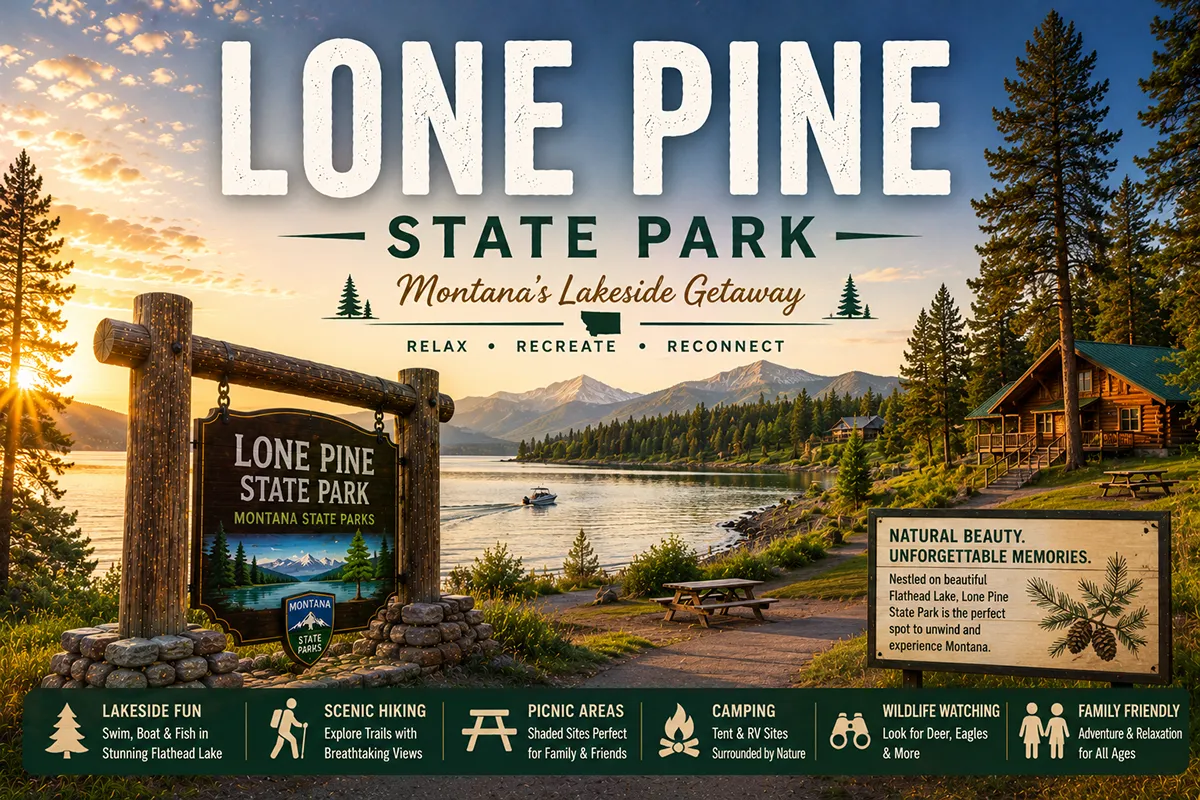
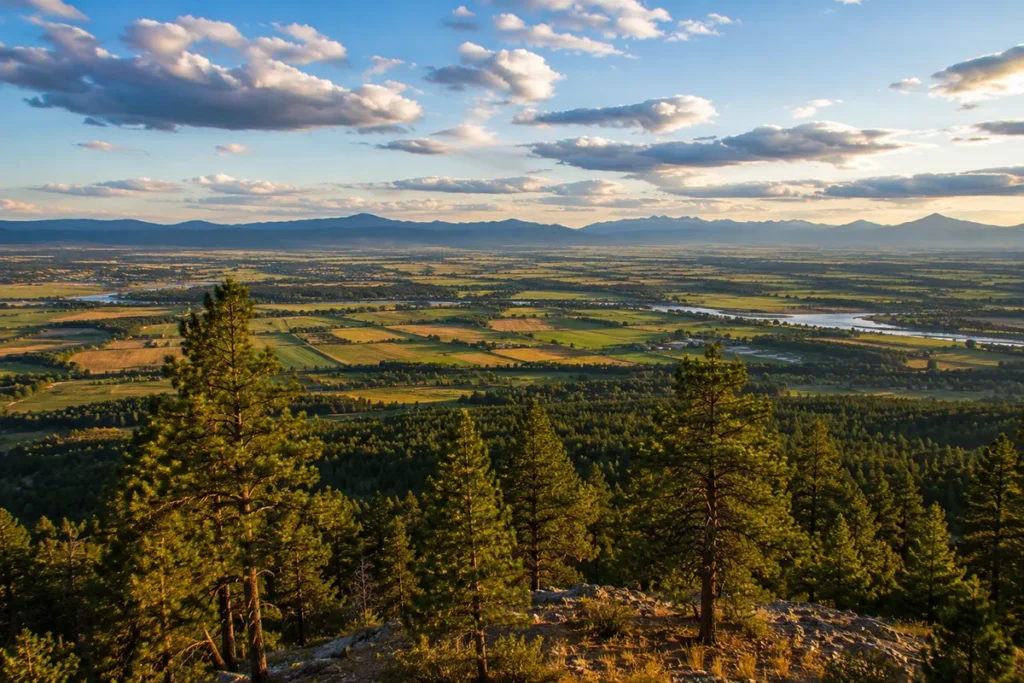
From the main overlook at Lone Pine, on a clear day, you can look east across the Flathead Valley and see Glacier National Park’s peaks rising on the horizon — 30 miles away, and the reason most travelers are in the Flathead in the first place. This is the state park you visit on the day you’re not doing Glacier. And it’s the easiest sell in the entire Montana state park system.
TL;DR: Lone Pine State Park sits on a ridge southwest of Kalispell, 270 acres with 7.5 miles of mixed-use trails, year-round access, and panoramic overlooks of the Flathead Valley including views of Glacier National Park, Big Mountain, Jewel Basin, and Flathead Lake. It’s the most accessible state park in the Glacier corridor — 10 minutes from downtown Kalispell, family-friendly, with a year-round visitor center and excellent interpretive programming. The strategic use case is simple: when your Glacier trip needs a low-effort day, this is where you go. Free for residents, modest fee for non-residents. Donated to the state in 1941 by local landowners Ernest and Hazel White.
I’m Robert Hayes, and I’ve spent enough time in the Flathead Valley to recognize Lone Pine for what it actually is: not a destination park, but a strategic park. Travelers don’t fly to Montana to see Lone Pine. They visit Lone Pine because it solves a specific trip-planning problem — the day in your Glacier itinerary when you don’t feel like driving an hour each way for another full park day. Or the half-day before your flight out. Or the rainy afternoon when the higher elevations are socked in. Lone Pine handles those days better than any other Montana state park, and the views from the overlooks make it worth the trip on their own merits too.
This is the deep-dive guide. For the broader Montana state parks landscape, see my Montana state parks pillar guide. The natural pairing partner for this park is Glacier National Park — see also my Montana national parks pillar guide for the broader federal context.
Liked this article?
Add Roaming Montana as a preferred source so you see more of our articles and guides on Google.
Quick Stats
| Stat | Detail |
|---|---|
| Park size | 270 acres |
| Elevation | 2,959–3,644 feet |
| Location | 4 miles SW of Kalispell on Foys Lake Road |
| Established | 1941 |
| Original land donors | Ernest and Hazel White (162-acre donation) |
| Trail system | 7.5 miles total; longest single trail 1.5 miles |
| Mountain biking | ~2/3 of trails open to MTB |
| Annual visitors (2023) | ~132,000 |
| Day-use fee [verify 2026] | $5/vehicle (non-resident); free for residents |
| Camping | None (day-use only) |
| Year-round access | Yes |
| Visitor center hours [verify 2026] | Wed–Sat 10 a.m.–3 p.m.; Sun 12:30 p.m.–3 p.m.; closed Mon–Tue |
| Snowshoe rental | $5/person; $10/family |
| Best for | Glacier rest day, families, light hiking, year-round access |
A Park Built by Donation
Most Montana state parks were created by federal-to-state land transfers, state purchases, or designations of public land. Lone Pine has a different origin: it was donated by private landowners.
In 1941 — during World War II, when the Flathead Valley was still primarily agricultural — Ernest and Hazel White donated 162 acres of their property on the ridge southwest of Kalispell to the State of Montana for use as a public park.
The donation included the timbered ridgeline with its existing trails and overlooks. Subsequent additions and purchases brought the park to its current 270 acres.
It’s worth pausing on this. The Whites chose to make their land permanently public during one of the most economically uncertain periods in American history.
The result is one of the most-used state parks in Montana — 132,000+ annual visitors, free to residents, with a substantial portion of those visitors being Flathead Valley families who use the park as a community resource.
That outcome wasn’t inevitable. It happened because two specific people decided their land mattered more as a park than as private property.
The park is officially named “Lone Pine” for a single ponderosa pine that historically stood as a landmark on the ridge — visible from miles away across the valley before the surrounding forest grew up to obscure it.
Why “Glacier Rest Day” Is the Right Frame
Most travelers planning a Glacier National Park trip get one piece of advice consistently wrong: they try to do Glacier every day.
Four straight days of Going-to-the-Sun Road, big hikes, early starts, and 60-mile drives wears down even enthusiastic visitors. The hidden truth is that you need a recovery day in the middle of any Glacier trip lasting longer than 4 days.
Lone Pine is the recovery day, and it’s perfectly designed for the purpose:
- Located 10 minutes from downtown Kalispell — accessible from any Kalispell, Whitefish, or Columbia Falls lodging
- No driving required to get there — you’re not adding 60+ miles to your day
- Short trails (longest single trail is 1.5 miles) — you can walk for an hour or for a half-day
- Pet-friendly — leashed dogs welcome on most trails
- Family-friendly — playground equipment, picnic shelters, an archery range
- Includes a visitor center with restrooms, water, and interpretive displays for when weather’s bad
- Excellent views — the overlooks deliver the postcard moment without the hike-in effort
- Cheap or free — $5 day-use for non-residents, no reservations required
A typical Glacier-rest-day itinerary at Lone Pine: arrive at the visitor center mid-morning, walk one or two short trails (1–2 hours total), have lunch at the picnic shelter, spend 30 minutes at the overlooks taking photos, head back to Kalispell or Whitefish for an afternoon nap before dinner. That’s a half-day of fresh air without the exhaustion of another full park day.
For broader Glacier-area trip planning, see where to stay in Glacier National Park, best hikes in Glacier, and the Going-to-the-Sun Road guide.
The Trail System: 7.5 Miles, Connected
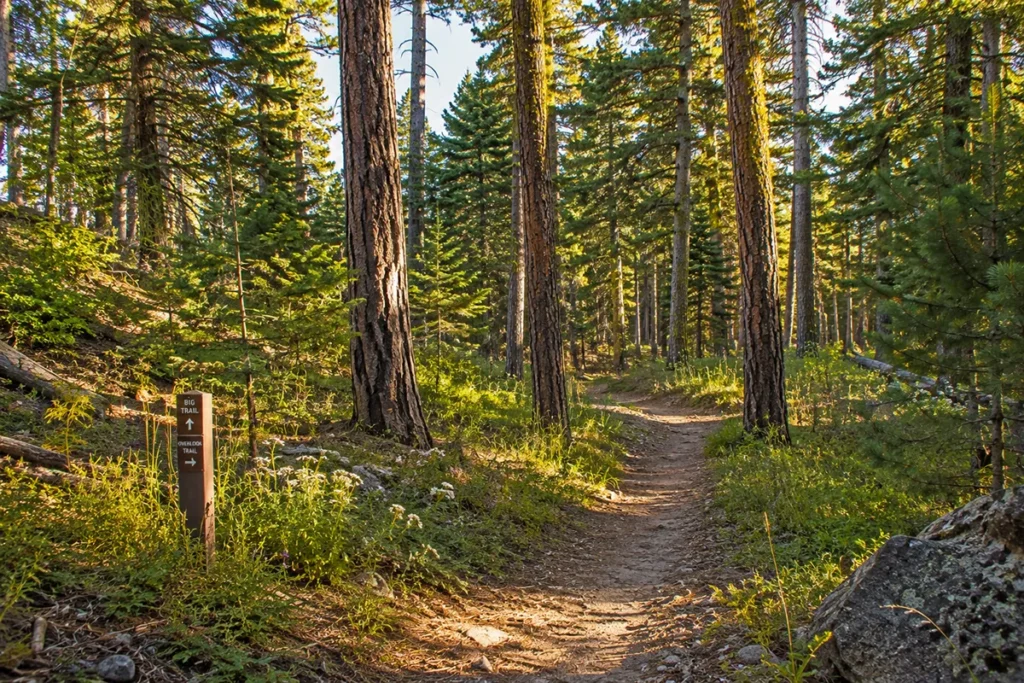
Lone Pine has roughly 7.5 miles of named trails, all connected, with the longest single trail running about 1.5 miles. The system is designed so you can chain trails to make a hike as short or long as you want.
Trail surfaces vary:
- Wide, well-surfaced trails near the visitor center (suitable for strollers in places)
- Single-track through the forested ridge
- Some steep sections gaining elevation toward the overlooks
Trail uses:
- All trails open to hiking and trail running
- About 2/3 of trails open to mountain biking
- Some trails open to horseback riding
- Snowshoeing in winter
- Cross-country skiing on appropriate sections in winter
- Hiker-only trails marked (yield rules: bikers yield to hikers and horses)
Recommended for first-time visitors: Stop at the visitor center, pick up the trail map, ask staff for the recommended loop based on your time and fitness. The longer loops (combining 3-4 named trails) make for a 60–90 minute walk that hits the major overlooks.
For families with young kids, the short trails near the visitor center area give plenty of nature time without major commitment. For visitors who want a workout, chaining the longer single-tracks together delivers a real morning hike with good elevation gain.
The Overlooks
The main reason to visit Lone Pine. The park has several developed overlook viewpoints along the ridge, each pointing east or southeast across the Flathead Valley. On a clear day, the views include:
- The Flathead Valley — agricultural land and forests stretching east toward the Mission Mountains
- Flathead Lake — the largest freshwater lake west of the Mississippi (visible to the south)
- The Mission Mountains — dramatic range east of the valley
- Big Mountain (Whitefish Mountain Resort) — visible to the north
- Jewel Basin Hiking Area — north end of the Swan Range, east-northeast
- Glacier National Park — peaks visible on the far eastern horizon, 30+ miles away
The best photography time is mid-to-late afternoon when the light hits the eastern mountains from the west. Bring a polarizing filter if you have one — the haze and atmospheric conditions can wash out the distant peaks otherwise.
Pro tip: Visit at sunset on a clear evening for the best light on Glacier’s peaks. The sun setting behind you puts the eastern peaks in dramatic glowing light.
The Visitor Center
Lone Pine’s visitor center is one of the better state-park interpretive facilities in Montana. The recently renovated building includes:
- Interactive interpretive displays on forest ecology, regional wildlife, and the Flathead Valley’s natural history
- A small gift shop with locally made items, field guides, and souvenirs
- Restrooms, water, and shelter from weather
- Self-guided audio tour content
- A staffed information desk where rangers can recommend specific routes and answer questions
Hours [verify 2026]:
- Wednesday–Saturday: 10 a.m.–3 p.m.
- Sunday: 12:30 p.m.–3 p.m.
- Closed Monday and Tuesday
- Some holiday closures (typically Nov 26–27, Dec 24–25, Dec 31, Jan 1)
The Monday–Tuesday closure trips up many visitors. Plan your Lone Pine visit for any other day of the week if you want the visitor center experience.
Year-Round Programming and Annual Events
Unlike most state parks that go quiet in winter or rely solely on self-directed visitation, Lone Pine runs a substantive year-round programming schedule. Some recurring events:
Raptor Day — Live bird-of-prey demonstrations and educational programs. One of the most popular annual events; brings hundreds of families.
National Trails Day — First Saturday of June. Guided hikes, trail maintenance volunteer opportunities, family activities.
National Public Lands Day — Late September. Volunteer events, conservation programming, special tours.
National Winter Trails Day — January or February. Free snowshoe rentals, guided winter hikes, hot beverages.
Star Gazing events — Periodic dark-sky viewing nights. Lone Pine’s elevation and tree cover make for surprisingly good stargazing despite proximity to Kalispell. See Montana night sky guide for the broader dark-sky context.
Children’s programs — Year-round nature programs, summer day camps, school-group field trips.
Adult workshops — Including birding workshops, foraging classes, backcountry skills (horsemanship, mule packing), and bat-box building.
Check the Montana FWP website or call the park directly for the current event calendar.
Wildlife at Lone Pine
This is a small park surrounded by residential and agricultural land, so the wildlife list is more modest than at remote state parks — but it’s not insignificant.
Common sightings:
- White-tailed deer (very common, often visible on trails)
- Songbirds and migratory species (the park is a recognized birding spot)
- Rabbits, squirrels, chipmunks
- Wild turkeys
Occasional sightings:
- Black bears (yes, even this close to Kalispell)
- Mountain lions (rare; transient through the park)
- Red foxes
- Coyotes
- Bobcats (almost never seen but present)
Bird life is the real draw for naturalists: Bald eagles overhead in winter, osprey along the Flathead corridor, several owl species, woodpeckers, hawks, and an extensive list of songbirds. The park keeps a birding checklist available at the visitor center. For broader context, see Montana bird species.
Bear awareness: Even though black bears are uncommon in the park, this is bear country. My Montana bear guide covers the basics. Bear spray on hikes is sensible practice; not strictly necessary but not unreasonable.
When to Visit: Month by Month
One of the few Montana state parks with genuine year-round appeal.
Spring (April–May): Wildflowers peak in May. Trails dry out as snowmelt drains. Light crowds. Montana in May covers the broader picture.
Summer (June–August): Peak season but never crowded by national park standards. Long days, warm temperatures, full visitor center hours. Montana in June, July, and August all work well.
Fall (September–October): My favorite season here. The deciduous trees in the park turn yellow and orange; the larches on surrounding ridges turn gold; the air is crisp; the crowds drop. Montana in September covers the broader timing.
Winter (November–March): The park stays open. Snowshoe rentals available at the visitor center. Cross-country skiing on appropriate trails. Cold but doable; the overlooks in winter with snow on the distant mountains are stunning. See Whitefish in winter for the broader context of winter in the Flathead Valley.
For year-round trip planning, best time to visit Montana covers regional patterns.
Pairing Lone Pine with the Glacier Trip
The strategic use case for almost every Lone Pine visitor:
The Classic 5-Day Glacier Itinerary with a Rest Day
- Day 1: Arrive Kalispell, settle into lodging, light walk at Lone Pine to acclimate
- Day 2: Going-to-the-Sun Road full day
- Day 3: Highline Trail or Iceberg Lake hike
- Day 4: REST DAY — morning at Lone Pine, afternoon in Whitefish or Bigfork, low-intensity dinner
- Day 5: Final park day, then departure
For the full Glacier deep dives, see the Glacier hub, best hikes in Glacier, Going-to-the-Sun Road, and where to stay in Glacier.
The Kalispell Half-Day
For travelers flying into Glacier Park International (FCA) early in the morning and not wanting to push into the park on arrival day: drive to Lone Pine, walk one of the longer loops, visit the overlooks, eat lunch at the picnic shelter, then drive to your Glacier lodging in the afternoon. Easy ramp into a Glacier trip.
The Pre-Departure Visit
For travelers leaving on an afternoon flight from FCA: morning visit to Lone Pine, then airport. The park is 15 minutes from the airport — much closer than driving back from East Glacier or Many Glacier.
The Multi-Stop Kalispell Day
Combine Lone Pine with other Kalispell attractions for a full non-Glacier day:
- Hockaday Museum of Art — Kalispell’s regional art museum, focused on Montana artists
- Northwest Montana History Museum — Local historical society museum
- Conrad Mansion — Restored 1895 Victorian home with tours
- Foys Lake — Adjacent to Lone Pine; swimming, fishing, paddling in summer
- Downtown Kalispell — Sun Rift Brewing, restaurants, shopping
- Mooses Saloon — One of Montana’s most famous old-school bars
This is one of the more underrated Montana day-trip combinations — Lone Pine in the morning, a museum in the afternoon, dinner in downtown Kalispell. See things to do in Kalispell for the broader options.
Pair with the Flathead Lake Towns
Lone Pine is a stop on the way to Bigfork, Lakeside, or Polson along Flathead Lake’s western shore. Add a Lone Pine morning stop to a Flathead Lake afternoon for a complete northwest Montana day. Things to do in Bigfork covers the lake-village side.
Pair with Other State Park Children
For the broader cluster, consider:
- Best for first-timers: Lone Pine + Lewis & Clark Caverns — the two most accessible Montana state parks, both family-friendly
- Best Glacier-area combination: Lone Pine + Giant Springs — different state parks at opposite ends of a Glacier-to-Great Falls road trip
- Best for families with varied interests: Lone Pine (kid-friendly, year-round) + Bannack State Park (ghost town) — different generations will gravitate to different aspects
- Best for accessibility: Lone Pine + Giant Springs — the two most wheelchair- and stroller-friendly state parks
Personal Tips: What I Wish I’d Known on My First Visit
Check visitor center hours. Monday and Tuesday closures trip up a lot of out-of-state visitors. Plan around them.
Bring binoculars for the overlooks. Glacier’s peaks 30 miles away pop into focus dramatically with even cheap binoculars.
Arrive in late afternoon for the best photos. Sunset light on the eastern peaks is the photographic highlight.
The trails connect. Don’t just walk one — chain two or three for a 60–90 minute loop that hits multiple overlooks.
Snowshoe rentals are a bargain. $5/person, $10/family for the day. Cheapest way to try snowshoeing if you’ve never done it.
Combine with Foys Lake. Foys Lake is right next door — swim in summer, ice skate in winter (when the lake freezes), or just stop for a picnic.
Bring a picnic. The picnic shelters are well-maintained and the views from them are exceptional. Pick up sandwiches at a Kalispell deli on the way out.
Cell service is reliable. Unlike most Montana state parks, you’re on the edge of Kalispell — coverage is normal. Useful for navigation and photos.
Watch for deer crossings on Foys Lake Road. Particularly at dawn and dusk. Drive carefully on the approach road.
Bring layers always. Elevation change between the visitor center and the high overlooks creates real temperature differences. A windbreaker is often welcome even in summer.
Self-guided audio tour content is worth using. Information at the visitor center will tell you how to access it via phone.
Practical Info Box
| Topic | Quick Answer |
|---|---|
| Address | 300 Lone Pine Road, Kalispell, MT |
| Day-use fee | $5/vehicle (non-resident); free for residents [verify 2026] |
| Visitor center hours | Wed–Sat 10 a.m.–3 p.m.; Sun 12:30 p.m.–3 p.m.; closed Mon–Tue [verify 2026] |
| Open year-round? | Yes |
| Trails total | 7.5 miles, all connected |
| Longest single trail | 1.5 miles |
| Camping | None (day-use only) |
| Pets allowed? | Yes, on leash on most trails |
| Time needed | 1–3 hours; full day with all activities |
| Closest airport | Glacier Park International (FCA), 15 minutes — see Montana airports |
| Driving distance from Kalispell | 10 minutes |
| Driving distance from West Glacier | 45 minutes |
| Driving distance from Whitefish | 25 minutes |
| Best for | Glacier rest day, families with young kids, visitors short on time |
| Pair with NPS | Glacier National Park (the primary use case) |
| Pair with state park child | Lewis & Clark Caverns, Giant Springs |
Conclusion: The Park That Solves a Real Problem
Lone Pine is the most useful state park in Montana for one specific reason: it solves the “what do we do today?” problem that haunts every multi-day Glacier itinerary.
The big park demands physical commitment; Lone Pine fills the gap. Whether that’s a half-day at the start of a trip, a rest day in the middle, or a final morning before flying out, the park’s accessibility, family-friendliness, and panoramic overlooks make it work in a way no other Montana site does.
My recommendation: don’t plan Lone Pine as a destination. Plan it as the buffer day in your Glacier trip. Plan it as the easy afternoon when the kids need to burn energy without another major hike.
Plan it as the place you take grandparents who want to see Glacier without driving four hours into the park. Used that way, Lone Pine becomes one of the most useful tools in the Montana travel kit — and a state park that has been welcoming visitors continuously since 1941 because Ernest and Hazel White decided to give their land away.
This is the deep-dive. For broader context:
- Montana state parks pillar guide — all 55+ state parks and how to choose
- Glacier National Park guide — the primary pairing
- Montana national parks pillar guide — broader federal-lands context
- Things to do in Kalispell — multi-stop Kalispell days
- Things to do in Montana and Montana bucket list — broader trip planning
Drop questions about Glacier rest-day planning, Kalispell-area itineraries, or the Lone Pine trail system in the comments — I’ll answer from experience.
FAQs About Lone Pine State Park
What is Lone Pine State Park famous for?
Lone Pine State Park is famous for its panoramic views of the Flathead Valley, Flathead Lake, and surrounding mountains. The park is a popular destination for hiking, mountain biking, wildlife viewing, and outdoor education near Kalispell.
Where is Lone Pine State Park located?
Lone Pine State Park is located on the southwestern edge of Kalispell in northwestern Montana. Its hilltop location provides spectacular overlooks of the Flathead Valley and nearby mountain ranges.
Is Lone Pine State Park worth visiting?
Yes. Lone Pine State Park offers some of the best viewpoints in the Flathead Valley, along with excellent hiking trails, family-friendly recreation, and easy access from Kalispell and Glacier National Park.
What can you do at Lone Pine State Park?
Popular activities include hiking, mountain biking, trail running, wildlife viewing, photography, snowshoeing in winter, picnicking, and participating in educational programs at the visitor center.
Are there hiking trails at Lone Pine State Park?
Yes. The park features several miles of multi-use trails suitable for hikers, runners, and mountain bikers. Trails range from easy walks to moderate climbs with rewarding scenic views.
Can you see Flathead Lake from Lone Pine State Park?
Yes. Many viewpoints within the park offer beautiful views of Flathead Lake, the Flathead Valley, and the surrounding mountain landscape, especially on clear days.
Is Lone Pine State Park family-friendly?
Absolutely. The park’s well-maintained trails, educational exhibits, picnic areas, and accessible visitor facilities make it a great destination for families with children.
Does Lone Pine State Park have a visitor center?
Yes. The Lone Pine Visitor Center features interactive exhibits, educational displays, wildlife information, and programs that help visitors learn about the natural and cultural history of the region.
Are dogs allowed at Lone Pine State Park?
Yes. Dogs are generally allowed on park trails and recreation areas but must be kept on a leash and under control according to park regulations.
What wildlife can you see at Lone Pine State Park?
Visitors may spot deer, black bears, foxes, coyotes, hawks, owls, songbirds, and a variety of other wildlife native to the Flathead Valley ecosystem.
Is there camping at Lone Pine State Park?
No. Lone Pine State Park does not offer camping facilities. However, numerous campgrounds are available nearby throughout the Flathead Valley and surrounding public lands.
What is the best time to visit Lone Pine State Park?
The park is enjoyable year-round. Summer and fall are popular for hiking and biking, while winter offers opportunities for snowshoeing and enjoying snow-covered views of the valley.
How much does it cost to visit Lone Pine State Park?
Montana residents generally receive state park access through the fee included with vehicle registration. Non-residents may need to pay a daily entrance fee or purchase an annual Montana State Parks Pass.
How long should you spend at Lone Pine State Park?
Most visitors spend two to four hours exploring the trails, enjoying the viewpoints, and visiting the educational center. Outdoor enthusiasts may choose to spend a half day or longer.
How far is Lone Pine State Park from Glacier National Park?
Lone Pine State Park is approximately 35 miles from Glacier National Park’s west entrance, making it a convenient stop for visitors exploring northwestern Montana.
Written by Robert Hayes, who has used Lone Pine as a Glacier rest-day so many times he’s lost count.