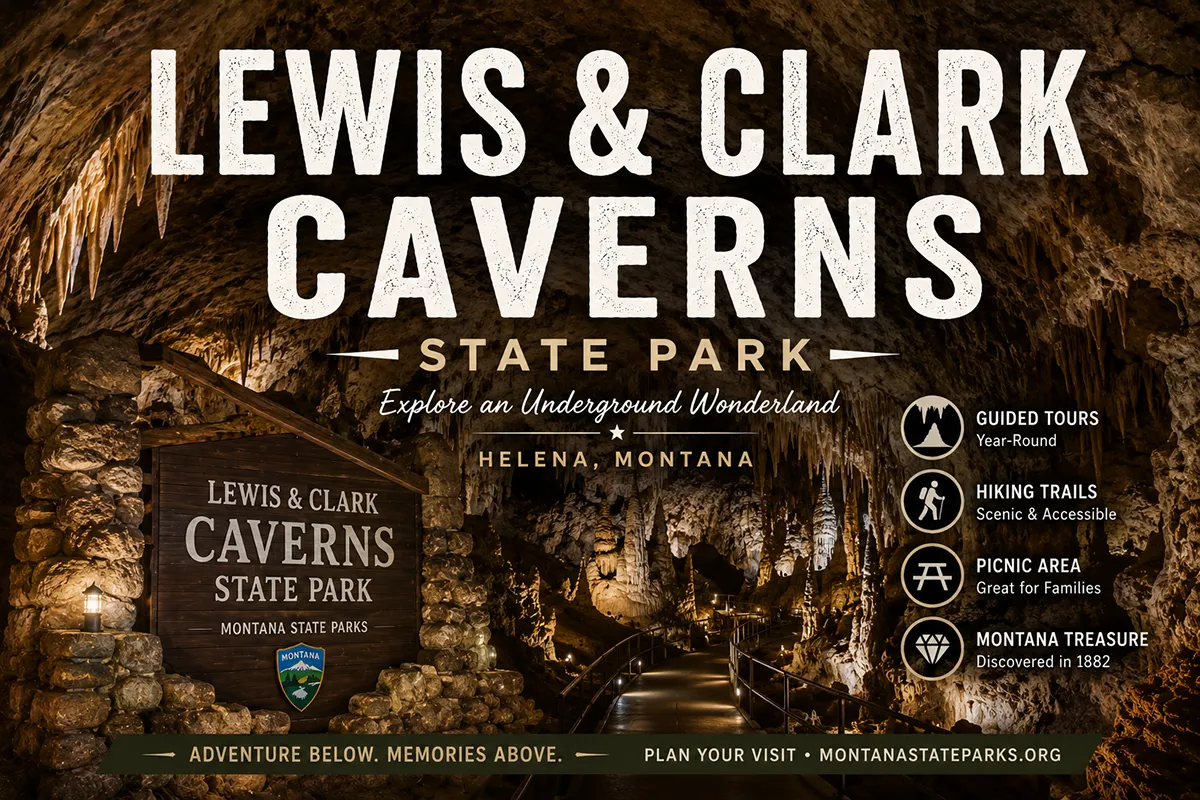
The first thing to know about Lewis and Clark Caverns is that Lewis and Clark never actually visited them. The expedition passed within a few miles in 1805 on their way up the Jefferson River, but the cave system itself wasn’t known to non-Indigenous explorers until hunters stumbled onto it in 1892. The naming is honorary — and the park itself is genuinely one of Montana’s underrated wonders.
TL;DR: Lewis and Clark Caverns is Montana’s first state park (established 1935) and one of the most highly decorated limestone cave systems in the Northwest. Theodore Roosevelt originally designated it as a National Monument in 1908 — the first west of the Mississippi — before it was transferred to Montana. Cave tours run May 1 through September 30, with reservation-only booking from Memorial Day through Labor Day (24 hours in advance). Two tour types: the strenuous 2-hour Classic Tour (with the famous slide) and the easier 90-minute Paradise Tour. December candlelight tours are the off-season highlight. Located 15 miles southeast of Whitehall on Montana Highway 2 — a natural midpoint stop between Glacier and Yellowstone.
I’m Robert Hayes, and I’ve done both tour options at Lewis and Clark Caverns multiple times, in summer and during the December candlelight season.
It’s the kind of state park experience that surprises first-time visitors — you don’t expect a 3,000-foot underground passage with cathedral-room formations to be sitting 15 miles off I-90 in southwestern Montana.
But it’s been delighting travelers since 1908, and the 2026 reservation system has made the visit more pleasant than ever.
This is the deep-dive guide. For the broader Montana state parks landscape, see my Montana state parks pillar guide.
Lewis and Clark Caverns is the most natural state park to pair with a Yellowstone trip or a Glacier-to-Yellowstone road trip — see my Montana national parks pillar guide for the broader routing.
Liked this article?
Add Roaming Montana as a preferred source so you see more of our articles and guides on Google.
Quick Stats
| Stat | Detail |
|---|---|
| Park size | 3,015 acres |
| Elevation | 4,921 feet (cave entrance higher) |
| Location | 15 miles SE of Whitehall on Montana Highway 2 |
| Established | 1935 (Montana’s first state park) |
| Original designation | 1908 National Monument (Theodore Roosevelt) |
| Cave system length | ~3,000 feet of mapped passage |
| Cave temperature | Constant 50°F year-round |
| Tour season | May 1 – September 30 (plus December candlelight) |
| Reservation required? | Yes, Memorial Day through Labor Day (24 hours in advance) |
| Tour booking phone | 1-855-922-6768 |
| Tour types | Classic (2 hours) and Paradise (90 minutes) |
| Annual visitors (2023) | ~47,000 |
| Camping | 40+ sites + cabins + tipi rental |
| Day-use fee [verify 2026] | $8/vehicle (non-resident) + tour ticket |
A History Most Visitors Don’t Know
The cave system was discovered (by non-Indigenous people) in 1892 by hunters Tom Williams and Bert Pannell, who entered the original opening and were astonished at what they found.
Local rancher Dan Morrison subsequently developed crude tours for paying visitors throughout the 1890s, including dynamite-blasting a more accessible entrance — which damaged some original formations but made the cave system visitable for ordinary people.
In 1908, President Theodore Roosevelt designated the caverns as “Lewis and Clark Cavern National Monument” — the first National Monument west of the Mississippi River.
The federal designation was political (it followed disputes over private exploitation of the cave) more than scientific, but it locked in protection.
Operations were inconsistent through the early 1900s — the federal government wasn’t equipped to run a tourist cave — and in 1935 the property was transferred to the State of Montana, becoming Montana’s first state park.
The Civilian Conservation Corps (CCC) did the real work that made modern tours possible. From 1935 to 1941, CCC crews cut stairs into the cave’s stone passages, installed lighting, built the visitor center and the trail up to the cave entrance, and constructed the original park infrastructure.
The stairs you walk down inside the cave today were carved by hand by CCC workers nearly a century ago.
The name itself: Lewis and Clark and their Corps of Discovery did pass through this area in 1805 — the expedition followed the Jefferson River past the cave’s hill. But they had no knowledge of the cave system. The naming honors the proximity of their route, not any actual exploration.
The Two Tour Options: Which Should You Choose?
For 2026, Lewis and Clark Caverns offers two main guided tour options. Choosing between them is the most important pre-trip decision.
The Classic Tour (2 hours, more strenuous)
The original full tour. Approximately 2 hours from the trailhead. Covers roughly a mile of underground passage including the major rooms (the Paradise Room, the Cathedral Room, the Garden of the Gods), and the famous slide — a polished limestone chute you descend on your butt to drop between cave levels. Stairs (many of them, often steep), stooping under low ceilings, and tight squeezes are part of the experience.
The Classic Tour requires:
- Reasonable physical fitness
- The ability to climb stairs without aid
- Comfort in tight spaces (some passages are 4 feet high)
- Willingness to slide
- About 2.5 hours total including the ¾-mile uphill walk to the cave entrance
Best for: Most able-bodied adults, kids ages 8+, anyone who wants the iconic Lewis and Clark Caverns experience. Not recommended for: Visitors with mobility limitations, claustrophobia, knee or hip issues, or fear of tight underground spaces.
The Paradise Tour (90 minutes, easier)
A shorter, less strenuous tour added in recent years. About one mile total. Visits the Paradise Room — the largest chamber in the system — with minimal stairs and mostly level pathways. No slide.
The Paradise Tour is suitable for:
- Families with younger children (ages 5+)
- Older travelers
- Visitors with moderate mobility limitations
- People who want to see the formations without the physical challenge
Important note: Even the “easier” Paradise Tour still requires the ¾-mile uphill walk from the trailhead to the cave entrance. This is the part most travelers underestimate.
My Honest Recommendation
The Classic Tour is the real Lewis and Clark Caverns experience. The slide alone is worth doing once in your life, and the lower-cave passages have formations you can’t see on the Paradise route. If you and your group can physically handle it, take the Classic.
The Paradise Tour is genuinely beautiful and not a consolation prize — the Paradise Room is the most impressive single chamber in the system and the Paradise Tour gets the full time to appreciate it.
The Walk to the Cave Entrance
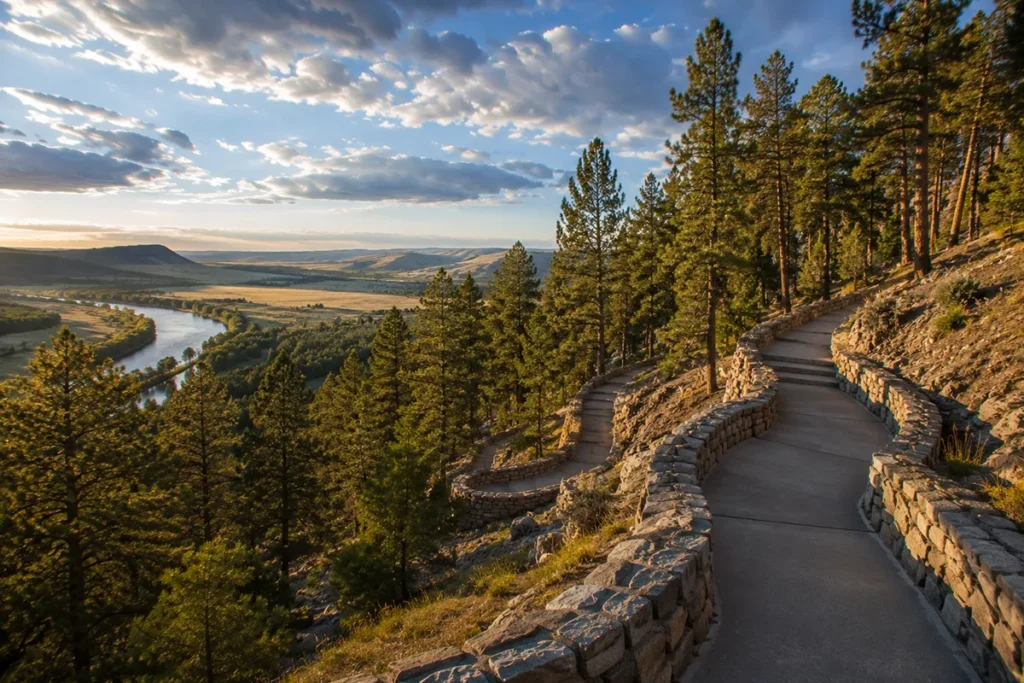
This is the most overlooked aspect of a Lewis and Clark Caverns visit, and the one that surprises travelers most. The visitor center and parking area are at the bottom of a hill. The cave entrance is at the top, roughly ¾ mile up a paved trail with significant elevation gain.
You will walk:
- ¾ mile uphill, on a paved path, with switchbacks
- Through ponderosa pine forest with great Jefferson River valley views
- For roughly 20–30 minutes depending on pace
- Before you even start the cave tour
Strollers do not work on the trail. Wheelchair accessibility is limited — though there is a small electric shuttle available for visitors who can’t manage the climb on certain days. Call ahead to confirm shuttle availability if needed.
Bring water for the walk up, especially in summer. The trail can be exposed and hot midday. The cave itself is 50°F regardless of season.
What You’ll See Inside
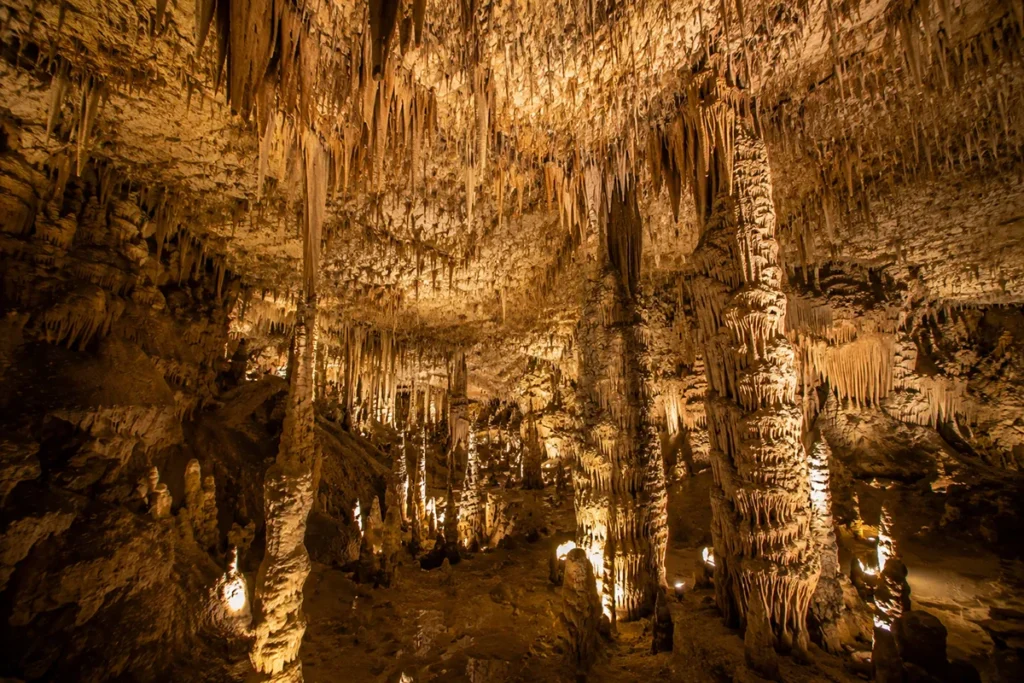
The cave system is what speleologists call “highly decorated” — meaning it has a remarkable density and variety of formations. What you’ll encounter:
Stalactites — formations growing down from the ceiling. Lewis and Clark Caverns has thousands, ranging from soda-straw thin to massive draperies several feet thick.
Stalagmites — formations growing up from the floor. The Cathedral Room features stalagmites over 10 feet tall.
Columns — formed when a stalactite and stalagmite meet. Several massive columns punctuate the major chambers.
Helictites — the rare and strange ones. Helictites are tiny calcite formations that grow sideways, twisting against gravity. The mechanism by which they form isn’t fully understood. Lewis and Clark Caverns has exceptional helictite displays.
Cave popcorn — bumpy mineral deposits that look exactly like popcorn, formed by evaporation along passage walls. The walls of several passages are entirely covered.
Drapery formations — thin, undulating sheets that look like stone curtains, formed when water flows down at an angle.
The Paradise Room — the largest chamber. The Paradise Tour focuses entirely on this room, and the Classic Tour spends significant time here. Cathedral-room scale, dramatic lighting installed by the CCC, and the densest formation concentration in the system.
The temperature is a constant 50°F year-round. You will want a light jacket or sweatshirt, even in summer. Several passages have water dripping from the ceiling — formations are still actively growing — so a hat helps too.
The 2026 Reservation System
This is new and worth understanding clearly.
From Memorial Day (late May) through Labor Day (early September):
- All tours by reservation only
- Reservations must be made at least 24 hours in advance
- Book through stateparks.mt.gov or by phone at 1-855-922-6768
- Tours cannot be purchased by calling the park directly
- Walk-up tickets are not available during peak season
Shoulder seasons (May 1 to Memorial Day; Labor Day to September 30):
- First-come, first-served if unsold tickets remain
- Reservations still recommended
My recommendation: Reserve as soon as you have firm trip dates, even in shoulder season. Peak summer weekends sell out days in advance. Weekday morning tours have the best availability.
December Candlelight Tours: The Best-Kept Secret
For two weekends in December [verify exact 2026 dates], the park reopens specifically for candlelight tours. Tour guides lead small groups through the same cave passages by candle and lantern light only — no electric lighting.
The candlelight experience is fundamentally different from the summer tours. The formations look entirely new. The atmosphere is more contemplative, almost reverent. Group sizes are smaller. And the heated cabins (see camping section) make for one of the most distinctive winter experiences in Montana.
Practical notes for candlelight tours:
- Sells out months in advance — book in October or earlier
- Tours run regardless of weather; the cave is always 50°F
- Tour fee is higher than summer tours
- Limited dates only — check the Montana FWP website
For broader December trip context, Christmas in Montana covers the seasonal landscape.
Camping, Cabins, and Tipi Rental
Lewis and Clark Caverns has one of the better state park lodging operations in Montana.
40+ campsites — Reservable through montanastateparks.reserveamerica.com from May 15 through September 20. Mix of tent and RV sites; some with electric hookups, some primitive. Shower and comfort station available.
Heated cabins — Several rentable cabins available year-round. Sleeping for 2–4 people, electric heat, electric outlets, basic furnishings (bunks, table). You bring your own bedding and cookware. The cabins are the best winter lodging option for the candlelight tours.
Tipi rental — Furnished tipi available along Cave Creek for a unique camping experience. Books well in advance for summer weekends.
Group sites — Reservable for larger gatherings.
For RV-specific guidance in the broader Three Forks / Bozeman / Butte corridor, see Montana’s best RV parks.
Above-Ground: Trails, Café, and Jefferson River Access
Most travelers focus on the cave and miss what’s outside.
Hiking and biking trails — Roughly 10 miles of trails through the park, ranging from the cave-access trail to longer loops climbing the surrounding hills. Best done before or after the cave tour.
The park café — Open during peak season at the visitor center. Basic but decent food; useful given the park’s relative isolation.
Jefferson River access — Several Montana FWP fishing access sites are nearby on the Jefferson River, offering fly fishing for brown and rainbow trout, plus float-trip launching for canoes and kayaks. The Jefferson is one of the headwater rivers of the Missouri — Lewis and Clark followed it upstream in 1805.
Wildlife — Mule deer, elk, wild turkeys, and occasionally bighorn sheep on the surrounding cliffs. Black bears are present but rarely seen near the developed areas. Bear safety still applies; see my Montana bear guide for the basics.
Best Time to Visit: Month by Month
May: Excellent shoulder season. Cave tours start May 1. Cool weather, light crowds, first-come-first-served tour booking. Montana in May covers the broader picture.
June: Cave is open, weather warming, crowds building. Reservations required from Memorial Day. Montana in June.
July–August: Peak season. Tours fill up. Reserve well in advance. Surrounding heat above ground is genuine; cave is 50°F regardless.
September: My favorite month. Reservations no longer required after Labor Day if unsold tickets remain; weather is dry and clear. Montana in September.
October: Cave tours end September 30. The above-ground park remains open for trails and camping in good weather. Montana in October.
November: Quiet. Visitor center open shorter hours; no cave tours. Montana in November.
December: Candlelight tour weekends only. Book months in advance. Montana in December.
January–April: Visitor center open daily 10 a.m.–4 p.m., but no cave tours. Heated cabins available year-round. Trails accessible weather permitting.
For broader Montana seasonal planning, best time to visit Montana covers the regional patterns.
Pairing Lewis and Clark Caverns with a Larger Trip
Lewis and Clark Caverns sits perfectly between Glacier and Yellowstone — making it the single most useful state park to add to a national parks itinerary.
The Glacier-to-Yellowstone Road Trip Midpoint
This is the natural use case. Driving south from Glacier National Park to Yellowstone National Park, Lewis and Clark Caverns is on the route via I-15 and I-90. Stop for a 2-hour cave tour, camp overnight, continue on to West Yellowstone or Gardiner the next day.
The Three Forks History Loop
Lewis and Clark Caverns is 30 minutes from Missouri Headwaters State Park — the spot where the Jefferson, Madison, and Gallatin rivers merge to form the Missouri. Add Madison Buffalo Jump State Park (Indigenous buffalo jump site) for a full day of southwest Montana history.
The Bozeman Day Trip
From Bozeman, Lewis and Clark Caverns is 45 minutes west on I-90. A perfect day trip from a Bozeman base — leave at 8 a.m., do the morning tour, lunch at the café, hike a trail, return to Bozeman by mid-afternoon. Pair with a soak at Bozeman Hot Springs to end the day.
The Yellowstone Pre/Post-Trip Stop
If you’re flying into Bozeman Yellowstone (BZN), Lewis and Clark Caverns makes an ideal pre- or post-Yellowstone day. It introduces the geology, gives a contrast experience to the surface-level wonders of Yellowstone, and works as a buffer day for adjusting to elevation. Pair with Chico Hot Springs in Paradise Valley for the full southwest Montana sample.
Personal Tips: What I Wish I’d Known on My First Visit
Wear closed-toe shoes with good tread. The cave floor is wet in places, uneven, and the slide is on polished limestone. Hiking shoes or sneakers — not sandals, not flip-flops.
Bring layers. The ¾-mile walk up to the cave entrance can be hot in summer. The cave is 50°F. The walk down afterward, in shadow, can be cool. Layers solve all of this.
Don’t try to do both tours in one day. It’s logistically possible but exhausting and redundant — most of the Paradise Tour content is also covered on the Classic Tour.
Use the restrooms at the visitor center before the trail walk. No facilities at the cave entrance.
Don’t bring a backpack into the cave. Small bags are fine; full hiking packs are discouraged. They snag in the tight passages.
Cell service is unreliable on the property. Coverage is fine in Whitehall and along I-90; spotty at the park.
The slide is optional but heavily encouraged. Even kids do it. If you’re physically able, just do it.
Take photos in the lit chambers. The cave guides will pause for photography in the Paradise Room and Cathedral Room. Phone cameras work fine; flash is allowed.
Eat in Whitehall after. Whitehall is small but has a few solid restaurants. Better than the park café if you have time.
Pair with Other State Park Children
For the broader cluster, consider:
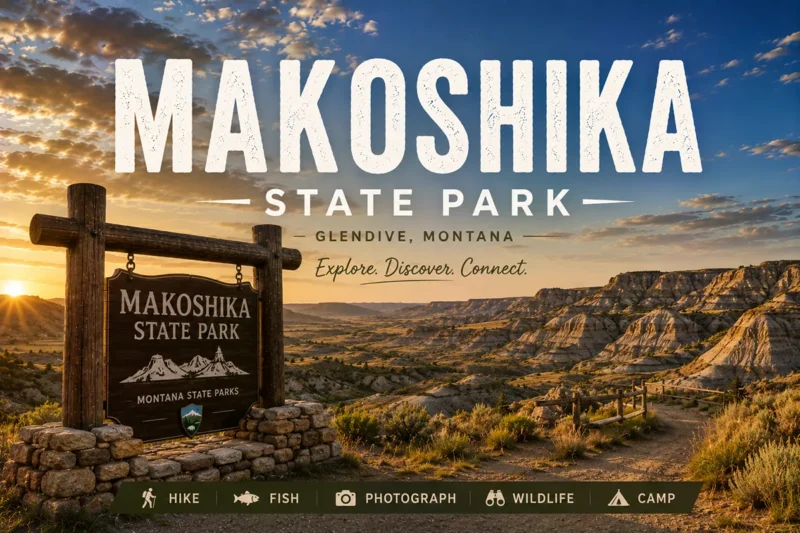
- Best for geology depth: Lewis and Clark Caverns + Makoshika State Park (badlands and dinosaur fossils) for the Montana underground-to-aboveground geology tour
- Best for first-state-park visitors: Lewis and Clark Caverns + Lone Pine State Park (Kalispell, near Glacier) — the two most accessible state parks in the cluster
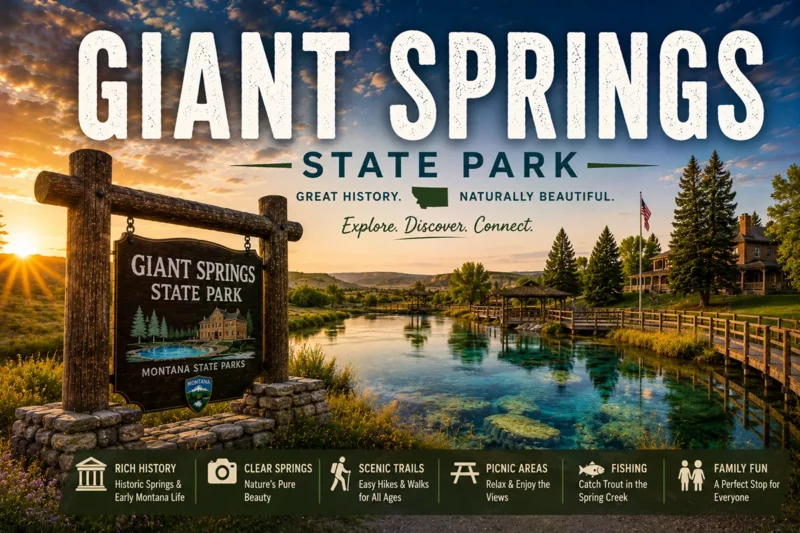
- Best for family travel: Lewis and Clark Caverns + Giant Springs State Park (Great Falls) — both are universally engaging for kids
Practical Info Box
| Topic | Quick Answer |
|---|---|
| Cave tour season | May 1 – September 30 (plus December candlelight) |
| Reservations required | Yes, Memorial Day – Labor Day (24 hours ahead) |
| Tour reservations | stateparks.mt.gov or 1-855-922-6768 |
| Cave temperature | Constant 50°F |
| Walk to cave entrance | ~3/4 mile uphill from visitor center |
| Two tour types | Classic (2 hours, with slide) or Paradise (90 min, easier) |
| Camping reservations | montanastateparks.reserveamerica.com |
| Heated cabins | Available year-round |
| Closest town | Whitehall (15 miles NW) |
| Closest airport | Bozeman Yellowstone (BZN), 60 miles east |
| Driving distance from Bozeman | 45 miles (~50 min) |
| Driving distance from Butte | 50 miles (~50 min) |
| Glacier-to-Yellowstone routing | Natural midpoint stop |
| Pair with NPS | Yellowstone, Glacier |
| Pair with state park child | Makoshika, Giant Springs, Lone Pine |
Conclusion: Montana’s Underground Treasure
If Montana’s state parks have a flagship, Lewis and Clark Caverns is it. The combination of dramatic underground scenery, accessible location between two national parks, multiple tour options for different ability levels, and the December candlelight tours makes this the single most versatile state park in the system.
It’s the only cave system of this scale in the Northwest, and the fact that it’s been welcoming visitors continuously since 1908 means the operation is genuinely refined.
My recommendation: book a Classic Tour for any reasonably fit traveler, do it as a 2-day stop on a longer Montana itinerary (camp overnight or stay in a cabin), and pair it with the surrounding southwest Montana attractions.
If you’re choosing one state park to add to a Glacier-and-Yellowstone trip, choose this one. If you’re choosing one Montana state park to introduce kids to geology, the Classic Tour with the slide will sell them on it forever.
This is the deep-dive. For broader context:
- Montana state parks pillar guide — all 55+ state parks and how to choose
- Montana national parks pillar guide — the federal counterpart
- Yellowstone National Park guide — natural pairing partner
- Glacier National Park guide — the northern half of the road trip
- Things to do in Montana and Montana bucket list — broader trip planning
Drop questions about the tour types, the reservation system, or the candlelight tours in the comments — I’ll answer from experience.
FAQs About Lewis & Clark Caverns State Park
What is Lewis & Clark Caverns State Park famous for?
Lewis & Clark Caverns State Park is famous for its spectacular limestone caves filled with stalactites, stalagmites, columns, and other impressive underground formations. It is Montana’s first and one of its most popular state parks.
Where is Lewis & Clark Caverns State Park located?
Lewis & Clark Caverns State Park is located in southwestern Montana between Butte and Bozeman, near the town of Whitehall. The park sits above the Jefferson River Valley and offers scenic views of the surrounding mountains.
Are the caverns at Lewis & Clark Caverns State Park natural?
Yes. The caverns were naturally formed over millions of years as water dissolved limestone rock and created a complex underground cave system filled with beautiful mineral formations.
Can you explore the caves without a guide?
No. The caverns can only be visited through guided tours led by park staff. Guided tours help protect the fragile cave environment while providing visitors with information about the cave’s geology and history.
How long is the Lewis & Clark Caverns tour?
Most guided cave tours last about two hours. Visitors should expect to walk approximately two miles, including stairways, slopes, and uneven surfaces within the cavern system.
Are cave tour reservations required?
Reservations are highly recommended, especially during the busy summer season. Tour availability can sell out quickly, so booking in advance is the best way to secure a spot.
Is Lewis & Clark Caverns State Park worth visiting?
Absolutely. The park offers one of the most impressive cave systems in the Northwest, along with scenic hiking trails, wildlife viewing opportunities, camping, and beautiful mountain landscapes.
What should I wear for a cave tour?
Visitors should wear sturdy walking shoes and comfortable clothing. The caves maintain cool temperatures year-round, so bringing a light jacket or sweatshirt is recommended.
How large are the Lewis & Clark Caverns?
The cave system contains several miles of mapped passageways and chambers. Guided tours visit some of the most spectacular sections featuring extensive limestone formations and underground rooms.
Can children visit Lewis & Clark Caverns?
Yes. Many families visit the caverns each year. However, the cave tour involves walking, stairs, and some narrow sections, so parents should consider their children’s comfort and mobility levels.
Is there camping at Lewis & Clark Caverns State Park?
Yes. The park offers campsites, cabins, picnic areas, and other visitor facilities, making it a popular destination for overnight stays and outdoor recreation.
What wildlife can be seen in Lewis & Clark Caverns State Park?
Visitors may spot mule deer, elk, bighorn sheep, hawks, eagles, and a variety of smaller mammals and birds throughout the park’s grasslands and forested areas.
What are the best things to do besides the cave tour?
Popular activities include hiking scenic trails, camping, wildlife watching, photography, picnicking, and enjoying panoramic views of the Jefferson River Valley.
When is the best time to visit Lewis & Clark Caverns State Park?
The most popular time to visit is from late spring through early fall when cave tours operate regularly and hiking trails are fully accessible. Summer offers the widest range of visitor services and activities.
Why is Lewis & Clark Caverns State Park important?
The park protects one of the largest and most impressive limestone cave systems in the Rocky Mountain region. It also preserves important geological features while providing educational and recreational opportunities for visitors.
Written by Robert Hayes, who has done the slide more times than is strictly necessary.