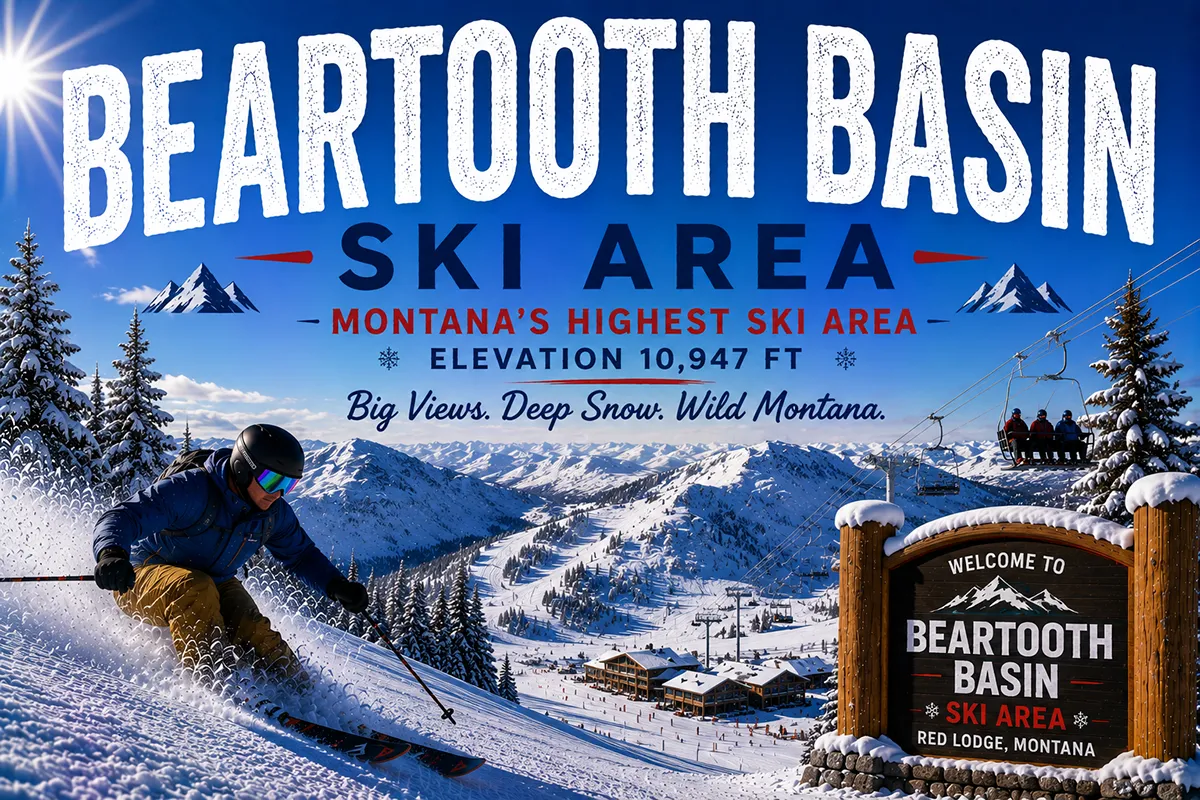
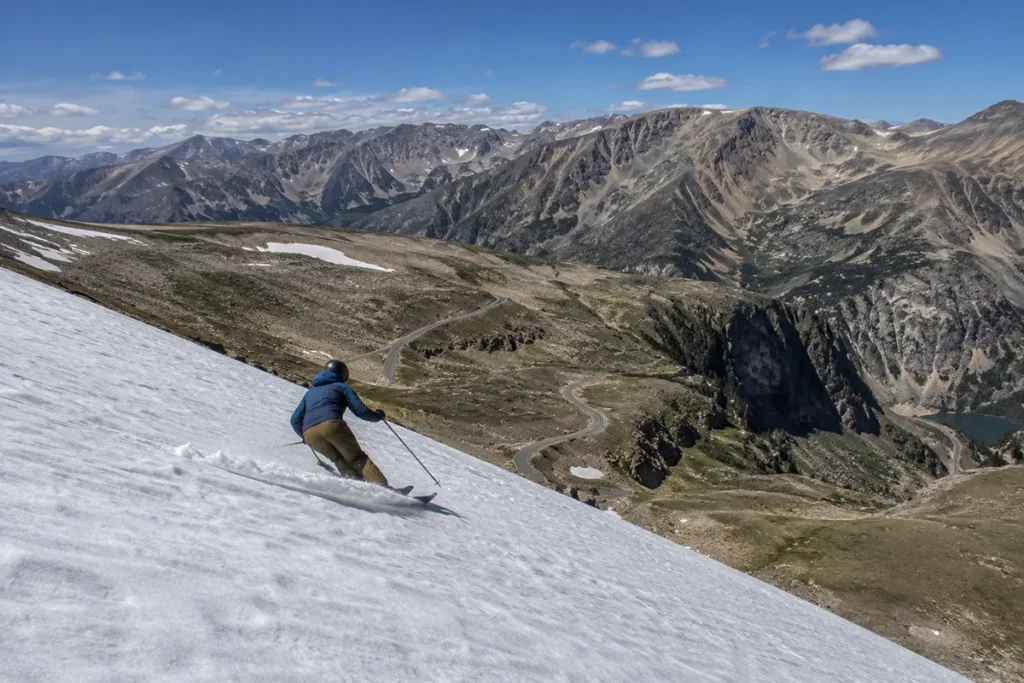
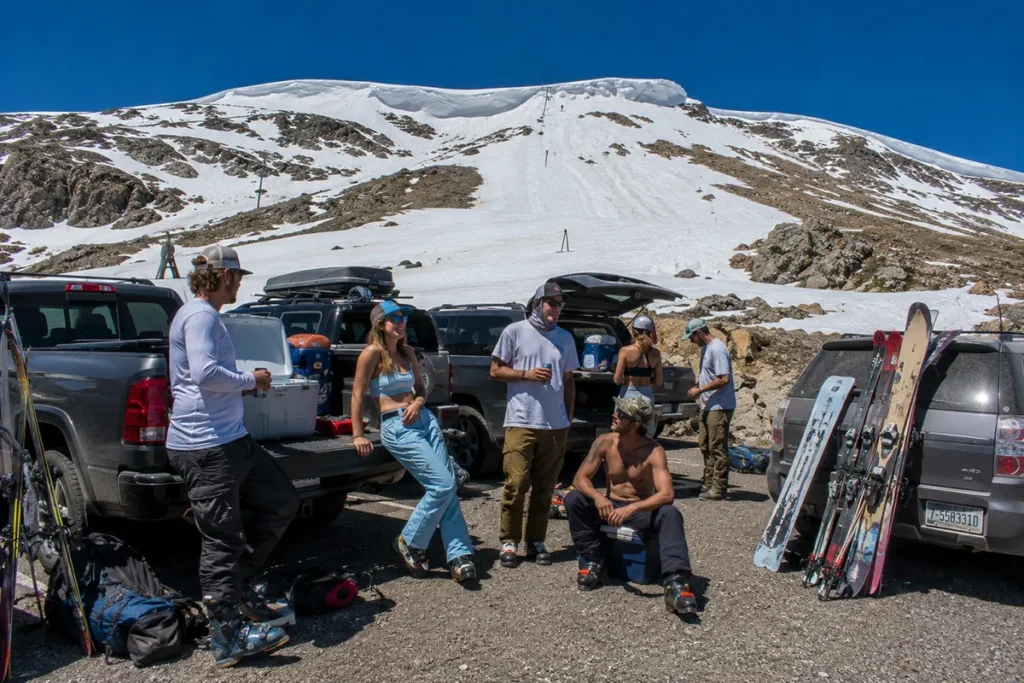
I drove up the Beartooth Highway on a Saturday in late June in shorts and a t-shirt, parked at 10,900 feet, layered into ski gear in the parking lot, and clicked into skis ten yards from my open car door.
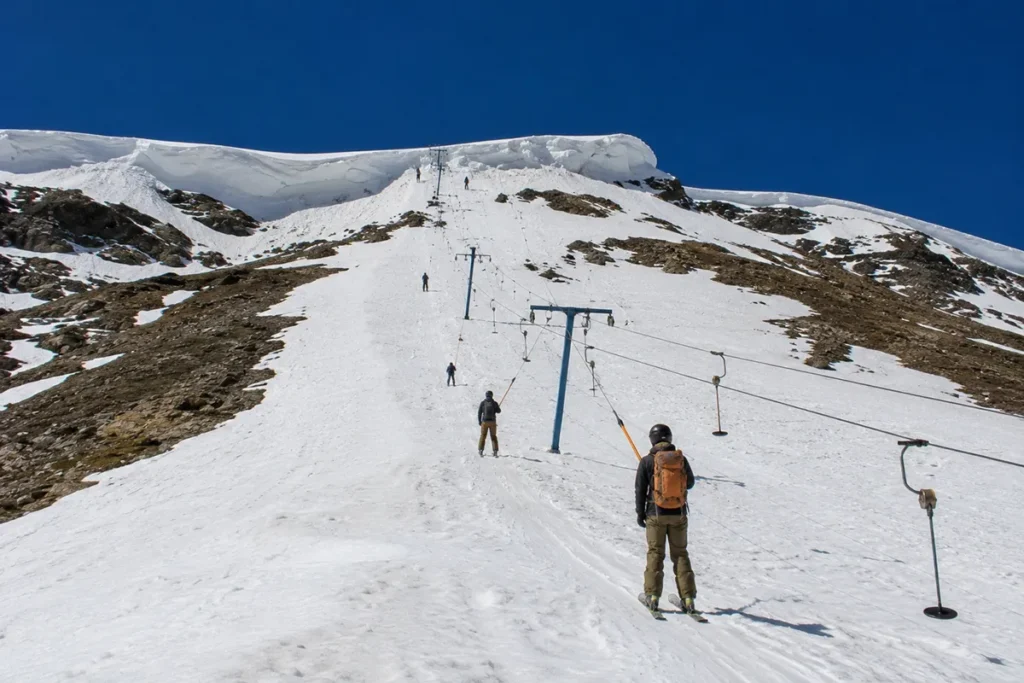
By 11 AM I was riding a Poma lift on a permanent snowfield. By 1 PM I was eating lunch on a tailgate, watching marmots scurry across exposed rock. Twenty miles south, Yellowstone tourists were complaining about the heat.
- Beartooth Basin Summer Ski Area sits at 10,900 feet at Beartooth Pass on the Wyoming-Montana border in Park County, Wyoming
- North America’s only summer-only ski area — opens around Memorial Day, typically closes by early/mid-July
- Mailing address is in Montana; physical location is in Wyoming (yes, really)
- 600 acres of skiing on the Twin Lakes Headwall, 9 named runs, 2 Poma surface lifts — no chairs, no lodge, no warming hut
- 1,000 feet of lift-served vertical on terrain ranging from 15 to 50 degrees in steepness
- Adjacent 3,000 vertical feet of shuttled or hike-in backcountry terrain
- 2026 season opened Memorial Day (May 25, 2026) — 64th season since the 1960s
- 2024 season cancelled entirely due to insufficient snowpack; 2026 has come back strong
- Day tickets are $50; season passes $395
- The right trip if you want a uniquely North American skiing experience and you’re comfortable with backcountry-style logistics; the wrong trip for beginners, families with non-skiers, or anyone unfamiliar with altitude
Liked this article?
Add Roaming Montana as a preferred source so you see more of our articles and guides on Google.
Why Beartooth Basin Is the Most Unique Ski Experience in North America
You can find summer skiing in a handful of places. Mt. Hood’s Timberline Lodge operates a glacier-based area on Palmer Snowfield through July or August.
Mammoth Mountain extends its season into July in big snow years. Whistler Blackcomb operates Horstman Glacier into August.
Beartooth Basin is different from all of these. It’s the only ski area in North America that is exclusively a summer operation. There is no winter season at all.
The road that leads to the resort is closed from October through May. The Poma lifts don’t run until the snow has stopped accumulating. The mountain is genuinely a summer-only experience.
The combination of factors that make this work:
- 10,900 feet of elevation at the base — among the highest ski-area base elevations in North America
- Twin Lakes Headwall holds a permanent snowfield that lasts well into summer
- The Beartooth Highway is closed in winter, so the resort can’t operate anyway
- U.S. Forest Service special use permit allows ski-area operations on non-wilderness land within the Shoshone National Forest
This is part of our complete guide to Montana ski resorts — and Beartooth Basin is one of two ski areas (with Yellowstone Club) that I include despite both being technically unusual cases.
Beartooth Basin’s mailing address is in Montana even though the resort itself is in Wyoming. The Montana ski-skier identity is real here even if the state boundary is technically Wyoming-side.
Where Beartooth Basin Actually Is (Wyoming vs. Montana)
This is the part most articles get confused about, so let me be direct.
Beartooth Basin Summer Ski Area is physically located in Park County, Wyoming, on the Shoshone National Forest, at Beartooth Pass on the U.S. Route 212 (the Beartooth Highway). The Wyoming-Montana state line runs near but not through the resort.
However, the resort’s mailing address is in Montana, which is why Beartooth Basin is frequently described as a Montana ski area — and why most regional ski coverage (including this guide) treats it as part of Montana’s ski landscape. The closest substantial town is Red Lodge, Montana, 23 miles north via the Beartooth Highway.
Getting there:
- From Red Lodge, Montana: 23 miles south via the Beartooth Highway (about 1 hour due to switchbacks)
- From Cooke City, Montana: about 25 miles east via Beartooth Highway (about 45 minutes)
- From Cody, Wyoming: about 85 miles via the Chief Joseph Scenic Byway and Beartooth Highway (about 2 hours)
- From Billings, Montana: about 80 miles south via Red Lodge (about 2 hours)
- From Yellowstone’s northeast entrance (Cooke City area): about 25 miles east
Beartooth Highway: The Only Way In
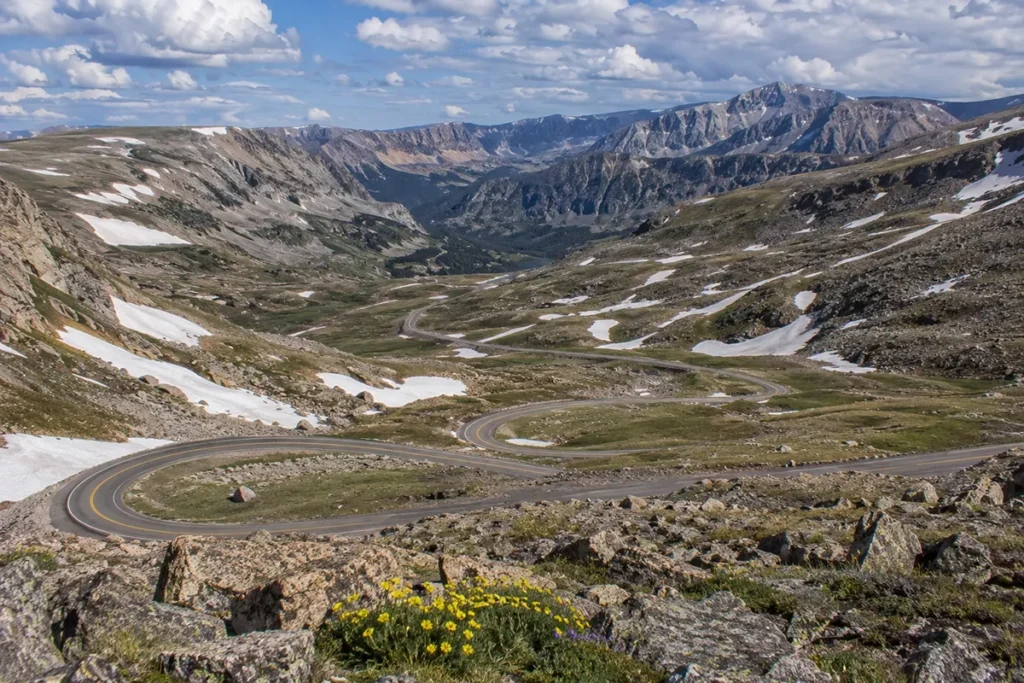
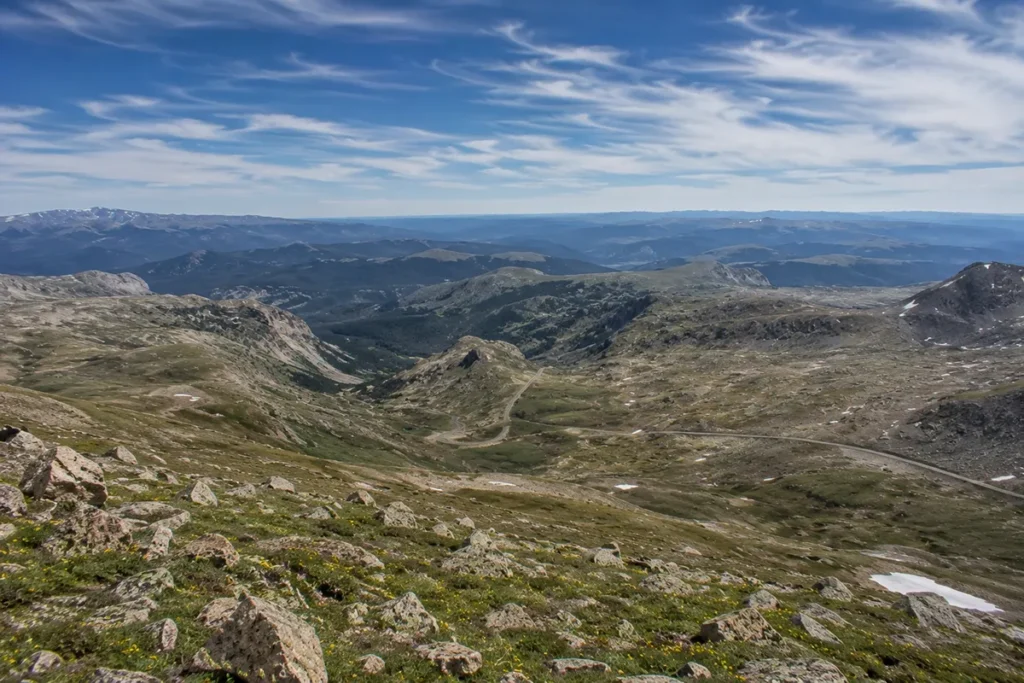
The Beartooth Highway (US-212) is the only road access to Beartooth Basin. This highway is one of the most dramatic in North America — designated as both an All-American Road and a National Scenic Byway, climbing over 10,000 feet across the Beartooth Plateau with dramatic switchbacks and panoramic mountain views.
The critical practical fact: The Beartooth Highway is closed from approximately mid-October through late May or early June each year.
The road simply cannot be plowed reliably given the elevation and snow accumulation — snow drifts of 3-5 feet are common, and avalanche risk above the road is significant.
The 2026 opening dates:
- Beartooth Highway opened: May 22, 2026
- Beartooth Basin opened: Memorial Day, May 25, 2026
Once the highway opens, the ski area typically takes a few days for safety checks before opening lifts. The 2026 season is the 64th since the resort’s founding in the mid-1960s.
For broader summer Montana planning, see Montana in May, Montana in June, and Montana in July.
The History: From 1960s Race Camp to Public Ski Area
Beartooth Basin opened in the mid-1960s as a race training camp, established by a group of Austrian ski racers and coaches looking for late-spring and summer snowpack to extend their training season.
For decades, the operation remained primarily a private training camp. Elite ski racers from across North America would arrive at Beartooth Pass in May, June, and July for hard-snow conditions perfect for technical training.
The mountain became an institution in U.S. Ski Team development — many of the country’s top racers from multiple Olympic generations spent summer time at Beartooth Basin.
The public opening came later, with Beartooth Basin operating under U.S. Forest Service permits as both a race-camp training facility and a publicly-accessible ski area.
Today, the resort operates as a hybrid — race camps still use the terrain during specific weeks, with the mountain otherwise open to the general public.
The current ownership is a small group of dedicated, die-hard skiers committed to maintaining the unique summer ski tradition.
Justin Modroo is one of the current co-owners and the public face of the operation in many recent media interviews.
The team has weathered multiple difficult seasons (including the cancelled 2024 season) through sheer commitment to the experience.
The 2026 season marks the 64th year of operation — making Beartooth Basin one of the longer-tenured summer ski operations in North America.
The Terrain: 600 Acres, 1,000 Feet, and Real Steeps
Beartooth Basin’s footprint covers approximately 600 acres on the Twin Lakes Headwall, with terrain that ranges from 15 degrees to 50 degrees in pitch. The 1,000-foot lift-served vertical drop is modest, but the terrain quality and pitch are anything but.
The terrain breakdown is unusual: Beartooth Basin is not a beginner-friendly mountain. The official terrain rating gears toward intermediate-to-expert skiers, with limited gentle skiing on the lower portions and significant steep terrain on the headwall itself.
Twin Lakes Headwall
The signature feature of the resort is the Twin Lakes Headwall — a steep amphitheater of snow that holds well into summer due to its north-facing aspect, shaded position, and high elevation. The headwall offers:
- Steep chutes with sustained pitch above 35 degrees
- Open powder skiing when conditions allow
- Natural terrain features including a cornice that’s a signature challenge
- A small terrain park (“Big Air Park”) for freestyle progression
- “Nikky’s Run” — locally known as one of the more challenging runs, described by co-owner Modroo as “the craziest 500 feet you’ll find anywhere”
The Surface Lifts
Beartooth Basin uses two Poma surface lifts — not chairlifts. A Poma is a button-style platter lift that you stand on with the platter between your legs.
Riding a Poma takes some practice if you’re not used to surface lifts, and it’s physically more demanding than a chairlift over the course of a ski day.
The slow lift speeds and physical demands of surface lifts at altitude mean most skiers stick to 2-4 hours of skiing per day rather than full ski days. This isn’t a destination resort designed for 7-hour ski sessions.
Backcountry Access
Beyond the lift-served 600 acres, Beartooth Basin sits adjacent to 3,000 vertical feet of additional terrain accessible via hike-in or shuttled backcountry skiing.
Some of this terrain is in the Shoshone National Forest, some borders the Absaroka-Beartooth Wilderness, and all of it requires proper avalanche gear and training to ski safely.
For experienced backcountry skiers, Beartooth Basin is one of the few places in North America where you can combine lift-served terrain with extensive backcountry options in late spring and early summer.
Lift Tickets, Pricing, and Operating Reality
Beartooth Basin’s pricing is straightforward and remarkably affordable for what is genuinely a once-in-a-lifetime experience for most visitors.
Lift Tickets
Day tickets are $50. Season passes are $395. This is among the most affordable per-day skiing in North America, especially considering the uniqueness of the experience.
A few specifics:
- Active military discounts typically available
- No advance reservations needed in most situations
- Cash payment has been preferred in some past seasons — verify before driving up
- Buy tickets at the small operations station at the base of the lifts
Operating Schedule
The 2026 season:
- Opening: Memorial Day, May 25, 2026
- Closing: To be determined — typically late June or early July depending on snowpack
- Operating Hours: 9:00 AM to 3:00 PM (note: shorter than typical ski areas)
- Operating Days: Wednesday through Sunday typically [verify current schedule]
Hours and days can shift based on snowpack and weather. Beartooth Basin operates on the Beartooth Highway’s schedule — if the highway closes for storms or maintenance, the ski area is inaccessible regardless of skiing conditions.
What There Isn’t
A few things to set expectations:
- No lodge — there’s no enclosed warming hut or building at the operation. You’re literally skiing from your car or trailer.
- No food service — pack everything you need
- No rental shop — bring your own gear
- No ski school — this is not a learn-to-ski operation
- No bathrooms beyond porta-potties at the parking area
- No nearby gas station — fill up in Red Lodge or Cooke City before driving
- No cell service at the resort
This isn’t a deficiency — it’s the deliberate character of the operation. Beartooth Basin’s marketing describes itself as “backcountry skiing with a lift.” That’s accurate.
What I Wish I Knew Before Skiing Beartooth Basin
A few things I’d tell my pre-Beartooth-Basin self.
Verify the Highway is open. This is non-negotiable. The Beartooth Highway opens around late May (May 22, 2026), but can re-close due to summer storms or maintenance. Always check Wyoming Department of Transportation road conditions before driving. The U.S. Department of Transportation maintains a similar service for federal highways.
Acclimatize to altitude. Beartooth Basin’s base is at 10,900 feet — higher than most people ever experience in their lives. Hydrate aggressively the day before. Limit alcohol. If you’re coming from sea level, build in a day at altitude beforehand (Red Lodge is around 5,500 feet; spending a night there helps).
Bring sunscreen and layers. The combination of high elevation, summer sun, and snow reflection produces sunburn risk that’s literally off the charts. Use the highest-SPF sunscreen you have and reapply every 2 hours. Layer for temperatures that may range from 35°F at lift opening to 55°F by midday.
Drive the Beartooth Highway carefully. The road has dramatic switchbacks at high elevation. Rental cars on summer tires can struggle on cold-morning patches. Many tourists driving the highway slow significantly on the switchbacks — be patient. The drive itself is one of the most beautiful in America.
Build a Yellowstone trip around it. This is the move. Yellowstone’s northeast entrance is at Cooke City, 25 miles east of Beartooth Pass. Add a few Yellowstone days to your Beartooth Basin trip and you’ve created one of the most uniquely Montana experiences possible. Lamar Valley, Yellowstone wolf watching, and the Grizzly and Wolf Discovery Center are all within day-trip range.
Stay in Red Lodge. The town of Red Lodge is the closest substantial accommodation option, with motels, B&Bs, restaurants, and the historic Red Lodge Ales brewery. Pair a ski day at Beartooth Basin with a Red Lodge Mountain Ski Resort winter trip later in the year for a complete Beartooth-country experience across seasons.
Pack like you’re going backcountry skiing. This isn’t a destination resort. Bring food, water, sunscreen, layers, repair gear, and the mindset of someone heading to a high-alpine environment. The drive back to civilization is significant if you forget something critical.
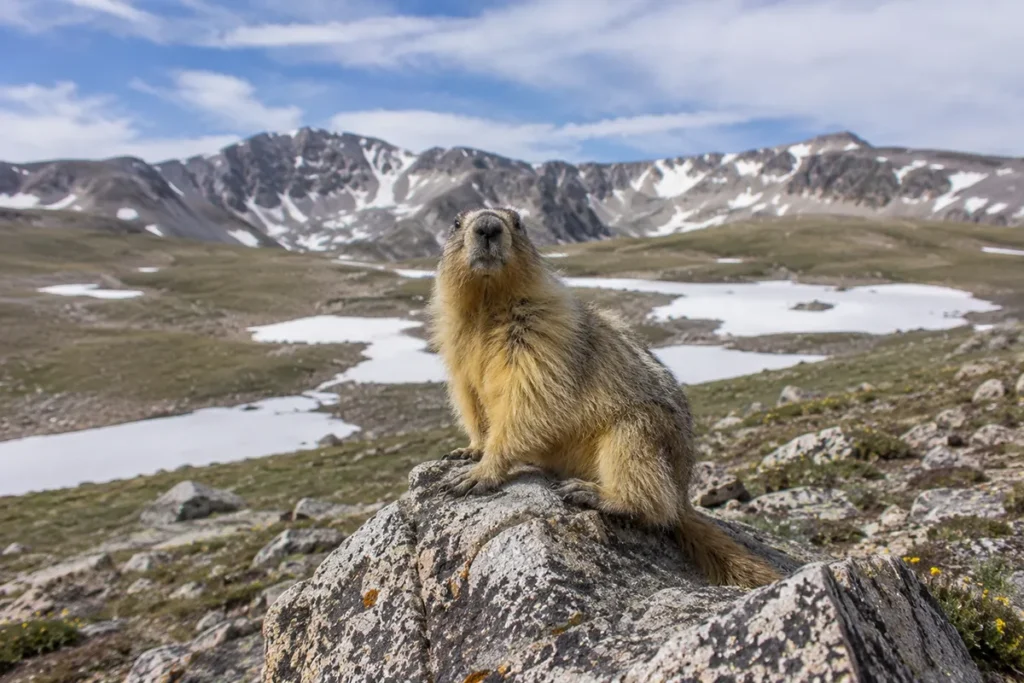
Photograph the marmots. The yellow-bellied marmots at Beartooth Pass are habituated to skiers and visitors, and they’re some of the most photogenic alpine wildlife in North America. The parking lot is essentially marmot country.
Plan around closures. Even when operating, Beartooth Basin can close on short notice for weather, lift maintenance, or unsafe snow conditions. Don’t make this the only ski experience of your trip — build in flexibility.
Beartooth Basin Compared to the Other 17 Montana Ski Areas
Quick honest comparisons.
Vs. Red Lodge Mountain: These are complementary — Red Lodge Mountain operates the winter season (December-April); Beartooth Basin operates the summer season (May-July). Pairing a Red Lodge Mountain winter trip with a Beartooth Basin summer trip is the complete Beartooth country experience. They share the same gateway town (Red Lodge) and many of the same trip patterns. Most visitors interested in one are good candidates for the other.
Vs. Turner Mountain Ski Area: Both are small, remote, weekend-emphasis operations. Turner is in northwest Montana, operates in winter, has 2,110 feet of vertical drop. Beartooth Basin is on the Wyoming-Montana border, operates only in summer, has 1,000 feet of vertical. Both reward the willingness to drive a long way for a unique experience.
Vs. Bridger Bowl or Big Sky Resort: Completely different products. These are winter destination ski areas. Beartooth Basin is a summer adventure operation. The comparison isn’t really fair — choose based on what season you’re traveling.
Vs. Mount Hood (Timberline), Mammoth Mountain, Whistler Blackcomb: Beartooth Basin is unique even among summer-skiing destinations. It’s the only ski area in North America that is exclusively a summer operation — the others all extend their winter seasons into summer rather than operating only in summer.
For the full picture, see the Montana ski resorts pillar guide.
Beartooth Basin Summer Ski Area: At-a-Glance
| Top Elevation | 10,900 ft |
|---|---|
| Base Elevation | 9,900 ft (approximately) |
| Vertical Drop | ~1,000 ft lift-served |
| Skiable Acres | 600 acres (Twin Lakes Headwall) |
| Trails | 9 named runs |
| Terrain Pitch | 15 to 50 degrees |
| Terrain Breakdown | Limited beginner, primarily intermediate-to-advanced |
| Lifts | 2 Poma surface lifts |
| Backcountry Adjacent | 3,000 vertical feet of shuttled/hike-in terrain |
| Day Lift Ticket | $50 (2026 season) |
| Season Pass | $395 (2026 season) |
| Operating Days | Typically Wednesday-Sunday [verify current schedule] |
| Operating Hours | 9:00 AM to 3:00 PM |
| 2026 Season | Opened May 25, 2026 (Memorial Day); typical close late June/early July |
| Number of Seasons | 64 (as of 2026) |
| Founded | Mid-1960s as Austrian race-training camp |
| Owner | Independent (Justin Modroo, co-owners) |
| Pass Affiliation | Independent — not on Ikon, Epic, or Indy |
| Snowmaking | None |
| Lodge | None (operates from parking lot) |
| Food Service | None — pack everything |
| Physical Location | Park County, Wyoming (mailing address in Montana) |
| Nearest Town | Red Lodge, MT (23 miles north via Beartooth Highway) |
| Highway Access | Beartooth Highway (US-212) — closes mid-October to late May |
| 2024 Status | Did not open due to insufficient snowpack |
Lift ticket prices, operating dates, and operational status change annually — verify current information on beartoothbasin.com before planning. The 2024 season cancellation is a recent reminder that operations are weather-dependent.
Things to Do Around Beartooth Basin When You’re Not Skiing
This is the section that distinguishes a Beartooth Basin trip from any other ski trip — the surrounding region offers some of the best summer wilderness travel in North America:
- Yellowstone National Park — northeast entrance at Cooke City is 25 miles east. Wildlife watching in Lamar Valley, Yellowstone wolf watching, Hayden Valley, and Mammoth Hot Springs are all within day-trip range
- The Beartooth Highway itself — drive the highway slowly, stop at scenic pullouts, photograph the wildlife and views
- Red Lodge — historic mining town with restaurants, breweries (Red Lodge Ales), Yellowstone Gateway Museum
- Beartooth Plateau hiking — extensive trails accessible from the highway, including alpine lake hikes
- Cody, Wyoming — about 90 minutes south via Chief Joseph Scenic Byway, with the Buffalo Bill Center of the West
- Chief Joseph Scenic Byway (WY-296) — alternative scenic route between Cody and the Beartooth Highway
- Absaroka-Beartooth Wilderness — adjacent wilderness areas for backpacking and hiking
For broader Montana summer planning, see things to do in Montana this fall, unique activities in Montana, and Montana in June.
Final Thoughts on Beartooth Basin
Beartooth Basin is the kind of place I’d never include in a generic “best Montana ski areas” list because it isn’t really competing with Big Sky, Whitefish, or Bridger Bowl for the same trips.
It’s a destination unto itself — a uniquely North American experience that happens to involve skiing.
The drive up the Beartooth Highway. The shorts-to-ski-gear parking lot transition. The Poma lifts at 10,900 feet. The Twin Lakes Headwall.
The marmots in the parking lot. The Yellowstone day trips from the same base camp. The visceral surreality of skiing in late June while the rest of the country starts barbecue season.
For most visitors, this isn’t the right answer for a primary Montana trip. For Montana-curious visitors with a flexible summer itinerary, for ski enthusiasts who want to extend their season into July, and for anyone road-tripping through Yellowstone country with adventurous instincts — Beartooth Basin is one of the most uniquely-American ski experiences available.
The 2024 cancellation and 2025 limited season are reminders that operations are entirely weather-dependent. The 2026 season has come back strong with the May 25 opening.
Whether 2027 and beyond will continue to operate consistently depends on snowpack patterns that are increasingly uncertain in a changing climate.
The sustainability of summer skiing as a viable operation is a real question — making any given season’s operations not entirely guaranteed.
If you have the chance to ski Beartooth Basin in a good snow year, take it. This is not the kind of experience you can postpone indefinitely.
The race-camp roots, the family-feel of die-hard summer skiers, the surreal beauty of the location, and the rarity of a true summer-only ski operation make Beartooth Basin one of the more memorable ski days you’ll ever have.
Pin this guide before your trip planning, and drop your questions in the comments below — I read every one and will happily help you decide if Beartooth Basin fits your summer itinerary, how to combine it with Yellowstone and Red Lodge for a complete trip, and how to handle the practical logistics of a high-altitude summer ski operation.
Frequently Asked Questions
Where is Beartooth Basin Ski Area?
Beartooth Basin Summer Ski Area is physically located in Park County, Wyoming, at Beartooth Pass on the U.S. Route 212 (Beartooth Highway). However, the resort’s mailing address is in Montana, which is why it’s frequently described as a Montana ski area. The resort is 23 miles south of Red Lodge, Montana, via the Beartooth Highway.
Why is Beartooth Basin only open in summer?
Beartooth Basin sits at 10,900 feet at Beartooth Pass, accessible only via the Beartooth Highway. The Beartooth Highway is closed from approximately mid-October through late May or early June each year due to heavy snowfall and avalanche risk that makes plowing impossible. As a result, the ski area can only operate when the highway is open — typically Memorial Day through early/mid July.
How much does a lift ticket at Beartooth Basin cost?
For the 2026 season, day lift tickets are $50, and season passes cost $395. Active military discounts are typically available. [Verify current pricing on beartoothbasin.com.] This is among the most affordable per-day skiing in North America, especially given the uniqueness of the experience.
When does Beartooth Basin open and close?
The 2026 season opened on Memorial Day, May 25, 2026, with closing typically projected for late June or early July depending on snowpack. The Beartooth Highway opened May 22, 2026, allowing initial access for safety checks. Operations depend entirely on snow conditions and highway accessibility — the 2024 season was cancelled entirely due to insufficient snowpack.
Is Beartooth Basin good for beginners?
No. Beartooth Basin is geared toward intermediate-to-advanced and expert skiers. Terrain ranges from 15 to 50 degrees in pitch on the Twin Lakes Headwall, with limited gentle skiing options. The Poma surface lifts also require some skiing skill to ride properly. This is not the right venue for absolute beginners — they should look at lift-served learning operations during winter season.
Is Beartooth Basin on the Ikon, Epic, or Indy Pass?
No. Beartooth Basin is independent and does not participate in any major mega-pass system. Day tickets and season passes are sold directly through the resort.
How big is Beartooth Basin?
Beartooth Basin covers approximately 600 acres of skiing on the Twin Lakes Headwall, with 9 named runs served by 2 Poma surface lifts. The lift-served vertical drop is approximately 1,000 feet, with an additional 3,000 vertical feet of adjacent shuttled or hike-in backcountry terrain.
Is there a lodge at Beartooth Basin?
No. Beartooth Basin operates without any base lodge, warming hut, or building infrastructure. Skiers operate entirely from the parking lot — gearing up at their vehicles, eating from coolers, and managing their day from open-air conditions. The marketing describes the experience as “backcountry skiing with a lift.”
Who owns Beartooth Basin?
Beartooth Basin is owned and operated by a small group of dedicated summer-skiing enthusiasts. Justin Modroo is one of the current co-owners and the primary public-facing operator. The ownership group has maintained the operation through multiple challenging seasons and is committed to preserving the unique summer skiing tradition.
What is the Twin Lakes Headwall?
The Twin Lakes Headwall is the signature ski terrain at Beartooth Basin — a steep amphitheater of snow that holds well into summer due to its north-facing aspect and high elevation. The headwall offers 600 acres of skiing with pitches ranging from 15 to 50 degrees, including the famous “Nikky’s Run” and a cornice feature. The headwall is what makes Beartooth Basin’s summer ski season possible.
How does Beartooth Basin compare to Mount Hood Timberline?
Both offer summer skiing, but the operations are different. Mount Hood’s Timberline Lodge operates a glacier-based area that extends a winter season into summer (typically operating year-round in some form). Beartooth Basin is the only summer-exclusive ski area in North America — it has no winter season at all. Timberline is a destination resort with full infrastructure; Beartooth Basin is a backcountry-style operation without a lodge.
Can I combine a Beartooth Basin trip with Yellowstone?
Yes — this is the recommended approach. Yellowstone’s northeast entrance at Cooke City is 25 miles east of Beartooth Pass. Many Beartooth Basin visitors build a multi-day trip that includes summer skiing, the Beartooth Highway scenic drive, Yellowstone wildlife watching, and exploring Red Lodge — one of the most uniquely American summer travel experiences available.