I was pumping gas at a dusty station outside of Livingston last summer when I noticed the pickup truck next to me had a bumper sticker that simply read “406.” No explanation needed.
The driver caught my eye and nodded—a silent acknowledgment between strangers who both understood exactly what those three digits meant.
That moment crystallized something I’d been noticing throughout my travels across Big Sky Country: the 406 isn’t just a phone number prefix here.
It’s become a tribal marker, a badge of identity, and a surprisingly emotional connection to place that you’ll encounter everywhere from Missoula coffee shops to remote ranches near the Canadian border.
Understanding this phenomenon is essential to grasping Montana History and what makes this state tick.
- Montana is one of only 12 US states with a single area code—406 has covered the entire state since 1947
- The 406 has evolved from a simple phone prefix into a powerful symbol of Montana identity and unity
- You’ll see 406 on bumper stickers, tattoos, business names, clothing, and license plates everywhere
- The low population density means Montana likely won’t need a second area code for decades
- Understanding the 406’s cultural significance helps visitors connect more authentically with locals
Liked this article?
Add Roaming Montana as a preferred source so you see more of our articles and guides on Google.
The Technical Origins: How Roaming Montanat Its One and Only Area Code
To understand why Montanans are so attached to 406, you need to go back to 1947. That’s when AT&T and Bell System created the North American Numbering Plan, dividing the United States and Canada into geographic regions, each assigned a unique three-digit code.
Montana received 406. And here’s the thing—it’s never changed.
While states like California now have more than 30 area codes and even small states like Connecticut juggle multiple codes, Montana has kept its original designation for over 75 years. This makes it part of an increasingly rare club.
The Single Area Code States
As of my last research during a trip to Helena’s Montana Historical Society, only 12 states still operate with a single area code. Montana’s neighbors Wyoming (307) and the Dakotas (701 for North, 605 for South) share this distinction.
What keeps Montana in this exclusive group? Pure math, really. Area codes need to be split when phone number combinations start running out. With Montana’s population hovering around 1.1 million spread across 147,040 square miles, we’re simply not burning through phone numbers fast enough to warrant a second code.
To put this in perspective: Montana is the fourth largest state by area but ranks 44th in population. There are more people in the city of San Jose, California than in all of Montana.
Why Three Digits Mean So Much: The Psychology of Place
During a conversation at the Sip ‘n Dip Lounge in Great Falls—yes, the one with the mermaids—a third-generation rancher named Dale explained it better than any academic could.
“When you tell someone you’re 406, they know you get it,” he said, gesturing to the bizarre underwater window where swimmers dressed as mermaids floated by. “They know you understand what forty below feels like. They know you’ve probably been stuck in the mud. They know you don’t panic when the nearest hospital is two hours away.”
This sentiment echoes everywhere I’ve traveled in Montana. The 406 has become shorthand for shared experience—a way to instantly communicate belonging without lengthy explanations.
Identity in a Disconnected Age
What fascinates me is how a relic of mid-century telecommunications infrastructure became such a potent identity marker. In an era of cell phones and area code portability, where many Americans keep phone numbers from states they left decades ago, Montanans have doubled down on their prefix.
I think it comes down to scarcity and unity. When you share something with relatively few people spread across an enormous landscape, that thing becomes precious. The 406 connects a fly fishing guide in Ennis with a tribal member on the Blackfeet reservation with a college student in Bozeman. Despite their differences, they’re all 406.
The psychology parallels how Montanans bonded through Montana’s worst winters—shared hardship creating community identity.
Where You’ll See 406: A Visual Guide for Visitors
If you’re visiting Montana, you’ll encounter the 406 everywhere. Understanding its significance will help you read the cultural landscape and maybe even spark conversations with locals.
On the Road
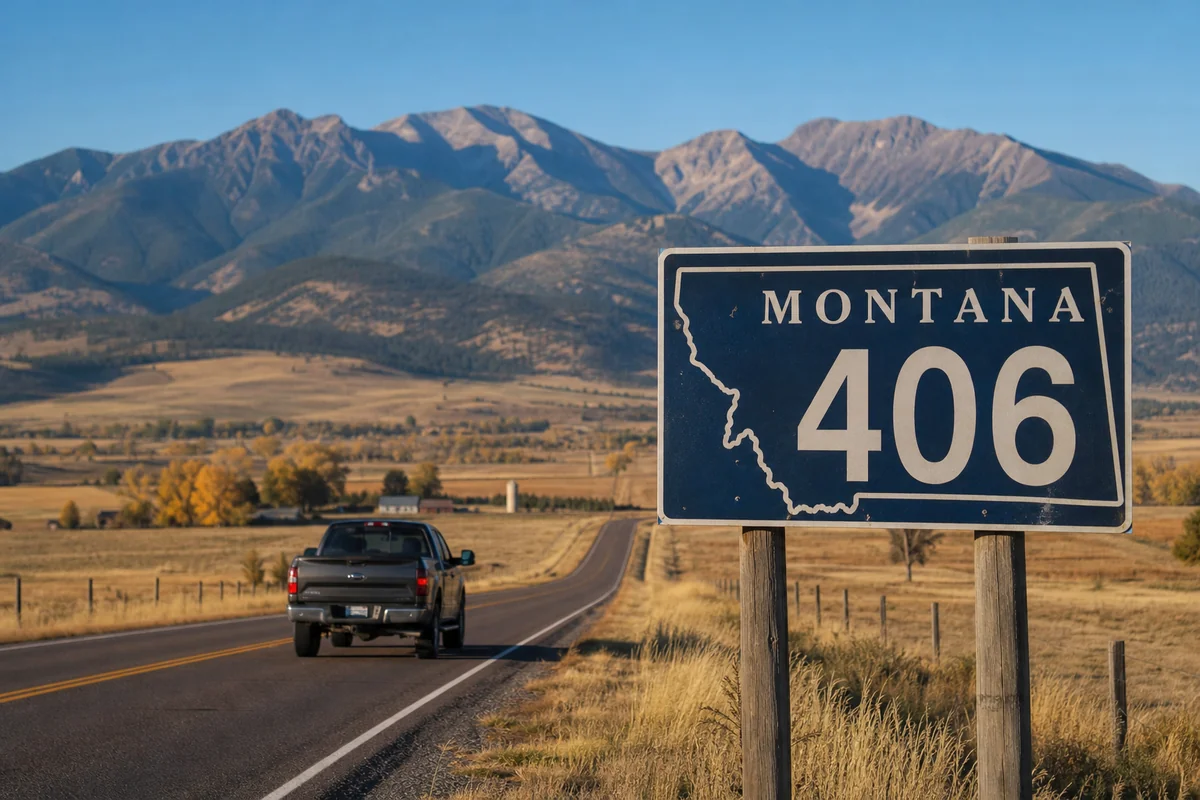
Bumper stickers remain the most common 406 sighting. On a recent drive from Billings to Glacier National Park, I counted no fewer than 47 vehicles sporting some variation of the 406 theme. Some are minimalist—just the numbers in bold font. Others incorporate elk antlers, mountain silhouettes, or the state outline.
License plates deserve special mention. Montana offers a bewildering array of specialty plates, and many feature the 406 prominently. Keep an eye out for them at trailhead parking lots and small-town main streets.
Business Names and Branding
Montana entrepreneurs have fully embraced the 406 as a marketing tool. Here’s a small sample of businesses I’ve personally encountered:
- 406 Brewing Company in Bozeman (excellent amber ale, by the way)
- 406 CrossFit in Missoula
- 406 Cleaning Services in Helena
- 406 Auto in Butte
- 406 Axe Throwing in Kalispell
The naming convention serves dual purposes: it immediately signals local ownership and creates instant brand recognition within the state. When Montanans see 406 in a business name, they know they’re supporting someone from home.
Clothing and Merchandise
Pack a suitcase with room for souvenirs, because 406 apparel is everywhere. On my last visit, I picked up a 406 hoodie at a shop in Whitefish that’s become my favorite travel layer. The woman at the register told me they sell more 406 merchandise than anything with “Montana” written on it.
T-shirts, hats, koozies, stickers, patches—if it can be printed on, someone in Montana has slapped 406 on it. Local boutiques and gas stations alike stock these items.
The Tattoo Phenomenon
Here’s something that genuinely surprised me: 406 tattoos are incredibly common. I first noticed this at a hot spring near Norris, where it seemed like every third person had the numbers inked somewhere on their body.
When I asked a tattoo artist in Missoula about it during a recent trip, she estimated that 406 designs comprise roughly 15% of her work. “It’s not just transplants trying to prove themselves,” she said. “I ink 406 on families who’ve been here since homesteading days.”
The permanence of a tattoo speaks to how seriously Montanans take this connection.
The 406 and Montana’s Unique History
Montana’s area code identity connects to deeper historical currents that have shaped the state’s character. The fierce independence and shared identity that 406 represents today echoes attitudes established during the territory’s earliest days.
Isolation Breeds Unity
Montana has always been defined by distance. When I visited the ghost towns around Bannack and Virginia City—remnants of the Roaming Montanald Rush—I was struck by how isolated early settlers were. Helena is 1,500 miles from Chicago, over 2,000 from New York. Before railroads, Montana might as well have been on the moon.
This isolation bred self-reliance but also community. When your nearest neighbor is 20 miles away and winter lasts seven months, you learn to depend on each other. The 406 taps into this heritage—it’s a modern expression of the same unity that helped pioneers survive.
The legacy of Montana’s pioneers persists in how current residents identify with their land and each other.
The Military Connection
Montana’s military history also plays into the 406 phenomenon. The state has always punched above its weight in military service, and veterans have been among the most enthusiastic adopters of 406 symbolism.
During a visit to Malmstrom Air Force Base in Great Falls, I learned about the extensive network of Montana missile silos and launch sites scattered across the Hi-Line region. The Cold War brought thousands of military families to Montana, many of whom stayed and became passionate Montanans. Their children and grandchildren often sport 406 gear as a way of claiming their adopted home.
For more on this military presence, you can explore Montana’s active military bases and even the rumored secret military installations that fuel local speculation.
Native vs. Transplant: The 406 as Gateway
One of the more interesting social dynamics I’ve observed involves how the 406 functions as a rite of passage for Montana newcomers.
The Transplant Experience
Montana has seen significant population growth in recent years, particularly since 2020. Places like Bozeman and Missoula have become magnets for remote workers and retirees seeking mountain town life.
This influx has created tension. At a bar in Livingston, I overheard a heated discussion about “Zoom refugees” and “Californicators” changing the state’s character. Housing prices have skyrocketed, traffic has increased, and longtime residents feel squeezed.
Yet the 406 offers newcomers a path toward acceptance. I met a family from Texas who’d moved to Billings three years earlier. The father mentioned that when he finally replaced his Texas plates and phone number with Montana equivalents, neighbors who’d been polite but distant suddenly invited him to community events.
“Getting my 406 number felt like getting my citizenship papers,” he joked.
What the 406 Doesn’t Give You
It’s worth noting that the 406 is necessary but not sufficient for Montana acceptance. The numbers don’t mean much if you’re constantly complaining about the cold, voting against local interests, or treating Montana like an outdoor theme park rather than a working landscape.
As one Missoula barista put it: “A 406 tattoo doesn’t mean anything if you can’t name the local rivers or don’t know what county you’re in.”
The code is an invitation, not an automatic membership.
Regional Variations Within the 406
Despite the unifying power of the area code, Montana is far from monolithic. During my extensive travels, I’ve observed distinct regional identities that add nuance to the 406 phenomenon.
Western Montana
The western third of the state—from Missoula to Kalispell—trends younger, more progressive, and more outdoor-recreation-focused. Here, the 406 often pairs with environmental imagery: mountains, rivers, wildlife.
Missoula in particular has a strong local identity tied to the university, the literary community, and outdoor industry. The 406 here sometimes carries a slightly ironic edge, deployed by people who simultaneously embrace and gently mock Montana clichés.
Eastern Montana
Cross the Continental Divide and you enter a different world. Eastern Montana is cattle country—vast, windswept, and deeply conservative. Towns like Miles City, Glendive, and Sidney feel more connected to the Great Plains than the Rockies.
The 406 here reads more traditional, often appearing alongside agricultural imagery and Christian symbology. It’s a declaration of rootedness, of families who’ve worked the same land for generations.
The cultural divide sometimes mirrors the state’s dramatic key historical events, where different regions experienced different defining moments.
The Hi-Line
That thin ribbon of towns along Highway 2 near the Canadian border—Havre, Shelby, Cut Bank—has its own character. This is farm and ranch country interspersed with Native reservations, historically shaped by the Great Northern Railway.
The 406 up here often appears on grain elevator silos, rodeo belt buckles, and the trucks that rumble down empty highways at dawn. It’s perhaps the purest expression of the code’s meaning: “I am here, in this remote place, and I’m not leaving.”
How the 406 Compares to Other State Identity Markers
Montana isn’t unique in having state-specific identity markers, but the 406 stands out for its intensity and universality.
Area Code Culture Elsewhere
Other states have area code pride—think 512 in Austin, 212 in Manhattan, or 313 in Detroit. But these are typically urban phenomena tied to specific cities, not entire states.
Montana’s difference is scale. The 406 covers cowboys and college professors, mining towns and ski resorts, Native communities and military bases. It’s not about being from Bozeman or Butte specifically—it’s about being from Montana, period.
Beyond Other Montana Symbols
Montana has plenty of other identity markers: the state flag, the grizzly bear, the phrase “Big Sky Country,” even the meaning behind the state’s name itself. But none of these have achieved the grassroots ubiquity of the 406.
I think the difference is exclusivity. Anyone can visit Glacier National Park or see a grizzly bear. But only Montanans have 406 phone numbers. The area code can’t be commercialized by outsiders or diluted by mass tourism. It remains intrinsically local.
Practical Implications for Visitors
Understanding the 406 phenomenon isn’t just culturally interesting—it has practical applications for travelers.
| Situation | How 406 Knowledge Helps |
|---|---|
| Souvenir shopping | 406 items are more authentically Montanan than generic tourist merchandise |
| Starting conversations | Commenting on 406 stickers or gear shows cultural awareness and opens doors |
| Reading the room | Heavy 406 presence usually indicates local-focused establishment vs. tourist trap |
| Supporting local | Businesses using 406 branding are typically Montana-owned and operated |
| Gift giving | If you meet a Montana-connected friend, 406 gear makes meaningful gifts |
Don’t Fake It
One word of caution: don’t pretend to be 406 if you’re not. Montanans can sniff out imposters quickly, and nothing undermines tourist-local relations faster than inauthentic posturing.
It’s perfectly fine to admire the 406 phenomenon as an outsider. Ask locals about it—most are happy to explain and will appreciate your genuine interest. Just don’t slap a 406 sticker on your rental car and try to pass as a local.
The 406 and Montana’s Future
What happens if Montana eventually needs a second area code? It’s a question that occasionally surfaces in state discussions, and opinions vary widely.
The Number Crunch
Based on current growth patterns and phone number usage, Montana probably won’t exhaust its 406 combinations for at least another 30-40 years. The state has roughly 8 million possible phone number combinations, and we’re nowhere near capacity.
However, technology could change this calculus. If new devices require numbers, or if the state experiences unexpected population growth, the timeline could compress.
Potential Division Scenarios
If Montana ever does split, the most likely scenario would divide along geographic lines—perhaps 406 for western Montana and a new code for the east. This would mirror natural regional divisions and minimize disruption.
The cultural implications would be significant. Eastern Montanans might feel abandoned, while westerners could be accused of hoarding the original code. It’s the kind of issue that seems trivial until you understand how much the numbers mean.
For now, though, the 406 remains unified—a single code for a vast and varied state.
Personal Reflections: What the 406 Taught Me About Belonging
I’ve traveled to all 50 states, and Montana’s area code culture genuinely surprised me. I didn’t expect to find such deep meaning in a telecommunications artifact.
But after spending considerable time in the 406, I understand it. This is a state where identity matters intensely, where belonging isn’t given but earned, and where small symbols carry enormous weight.
The harshness of Montana—its brutal winters like the catastrophic winter of 1886, its isolation, its demanding landscape—has always required cooperation. The 406 is the modern expression of that necessity. It says: “We’re all in this together, across the mountains and plains, united by three digits and everything they represent.”
Montana has endured many challenges throughout its history, from major earthquakes to devastating wildfire seasons. Through it all, the shared identity represented by 406 has helped communities bond and rebuild.
My Own 406 Story
I don’t have a 406 phone number or a tattoo. I’m not a Montanan, and I won’t pretend to be one. But I keep a 406 sticker on my camera bag—a reminder of the places I’ve been in Big Sky Country and the people who’ve welcomed me despite my outsider status.
When other travelers notice it and ask about Montana, I have stories to share. About the rancher in Lewistown who fixed my flat tire and refused payment. About the sunrise over the Mission Mountains that made me cry. About that nod at the gas station in Livingston.
The 406 has become my way of honoring a place that’s given me so much, even as I remain fundamentally apart from it.
The Darker Sides of Montana Identity
No honest discussion of Montana identity would be complete without acknowledging its complications. The same fierce independence that creates 406 pride can also enable isolation and insularity.
Montana has its share of shadows, from serial killers who exploited its remoteness to the troubled history of the state prison system. The 406 unity can sometimes mask real divisions and problems that deserve attention rather than glossing over.
Even unusual aspects of the state’s geography—like the underwater history that shaped its landscape—remind us that Montana’s story is complex and sometimes strange.
For visitors, understanding the 406 means understanding both the pride and the blind spots. It means recognizing what brings Montanans together while also seeing where work remains to be done.
What to Tell Friends When You Return Home
When you visit Montana and return with stories, the 406 offers a perfect entry point for explaining what makes the state special.
You might describe seeing the numbers everywhere—on bumpers, biceps, and bar signs. You might talk about the single area code covering 147,000 square miles. You might share the conversations you had with locals who helped you understand what belonging means in Big Sky Country.
And if your friends don’t quite get it, that’s okay. Some things about Montana resist easy explanation. The 406 is one of them—three digits that somehow contain multitudes.
It connects to everything that makes Montana unique, from its culinary heritage shaped by ranching and Native traditions to its continuing sense of frontier independence.
That’s the real Montana meaning behind 406: not a phone number, but a promise. A promise that this place is different, that its people are bound together by something more than geography, and that those three digits will welcome you if you approach with respect.
When you see 406, you’re seeing Montana’s heart.
Frequently Asked Questions
What does 406 mean in Montana and why is it significant?
406 is Montana’s sole area code, covering the entire state since 1947, and it’s become a powerful symbol of Montana pride and identity. You’ll see ‘406’ on bumper stickers, clothing, and local business names throughout your travels. For Montanans, displaying 406 represents a connection to the state’s tight-knit community and vast open spaces.
Why does Montana only have one area code while other states have multiple?
Montana remains one of only 12 states with a single area code because of its low population density—roughly 1.1 million people spread across 147,000 square miles. When I drove across the state, I realized the 406 area code unifies everything from Missoula to Miles City, making it a rare geographic identifier that covers Big Sky Country entirely.
Where can I buy authentic Montana 406 merchandise during my trip?
You’ll find genuine 406 gear at local shops in towns like Bozeman, Missoula, Whitefish, and Helena, typically ranging from $15-$45 for t-shirts and hats. I recommend checking out Montana-owned stores like The 406 Shop or local boutiques rather than generic tourist traps. Farmers markets and craft fairs also feature locally-designed 406 apparel with unique Montana artwork.
What is the best time to visit Montana to experience local 406 culture and events?
Summer months from June through August offer the most festivals and outdoor events celebrating Montana culture, including rodeos and county fairs where 406 pride runs deep. I’d also suggest visiting during Montana Day on November 8th when locals especially embrace their state identity. Fall brings fewer crowds, lower lodging costs around $80-$150 per night, and stunning scenery for exploring small-town Montana.
How far do I need to drive to explore different regions within Montana’s 406 area code?
Montana spans roughly 550 miles east to west, so exploring the full 406 territory requires significant driving time—about 8-9 hours from the Idaho border to North Dakota. The distance from Glacier National Park to Yellowstone’s Montana entrance is approximately 340 miles, or 5-6 hours of scenic driving. I recommend planning regional trips rather than trying to cover everything in one visit.
What should I pack for a Montana road trip to explore 406 country?
Pack layers regardless of season since Montana weather can shift 40 degrees in a single day, even during summer months. I always bring a good pair of hiking boots, a physical road map (cell service is unreliable in rural 406 areas), and a cooler for long stretches between towns. Don’t forget sunscreen and sunglasses—the high elevation means stronger UV exposure than you might expect.
Are there any historic sites that explain Montana’s 406 area code history?
While no museum is dedicated specifically to the 406 area code, the Montana Historical Society Museum in Helena covers telecommunications history and the state’s development since territorial days. The museum admission is only $5 for adults and provides excellent context for understanding Montana’s isolated geography that led to the single area code. I found visiting small-town historical societies in places like Butte and Virginia City also gave great insight into Montana’s unique communication challenges throughout history.
Sources