On June 18, 1805, Meriwether Lewis stood on the bank of a Montana spring and wrote in his journal that it was “the largest fountain or spring I ever saw.”
Two hundred and twenty-one years later, you can stand on essentially the same spot and watch 156 million gallons a day still flowing up from the ground — and the water you’re looking at fell as snow in the Little Belt Mountains 26 years ago.
TL;DR: Giant Springs State Park in Great Falls is Montana’s most-visited state park, home to one of the largest freshwater springs in the United States. Water bubbles up from the Madison Aquifer at a constant 156 million gallons per day, a constant 54°F year-round, after a 26-year underground journey from the Little Belt Mountains 60 miles away. The park is also home to the Roe River — once recognized by the Guinness Book as the world’s shortest river at 201 feet — and sits next to the Missouri (longest river in North America). It’s adjacent to the Lewis & Clark Interpretive Center, has a working trout hatchery, anchors a 60-mile urban trail network, and is one of Montana’s best year-round state parks.
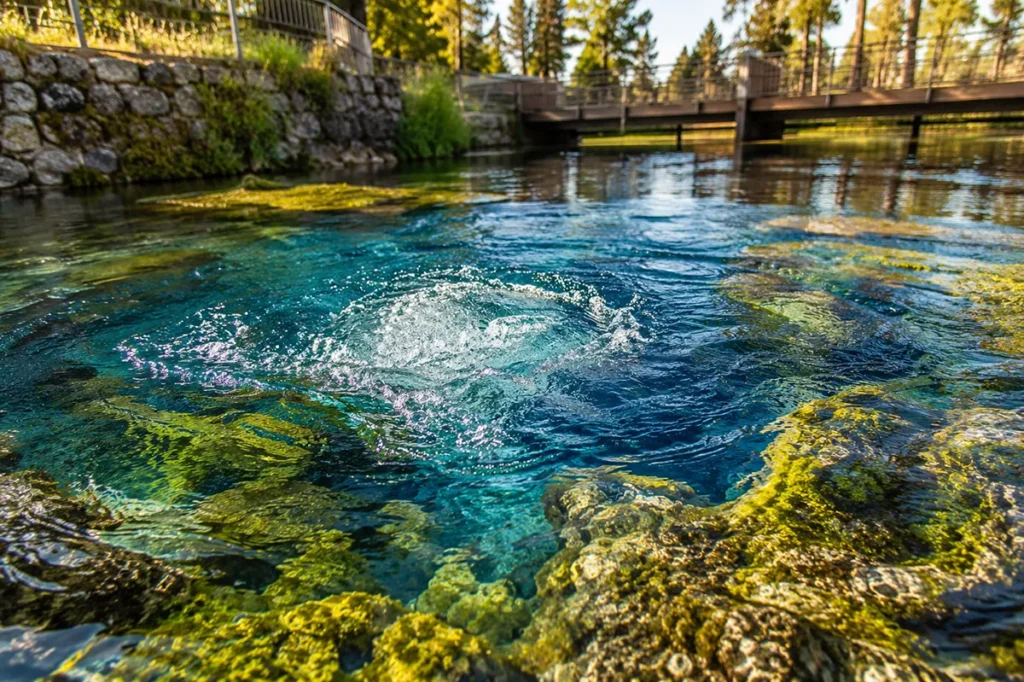
I’m Robert Hayes, and I’ve stopped at Giant Springs more times than I can count over two decades of driving central Montana. It’s the kind of place that should feel ordinary because it’s right in town — and yet every visit I find myself standing at the spring overlook for longer than I meant to. Something about watching water that fell as snow in 2000 still bubbling up in 2026, after a quarter-century underground, doesn’t get old.
This is the deep-dive for Giant Springs. For the broader Montana state parks landscape, see my Montana state parks pillar guide.
For the federal Lewis & Clark trail context that runs directly through the park, see my Montana national parks pillar guide, which covers the Lewis & Clark National Historic Trail and all ten NPS-managed sites in Montana.
Liked this article?
Add Roaming Montana as a preferred source so you see more of our articles and guides on Google.
Quick Stats
| Stat | Detail |
|---|---|
| Park size | 4,500+ acres |
| Location | Great Falls, Montana |
| Spring discharge | 156 million gallons per day |
| Water temperature | Constant 54°F year-round |
| Water source | Madison Aquifer, Little Belt Mountains (60 miles away) |
| Water travel time | ~26 years from snowmelt to spring |
| Roe River length | 201 feet (former Guinness World Record holder) |
| Adjacent river | Missouri River (longest in North America) |
| Most-visited state park in Montana | Yes |
| Lewis & Clark journal date | June 18, 1805 |
| Trout hatchery output | ~1.3 million fish/year |
| Bird species recorded | 80+ |
| Day-use fee [verify 2026] | $8/vehicle (non-resident); free for residents |
| Camping | None (day-use only) |
| Year-round access | Yes |
The Madison Aquifer and the 26-Year Journey
This is the geology no other Giant Springs guide explains, and it’s the most interesting thing about the place.
The water you watch bubbling up from Giant Springs didn’t fall here. It fell as rain and snow in the Little Belt Mountains roughly 60 miles southeast of Great Falls.
From there, it percolated down through fractured limestone into a vast underground reservoir called the Madison Aquifer — a regional groundwater system that underlies parts of Montana, Wyoming, and South Dakota.
Once in the aquifer, the water moves slowly — measured in feet per year — through the limestone toward natural discharge points. Giant Springs is one of the largest of those discharge points.
Hydrologists estimate the average water molecule takes approximately 26 years to make the journey from Little Belt snowfall to the moment it emerges into daylight at the spring.
Think about what that means. The water you’re watching today fell as snow in 2000. The water bubbling up when Lewis stood here in 1805 fell during the colonial era.
The constant 54°F temperature is because deep groundwater never sees seasonal change — it stays at the average annual temperature of the rock it’s flowing through.
The geology is also why the discharge is so constant. Surface springs vary wildly with rainfall and seasons; Giant Springs barely fluctuates. 156 million gallons today, 156 million gallons in February, 156 million gallons during a drought. Reliable to a degree most water sources never approach.
The Lewis & Clark Discovery (and a Quote Worth Reading)
The Corps of Discovery reached this spot on June 18, 1805, during the portage around the Great Falls of the Missouri. Lewis’s journal entry has become one of the most-quoted passages from the expedition:
“I have seen one in the State of Virginia, but it is in scarcely no comparison to this; it is the largest fountain or spring I ever saw.”
Lewis went on to describe the water’s clarity, its temperature, and the gravel-bed flow of the Roe River into the Missouri. He estimated discharge (correctly, as it turned out) at staggering volumes. The expedition’s surveyor sketched the spring; the journals captured it in detail. It’s one of the few stops on the entire Lewis & Clark route where you can read the original 1805 description and then look at the actual scene essentially unchanged.
For the broader Lewis & Clark Trail context across Montana, see key historical events in Montana and Montana’s history overview. The Lewis & Clark Interpretive Center is right next door (more below).
The Roe River: A 201-Foot Guinness Record
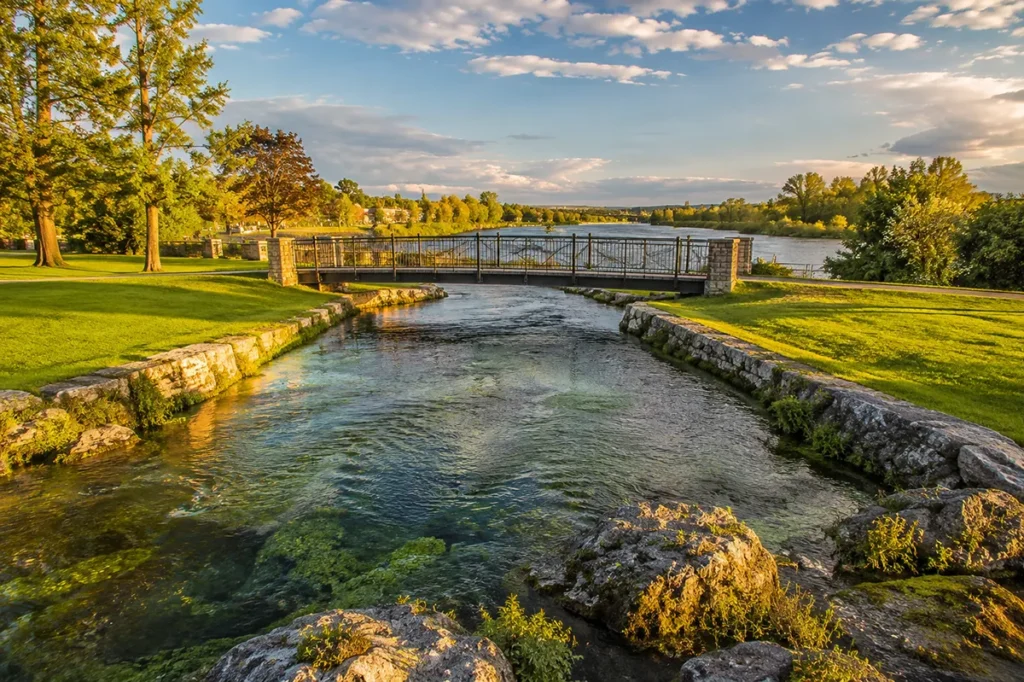
The Roe River runs 201 feet from Giant Springs to its confluence with the Missouri. It is — or was — the shortest named river in the world according to the Guinness Book of World Records.
The backstory is worth knowing. The Roe wasn’t even named “the Roe” until 1989. A 5th-grade class at Susanville Elementary School in Susanville, California, was studying world records and challenged the previous “world’s shortest river” claim.
The class’s teacher, with help from the City of Great Falls, formally named the spring outflow “the Roe River” and successfully petitioned Guinness for the title. The river kept the record for several years before Guinness eventually retired the “shortest river” category entirely — but the name stuck.
So when you stand at the viewing bridge, you’re looking at the world’s shortest named river, named by a class of California fifth-graders, flowing for 201 feet from the world’s largest freshwater spring into North America’s longest river. The trifecta is genuinely unique. There’s no other spot on Earth where these three superlatives converge in a 500-foot radius.
What to Do at the Park
Visit the Main Spring Pool
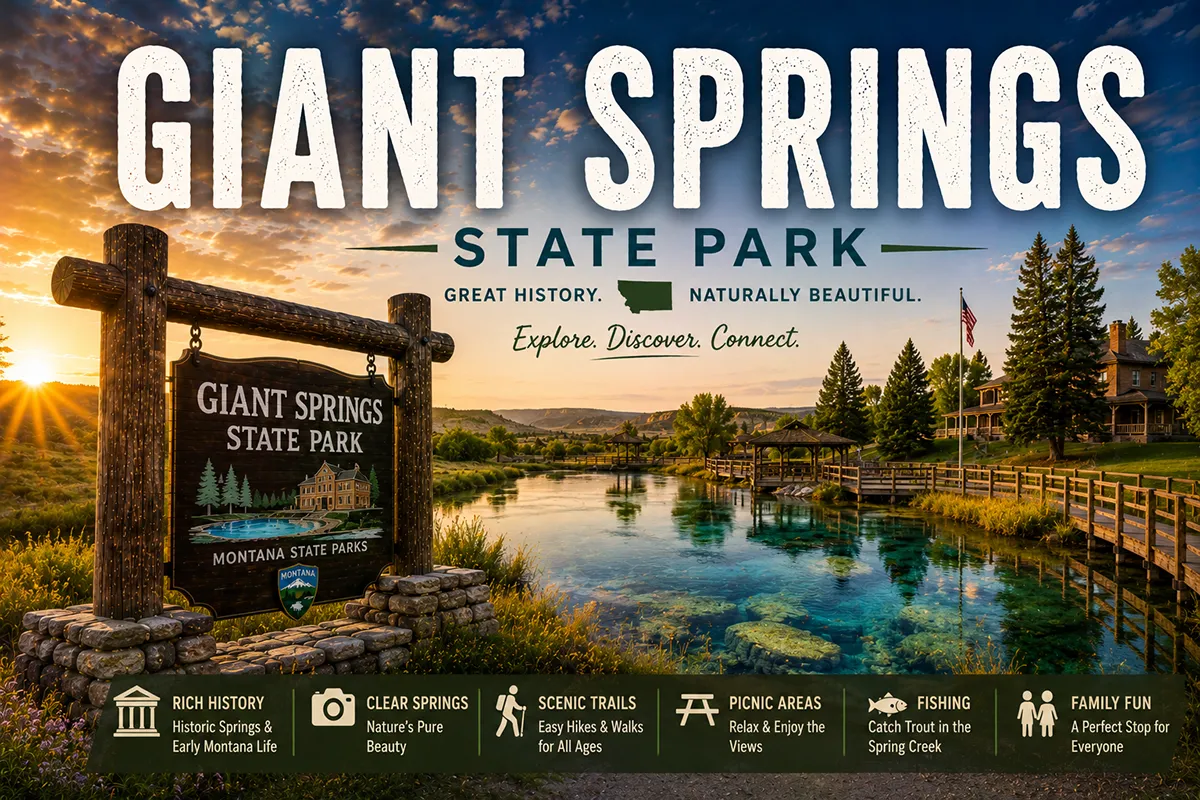
The viewing bridge over the spring pool is the centerpiece. Multiple bridges and platforms let you peer directly into the crystal-clear water and watch the vegetation move in the upwelling currents. Occasional trout cruise through.
Photography tip: Early morning or late afternoon light is best — direct overhead sun bleaches out the underwater colors. Polarizing filter helps significantly.
Giant Springs Trout Hatchery
The state fish hatchery is one of the park’s most underrated features. Open to the public, with interpretive displays explaining the operation, viewing windows into the rearing ponds, and feeding opportunities (bring quarters for fish food).
The hatchery raises about 1.3 million rainbow trout and kokanee salmon per year, which are then distributed to lakes and rivers within a 150-mile radius. For families, this is the part of Giant Springs that kids remember — the chance to actively feed fish through the chain-link fences is a hit.
Visit the Visitor Center
Just across from the spring pool. Features taxidermy mounts of grizzly and black bears, fish and bird identification exhibits, wildlife photographs, and a small theater showing wildlife videos. Free admission, restrooms, drinking water, gift shop. Open daily; reduced winter hours [verify 2026].
Walk or Bike the River’s Edge Trail
This is the secret superpower of Giant Springs. The River’s Edge Trail system in Great Falls runs 60 miles total along both sides of the Missouri River, with Giant Springs as its centerpiece.
The paved sections immediately around the park are accessible to all abilities; further out, the trail branches into single-track for mountain biking.
From Giant Springs you can:
- Walk west toward downtown Great Falls (about 2 miles of paved trail)
- Walk east toward Rainbow Falls Overlook (about 1.5 miles)
- Bike further to Black Eagle Falls Overlook and beyond
- Continue along the Missouri for many additional miles
This is one of the best urban-to-natural trail systems in the United States. Things to do in Montana covers other top outdoor experiences in the state.
Rainbow Falls Overlook
A short walk or bike ride east of the main spring puts you at the overlook for Rainbow Falls — one of the actual “great falls” of the Missouri that Lewis and Clark portaged around in 1805.
The natural falls are now partly obscured by Rainbow Falls Dam (one of several hydroelectric projects on this stretch of the Missouri, which is why Great Falls earned the nickname “the Electric City”), but the overlook still gives you a real sense of scale.
Black Eagle Falls Overlook
Further along the trail system, Black Eagle Falls is another of the original five waterfalls. Adjacent Black Eagle Dam was the first hydroelectric dam built on the Missouri (1890).
Birding (80+ Species)
The combination of the spring, the Missouri River, the trout hatchery, and the protected park environment makes Giant Springs a serious birding destination.
Recorded species include American white pelicans, great blue herons, double-crested cormorants, multiple duck and goose species, bald eagles, osprey, kingfishers, and a wide range of songbirds.
Winter brings interesting waterfowl drawn to the open water that won’t freeze. See Montana bird species for the broader avian context.
Fishing the Missouri
The Missouri River below Giant Springs is a productive trout fishery. Anglers fly fish and spin fish for rainbow and brown trout from the bank or with waders. The constant cold water from the spring keeps a stretch of the Missouri immediately downstream at trout-friendly temperatures even in summer.
Winter at Giant Springs: A Hidden Highlight
Most state park guides describe Giant Springs as a summer destination. The locals know better.
Because the spring water is a constant 54°F, the spring pool and the Roe River never freeze. In winter, with surrounding ground temperatures well below freezing, steam rises off the spring water in dramatic clouds.
Hundreds of birds — geese, ducks, and seagulls especially — gather on the unfrozen water because it’s their only source of liquid water for miles. The park lawn frosts over while the spring water remains liquid and clear.
It’s one of the most distinctive winter scenes in Montana. Bundle up, walk the bridges, watch the steam, and you’ll have the park almost to yourself. Montana in January covers the broader winter trip-planning context, and Montana winter weather covers what to expect.
The Lewis & Clark Interpretive Center
Operated by the U.S. Forest Service, located adjacent to Giant Springs State Park, this is one of the best Lewis & Clark museums in the country.
The 25,000-square-foot facility covers the entire 1804–1806 expedition with full-scale dioramas, original artifacts, an Imax-style theater, and detailed exhibits on the Corps of Discovery’s relationship with the Indigenous nations they encountered.
Practical: Admission [verify 2026] is around $5 for adults, $2 for youth 6-17. Open daily Memorial Day through September 30, 9 a.m. to 6 p.m.; reduced hours rest of year. Allow 90 minutes minimum.
This is the natural pairing with Giant Springs. Build a half-day around both: spring in the morning, interpretive center after lunch.
Pair with Other Great Falls and Central Montana Sites
Giant Springs anchors what should be a multi-day Great Falls visit. Here’s how to extend:
Within Great Falls
- C.M. Russell Museum — Charles M. Russell was Montana’s most famous cowboy artist; the museum houses the world’s largest collection of his work and a recreation of his original log cabin studio. Half-day minimum.
- First Peoples Buffalo Jump State Park — 15 miles south of Great Falls; one of the largest preserved Indigenous buffalo jumps in North America. Sister state park to Giant Springs.
- Great Falls Brewery Tour — Multiple breweries in walking distance of downtown.
- Great Falls coffee scene — See the best coffee shops in Great Falls for local picks.
Day Trips from Great Falls
- Sluice Boxes State Park — 30 miles south; limestone canyon hiking. Strong natural pairing with Giant Springs for a two-state-parks day.
- Helena — 90 minutes south; state capital with museums, hot springs, and historic downtown.
- Glacier National Park (East Side) — 3 hours northwest via Browning; if you have time to extend.
The Central Montana Loop
Use Great Falls as a base for 3–4 nights: Day 1 Giant Springs + Interpretive Center, Day 2 Sluice Boxes, Day 3 First Peoples Buffalo Jump + C.M. Russell Museum, Day 4 day trip to Helena or onward to Glacier. This is one of the best basecamps for non-park-focused Montana travel.
For RV-specific options, RV parks in Great Falls covers the lodging landscape.
Pair with Other State Park Children
For the broader cluster, consider:
- Best for families: Giant Springs + Lewis & Clark Caverns (limestone caves between Bozeman and Butte) — both are genuinely engaging for kids
- Best for accessibility: Giant Springs + Lone Pine State Park (Kalispell) — Montana’s most family-friendly state parks
- Best for history immersion: Giant Springs + Bannack State Park (gold rush ghost town near Dillon) — territorial-era plus Lewis & Clark
- Best for Central Montana focus: Giant Springs + Sluice Boxes State Park — both within an hour of Great Falls
Personal Tips: What I Wish I’d Known on My First Visit
Bring quarters. The trout hatchery has feeding machines that take quarters for fish food. If you’re traveling with kids, this is the part of the visit they’ll remember. Stock up before you arrive.
Walk all the bridges. The park has multiple viewing platforms and bridges over the spring and Roe River. Each gives a different angle on the water clarity. Don’t just stop at the first one.
Visit early or late. Midday in summer can be crowded with families and tour groups. Early morning (right after opening) and late afternoon (after 4 p.m.) are noticeably quieter.
Combine with the Interpretive Center. The two sites are designed to work together. Allow at least 90 minutes for the museum.
Use the River’s Edge Trail. Most visitors stay within sight of the parking lot. A 30-minute walk east takes you to Rainbow Falls Overlook — entirely different landscape.
Try the winter visit. Steam rising off the water at 0°F is genuinely beautiful and almost nobody is there.
Park admits dogs on leash. Family-friendly in every sense.
Cell service is reliable. Unlike most Montana state parks, you’re in town — coverage is normal.
No camping. This is day-use only. Plan to stay in Great Falls or at one of the regional RV parks. RV parks in Great Falls and the best RV parks in Montana cover the options.
Watch the unique bridge. Local quirky factoid: one of the park’s footbridges has no railings — possibly the only functioning public bridge in the world without them. Older visitors and parents with small children should take a different bridge.
Practical Info Box
| Topic | Quick Answer |
|---|---|
| Address | 4600 Giant Springs Road, Great Falls, MT |
| Day-use fee | $8/vehicle (non-resident); free for residents [verify 2026] |
| Open | Year-round, daily |
| Visitor center hours | Reduced in winter; full summer hours from Memorial Day |
| Trout hatchery | Open to the public, free |
| Lewis & Clark Interpretive Center | Adjacent; $5 adult, $2 youth [verify 2026] |
| Camping | None — day use only |
| Closest airport | Great Falls International (GTF) — see Montana airports |
| Closest other state park | Sluice Boxes State Park (30 miles south) |
| Time needed | 2 hours minimum; full day with Interpretive Center and trails |
| Best season | Year-round; winter is unique |
| Pair with NPS | Lewis & Clark NHT (via the Interpretive Center) — see Montana national parks |
| Pair with state park child | Sluice Boxes, Lewis & Clark Caverns, Lone Pine |
Conclusion: The Most Accessible Wonder in Montana
Giant Springs is unusual in the Montana parks landscape because it’s right in town, free or nearly free, accessible in every season, and family-friendly to a degree that most state parks aren’t.
The geology is genuinely remarkable, the Lewis & Clark history is right there to read in original sources, and the surrounding trail system makes it as deep as you want to go — a 30-minute photo stop or a half-day exploration.
My recommendation: combine Giant Springs with the Lewis & Clark Interpretive Center on a half-day visit if you’re passing through Great Falls.
If you’re spending the night, walk out to Rainbow Falls Overlook at sunset. If you’re spending two nights, day-trip to Sluice Boxes State Park and the First Peoples Buffalo Jump south of town. This is one of the easiest state parks to underestimate and one of the easiest to enjoy.
This is the deep-dive. For broader context:
- Montana state parks pillar guide — all 55+ state parks and how to choose
- Montana national parks pillar guide — Lewis & Clark NHT in the federal-lands landscape
- Great Falls hub — the city that anchors a Giant Springs trip
- Things to do in Montana and Montana bucket list — broader trip planning
Drop questions about the Roe River story, the Lewis & Clark angle, or the trail system in the comments — I’ll answer from experience.
FAQs About Giant Springs State Park
What is Giant Springs State Park famous for?
Giant Springs State Park is famous for Giant Springs, one of the largest freshwater springs in the United States. The park is also known for its crystal-clear water, scenic walking trails, fish hatchery, and beautiful views along the Missouri River.
Where is Giant Springs State Park located?
Giant Springs State Park is located in Great Falls, Montana, along the Missouri River. The park is one of the most visited state parks in Montana and is easily accessible from downtown Great Falls.
How big is Giant Springs?
Giant Springs produces an estimated 150 million gallons of water each day, making it one of the largest freshwater springs in the country. The water originates from snowmelt and rainfall that traveled underground through the Little Belt Mountains.
Why is the water at Giant Springs so clear?
The water is naturally filtered through layers of limestone and underground rock formations over many years. This natural filtration process gives the spring its remarkable clarity and consistent quality.
Is Giant Springs State Park worth visiting?
Yes. Giant Springs State Park offers a unique combination of natural beauty, history, wildlife viewing, family-friendly trails, and one of Montana’s most impressive natural landmarks.
How much does it cost to visit Giant Springs State Park?
Montana residents generally receive park access through the state parks fee included with vehicle registration. Non-residents may need to pay a daily entrance fee or purchase an annual Montana State Parks Pass.
What can you do at Giant Springs State Park?
Popular activities include walking and biking along scenic trails, wildlife viewing, birdwatching, photography, picnicking, fishing nearby, visiting the fish hatchery, and learning about the area’s history.
Is Giant Springs State Park family-friendly?
Yes. The park features easy walking paths, picnic areas, educational exhibits, wildlife viewing opportunities, and accessible facilities that make it ideal for families with children.
Can you swim in Giant Springs?
Swimming is not allowed directly in the spring. The spring is protected to preserve water quality and the natural environment. Visitors can enjoy viewing the spring from designated observation areas.
What wildlife can you see at Giant Springs State Park?
Visitors commonly see waterfowl, songbirds, bald eagles, deer, squirrels, and fish species living in the spring-fed waters and surrounding habitats.
What is the Giant Springs Fish Hatchery?
The Giant Springs Fish Hatchery raises trout and other fish species that help support fisheries throughout Montana. It is a popular attraction where visitors can observe fish and learn about conservation efforts.
How much time do you need at Giant Springs State Park?
Most visitors spend one to three hours exploring the spring, walking trails, fish hatchery, and nearby historic attractions. Outdoor enthusiasts may choose to spend a half day enjoying the park.
What is the best time to visit Giant Springs State Park?
The park can be visited year-round, but spring, summer, and fall offer the most comfortable weather for walking, wildlife viewing, and enjoying the outdoor scenery.
Is Giant Springs connected to the Missouri River?
Yes. Giant Springs flows directly into the Missouri River and contributes a significant amount of freshwater to the river system near Great Falls.
Why is Giant Springs State Park important?
The park protects one of the nation’s largest freshwater springs while preserving important natural, historical, and recreational resources. It also provides valuable habitat for wildlife and educational opportunities for visitors.
Written by Robert Hayes, who has stood on the spring bridge in every season and still doesn’t entirely believe the water is 26 years old.