In the summer of 1904, a fire tore through downtown Havre, Montana, and destroyed most of the commercial district. What the town did next is the thing that no travel guide has properly explained: the businesses didn’t close. They moved underground.
The saloon went below street level and kept serving. The Chinese laundry found space in the tunnels and kept washing. The bakery fired up its ovens underground. The brothel — because frontier towns were what they were — relocated below the surface and continued operations. For months, and in some cases years, while the brick buildings above were reconstructed, Havre was a functioning underground city.
The tour today walks through recreations of those spaces. It’s called Havre Beneath the Streets. Every travel guide mentions it. None of them tell you why it exists.
Quick Answer — Things to Do in Havre MT
Havre’s essential experiences: tour Havre Beneath the Streets (the underground city that operated after the 1904 fire — the origin story is better than any guide tells it), explore Beaver Creek Park (the largest county park in the United States, 10,000 acres in the Bear Paw Mountain foothills, minutes from town), visit the Wahkpa Chu’gn Buffalo Jump Archaeological Site (2,000 years old), tour Fort Assinniboine (Montana’s largest historic military post — home of the Buffalo Soldiers), visit the H. Earl Clack Museum (official Montana Dinosaur Trail stop), and ski or hike Bear Paw Ski Bowl in the Bear Paw Mountains. Budget 2 full days minimum.
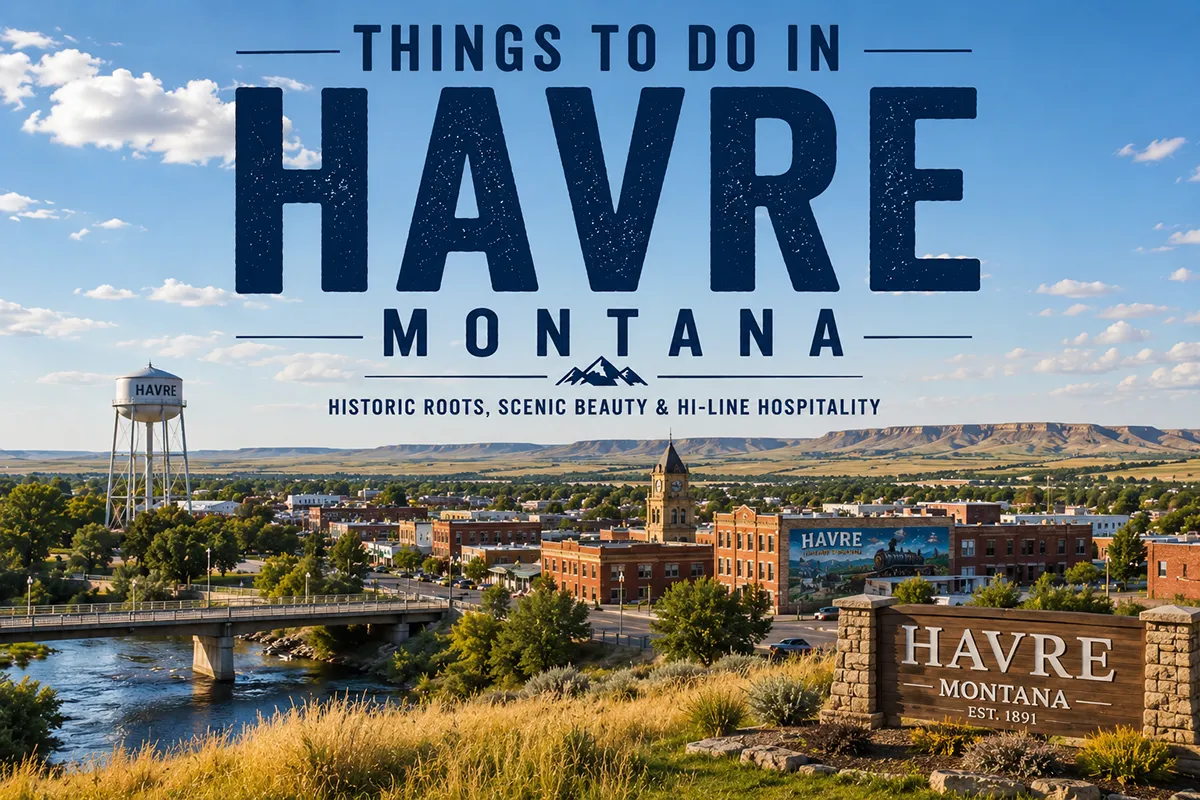
- Havre (~9,800) is the largest town on Montana’s Hi-Line — the US-2 corridor that follows the old Great Northern Railway route across northern Montana
- Havre Beneath the Streets: After an 1904 fire, Havre’s businesses moved underground and kept operating. A brothel, Chinese laundry, saloon, bakery, and butcher shop all ran below the streets while the town rebuilt above.
- Beaver Creek Park: The largest county park in the United States — 10,000 acres in the Bear Paw Mountain foothills, 10 minutes from downtown
- Fort Assinniboine: Montana’s oldest and largest military post (1879), home to the Buffalo Soldiers of the 10th Cavalry — an angle no travel guide has covered
- Wahkpa Chu’gn: A Nakoda (Assiniboine) term meaning “Big River” — a 2,000-year-old buffalo jump site with dioramas by nationally known artist Bob Scriver
- Bear Paw Ski Bowl: The Hi-Line’s local ski area in the Bear Paw Mountains — no travel blog covering Havre mentions it
- Havre is a scheduled Amtrak Empire Builder stop (Chicago–Seattle) — arrive by train through the Hi-Line’s wide-sky prairie
- For city context, lodging, and dining details, see my Havre city guide
Liked this article?
Add Roaming Montana as a preferred source so you see more of our articles and guides on Google.
Understanding Havre: The Crown Jewel of the Hi-Line
“The Hi-Line” refers to the US-2 corridor that runs east-west across the top of Montana, following the route of James J. Hill’s Great Northern Railway — the northernmost transcontinental line, completed in 1893. The towns along it were mostly railroad towns, and most of them are small. Havre at nearly 10,000 people is the largest by a significant margin.
What Havre has that the surrounding prairie doesn’t: a working underground city preserved from 1904, a 10,000-acre county wilderness park starting at its southern edge, a 2,000-year-old Indigenous archaeological site at its western boundary, the state’s largest historic military fort six miles away, and Montana State University Northern adding the specific energy that a college town brings to a rural service center.
Seedoflifelabs.com, the freshest travel guide on this SERP (published May 2026), calls it accurately: “There aren’t many towns where you can tour a 120-year-old underground city in the morning and hike 10,000 acres of Bears Paw Mountain wilderness in the afternoon. Havre is one of them.”
For lodging recommendations and restaurant details, see my Havre, Montana city guide.
All 18 Things to Do in Havre MT
History & Culture (Havre’s Defining Identity):
- Havre Beneath the Streets — underground city, full origin story ⭐
- Wahkpa Chu’gn Buffalo Jump Archaeological Site ⭐
- Fort Assinniboine — Montana’s largest historic military post + Buffalo Soldiers ⭐
- H. Earl Clack Memorial Museum — official Montana Dinosaur Trail stop ⭐
- Don Greytak pencil drawings ⭐
- Hill County Courthouse + US Historic Post Office and Courthouse
- Havre Historic Tours and More (guided walking tours)
Outdoor Recreation: 8. Beaver Creek Park — largest county park in the United States ⭐ 9. Bear Paw Ski Bowl — skiing in the Bear Paw Mountains ⭐ 10. Bear Paw Mountains hiking (summer) 11. Rookery Wildlife Management Area (birding) 12. Dark-sky stargazing on the Hi-Line ⭐
Events: 13. Great Northern Fair (July 15–19, 2026) ⭐ 14. Rocky Boy Pow Wow (August, Chippewa Cree Tribe) ⭐ 15. Festival Days (September)
Food, Drink & Arts: 16. Bow & Marrow steakhouse — “the gem inside” 17. 40 Below Public House (bison burger + cheeseburger soup) 18. Artitudes Gallery, High Plains Gallery, Old Library Gallery
Getting There Uniquely:
- Amtrak Empire Builder scheduled stop (Chicago–Seattle) ⭐
Havre Beneath the Streets: The Origin Story No Guide Tells ⭐
Every travel guide to Havre includes this attraction. Not one of them explains where it came from.
On the night of March 28, 1904, a fire swept through downtown Havre’s commercial district, destroying most of the buildings above ground. For a frontier town that had only incorporated in 1893, losing most of its business district was existential. Reconstruction would take time — but the town’s merchants had no interest in waiting.
They moved underground.
The tunnels and basement spaces beneath Havre’s streets became a functioning commercial district while the town rebuilt above. The spaces that opened in the tunnels included:
- A saloon — which was the obvious first mover
- A Chinese laundry, reflecting the significant Chinese immigrant community that worked in railroad towns along the Hi-Line
- A bakery — which fired its ovens underground and produced bread for the town
- A butcher shop — stocking meat in naturally cool underground conditions
- A brothel — one of the more candid inclusions in the tour, and a historically accurate reflection of what frontier towns actually contained
Some of these businesses operated underground for months; a few persisted for years after the above-ground reconstruction was complete, finding the below-street environment convenient for their particular needs.
The guided tour today walks through recreations of these original spaces — the period furnishings, the goods on shelves, the atmospheric lighting of a 120-year-old underground commercial district. TripAdvisor reviewers who take the tour are uniformly positive: the tour guides are knowledgeable, questions are answered thoroughly, and the immersion into what these spaces actually were is genuinely effective.
Cost: Tour admission. Address: Downtown Havre. [Verify current tour times and pricing at havrebelowthestreets.com or equivalent.]
Wahkpa Chu’gn — The Name and the Site ⭐
Every guide to Havre mentions the Wahkpa Chu’gn Buffalo Jump. Not one of them explains the name.
Wahkpa Chu’gn is a term from the Nakoda language — the language of the Assiniboine people, one of the Indigenous nations who inhabited the Hi-Line region. It translates roughly as “Big River,” referring to the Milk River that runs near this site. The Nakoda people named the river and the site; the name persisted into the English-language record as the site’s formal designation.
The site itself is one of the most significant archaeological buffalo jump complexes in Montana. For approximately 2,000 years, Indigenous peoples used the terrain here — a series of cliffs above the Milk River — as a communal hunting site.
Hunters would drive bison herds toward the cliff edge, with the animals’ momentum carrying them over. The meat, hides, and bones were processed at the base. The scale of archaeological material at this site reflects millennia of use.
The H. Earl Clack Museum (which also has a standalone entry below) houses a detailed exhibit on the Wahkpa Chu’gn site, including an actual archaeological excavation diorama created by Bob Scriver — a nationally known artist whose bronze sculptures and dioramas are held in major collections across the Mountain West. That Scriver’s work is at a Hi-Line museum is the kind of specific detail no travel guide has developed.
Tours of the Wahkpa Chu’gn site itself operate seasonally. TripAdvisor and Yelp reviewers are consistent: “It was a great tour, every question was answered. I highly recommend this site!” and “Our whole family enjoyed the tour and we highly recommend it — one of the must-see’s in Havre!”
Cost: Tour fee. Location: Just west of Havre off US-2. [Verify current tour schedule.]
Fort Assinniboine and the Buffalo Soldiers ⭐
This is the Havre historical attraction that every guide undercovers — and one angle that no travel guide at all has mentioned.
Fort Assinniboine was established in 1879, making it one of the earliest military installations in Montana. More specifically, it was the largest military post in Montana — an extensive complex of buildings, barracks, officers’ quarters, and support structures covering a significant footprint near the Milk River, 6 miles southwest of Havre.
centralmontana.com describes it accurately: “Tour a military post of yesterday. Historic Fort Assinniboine, a late 19th-century Army installation, is one of the oldest in existence and the largest in Montana.”
What no travel guide mentions: the Buffalo Soldiers.
The 10th Cavalry Regiment — one of the original Buffalo Soldier regiments, all-Black United States Army units created after the Civil War — was stationed at Fort Assinniboine in the 1880s and 1890s.
The 10th Cavalry’s service in Montana, patrolling the Hi-Line corridor, pursuing horse thieves and cattle rustlers, and maintaining military order in the early territorial period, is among the most significant and least-known chapters of African American military history in the Mountain West.
The term “Buffalo Soldiers” was coined by Indigenous peoples who encountered these units — the specific origins of the name are disputed, but the designation became the common identifier for all-Black Army regiments throughout the West.
Fort Assinniboine today: preserved original buildings are accessible for tours through the Havre Historic Tours and More program and through the H. Earl Clack Museum’s programming. The fort’s scale — even in its preserved form — conveys the significant military investment the federal government made in securing the Hi-Line in the 1880s.
Location: 6 miles southwest of Havre near the Milk River. [Verify current tour availability at H. Earl Clack Museum.]
H. Earl Clack Memorial Museum — On the Montana Dinosaur Trail ⭐
Located in the Holiday Village Shopping Center on Highway 2 West (an unremarkable location for a remarkable museum), the H. Earl Clack Memorial Museum serves multiple functions simultaneously:
Montana Dinosaur Trail official stop. The museum is one of the designated sites on Montana’s statewide dinosaur trail, recognizing significant fossil collections and palaeontological content. For visitors specifically tracking the Montana Dino Trail, Havre and the H. Earl Clack Museum are a required stop. No travel blog covering Havre has developed this angle.
Wahkpa Chu’gn exhibit. The museum houses a detailed archaeological excavation display of the Wahkpa Chu’gn Buffalo Jump, including the Bob Scriver dioramas described above. This is the most comprehensive interpretation of the site’s archaeology available without visiting the site itself.
Hi-Line history. The museum’s broader collection covers the history and development of Havre and the surrounding Hi-Line area — railroad era, homesteader period, Indigenous history, and 20th-century development.
centralmontana.com: “The museum features an archaeological excavation of a buffalo jump and a detailed explanation of a buffalo-kill. Four dioramas grace the museum, one by nationally known artist, Bob Scriver.”
Hours: [Verify current at H. Earl Clack Museum contact or visithavremt.com.] Cost: Modest admission.
Don Greytak’s Pencil Drawings — Havre’s Hidden Art Stop ⭐
Here is the Havre attraction that appears in exactly one TripAdvisor review and nowhere else — and that review is emphatic enough to be worth including.
A TripAdvisor visitor describes: “Wonderful display of the pencil drawings of Don Greytak with prints and calendars for purchase. We spent almost an hour enjoying the humor and detail captured in scenes of ranch life and rodeos, cars, planes and trains. Quite a talented man. A must-see stop in Havre! We bought a calendar as a souvenir to remind us all year of our Western trip.”
Don Greytak is a local artist working in pencil, capturing the specific visual vocabulary of Hi-Line ranch culture — rodeos, machinery, working cowboys, period vehicles, and the particular humor of a region that has been making do with what’s available for 130 years.
The drawings are described as detailed, funny, and specific to this place in a way that mass-produced Montana souvenirs aren’t.
Location: [Verify current display/gallery location locally — the TripAdvisor listing places it in downtown Havre.] Cost: Free to browse; prints and calendars for purchase.
Beaver Creek Park — The Largest County Park in the United States ⭐
This is the superlative that no travel blog has properly built out.
Beaver Creek Park covers 10,000 acres in the foothills of the Bear Paw Mountains, beginning just minutes south of Havre’s downtown. It is administered by Hill County — making it a county park. And at 10,000 acres, it is the largest county park in the United States.
Not a state park. Not a national forest or wilderness area. A county park. The distinction matters because it reflects a remarkable level of local investment in public land access — Hill County maintains 10,000 acres of mountain foothills, forests, streams, and meadows for public use, within minutes of town.
What’s in the park: fishing (trout in Beaver Creek), hiking (trails through forested terrain), wildlife viewing (white-tailed deer, wild turkeys, upland birds, and occasional black bears), picnicking, and camping at multiple campgrounds throughout the park.
The scenery transitions from open prairie at the park’s northern entry to densely forested mountain terrain as you move south into the Bear Paw highlands.
seedoflifelabs.com: “Beaver Creek Park is the largest county park in the United States, a sprawling, 10,000-acre preserve that rises from the foothills of the Bears Paw Mountains. The park covers some of the most scenic terrain in northern Montana. Fishing, hiking, wildlife viewing, picnicking, and camping are all on the table, and it’s only minutes from town.”
Park permit: $15/night or $95/year. [Verify current permit requirements and campground availability.]
Bear Paw Ski Bowl — The Hi-Line’s Local Mountain ⭐
Here is the Havre-area activity that no travel guide has ever mentioned: Bear Paw Ski Bowl in the Bear Paw Mountains south of Havre.
For a town on the Hi-Line — Montana’s flat northern agricultural corridor — having a ski area within close driving distance is genuinely distinctive. The Bear Paw Mountains rise to the south of Havre, and Bear Paw Ski Bowl sits in those hills, providing downhill skiing and snowboarding access to Havre residents and visitors through the winter season.
For our complete Bear Paw Ski Bowl guide — terrain, lift details, season dates, and how to get there from Havre — see my Bear Paw Ski Bowl guide.
In summer, the Bear Paw Mountains provide hiking terrain accessible from Havre in combination with Beaver Creek Park. The same hills that hold ski runs in winter hold forest trails, wildlife, and the specific beauty of an isolated mountain range rising from an otherwise flat prairie landscape.
Dark-Sky Stargazing on the Hi-Line ⭐
This is the Havre characteristic that seedoflifelabs.com calls out and no other travel guide develops: the Hi-Line’s extraordinary dark skies.
The US-2 corridor across northern Montana is among the least light-polluted regions in the lower 48 states. The nearest major cities are Great Falls (115 miles south) and Billings (roughly 300 miles southeast). The population density along the Hi-Line is among the lowest in the continental US.
The result is a night sky of a quality that most Americans have never experienced — the Milky Way visible as a physical band across the sky, not a faint suggestion.
Beaver Creek Park’s campgrounds, just minutes from Havre, provide the specific dark-sky conditions that make stargazing genuinely extraordinary. On a clear summer night in the park, the sky produces the specific effect that makes people stop talking mid-sentence and just look up.
There are no formal dark-sky programs or telescopes available in Havre — this is entirely self-directed. Bring your own optics and a red-light headlamp, and camp in Beaver Creek Park for the best access.
Arriving by Amtrak Empire Builder ⭐
This is the Havre travel angle that seedoflifelabs.com mentions and no travel guide builds out. Havre is a scheduled stop on the Amtrak Empire Builder — the train route running from Chicago to Seattle, widely considered one of the most scenic rail journeys in the United States.
The Empire Builder’s route through Montana follows the Hi-Line — the old Great Northern Railway corridor that James J. Hill built in the early 1890s. Traveling by train across northern Montana means watching the prairie unfold for hours, then the mountains begin to rise in the west as the train approaches Glacier country.
Havre’s position on this route makes it one of the few Montana destinations accessible without a car — though once you arrive, transportation within the area requires a rental or local contact.
For travelers specifically interested in the Hi-Line’s railroad heritage, arriving in Havre by the train that’s been running this route since before living memory is a meaningful connection to the town’s origin story.
Amtrak station: Havre has a historic station building. The Empire Builder typically arrives in the early morning hours — check current schedules at amtrak.com.
Events: Havre’s Annual Calendar
Great Northern Fair — July 15–19, 2026 ⭐
The Great Northern Fair runs five days: July 15–19, 2026 — bringing carnival rides, livestock shows, local entertainment, a rodeo, and community gathering to Havre’s fairgrounds. visithavremt.com: “Mid-July brings the Great Northern Fair, featuring carnival rides, livestock shows, and local entertainment.”
The fair is named for James J. Hill’s Great Northern Railway — Havre’s founding institution. For a community built by the railroad, an annual fair that takes the railroad’s name is appropriately continuous with the town’s identity.
[Verify current schedule and events at the Hill County fairgrounds or visithavremt.com.]
Rocky Boy Pow Wow — August ⭐
The Rocky Boy’s Indian Reservation, home of the Chippewa Cree Tribe, is adjacent to Havre to the south — the reservation’s boundaries overlap with the Bear Paw Mountains area. The annual Rocky Boy Pow Wow in early August brings traditional dancing, drumming, and cultural celebration to the reservation.
visithavremt.com describes it: “Experience the rich Native American culture at the Rocky Boy Pow Wow in early August with traditional dances and music.”
The Pow Wow is a significant cultural event that no travel blog covering Havre has built out as a visitor-accessible experience. The proximity of the Rocky Boy’s Reservation to Havre makes this a natural pairing with other Havre activities — the Wahkpa Chu’gn site’s Indigenous context and the Pow Wow cultural experience complement each other directly.
[Verify current year dates with the Rocky Boy’s Indian Reservation.]
Festival Days — September
Mid-September’s Festival Days offer a weekend of parades, food vendors, and community activities. visithavremt.com: “A weekend of fun with parades, food vendors, and community activities, making it a fun-filled event for all ages.”
July 4th Celebration
The Fourth of July in Havre includes parades, family-friendly activities, and a fireworks display. visithavremt.com: “Celebrate Independence Day with parades, family-friendly activities, and a stunning fireworks display in early July.”
Food, Drink, and Havre’s Social Scene
Bow & Marrow
Yelp’s top-rated Havre dining: “The exterior blends in well with the rustic landscape, hiding the gem inside.” A steakhouse that earns its reputation as the best meal in Havre — the exterior gives nothing away, and first-time visitors are consistently surprised.
40 Below Public House
Yelp specifically calls out the bison burger with cheeseburger soup: “We ordered from the specials menu — Kel got the BIG bison burger with the cheeseburger soup for a side, the soup was the star there.” A casual bar and restaurant with the specific pleasures of a Hi-Line town that does its own thing without apology.
Murphy’s Pub
Yelp’s most-reviewed Havre restaurant with 78 reviews — the crunchy Asian chicken salad specifically called out. Murphy’s functions as Havre’s consistent social anchor, the place where everyone from MSU-Northern students to retired ranchers ends up.
Vine 19 Wine Bar
TripAdvisor: “Wine, Wine and more Wine. We have six wines by the glass (3 white, 3 red) that we rotate weekly.” A wine bar in a Hi-Line town of 9,800 represents a specific kind of community sophistication that Havre’s college-town energy produces.
Artitudes Gallery, High Plains Gallery & Frame Shop, Old Library Gallery
Three art spaces serving the Hi-Line’s creative community:
Artitudes Gallery (TripBuzz): an artist co-op featuring local Montana artists with regular receptions where visitors can speak with the artists directly.
High Plains Gallery & Frame Shop (TripBuzz): specializes in local Montana artists with custom frames made from barn wood and oak.
Old Library Gallery (TripAdvisor landmark): the former library building converted to gallery use.
Things to Do in Havre by Traveler Type
For History Enthusiasts
Havre Beneath the Streets (the underground city — the origin story is the attraction), Fort Assinniboine and the Buffalo Soldiers (Montana’s largest historic military post, 10th Cavalry history), Wahkpa Chu’gn Buffalo Jump (2,000-year-old site, Bob Scriver dioramas at the Clack Museum), H. Earl Clack Memorial Museum (Montana Dino Trail, Hi-Line history), Hill County Courthouse and US Historic Post Office and Courthouse.
For Outdoor Enthusiasts
Beaver Creek Park (10,000 acres, largest county park in the US, camping, fishing, hiking, wildlife), Bear Paw Ski Bowl in winter, Bear Paw Mountains hiking in summer, Rookery Wildlife Management Area (birding), dark-sky stargazing from Beaver Creek Park campgrounds.
For Culture and Events
Great Northern Fair (July 15–19, 2026), Rocky Boy Pow Wow (August, Chippewa Cree Tribe), Festival Days (September), Don Greytak pencil drawings (local art), Artitudes Gallery.
For Unique Travel Experiences
Arriving on the Amtrak Empire Builder (Chicago–Seattle, Hi-Line route), dark-sky stargazing in Beaver Creek Park, touring the underground city that a Montana town built rather than close.
For Families
Havre Beneath the Streets (genuinely immersive for children), H. Earl Clack Museum (dinosaur trail, interactive), Wahkpa Chu’gn (guided archaeological tours — reviewers consistently recommend for families), Beaver Creek Park fishing and camping, Great Northern Fair rides and livestock.
Free and Low-Cost Activities
Beaver Creek Park day use (permit fee), Don Greytak gallery (free to browse), Old Library Gallery, downtown walking tour (free), dark-sky stargazing (free with Beaver Creek Park permit).
For broader seasonal guidance, see my best time to visit Montana guide.
Day Trips from Havre
Chinook and the Bear Paw Battlefield (40 miles east)
Chinook, 40 miles east of Havre on US-2, is the county seat of Blaine County and the site of the Bear Paw Battlefield — where Chief Joseph of the Nez Perce surrendered to General Nelson Miles on October 5, 1877, after a 1,170-mile flight from Oregon. “From where the sun now stands, I will fight no more forever” was spoken approximately 40 miles from Havre. The Blaine County Museum in Chinook covers both the battle and the broader Nez Perce story.
Hi-Line Day Drive
The US-2 corridor east or west of Havre through the open Hi-Line prairie provides one of Montana’s most underrated scenic drives — not dramatic mountain scenery, but the specific beauty of enormous sky, grain elevators punctuating the horizon, and the knowledge that this is the territory James J. Hill’s railway opened to homesteaders in the 1910s. For guided outdoor options along the Hi-Line, see my Montana guided tours guide.
What Competitors Miss About Havre
Every travel guide covers: Havre Beneath the Streets (as a name), Wahkpa Chu’gn (as a name), Fort Assinniboine (as a name), and Beaver Creek Park. Here’s what none of them build out:
The Havre Beneath the Streets origin story. The underground city exists because a fire in 1904 destroyed the above-ground town and the businesses refused to close. They moved underground and kept running — a saloon, a laundry, a bakery, a butcher shop, a brothel. That decision is the story. No travel guide tells it.
Beaver Creek Park’s superlative. The largest county park in the United States. Not a state park, not national forest — a county park. 10,000 acres. Minutes from town. The size distinction makes it genuinely remarkable, and no travel blog has led with this.
The Buffalo Soldiers at Fort Assinniboine. The 10th Cavalry Regiment — all-Black US Army troops — were stationed at Montana’s largest military post in the 1880s and 1890s. This is one of the most significant untold stories of African American military history in Montana. Zero travel blogs covering Havre have mentioned it.
The Wahkpa Chu’gn naming etymology. “Big River” in the Nakoda language, referring to the Milk River. The name itself tells you who named this landscape and what they called the river that defines it. No travel guide explains this.
Bear Paw Ski Bowl. A ski area in the Bear Paw Mountains, accessible from Havre. No travel blog covering Havre mentions it. We have a full guide at /bear-paw-ski-bowl/.
Amtrak Empire Builder service. Havre is a scheduled stop on the Chicago–Seattle route. The train follows the exact Great Northern Railway corridor that made Havre. Arriving by train is a historically authentic connection to the town’s origin that no travel guide develops.
Rocky Boy Pow Wow. The Chippewa Cree Tribe’s annual pow wow, on the reservation adjacent to Havre, in August. A significant cultural event accessible to visitors. No travel blog has built this out.
Don Greytak’s pencil drawings. One TripAdvisor reviewer calls it “a must-see stop in Havre.” No travel guide has it.
Dark-sky stargazing. The Hi-Line’s distance from light pollution produces extraordinary night skies. Beaver Creek Park’s campgrounds provide the access point. No travel guide builds this out.
Explore More Montana Cities
Montana has a lot of ground to cover. Whether you’re building a road trip route or just curious what the next town down the highway has to offer, here are the city guides we’ve put together so far:
- Things to Do in Bozeman, Montana — Montana’s fastest-growing city, with great restaurants, the Museum of the Rockies, and easy access to Gallatin Canyon and Big Sky.
- Things to Do in Livingston, Montana — The original Yellowstone gateway; a fly fishing capital with a surprising arts scene, vintage neon downtown, and the Absaroka Mountains as a backdrop.
- Things to Do in Missoula, Montana — Western Montana’s outdoor playground, where the Clark Fork River flows through downtown and hiking, breweries, art galleries, and live music are all part of daily life.
- Things to Do in Whitefish, Montana — The gateway to Glacier National Park, with a walkable downtown, ski resort access at Whitefish Mountain, and Whitefish Lake on the edge of town.
- Things to Do in Kalispell, Montana — The commercial hub of the Flathead Valley; close to Glacier, Flathead Lake, and some of the best scenic drives in northwest Montana.
- Things to Do in Bigfork, Montana — A small arts village on Flathead Lake that punches above its size with galleries, live theater, and excellent waterfront dining.
- Things to Do in Polson, Montana — Sitting on the southern shore of Flathead Lake, Polson combines lake recreation, cherry orchards, and sweeping views of the Mission Mountains.
- Things to Do in Butte, Montana — One of Montana’s most historically layered cities; mining heritage, Victorian architecture, and a working-class character that’s entirely its own.
- Things to Do in Helena, Montana — Montana’s compact, walkable capital; the state capitol building, Last Chance Gulch, and the Cathedral of Saint Helena are all within easy reach downtown.
- Things to Do in Great Falls, Montana — The Electric City is home to the Missouri River’s famous waterfalls, the Lewis and Clark National Historic Trail Interpretive Center, and an impressive collection of museums.
- Things to Do in Billings, Montana — Montana’s largest city offers a mix of urban amenities, sandstone Rimrocks, vibrant breweries, family attractions, and easy access to nearby state parks and national monuments.
- Things to Do in Dillon, Montana — A quiet southwestern Montana town with serious fly fishing access on the Beaverhead River and a pace that feels far removed from the tourist trail.
- Things to Do in Hamilton, Montana — Nestled in the scenic Bitterroot Valley, Hamilton is known for hiking, fishing, historic downtown charm, and easy access to the Bitterroot Mountains.
- Things to Do in West Yellowstone, Montana — The busiest gateway to Yellowstone National Park, offering wildlife viewing, snowmobiling, museums, and year-round outdoor adventures.
- Things to Do in Gardiner, Montana — Yellowstone’s original entrance town, famous for the Roosevelt Arch, abundant wildlife, river rafting, and quick access to Mammoth Hot Springs.
- Things to Do in Red Lodge, Montana — A charming mountain town at the base of the Beartooth Highway, known for its historic downtown, outdoor recreation, and one of America’s most scenic drives.
- Things to Do in Polebridge, Montana — Glacier’s remote northwest corner; no cell service, no power grid, a legendary bakery, and some of the most untouched backcountry in the park.
- Things to Do in Miles City, Montana — Eastern Montana’s cowboy capital, home to the Bucking Horse Sale and a historic downtown that hasn’t changed much since the cattle drives.
- Things to Do in Havre, Montana — A welcoming Hi-Line community where railroad history, underground tours, and wide-open prairie landscapes showcase a different side of northern Montana.
- Libby, Montana Guide — A timber town in the far northwest tucked along the Kootenai River, with Kootenai Falls and the Cabinet Mountains Wilderness on its doorstep.

Final Thoughts
Havre doesn’t get many visitors who planned to come. Most arrive because it’s on the way — the Empire Builder stops, the US-2 road trip passes through, and the Hi-Line doesn’t offer many alternatives for food and a bed.
The ones who stay longer than planned are usually the ones who went underground first.
Havre Beneath the Streets takes about two hours and changes how you look at the rest of the town — the buildings above you were all built after the fire, and below the streets that replaced them, the original commercial district still exists in the dark. The Chinese laundry is still down there. The saloon is still down there. The bakery ovens, cold now for 120 years, are still down there.
After that, Beaver Creek Park is 10 minutes south, and the Bear Paw Mountains start where the park starts, and the sky at night in northern Montana doesn’t look like any sky you’ve seen if you’ve spent your life near cities.
Give Havre two days. It will use them.
Questions about Havre? Drop them in the comments.
Frequently Asked Questions
What are the best things to do in Havre Montana?
Havre’s essential experiences: Havre Beneath the Streets (the underground city that operated after the 1904 fire — book a guided tour), Beaver Creek Park (the largest county park in the United States, 10,000 acres in the Bear Paw Mountain foothills), Wahkpa Chu’gn Buffalo Jump Archaeological Site (2,000-year-old Indigenous site), Fort Assinniboine (Montana’s largest historic military post, home of the Buffalo Soldiers of the 10th Cavalry), and the H. Earl Clack Memorial Museum (official Montana Dinosaur Trail stop). In winter, add Bear Paw Ski Bowl.
What is Havre Beneath the Streets?
Havre Beneath the Streets is a guided tour of the underground commercial district that operated beneath Havre’s main street after a fire destroyed the above-ground town in 1904. Rather than close while rebuilding, Havre’s businesses — including a saloon, Chinese laundry, bakery, butcher shop, and brothel — moved into the tunnels and basement spaces beneath the street and kept operating, some for months and some for years. The tour today walks through recreations of these original spaces with period furnishings and props, guided by knowledgeable local historians.
What is Beaver Creek Park near Havre Montana?
Beaver Creek Park is a 10,000-acre county park in the foothills of the Bear Paw Mountains, administered by Hill County and located just minutes south of Havre. It is the largest county park in the United States. The park offers fishing (Beaver Creek trout), hiking, wildlife viewing (white-tailed deer, wild turkeys, upland birds), picnicking, and camping at multiple campgrounds. A park permit ($15/night or $95/year) is required for all uses.
What is Fort Assinniboine near Havre?
Fort Assinniboine was established in 1879 as one of Montana’s earliest military installations and grew to become the largest military post in the state. Located 6 miles southwest of Havre near the Milk River, the fort is notable for housing the 10th Cavalry Regiment — the Buffalo Soldiers, one of the original all-Black US Army units created after the Civil War — in the 1880s and 1890s. Preserved buildings are accessible through Havre Historic Tours and the H. Earl Clack Museum’s programming.
What is Wahkpa Chu’gn near Havre Montana?
Wahkpa Chu’gn is a 2,000-year-old buffalo jump archaeological site just west of Havre. The name comes from the Nakoda (Assiniboine) language and means “Big River,” referring to the Milk River nearby. For millennia, Indigenous peoples drove bison herds over the cliffs at this site for communal hunting and processing. Guided tours operate seasonally at the site; the H. Earl Clack Memorial Museum in Havre houses detailed exhibits on the site including dioramas created by nationally known artist Bob Scriver.
Does Amtrak stop in Havre Montana?
Yes — Havre is a scheduled stop on the Amtrak Empire Builder (Chicago to Seattle), one of the most scenic train routes in the United States. The Empire Builder follows the old Great Northern Railway corridor across northern Montana’s Hi-Line, passing through Havre. The train typically arrives in the early morning hours; check current schedules at amtrak.com. Havre’s railroad heritage makes arriving by train a historically resonant way to approach the town.
Is Bear Paw Ski Bowl near Havre?
Yes — Bear Paw Ski Bowl is located in the Bear Paw Mountains south of Havre, providing downhill skiing and snowboarding access for Hi-Line residents and visitors during the winter season. It is one of the most underreported Havre-area activities; no travel blog covering Havre mentions it. See our complete Bear Paw Ski Bowl guide for terrain details, season dates, and directions.