The first time I drove into Gardiner, Montana, I stopped at a traffic light — one of the very few in this town of 791 people — and looked over to find an elk standing in a parking lot, completely unbothered, chewing something with the serene confidence of an animal that has never once been told it doesn’t belong here. Three tourists were photographing it from the sidewalk. The elk didn’t look up.
That moment captures Gardiner better than anything I could write. It is a town where the boundary between civilization and wildness is more suggestion than fact, where the Yellowstone River moves through the center of things with enough force that you feel it, and where the gateway to America’s first national park is half a mile from the only stoplight in the county.
Quick Answer — Things to Do in Gardiner Montana
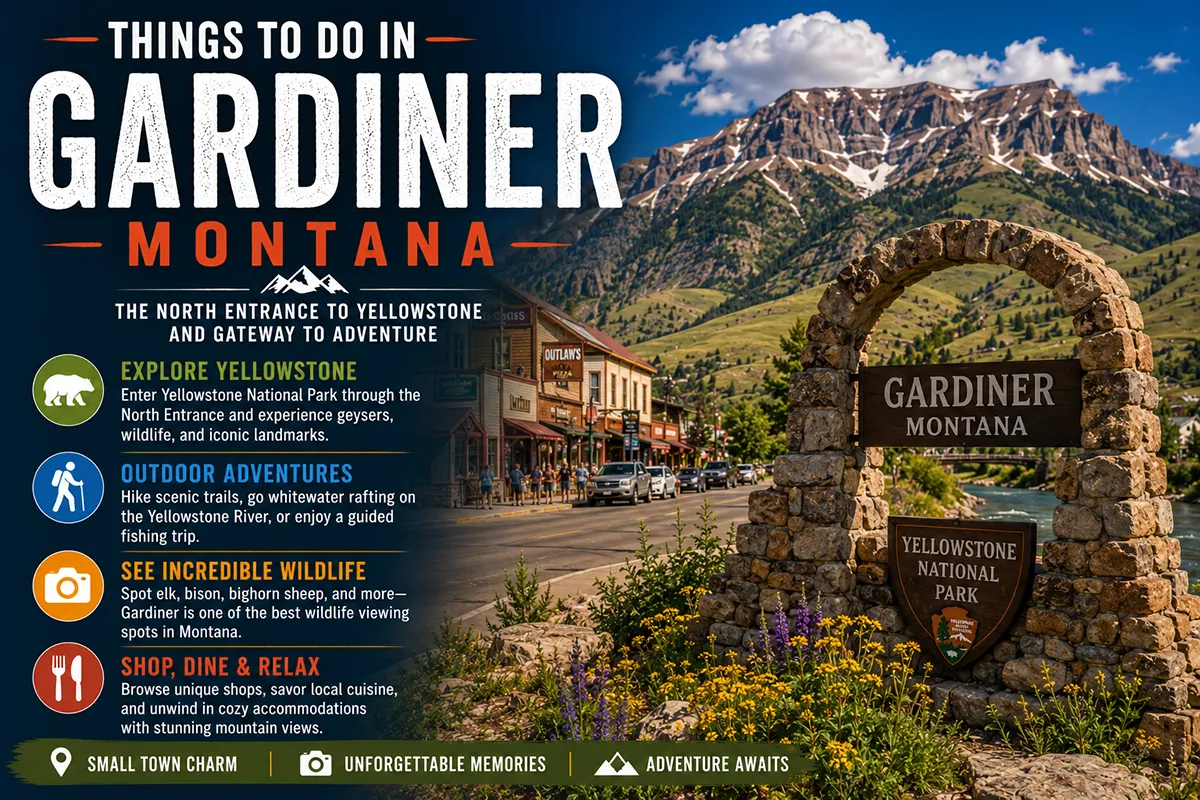
Gardiner’s essential experiences: photograph the Roosevelt Arch (Teddy Roosevelt laid the cornerstone in 1903 — the full story is better than the landmark suggests), drive 5 miles to Mammoth Hot Springs, watch elk graze on downtown lawns (free, year-round), raft the Yellowstone River with Wild West Rafting or Flying Pig Adventures, fly fish with Parks’ Fly Shop (est. 1953), hike to Jardine — the oldest dude ranch in Montana (2.6 miles round trip), and position yourself for Lamar Valley wolf watching, which from Gardiner’s year-round north entrance is unmatched in winter. Budget 2–4 days.
- Gardiner (population ~791) sits at Yellowstone’s North Entrance — 5 miles from Mammoth Hot Springs
- Gardiner is the ONLY Yellowstone entrance open to motorized vehicles year-round — all other entrances close in winter
- Roosevelt Arch: Teddy Roosevelt laid the cornerstone in person on April 24, 1903
- Elk walk the streets of Gardiner year-round — this is not a special event, it’s Tuesday
- Parks’ Fly Shop has operated continuously since 1953 — over 70 years in a town of 800
- Red’s Blue Goose Saloon: burned in 2020, rebuilt as an outdoor food truck park with live music — the best Gardiner dining story no travel blog covers
- Lamar Valley wolf watching is exceptional from Gardiner — and winter, when all other entrances are closed, is the premium season
- For RV travelers, see our Gardiner RV parks guide
Liked this article?
Add Roaming Montana as a preferred source so you see more of our articles and guides on Google.
Why Gardiner Is More Than a Park Gateway
Gardiner’s story in recent years is one of resilience that no travel guide has covered properly. The town was hit by Covid-19 in 2020, lost three historic buildings including the beloved Red’s Blue Goose Saloon to fire the same year, and in 2022 experienced a thousand-year flood of the Yellowstone River — the event that produced the viral video of a house collapsing into the river that millions watched online. That house was in Gardiner.
Despite three consecutive years of hardship, the community rebuilt. Red’s Blue Goose came back as an outdoor food truck park. The businesses that stayed open did so because the people running them chose to stay. As one shopkeeper told a visitor during the recovery: “We’re making in one week what we used to make in one shift. So, thank you for buying this t-shirt.”
That spirit — small, specific, genuine — is what makes Gardiner worth more than a morning stop on the way into Yellowstone.
Locals call the North Entrance “nature’s favorite entrance,” and while that’s obviously promotional, the sentiment is accurate: the Yellowstone River runs through downtown, elk graze on the lawns, bison wander through in winter, and the Absaroka peaks press in from every direction.
For full city logistics — lodging, dining, navigation — see my Gardiner, Montana city guide.
All 20 Things to Do in Gardiner Montana
History & Iconic Landmarks:
- Roosevelt Arch — Teddy Roosevelt, 1903, full story below ⭐
- Yellowstone Heritage and Research Center (free lobby + NPS exhibits)
Yellowstone National Park (North Entrance): 3. Mammoth Hot Springs (5 miles inside) 4. Beaver Ponds Loop Trail — moose habitat, 4.5 miles 5. Osprey Falls Trail — hidden canyon waterfall 6. Lamar Valley wildlife (wolves, grizzlies, bison) ⭐ 7. Tower Fall + Tower-Roosevelt area 8. Grand Canyon of the Yellowstone
Free In-Town Experiences: 9. Elk watching on downtown streets ⭐ — daily, year-round 10. Bison in town (winter) — wander down from park seeking lower elevation
Water Activities: 11. Whitewater rafting the Yellowstone River ⭐ 12. Fly fishing (Parks’ Fly Shop est. 1953) ⭐
Hiking: 13. Jardine Trail — oldest dude ranch in Montana (2.6 miles) ⭐ 14. Bunsen Peak Trail — summit views 15. Electric Peak (10,969 ft) — ambitious summit
Events: 16. Annual Gardiner Rodeo — Jim Duffy Arena ⭐
Food & Drink: 17. Iron Horse Bar & Grill (elk meatloaf, pan-fried rainbow trout) 18. Red’s Blue Goose food truck park (Huckleberry Vodka Lemonade, live music) ⭐
Horseback Riding: 19. Guided pack trips and trail rides into Absaroka-Beartooth Wilderness
Day Trips: 20. Paradise Valley scenic drive to Chico Hot Springs
The Roosevelt Arch: The Full Story
1. Roosevelt Arch — What Every Guide Skips ⭐
Every travel guide mentions the Roosevelt Arch. None of them tell the story properly. Let me fix that.
The arch stands 50 feet tall at the North Entrance to Yellowstone, built from locally quarried basalt blocks. On April 24, 1903, President Theodore Roosevelt personally laid the cornerstone — Roosevelt was on an extended western tour that brought him through Gardiner specifically for this purpose.
At the time of the laying, Yellowstone had been the world’s first national park for 31 years, but had not yet acquired its permanent gateway architecture.
The inscription — “For the Benefit and Enjoyment of the People” — was the suggestion of Congressman John F. Lacey of Iowa, who also authored the Lacey Act of 1900, one of America’s earliest wildlife protection laws. The inscription comes from the 1872 legislation that created the park.
The arch is the most photographed object in Gardiner, and the scene in front of it — bison crossing the road directly under the arch, as they regularly do — is one of the most distinctively American images I’ve encountered in this country.
Standing at the arch and reading the inscription in context — understanding that Teddy Roosevelt was here, that this was a deliberate act of civic symbolism — gives the photograph a weight that passing traffic doesn’t provide.
Cost: Free.
Location: Park Street, Gardiner.
Bison crossing: Random.
Best time for photographs: Early morning or evening when light comes from the west.
2. Yellowstone Heritage and Research Center
Located in Gardiner, the Yellowstone Heritage and Research Center is a branch of the National Park Service’s research and collections infrastructure — over 1,100 boxes of archival materials, 5,000+ cubic feet of storage, covering the park’s complete documented history.
The lobby and temporary exhibits set up by the National Park Service are accessible to visitors. crazyfamilyadventure.com: “The Heritage and Research Center is home to a variety of research and documentation on Yellowstone. You can tour the lobby and temporary exhibits set up by the National Park Service when you visit.”
While the full archive isn’t publicly browsable, the exhibits in the accessible areas provide context for Yellowstone’s history that even frequent park visitors typically lack.
Cost: Free (lobby and exhibits).
Address: Gardiner. [Verify current hours with NPS.]
Yellowstone National Park via the North Entrance
3. Mammoth Hot Springs (5 Miles Inside) ⭐
The Yellowstone feature nearest to Gardiner, Mammoth Hot Springs is a geological time-lapse in progress — a stepped travertine terrace where hot water carrying dissolved limestone emerges from underground and deposits mineral formations that change week to week, year to year.
The terrace looks different every season because it genuinely is different: the hydrothermal activity continuously reshapes the surface.
The extensive boardwalk system at Mammoth provides safe access above the thermally active surface. thisheretown.com: “The ever-changing complex system of vibrant hot springs lays on a terraced hill of travertine, and an extensive boardwalk system winds around and over the area.”
Mammoth Hot Springs is also where elk concentrate most predictably near Gardiner — the Mammoth area’s open lawns and historic military buildings create the specific habitat where cow elk calve in late spring and herds graze through summer. You will see elk here; the only variable is how many.
Distance from Gardiner: 5 miles south via US-89.
No separate fee: Included with Yellowstone park entry.
4. Beaver Ponds Loop Trail
A 4.5-mile loop accessible from the Mammoth Hot Springs area, the Beaver Ponds Loop climbs through sagebrush, passes a series of beaver ponds, and provides consistently good moose viewing in the wetland sections. Expedia specifically recommends this trail. The loop is moderately strenuous; plan 2–3 hours.
The beaver pond habitats attract waterfowl and songbirds in addition to moose, making this one of the more wildlife-productive hikes accessible from the north entrance.
5. Osprey Falls Trail
A more demanding Yellowstone hike accessible from Bunsen Peak Road: the Osprey Falls Trail descends steeply into the Sheepeater Canyon to reach a dramatic 150-foot waterfall on the Gardner River. The round trip is approximately 9 miles with significant elevation change.
Expedia lists Osprey Falls among Gardiner’s top hiking attractions. The canyon itself — dark basalt walls, the roaring Gardner River, and the falls at the end — is one of the less-visited spectacular landscapes in the northern Yellowstone area.
6. Lamar Valley: Wolf Watching and Wildlife ⭐
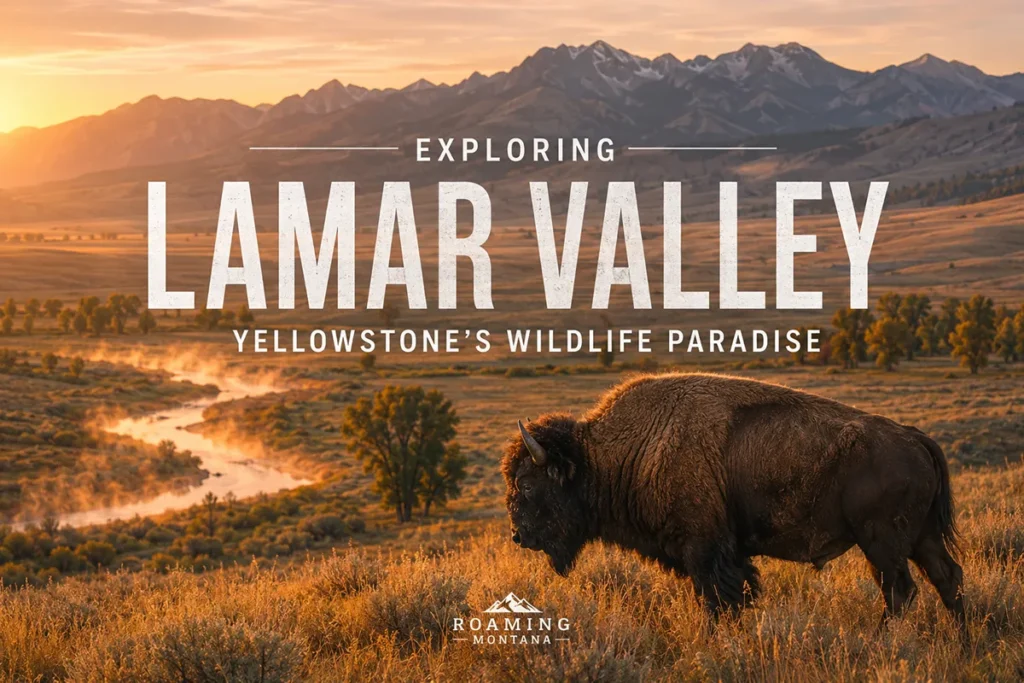
The Lamar Valley is the finest wildlife viewing corridor in the continental United States. Wolves, grizzly bears, bison, pronghorn, elk, and raptors move through a broad mountain valley in concentrations that have no equivalent in American wilderness.
From Gardiner via the North Entrance, the Lamar Valley is approximately 45–60 minutes east through the park. For the full strategy on timing, positioning, species behavior, and the specific spots that produce the best sightings, see my Lamar Valley wildlife guide and Yellowstone wolf watching guide.
The critical Gardiner advantage: because Gardiner’s North Entrance stays open year-round, visitors can access the Lamar Valley in winter — when every other Yellowstone entrance is closed to cars. Winter wolf watching from the Lamar is the best in the world.
The packs are active in open terrain; the wolf biologists stationed at pull-outs radio each other when sightings occur; and the silence of a winter Lamar morning, snow-covered and still, has no summer equivalent. No travel blog covering Gardiner has built out this winter Lamar Valley advantage properly.
For Cooke City visitors, the route through Gardiner’s North Entrance and across the Lamar Valley provides access in winter when the Beartooth Highway to Red Lodge is closed.
Elk on the Streets: Gardiner’s Free Daily Experience ⭐
Here is the single most distinctive thing about Gardiner that no travel blog has properly built out: elk walk through downtown Gardiner on a daily basis, year-round. This is not a seasonal event, not a lucky wildlife sighting, and not a performance.
The visitgardinermt.com social media account posts this regularly with captions like: “A typical day in Gardiner! Elk are often found grazing on lawns, lounging in the shade, and strolling through the streets in town.”
Cow elk calve near Mammoth in late spring, and the herds that use the Mammoth area flow in and out of Gardiner throughout the year. In winter, bison add to the mix, coming down from the park to seek lower elevation and easier grazing.
The practical visitor guide to Gardiner’s street wildlife:
- Keep 25 yards (23 meters) minimum distance from elk at all times
- During calving season (late May–June), cow elk are protective and can be aggressive
- Bison require 25 yards as well — they move faster than they look
- Do not approach for photographs; use the zoom lens from a distance
- The Jim Duffy Arena area, downtown sidewalks, and the parks along the river are the most consistent elk viewing locations
What no travel guide explains: walking downtown Gardiner after dinner, finding a bench near the river, and watching elk graze 30 yards away is the specific experience that makes Gardiner feel like a place that exists at the edge of something genuinely wild. It’s free. It happens every day.
Water Activities: The Yellowstone River
7. Whitewater Rafting the Yellowstone River ⭐
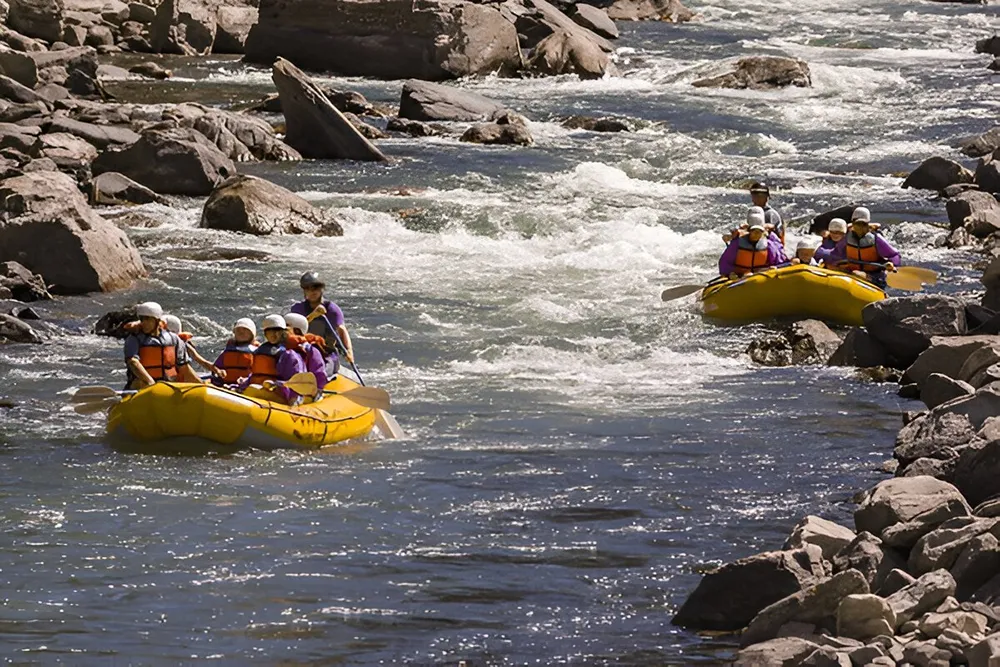
The Yellowstone River runs directly through Gardiner — and several professional outfitters run rafting trips from town:
Wild West Rafting — thisheretown.com’s recommendation. Offers full-day, half-day (2-hour), and overnight trips. Also runs two creative combos: “Saddle & Paddle” (rafting + horseback riding) and “Float & Soak” (rafting + hot springs soak at the end). These combo packages are genuinely distinctive — multi-activity experiences that no other Montana rafting operation packages the same way.
Flying Pig Adventures and Montana Whitewater — yellowstonepark.com’s 2026 recommendations. Both run river trips on the Yellowstone with varying rapid classifications depending on water level and chosen section.
The Yellowstone River through Gardiner and the canyon just north of town produces genuine Class III whitewater in peak season. The backdrop — Absaroka peaks, the Gardner River confluence, and the canyon walls — makes this a visually exceptional rafting corridor.
For guided outdoor options across Montana, see my Montana guided tours guide.
8. Fly Fishing: Parks’ Fly Shop (Since 1953) ⭐
Parks’ Fly Shop has operated continuously in Gardiner since 1953, under continuous family operation by the Parks family. That’s over 70 years of institutional knowledge about the Yellowstone River, the Gardner River, Slough Creek, the Madison, and every other fishery accessible from Gardiner.
Expedia: “Established in 1953, Parks’ Fly Shop offers expert guidance and locally-crafted flies for Yellowstone’s waters. Book their personalized guided trips to access hidden fishing spots with regional specialists.”
In a tourist town where outfitters come and go, a single-family operation running continuously for 70+ years represents genuinely accumulated local knowledge. The guided trips from Parks’ Fly Shop access both the Yellowstone River near town and park fisheries accessible to wading anglers.
In winter, Parks’ Fly Shop also rents cross-country skis — yellowstonepark.com: “Rent cross-country skis from Park’s Fly Shop and head to nearby National Forest trails, or do a ski tour of Mammoth Hot Springs or Tower Fall.”
Address: Downtown Gardiner.
Hours: [Verify current at parksflyshop.com.]
Hiking in and Around Gardiner
9. Jardine Trail — The Oldest Dude Ranch in Montana ⭐
Here’s the Gardiner hike that no major travel blog covers — and crazyfamilyadventure.com, the only travel blog to mention it, describes it as a compelling choice: a 2.6-mile round trip hike through the Custer Gallatin National Forest to Jardine, the site of the oldest dude ranch in Montana.
At the ranch site, original historic buildings stand in various states of preservation — walk through them and examine what remains of a working dude ranch operation from Montana’s earliest tourism era. The hike itself moves through forest and meadow with views of the Yellowstone River canyon.
For history-oriented visitors who want a Gardiner hiking option with a narrative payoff beyond scenery alone, Jardine delivers. The round trip takes 60–90 minutes at a leisurely pace.
Trailhead: Ask at Gardiner Chamber of Commerce or Parks’ Fly Shop for current directions.
10. Bunsen Peak and Electric Peak
Bunsen Peak (8,564 ft) is accessible from Mammoth Hot Springs via a 4.2-mile round-trip trail — a moderate climb with panoramic views of the Mammoth area, the Swan Lake Flats, and the mountains beyond. Named for the inventor of the Bunsen burner (Robert Bunsen theorized about the geothermal mechanics of Yellowstone’s geysers in the 1840s).
Electric Peak (10,969 feet) is Yellowstone’s highest peak in the northern section — Expedia lists it as a recommended Gardiner area attraction. The summit trail is demanding (~12 miles round trip with 4,000+ feet of elevation gain from the Swan Lake Flats trailhead) and should only be attempted by experienced hikers with navigation skills.
Both objectives require driving 5 miles into Yellowstone to reach the trailheads.
11. Osprey Falls Trail
Covered above in the Yellowstone section — accessible from Bunsen Peak Road inside the park. A 9-mile round trip with significant descent into Sheepeater Canyon to reach a 150-foot waterfall. One of northern Yellowstone’s most dramatic and least-visited hiking destinations.
The Annual Gardiner Rodeo ⭐
Summer brings the Annual Gardiner Rodeo to the Jim Duffy Arena at 100 US HWY 89. visitgardinermt.com provides the specifics most travel blogs lack:
- Admission: $25/adult; $20 for children ages 7–12; free for children 6 and under
- Rodeo Parade: Saturday at noon
- Events: Barrel racing, bronc riding, breakaway roping, steer wrestling, team roping, bull riding
- Tickets: Available only at the rodeo gate (no advance online sales)
For a town of 791 people, a PRCA-caliber rodeo with a Saturday noon parade represents a significant community investment in authentic western tradition. The Gardiner Rodeo is a genuine event — not a tourist performance, but a local institution that draws competitors and spectators from across the region.
[Verify current year dates at visitgardinermt.com.]
Horseback Riding: Into the Absaroka-Beartooth Wilderness
Several Gardiner outfitters offer guided horseback rides, pack trips, and hunting expeditions into the Custer Gallatin National Forest and the Absaroka-Beartooth Wilderness north and east of Gardiner:
Wilderness Connection and Montana Yellowstone are listed by TripAdvisor as nearby outfitters. Multiple operations have operated in this corridor since the 1970s, offering everything from two-hour trail rides to week-long backcountry pack trips with full camp support.
The landscape accessible by horse from Gardiner — the Absaroka Mountains, the wilderness corridors that adjoin Yellowstone’s northern boundary — is genuinely roadless and spectacular. For visitors who want Montana wilderness beyond the national park’s infrastructure, a guided pack trip from Gardiner accesses it.
For guided outdoor options, see my Montana guided tours guide.
Food, Drink, and the Gardiner Downtown Scene
12. Red’s Blue Goose Saloon — Now a Food Truck Park ⭐
The story of Red’s Blue Goose Saloon is Gardiner’s most compelling recent narrative. The beloved local institution burned down in 2020 — one of three historic buildings the town lost that year. Rather than leave the lot dark, the community reimagined it.
yellowstonepark.com (2026, fresh): “This former Gardiner staple burned down in 2020, but the lot has been re-imagined into a food truck park anchored by the outdoor bar. Order a Huckleberry Vodka Lemonade and grab a bite to eat from one of several food trucks. Expect live music all summer long throughout Gardiner.”
The food truck park on what was Red’s lot has become one of the most alive outdoor social spaces in the Gardiner summer — casual, outdoor, with live music and a rotating cast of food vendors. The Huckleberry Vodka Lemonade is the signature drink. No major travel blog has covered this as a current dining and entertainment recommendation.
13. Iron Horse Bar & Grill
Gardiner’s primary sit-down dining option for local Montana cuisine. yellowstonepark.com specifically recommends it: “Snag a table at the Iron Horse Bar & Grill for local fare like elk meatloaf and pan-fried rainbow trout.”
Elk meatloaf made from elk sourced from the surrounding area, and pan-fried rainbow trout from Montana waters, are the specific dishes that have earned Iron Horse its repeat-visitor following. In a tourist corridor where restaurants can coast on captive audience pricing, Iron Horse maintains a local-favorite reputation.
14. Downtown Gardiner Shops
Downtown Gardiner’s commercial district covers: art galleries focusing on western and wildlife art, outdoor gear and sporting goods, a general store, gift shops, and a sweet shop. The Gardiner Chamber of Commerce maintains brochures and current business information.
For scanning current restaurant hours, yellowstonepark.com notes: “Scan the QR codes posted around town to get the hours of local restaurants” — a practical system the town has adopted.
Winter in Gardiner: The Year-Round Entrance Advantage ⭐
This is the most important Gardiner distinction that no travel blog has fully explained: Gardiner’s North Entrance to Yellowstone is the only entrance open to motorized vehicles year-round. Every other Yellowstone entrance closes to cars in winter. Gardiner stays open.
What this means in practice:
You can drive to Mammoth Hot Springs in January. The road from Gardiner south to Mammoth is plowed and maintained throughout winter. The thermal features of Mammoth look entirely different in snow — steam rising from the terraces into cold air, the formations dusted white, bison standing among the thermal vents. No other Yellowstone access point sees this.
You can reach the Lamar Valley in December. The road from Mammoth east to the Lamar Valley stays open in winter — the same road that in summer carries tourist traffic moving at crawl speed. In winter, that same road is quiet, cold, and populated with wolves hunting in open terrain. Winter is definitively the best wolf watching season, and Gardiner is the only place you can drive to it.
Cross-country skiing into Mammoth and Tower Fall. Parks’ Fly Shop rents cross-country ski equipment. The road from the North Entrance toward Mammoth provides a groomed, low-traffic ski corridor with thermal features steaming alongside the route.
Bison in town. In winter, bison move to lower elevation seeking accessible grass under the snow. They come through Gardiner’s streets — actual bison, walking through actual downtown — in a way that summer visitors rarely see.
For winter accommodation options throughout Montana, see my best time to visit Montana guide.
The Paradise Valley Scenic Drive
15. Gardiner to Livingston via US-89 ⭐
Paradise Valley — the corridor of the Yellowstone River between Gardiner and Livingston — is one of Montana’s most beautiful driving experiences. 55 miles north on US-89, the Yellowstone River winds through a broad valley flanked by the Absaroka Range to the east and the Gallatin Range to the west.
Along the route: Chico Hot Springs Resort (30 miles north of Gardiner near Pray), one of the most beloved hot springs resorts in Montana — natural geothermal pools, a legendary restaurant, and a saloon with live music most weekends. See my complete Chico Hot Springs guide for the full experience breakdown.
The drive ends in Livingston — 25 miles east of Bozeman on I-90, an arts-oriented small city with fly shops, galleries, the Dan Bailey’s fly fishing institution, and a downtown that has managed to remain authentically itself despite proximity to Bozeman’s growth pressure.
The round trip Gardiner → Chico Hot Springs → Livingston → back makes for a complete Paradise Valley day.
Things to Do in Gardiner by Traveler Type
For Wildlife Enthusiasts
Gardiner is among the best wildlife watching bases in North America. Priority sequence: Lamar Valley at dawn (wolves and grizzlies most visible in early morning), Mammoth Hot Springs area (elk, bison, pronghorn throughout the day), the Gardner River confluence near town (osprey, bald eagles, river otters). In winter, the Lamar Valley wolf packs are active and visible in ways summer crowds prevent.
See my Lamar Valley guide and Yellowstone wolf watching guide for specific strategy.
For Anglers
Parks’ Fly Shop since 1953 is the first call — guided trips, locally tied flies, and 70+ years of river knowledge. The Yellowstone River from Gardiner north through Paradise Valley provides public access to one of Montana’s most significant trout fisheries. The Gardner River (entering the Yellowstone at Gardiner) and Slough Creek inside the park add additional variety.
For Outdoor Adventurers
Whitewater rafting the Yellowstone (Wild West Rafting, Flying Pig Adventures, Montana Whitewater), Jardine hike to oldest dude ranch in Montana, Bunsen Peak or Electric Peak climbing, horseback pack trips into the Absaroka-Beartooth Wilderness.
For History Lovers
Roosevelt Arch (full story at the cornerstone, not just the photograph), Yellowstone Heritage and Research Center (NPS exhibits free), Jardine historic dude ranch walk-through, the town’s own flood and resilience story.
For Families
Elk watching on downtown streets (free, daily, unforgettable for children), Mammoth Hot Springs boardwalk, Wild West Rafting family half-day (Class II–III, family-friendly), the Gardiner Rodeo in summer ($20 for kids 7–12, free under 6), Iron Horse Bar & Grill for dinner.
Free Activities
Roosevelt Arch (free), elk watching downtown (free), Yellowstone Heritage and Research Center lobby/exhibits (free), Mammoth Hot Springs (with park entry, no additional charge), Beaver Ponds Loop trailhead (with park entry).
Practical Planning
Getting to Gardiner: Gardiner is 55 miles south of Livingston on US-89, and 80 miles south of Bozeman. Bozeman Yellowstone International Airport (BZN) is the closest commercial airport — approximately 80 miles north. A car is absolutely essential; there is no public transit to or from Gardiner.
How long to stay: 2 days covers a Yellowstone day (Mammoth + Lamar Valley), an afternoon rafting trip, and an elk-watching downtown evening. 3 days adds the Jardine hike, fly fishing with Parks’, and the Paradise Valley drive to Chico Hot Springs. 4 days enables winter Yellowstone ski touring or sustained Lamar Valley wolf watching.
Vehicle reservations for Yellowstone: Required from late May through August (specific dates vary annually). Book at recreation.gov immediately when your dates are confirmed — they sell out quickly.
Winter access: The North Entrance road from Gardiner to Mammoth is plowed year-round. All other Yellowstone entrances are closed to wheeled vehicles in winter. Gardiner is the only winter Yellowstone gateway.
For RV travelers specifically, Gardiner has campgrounds immediately adjacent to the park boundary.
What Competitors Miss About Gardiner
Every major travel blog covering Gardiner hits: Roosevelt Arch, Mammoth Hot Springs, rafting, and fly fishing. Here’s what none of them build out:
The year-round entrance significance — yellowstonepark.com mentions it in a single sentence. No travel blog has built out what this means for winter visitors: Lamar Valley wolves accessible by car when every other entrance is closed, Mammoth Hot Springs in snow, bison in downtown. This is genuinely transformative information for winter Montana travel planning.
The Roosevelt Arch full story — The inscription, the Lacey Act connection, Roosevelt’s personal presence on April 24, 1903, the locally quarried basalt. Every guide says “Roosevelt Arch” and nothing else. The story behind the arch is the reason the arch matters.
Elk on the streets as a built-out visitor experience — Not just mentioned, but explained: when it happens, where, how to position yourself safely, what time of year produces the most concentrated sightings (calving season, early morning). The closest thing to a predictable wildlife encounter available at any price in Montana.
Parks’ Fly Shop 70+ year heritage — “Established 1953, continuous family operation.” The shop is older than most of the buildings around it and has served fishermen continuously through every disruption this town has experienced. Nobody has covered this heritage as an attraction in itself.
The Jardine hike — crazyfamilyadventure.com covers it once. The oldest dude ranch in Montana, 2.6 miles from town through national forest, with original buildings you can walk through. Zero major travel blogs have this.
Red’s Blue Goose food truck park — burned 2020, rebuilt as outdoor social space with Huckleberry Vodka Lemonade, food trucks, and live music all summer. yellowstonepark.com (March 2026) covers it; no other travel blog has this as a current Gardiner dining recommendation.
Gardiner’s resilience story — Covid, fire, and a thousand-year flood in three consecutive years. The house collapsing into the Yellowstone River in the 2022 flood went globally viral. This is recent, significant local context that helps visitors understand what they’re walking into.
Explore More Montana Cities
Montana has a lot of ground to cover. Whether you’re building a road trip route or just curious what the next town down the highway has to offer, here are the city guides we’ve put together so far:
- Things to Do in Bozeman, Montana — Montana’s fastest-growing city, with great restaurants, the Museum of the Rockies, and easy access to Gallatin Canyon and Big Sky.
- Things to Do in Livingston, Montana — The original Yellowstone gateway; a fly fishing capital with a surprising arts scene, vintage neon downtown, and the Absaroka Mountains as a backdrop.
- Things to Do in Missoula, Montana — Western Montana’s outdoor playground, where the Clark Fork River flows through downtown and hiking, breweries, art galleries, and live music are all part of daily life.
- Things to Do in Whitefish, Montana — The gateway to Glacier National Park, with a walkable downtown, ski resort access at Whitefish Mountain, and Whitefish Lake on the edge of town.
- Things to Do in Kalispell, Montana — The commercial hub of the Flathead Valley; close to Glacier, Flathead Lake, and some of the best scenic drives in northwest Montana.
- Things to Do in Bigfork, Montana — A small arts village on Flathead Lake that punches above its size with galleries, live theater, and excellent waterfront dining.
- Things to Do in Polson, Montana — Sitting on the southern shore of Flathead Lake, Polson combines lake recreation, cherry orchards, and sweeping views of the Mission Mountains.
- Things to Do in Butte, Montana — One of Montana’s most historically layered cities; mining heritage, Victorian architecture, and a working-class character that’s entirely its own.
- Things to Do in Helena, Montana — Montana’s compact, walkable capital; the state capitol building, Last Chance Gulch, and the Cathedral of Saint Helena are all within easy reach downtown.
- Things to Do in Great Falls, Montana — The Electric City is home to the Missouri River’s famous waterfalls, the Lewis and Clark National Historic Trail Interpretive Center, and an impressive collection of museums.
- Things to Do in Billings, Montana — Montana’s largest city offers a mix of urban amenities, sandstone Rimrocks, vibrant breweries, family attractions, and easy access to nearby state parks and national monuments.
- Things to Do in Dillon, Montana — A quiet southwestern Montana town with serious fly fishing access on the Beaverhead River and a pace that feels far removed from the tourist trail.
- Things to Do in Hamilton, Montana — Nestled in the scenic Bitterroot Valley, Hamilton is known for hiking, fishing, historic downtown charm, and easy access to the Bitterroot Mountains.
- Things to Do in West Yellowstone, Montana — The busiest gateway to Yellowstone National Park, offering wildlife viewing, snowmobiling, museums, and year-round outdoor adventures.
- Things to Do in Gardiner, Montana — Yellowstone’s original entrance town, famous for the Roosevelt Arch, abundant wildlife, river rafting, and quick access to Mammoth Hot Springs.
- Things to Do in Red Lodge, Montana — A charming mountain town at the base of the Beartooth Highway, known for its historic downtown, outdoor recreation, and one of America’s most scenic drives.
- Things to Do in Polebridge, Montana — Glacier’s remote northwest corner; no cell service, no power grid, a legendary bakery, and some of the most untouched backcountry in the park.
- Things to Do in Miles City, Montana — Eastern Montana’s cowboy capital, home to the Bucking Horse Sale and a historic downtown that hasn’t changed much since the cattle drives.
- Things to Do in Havre, Montana — A welcoming Hi-Line community where railroad history, underground tours, and wide-open prairie landscapes showcase a different side of northern Montana.
- Libby, Montana Guide — A timber town in the far northwest tucked along the Kootenai River, with Kootenai Falls and the Cabinet Mountains Wilderness on its doorstep.
Final Thoughts
Gardiner is the town that exists because Yellowstone does — but it has earned a character of its own through 150 years of proximity to something larger than itself.
The elk aren’t performing. The Roosevelt Arch inscription wasn’t chosen for marketing purposes. The Parks family has been tying flies in this town since before most travel bloggers were born. And when the Yellowstone River flooded in 2022 and a house collapsed in front of the whole internet, the businesses that survived reopened. The saloon that burned came back as a food truck park with live music.
That particular combination of wildness, history, and stubborn community persistence is what makes Gardiner worth four nights instead of one morning.
Find a bench on the river after dinner. Watch the elk come off the hillside. Order another Huckleberry Vodka Lemonade.
Questions about Gardiner? Drop them in the comments.
Frequently Asked Questions
What are the best things to do in Gardiner Montana?
Gardiner’s essential experiences: photograph and learn the full story of the Roosevelt Arch (Teddy Roosevelt personally laid the cornerstone April 24, 1903), drive 5 miles to Mammoth Hot Springs, watch elk graze on downtown lawns (free, year-round — genuinely daily), raft the Yellowstone River with Wild West Rafting or Flying Pig Adventures, fly fish with Parks’ Fly Shop (est. 1953, 70+ years of river knowledge), hike to Jardine (oldest dude ranch in Montana, 2.6 miles), and position yourself for Lamar Valley wolf watching — best in winter when only Gardiner’s entrance remains open.
Is Gardiner Montana open year-round?
Yes — and critically, Gardiner’s North Entrance to Yellowstone National Park is the only Yellowstone entrance open to motorized vehicles year-round. All other entrances (West/West Yellowstone, South, East) close to cars in winter. This makes Gardiner the only place you can drive to Mammoth Hot Springs, Lamar Valley wolf watching, and other northern Yellowstone features in winter.
What wildlife can you see in Gardiner Montana?
Elk graze on downtown Gardiner’s lawns daily, year-round — cow elk calve near Mammoth in late May and herds use the Mammoth-Gardiner corridor throughout the year. In winter, bison come into town from the park seeking lower-elevation grazing. Inside Yellowstone from the North Entrance: bison throughout the Mammoth area, wolves and grizzly bears in the Lamar Valley (best at dawn), pronghorn on open flats, and moose near the Beaver Ponds area.
What is the Roosevelt Arch in Gardiner?
The Roosevelt Arch is a 50-foot basalt stone gateway at Yellowstone’s North Entrance in Gardiner, Montana. President Theodore Roosevelt personally laid its cornerstone on April 24, 1903. The arch’s inscription — “For the Benefit and Enjoyment of the People” — was suggested by Congressman John F. Lacey of Iowa, also the author of the 1900 Lacey Act, one of America’s first wildlife protection laws. The blocks were quarried locally. Bison regularly walk beneath it. Every visitor to Gardiner photographs it; far fewer know the story.
What rafting is available in Gardiner Montana?
Multiple outfitters run Yellowstone River whitewater trips from Gardiner: Wild West Rafting (half-day, full-day, overnight; plus “Saddle & Paddle” rafting + horseback combo and “Float & Soak” rafting + hot springs combo), Flying Pig Adventures, and Montana Whitewater both offer standard river trips. The Yellowstone River through Gardiner runs Class III whitewater at peak season in a canyon with Absaroka peak views. Family-friendly half-day options available.
How far is Gardiner from Yellowstone National Park?
The North Entrance to Yellowstone National Park is at the southern edge of Gardiner — approximately a half-mile from downtown. Mammoth Hot Springs is 5 miles south of Gardiner via US-89. The Lamar Valley is approximately 45–60 minutes from Gardiner through Mammoth and along the Northeast Entrance road.
What is Chico Hot Springs near Gardiner?
Chico Hot Springs is a historic natural geothermal hot springs resort located approximately 30 miles north of Gardiner in Paradise Valley near Pray, Montana. Natural mineral pools (heated to approximately 96°F outdoor main pool), a historic lodge, a restaurant consistently rated among the best in rural Montana, and a saloon with live music make it one of the most beloved destinations in the greater Yellowstone area. See my complete Chico Hot Springs guide for current rates and booking.