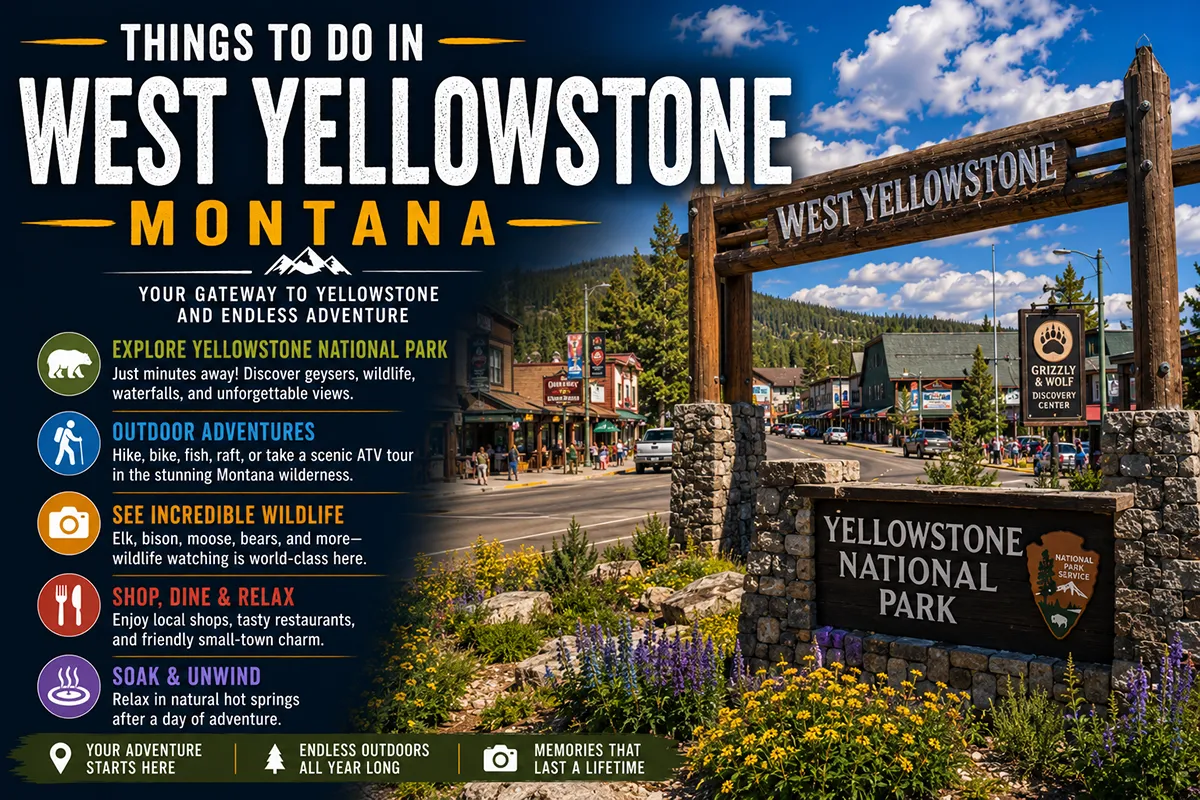
Most people pass through West Yellowstone. They fuel up, maybe grab a sandwich, and head through the gate into the park. What they don’t realize — what I didn’t realize on my first two visits — is that they’re standing in one of the most specifically formed towns in Montana, a place the Union Pacific Railroad built from scratch in 1908 to be the western gateway to America’s first national park.
The depot they built is still there. The railroad car they parked here — a 1903 executive rail car that experts call the most perfectly preserved of its kind in the world — is still there too, free to view at the Holiday Inn on Yellowstone Avenue.
West Yellowstone is a gateway. But it’s also a destination. The Playmill Theatre has run professional Broadway-caliber summer theater here for over 60 consecutive years.
A working seismograph at a visitor center 27 miles from town still registers aftershocks from a 1959 earthquake that killed 28 people and buried a campground under a landslide — with 19 bodies still there. The Rendezvous Ski Trails begin at a trailhead practically inside the city limits.
The park is the main event. But what surrounds it is more interesting than almost anyone gives it credit for.
Quick Answer — Things to Do in West Yellowstone Montana
West Yellowstone’s essential experiences: Yellowstone National Park (west entrance, Old Faithful 1 hour, Grand Prismatic Spring, Firehole River swimming hole), Grizzly & Wolf Discovery Center, Playmill Theatre (60+ years of Broadway favorites), Yellowstone Historic Center (in the 1909 Union Pacific Depot), the Oregon Short Line 1903 Railroad Car (free, most perfectly preserved executive railroad car in the world), Quake Lake (27 miles northwest — a mountain slid into a river in 1959), Rendezvous Ski Trails (18 miles, adjacent to town), and winter snowmobiling into the park (the defining West Yellowstone experience).
- West Yellowstone (population ~1,500) sits at Yellowstone’s west entrance — the closest access point to Old Faithful and Grand Prismatic Spring
- The town was purpose-built by the Union Pacific Railroad in 1908 — a history visible everywhere if you know to look
- Playmill Theatre: Broadway-caliber summer theater in a town of 1,500, running continuously since 1964 — 60+ years
- Oregon Short Line 1903 Railroad Car: FREE, at the Holiday Inn, “most perfectly preserved executive railroad car in the world”
- Quake Lake: A 7.5-magnitude earthquake in 1959 (Montana’s largest) slid a mountain into the Madison River. 19 people are still buried under the landslide.
- Winter transforms West Yellowstone completely — snowmobiling, snow coach tours into the park, cross-country skiing
- We have a complete Grizzly & Wolf Discovery Center guide — linked below
Liked this article?
Add Roaming Montana as a preferred source so you see more of our articles and guides on Google.
Understanding West Yellowstone: A Town Built for One Purpose
West Yellowstone exists because the Union Pacific Railroad decided it should. In 1907–1908, the railroad extended its Oregon Short Line branch into southwestern Montana specifically to create a western gateway to Yellowstone National Park.
They built the town, built the depot, laid out the street grid, and named the main streets after park features (Madison, Canyon, Firehole, Gibbon, Gallatin). The 1909 Union Pacific Depot is now the Yellowstone Historic Center; the Oregon Short Line railroad car from 1903 sits next to the Holiday Inn on Yellowstone Avenue.
Every street name in West Yellowstone is a Yellowstone feature. The town’s entire reason for existence is the park half a mile away. Understanding that origin makes the place more interesting — and makes the Railroad history that no travel guide has properly built out more resonant.
For city context including lodging and dining, see my West Yellowstone city guide.
All 25 Things to Do in West Yellowstone Montana
Yellowstone National Park (West Entrance Access):
- Old Faithful (1 hour from West Yellowstone)
- Grand Prismatic Spring
- Firehole River swimming hole ⭐
- Monument Geyser Basin + Gibbon Falls
- Madison Junction wildlife watching
History & Culture: 6. Yellowstone Historic Center (1909 Union Pacific Depot) 7. Oregon Short Line 1903 Railroad Car — FREE ⭐ 8. Bear Paw Trail Historic Walking Tour (21 sites, green footprints) ⭐ 9. West Yellowstone Visitor Information Center
Wildlife: 10. Grizzly & Wolf Discovery Center ⭐
Arts & Entertainment: 11. Playmill Theatre — 60+ years of Broadway in a town of 1,500 ⭐ 12. Yellowstone Giant Screen Theater (6-story screen)
Outdoor Recreation: 13. Rendezvous Ski Trails (18-mile network, adjacent to town) 14. Fly fishing — Madison River, Henry’s Fork, Gallatin River 15. Hebgen Lake — camping, fishing, boating, birding 16. Henry’s Lake State Park (Idaho, 15 miles west) ⭐ 17. Mountain biking (Rendezvous trails in summer) 18. Horseback riding (guided, Gallatin National Forest) 19. Yellowstone Park Zipline and Aerial Adventures
Unique Experiences: 20. Quake Lake / Madison Canyon Earthquake Lake Visitor Center ⭐ 21. Chuckwagon dinners at area dude ranches 22. Yellowstone Big Gun Fun (indoor shooting range)
Events: 23. Wild West Yellowstone Rodeo (June–August)
Winter (Defining Season): 24. Snowmobiling into Yellowstone (winter, 400+ per day) 25. Yellowstone Expeditions snow coach tours + cross-country skiing
Food:
- Las Palmitas Taco Bus, Firehole BBQ CO., Beartooth Barbeque, huckleberry ice cream everywhere
Yellowstone National Park: What the West Entrance Opens Up
1. Old Faithful (1 Hour from West Yellowstone)
The west entrance is the fastest road to Yellowstone’s most famous features. From the west entrance gate, it’s approximately 45–60 minutes to Old Faithful via the Madison-Firehole corridor — a drive that is itself worth the trip, following the Firehole River through geothermally active terrain past active geysers, hot springs, and bison grazing roadside.
Old Faithful erupts approximately every 90 minutes with a water column reaching 130 feet. The visitor center provides eruption time predictions within 10 minutes. Arrive 20–30 minutes before the predicted time; the surrounding boardwalk fills quickly.
Vehicle reservation: Required for Yellowstone entry from May 26 through August (specific dates vary annually). Book via recreation.gov as soon as your dates are confirmed.
2. Grand Prismatic Spring
The largest hot spring in the United States (370 feet across, 121 feet deep), Grand Prismatic produces a thermal gradient that creates distinct color rings: orange and yellow bacteria at the cooler edges, brilliant blue at the scalding center. The Grand Prismatic Overlook trail (a 1-mile round trip from the parking area) provides the elevated perspective that makes the color pattern fully visible.
Grand Prismatic is approximately 50 minutes from West Yellowstone’s west entrance via the same Firehole River corridor as Old Faithful.
3. Firehole River Swimming Hole — The Yellowstone Secret ⭐
Here is the West Yellowstone area activity that no major travel blog covers: inside Yellowstone National Park, geothermal activity warms sections of the Firehole River to swimmable temperatures in summer.
The designated swimming area near Firehole Falls creates one of the most unusual swimming experiences in the United States — river swimming inside a national park, in geothermally warmed water, surrounded by volcanic landscape.
visittheusa.com mentions it specifically: “go for a swim at the Firehole Falls summer swimming hole.” This is well-known among Yellowstone veterans and almost completely absent from travel blogs targeting West Yellowstone visitors.
The swimming area opens when water temperatures are appropriate (typically July–August). No lifeguards. Standard open-water swimming cautions apply.
Location: Firehole Canyon Drive, a one-way scenic road just south of Madison Junction, approximately 30 minutes from West Yellowstone.
4. Monument Geyser Basin and Gibbon Falls
Two less-crowded Yellowstone features accessible from the west entrance:
Monument Geyser Basin — An off-the-beaten-path thermal area reached via a 3-mile round trip hike with significant elevation gain. The basin features “monument” style thermal vents — tall, silica-encrusted spires that look alien in the best possible way. Far fewer visitors than Old Faithful Basin or Grand Prismatic.
Gibbon Falls — A 84-foot waterfall on the Gibbon River, visible from the road and from a short walk. visittheusa.com: “see the 26-meter cascade at Gibbon Falls.” Easy access makes it a natural stop between other features.
History, Culture, and the Railroad Town
5. Yellowstone Historic Center (in the 1909 Union Pacific Depot) ⭐
The story of West Yellowstone is the story of American tourism infrastructure. The Union Pacific Railroad created this town specifically to deliver park visitors.
The 1909 Union Pacific Depot they built is now the Yellowstone Historic Center — a museum open seasonally (May through October) documenting the history of travel to and within Yellowstone through antique vehicles: stagecoaches, snow plows, early automobiles, and railroad equipment.
The depot itself is architecturally significant — purpose-built with the specific character and function of a gateway — and the vehicle collection tells the complete story of how Americans got to Yellowstone from the 1870s through the automobile era.
Hours: May–October daily.
Cost: Modest admission.
Address: 104 Yellowstone Avenue.
6. Oregon Short Line 1903 Railroad Car — FREE ⭐
This is the West Yellowstone attraction that no travel blog covers properly — and it’s free, year-round, at the Holiday Inn on Yellowstone Avenue.
The Oregon Short Line railroad car from 1903 once belonged to the Vice President of the Union Pacific Railroad. It was parked here as part of the railroad’s original West Yellowstone infrastructure and has never left.
Experts have commented that it is “the most perfectly preserved executive railroad car in the world today.” One berth has been converted into a display on the railroad history of West Yellowstone and the Union Pacific’s role in creating the town.
This is a genuinely extraordinary piece of American transportation history, sitting free and accessible inside a hotel in a town of 1,500 people. It is open any hours the Holiday Inn is open, at no charge.
Location: Holiday Inn West Yellowstone, 315 Yellowstone Avenue.
Admission: Free.
7. Bear Paw Trail Historic Walking Tour ⭐
The Bear Paw Trail is West Yellowstone’s self-guided historic walking tour — a free, unhurried way to experience the railroad-built character of the town.
Green bear paw prints on the sidewalk lead you through 21 historic sites in the compact downtown grid, covering the railroad history, the park’s early tourism infrastructure, key historical buildings, and the stories of the people who built this town in 1908.
Pick up the map at the Chamber of Commerce (30 Yellowstone Avenue) or at any of the 21 site locations.
yellowstonevacations.com covers it; no other major travel guide does. It’s free, it takes 60–90 minutes, and it transforms a town that looks like a standard tourist gateway into something with a specific, legible history.
Cost: Free.
Map available: Chamber of Commerce.
Grizzly & Wolf Discovery Center ⭐
West Yellowstone’s most distinctive in-town attraction has a complete dedicated guide on RoamingMontana.com. For the full breakdown including the 45th Parallel mission, individual animal rescue stories, pool specs, Zooper Tours, and practical tips, see my Grizzly & Wolf Discovery Center guide.
The brief version: An AZA-accredited, non-profit wildlife park housing grizzly bears, wolves, river otters, and birds of prey — all non-releasable animals that cannot survive in the wild. The close-viewing environment makes encounters possible that no Yellowstone drive can guarantee. Grizzly bears don’t hibernate at the facility, making it a year-round option.
The Discovery Center addresses the most common West Yellowstone visitor frustration: “We drove through Yellowstone and didn’t see any bears.” The center provides the reliable encounter that the park can’t promise.
Address: 201 South Canyon Street.
Phone: (406) 646-7001. [Verify current hours and pricing at grizzlydiscoveryctr.org.]
Arts and Entertainment
8. Playmill Theatre — 60+ Years of Summer Theater ⭐
Here’s a statistic that deserves more attention: a town of 1,500 people has sustained professional Broadway-caliber summer theater for over 60 consecutive years. The Playmill Theatre opened in 1964 and has been running a full summer season every year since.
Past productions include Singing in the Rain, Peter Pan, Annie, Newsies, and Cinderella — major Broadway hits performed by professional casts in a theater on Madison Avenue in the center of downtown West Yellowstone. Expedia rates Playmill Theatre as the #1 attraction in West Yellowstone — ahead of the park itself — based on booking activity.
The combination of professional theatrical quality and the specific incongruity of Broadway-level production values in a remote Montana mountain town is the Playmill experience. For families visiting Yellowstone, an evening at the Playmill provides a complete counterpoint to the outdoor day — indoor, air-conditioned, professionally performed.
Season: May through September.
Address: 29 Madison Avenue. [Verify current season schedule and ticket prices at playmilltheatre.com.]
9. Yellowstone Giant Screen Theater (6-Story Screen)
The Yellowstone Giant Screen Theater is not merely an IMAX theater — livingoutlau.com correctly notes the screen is six stories tall. visittheusa.com confirms the Yellowstone nature documentary playing on this screen. The theater runs documentary and educational films focused on Yellowstone, wildlife, and the Greater Yellowstone Ecosystem.
For families arriving tired from a long day in the park, the Giant Screen Theater provides a genuinely impressive decompression option — seeing the same landscapes you’ve been hiking through scaled to six stories is a different kind of perspective.
[Verify current show schedule and pricing at yellowstonegiantscreen.com.]
Outdoor Recreation In and Around Town
10. Rendezvous Ski Trails ⭐
One of the most convenient outdoor recreation resources in Montana relative to accommodation. The Rendezvous Ski Trails trailhead is at 100 S Geyser St — likely within walking distance of your hotel. The 18-mile network of forested trails runs through Gallatin National Forest adjacent to the national park.
In winter: Cross-country skiing on groomed trails. Free Heel and Wheel (downtown outfitter) rents cross-country ski equipment and offers tours.
In summer: The same network becomes a hiking and mountain biking trail system — a way to get away from the road-oriented crowds while staying close to town infrastructure.
Viator accurately describes it: “In summer, these trails are a great option for hikers and bikers looking to get away from the crowds; in winter they are a great spot for winter sports.”
11. Fly Fishing: Madison River, Henry’s Fork, Gallatin River
The rivers surrounding West Yellowstone are among the finest fly fishing waters in the Mountain West:
Madison River — The river that flows from Yellowstone’s west side through West Yellowstone and north toward Ennis is one of Montana’s most celebrated trout fisheries. Blue-ribbon designated sections hold large brown and rainbow trout.
Henry’s Fork (North Fork of the Snake River) — Flowing through Island Park, Idaho, about 20 miles west of West Yellowstone, the Henry’s Fork is considered one of the technical dry-fly fisheries in North America. The Railroad Ranch section on Harriman State Park is particularly celebrated.
Gallatin River — South of West Yellowstone toward Big Sky (via US-191), the Gallatin offers accessible public fishing on a Blue-Ribbon river with varied character from canyon to valley.
For guided fishing options in the area, see my Montana guided tours guide.
12. Hebgen Lake
Hebgen Lake, created by Hebgen Dam on the Madison River, sits a few miles northwest of West Yellowstone. The lake offers camping, fishing (brown and rainbow trout, whitefish), boating, and birding along shore areas that attract waterfowl.
Hebgen Lake’s shoreline campgrounds are significantly less crowded than Yellowstone’s internal camping options and more scenic than town lodging — worth considering for visitors who want outdoor immersion alongside park access.
13. Henry’s Lake State Park (Idaho) ⭐
15 miles west of West Yellowstone in Island Park, Idaho, Henry’s Lake is a high-altitude lake known as one of the finest cutthroat trout fisheries in the intermountain West. The state park has camping, boat ramps, and shore fishing access.
westyellowstonenet.com specifically recommends it; no travel blog builds it out as a West Yellowstone day trip. The cutthroat fishing quality, combined with the mountain scenery and absence of the crowds that concentrate in the national park, makes Henry’s Lake a legitimate alternative for anglers who want trophy trout fishing without competing for limited Yellowstone river access points.
14. Yellowstone Zipline and Aerial Adventures
The Yellowstone Park Zipline (also called Yellowstone Aerial Adventures) offers a ropes course, ziplines, and — through partnership with Geyser Whitewater — Gallatin River rafting packages. Expedia lists it among West Yellowstone’s top activities.
For families with teenagers who need more adrenaline than watching geysers erupt provides, the zipline-to-rafting combination makes for a genuinely active West Yellowstone day.
[Verify current availability and booking at the park’s website.]
Quake Lake: The Full Story No Competitor Tells ⭐
27 miles northwest of West Yellowstone on US-287, Earthquake Lake (locally “Quake Lake”) is one of the most haunting landscapes in Montana — and the story behind it is more dramatic than any travel guide has explained.
On the night of August 17, 1959, at 11:37 PM, a 7.5-magnitude earthquake — the largest ever recorded in Montana — struck the Madison River Canyon 27 miles from West Yellowstone. The earthquake caused a massive landslide: approximately 80 million tons of rock, soil, and trees slid down the canyon wall at nearly 100 miles per hour, damming the Madison River and creating Earthquake Lake.
The landslide buried active campgrounds. 28 people were killed. 19 of their bodies are still under the landslide — they were never recovered. A simple iron cross marks the approximate location where the campground existed.
In West Yellowstone, 27 miles away, people felt the ground shake.
The Madison Canyon Earthquake Lake Visitor Center sits at the western end of the Madison River Canyon Earthquake Area. It overlooks Earthquake Lake and includes:
- A view of the Madison slide itself
- A working seismograph that still registers earthquake activity
- Interpretive programs about the earthquake, geology, and the aftermath
- A DVD presentation and displays on geology, wildlife, and the Greater Yellowstone area
The submerged ghost town of the buried campsite is visible through the water in certain conditions.
Every competitor mentions Quake Lake. None tells this story with the specificity it deserves.
Hours: Memorial Day – Labor Day, daily 8:30 AM – 6:00 PM. Cost: Free. Phone: (406) 823-7620. Distance: 27 miles northwest on US-287.
Winter West Yellowstone: The Defining Season ⭐
Most travel guides treat West Yellowstone as a summer destination. This genuinely misunderstands what the town is.
West Yellowstone is the snowmobile capital of the United States. The town hosts the International Snowmobile Expo annually. When Yellowstone National Park opens to snowmobiling in winter (on a permit system), over 400 snowmobiles per day access the park through the West Entrance. The entire character of the town shifts: the summer backpacker crowd is replaced by snowmobile groups, the restaurants adjust their menus, and the town takes on the specific energy of a winter sports headquarters that has no equivalent in summer.
Snowmobiling Into Yellowstone
Yellowstone in winter with Yellowstone’s roads closed to cars is one of the most extraordinary experiences available in the Mountain West.
The snowmobiling access through the west entrance reaches the park’s interior features — Old Faithful, Grand Prismatic, the Lower Geyser Basin — in a near-silence that summer never provides. Snowmobiles are available to rent from multiple outfitters in town.
Guided tours are recommended for first-timers. [Verify current winter season snowmobile permit system at recreation.gov/nps/yell.]
Yellowstone Expeditions Snow Coach Tours
Yellowstone Expeditions offers snow coach tours — tracked vehicles providing heated, guided access into the park’s interior during winter. livingoutlau.com specifically covers Yellowstone Expeditions as the winter access provider, noting they reach iconic terrains including the Mammoth Area, Canyon Area, and Old Faithful ski trails. These are the same landscapes visited in summer, in a state of snow-covered silence.
The combination of heated vehicle access and expert interpretation makes Yellowstone Expeditions the best option for visitors who want winter Yellowstone without snowmobile experience.
For winter accommodation options near West Yellowstone, see my best Montana Airbnbs for winter guide.
Cross-Country Skiing
The Rendezvous Ski Trails provide the in-town Nordic option; Free Heel and Wheel rents equipment and offers guided tours. The same trails that summer hikers use become groomed Nordic tracks accessible from downtown.
Beyond the Rendezvous network, backcountry skiing in the Gallatin National Forest and the park’s designated winter trail systems provide more remote options for experienced Nordic skiers.
Dog Sled Tours
TripAdvisor lists dog sledding as a West Yellowstone winter attraction; the experience of learning to mush a team of huskies through Yellowstone Country snow has been featured in the New York Times, National Geographic Channel, and Animal Planet.
Events and Seasonal Highlights
Wild West Yellowstone Rodeo (June–August)
The Wild West Yellowstone Rodeo runs June through August with daredevil cowboys competing in bucking horse, bull riding, barrel racing, and other PRCA events.
visittheusa.com: “June through August, watch daredevil cowboys climb on bucking horses and bulls at the Wild West Yellowstone Rodeo.” For families visiting during summer, the rodeo provides the specific western cultural experience that Yellowstone itself doesn’t offer.
Chuckwagon Dinners ⭐
Several dude ranches in the West Yellowstone area offer chuckwagon dinners — campfire-cooked meals with cowboy poetry, storytelling under the stars, and the specific atmosphere of Montana ranch culture.
visittheusa.com specifically covers “join an authentic chuckwagon dinner at a dude ranch, complete with campfire cooking, cowboy poetry and storytelling under the stars.”
No travel blog has built out the chuckwagon dinner experience as a specific West Yellowstone activity recommendation. For families with children or first-time Montana visitors, this is one of the most authentically western evenings available.
Food, Drink, and the Huckleberry Trail
Las Palmitas — The Taco Bus ⭐
Las Palmitas, known locally as the Taco Bus, is parked on Canyon Street — the main street running through town. midlifeglobetrotter.com gives it the most thorough recommendation: “We particularly liked the Taco Bus known as Las Palmitas, which is parked right on Canyon, the main street that runs through town. We preferred the tacos to the burritos.”
In a tourist town where restaurants can coast on captive audiences, the Taco Bus earns its recommendation through quality. The tacos specifically are the order.
Firehole BBQ CO. and Beartooth Barbeque
Two BBQ operations in West Yellowstone provide the hearty-meal-after-outdoor-exertion option that a gateway town needs. midlifeglobetrotter.com mentions both. Both appear consistently in local dining recommendations.
Huckleberry Ice Cream
Available at multiple shops throughout West Yellowstone, huckleberry ice cream is the specific local treat that midlifeglobetrotter.com specifically flags: “Don’t forget to try the local treat, Huckleberry ice cream; it’s served in many places!” The huckleberry — Montana’s native wild berry — doesn’t travel well and doesn’t exist in most grocery stores. West Yellowstone is one of the best places in the state to experience it in processed form.
Ernie’s
A breakfast institution in West Yellowstone, recommended by midlifeglobetrotter.com for starting the day before heading into the park.
Under Canvas
West Yellowstone’s luxury glamping option sits just outside town in an open Montana valley — canvas tents with real beds, mountain views, and a stream for swimming. midlifeglobetrotter.com stayed here and rates it specifically for the combination of outdoor immersion and proximity to both town services and the national park.
Yellowstone Big Gun Fun
TripAdvisor lists Yellowstone Big Gun Fun as a West Yellowstone attraction — an indoor shooting range located at the west entrance offering rentals of machine guns, handguns, and rifles. No travel blog covering West Yellowstone has covered this as a visitor activity. For visitors with specific interest in firearms and marksmanship, this is a genuine West Yellowstone-specific option.
Things to Do in West Yellowstone by Traveler Type
For Families
Grizzly & Wolf Discovery Center (guaranteed bear/wolf viewing, educational), Playmill Theatre (evening, Broadway favorites, all ages), Yellowstone Giant Screen Theater (6-story screen, nature documentaries), Wild West Yellowstone Rodeo (summer evenings), Yellowstone Park Zipline and Aerial Adventures (ages 4+), Firehole River swimming hole (summer, inside the park).
For History Enthusiasts
Oregon Short Line 1903 Railroad Car (FREE, most preserved executive railroad car in the world), Bear Paw Trail Walking Tour (21 sites, green footprints on sidewalk), Yellowstone Historic Center (1909 Union Pacific Depot), Quake Lake Visitor Center (1959 earthquake, 28 killed, working seismograph). Two hours in these four attractions tells the complete story of why West Yellowstone exists.
For Outdoor Enthusiasts
Rendezvous Ski Trails (18 miles, steps from downtown), Madison River fly fishing, Henry’s Lake State Park (cutthroat trout, Idaho), Hebgen Lake (camping, boating, fishing), horseback riding in Gallatin National Forest.
For Winter Visitors
Snowmobiling into Yellowstone (400+ per day through west entrance), Yellowstone Expeditions snow coach tours, cross-country skiing on Rendezvous Ski Trails (Free Heel and Wheel rentals), dog sled tours, Grizzly & Wolf Center (bears are awake year-round — no hibernation).
Free and Budget Activities
Bear Paw Trail Walking Tour (free), Oregon Short Line Railroad Car (free, Holiday Inn), Firehole River swimming hole (park entry fee required), Rendezvous Ski Trails in summer (free hiking), Quake Lake Visitor Center (free), Hebgen Lake access (free day use areas).
For Wildlife Viewing
Grizzly & Wolf Discovery Center (guaranteed grizzlies and wolves year-round), Madison Junction in Yellowstone (bison herds daily), Hebgen Lake (waterfowl and waterfowl birding), Henry’s Fork near Harriman State Park (moose, osprey, trumpeter swans).
Day Trips From West Yellowstone
Virginia City (1.5 hours north)
Montana’s best-preserved ghost town from the 1860s gold rush era — Virginia City and its sister settlement Nevada City sit 90 miles north of West Yellowstone. westyellowstonenet.com and other guides mention Virginia City as a day trip. For the full ghost town context, see my Montana ghost towns guide.
Grand Teton National Park (1 hour south)
The Tetons are 60 miles south of West Yellowstone via US-89/191. The vertical drama of the Teton Range is entirely different from Yellowstone’s plateau character — a complementary experience for visitors with multiple days. Moose, bald eagles, and elk are common in the Teton corridor.
Lamar Valley (2.5 hours through the park)
The best wildlife viewing in the continental United States sits 2.5 hours through Yellowstone from the west entrance. For the strategy on timing, positioning, and what to watch for, see my Lamar Valley guide and Yellowstone wolf watching guide.
Harriman State Park (Idaho, 30 minutes west)
The Henry’s Fork flows through Harriman State Park — the Railroad Ranch section is one of the most technically challenging and rewarding dry-fly fisheries in North America, with exceptional access and minimal crowds relative to its reputation. Also offers horseback riding and hiking. westyellowstonenet.com recommends it.
Practical Planning
Getting to West Yellowstone: West Yellowstone Airport (WYS) offers seasonal service. Year-round, Bozeman Yellowstone International Airport (BZN) is 90 miles north via US-191 — the most reliable commercial option.
How long to stay: 2 days minimum covers a full Yellowstone day (Old Faithful, Grand Prismatic), the Grizzly & Wolf Center, Playmill Theatre evening, and the Oregon Short Line car. 3 days adds Quake Lake, Rendezvous Trails, and a Madison River fishing session. 4+ days enables Lamar Valley wildlife and Henry’s Lake.
Vehicle reservations: Required for Yellowstone entry May 26–August (varies annually). Book at recreation.gov the day reservations open — they sell out within hours.
Seasonal note: West Yellowstone’s west entrance closes to wheeled vehicles in winter (typically November–April). During winter, the town operates as a snowmobile and snow coach gateway. The park is accessible in winter by snowmobile (permitted) or by organized snow coach tours.
For seasonal guidance across Montana, see my best time to visit Montana guide.
What Competitors Miss About West Yellowstone
After reviewing every travel guide for this keyword, these are the gaps that no guide has filled:
The Oregon Short Line 1903 Railroad Car — “The most perfectly preserved executive railroad car in the world” is FREE, year-round, at the Holiday Inn. One travel guide mentions it. None builds it out as the attraction it is.
The Bear Paw Trail Walking Tour — Green bear paw prints on the sidewalk leading to 21 historic sites, free, covering the railroad-origin story of the town. One guide covers it. None of the major travel blogs does.
The Railroad Origin Story — West Yellowstone was built by Union Pacific Railroad in 1908. Every street name is a Yellowstone feature. The 1909 depot is now a museum. The 1903 executive car is at the Holiday Inn. The Bear Paw Trail walks you through all of it. No travel blog connects these into a coherent narrative.
Quake Lake’s human story — 28 people killed. 19 still buried. A working seismograph. A mountain that moved in the night. Every guide says “earthquake lake.” None tells the story with the gravity it deserves.
Playmill Theatre’s 60+ consecutive years — Since 1964, without interruption, in a town of 1,500. That’s extraordinary. No travel blog has made that case.
Winter as the defining season — West Yellowstone in winter is a completely different town than West Yellowstone in summer, with a specific culture built around snowmobiling at a scale (400+ per day into the park) that no summer activity matches. No travel blog has built out the winter character of West Yellowstone as the primary visitor experience it is for the snowmobile community.
The Firehole River swimming hole — Geothermally warmed river swimming inside Yellowstone National Park. A well-known secret among Yellowstone veterans. Almost never appears in travel guides targeting West Yellowstone visitors.
Explore More Montana Cities
Montana has a lot of ground to cover. Whether you’re building a road trip route or just curious what the next town down the highway has to offer, here are the city guides we’ve put together so far:
- Things to Do in Bozeman, Montana — Montana’s fastest-growing city, with great restaurants, the Museum of the Rockies, and easy access to Gallatin Canyon and Big Sky.
- Things to Do in Livingston, Montana — The original Yellowstone gateway; a fly fishing capital with a surprising arts scene, vintage neon downtown, and the Absaroka Mountains as a backdrop.
- Things to Do in Missoula, Montana — Western Montana’s outdoor playground, where the Clark Fork River flows through downtown and hiking, breweries, art galleries, and live music are all part of daily life.
- Things to Do in Whitefish, Montana — The gateway to Glacier National Park, with a walkable downtown, ski resort access at Whitefish Mountain, and Whitefish Lake on the edge of town.
- Things to Do in Kalispell, Montana — The commercial hub of the Flathead Valley; close to Glacier, Flathead Lake, and some of the best scenic drives in northwest Montana.
- Things to Do in Bigfork, Montana — A small arts village on Flathead Lake that punches above its size with galleries, live theater, and excellent waterfront dining.
- Things to Do in Polson, Montana — Sitting on the southern shore of Flathead Lake, Polson combines lake recreation, cherry orchards, and sweeping views of the Mission Mountains.
- Things to Do in Butte, Montana — One of Montana’s most historically layered cities; mining heritage, Victorian architecture, and a working-class character that’s entirely its own.
- Things to Do in Helena, Montana — Montana’s compact, walkable capital; the state capitol building, Last Chance Gulch, and the Cathedral of Saint Helena are all within easy reach downtown.
- Things to Do in Great Falls, Montana — The Electric City is home to the Missouri River’s famous waterfalls, the Lewis and Clark National Historic Trail Interpretive Center, and an impressive collection of museums.
- Things to Do in Billings, Montana — Montana’s largest city offers a mix of urban amenities, sandstone Rimrocks, vibrant breweries, family attractions, and easy access to nearby state parks and national monuments.
- Things to Do in Dillon, Montana — A quiet southwestern Montana town with serious fly fishing access on the Beaverhead River and a pace that feels far removed from the tourist trail.
- Things to Do in Hamilton, Montana — Nestled in the scenic Bitterroot Valley, Hamilton is known for hiking, fishing, historic downtown charm, and easy access to the Bitterroot Mountains.
- Things to Do in West Yellowstone, Montana — The busiest gateway to Yellowstone National Park, offering wildlife viewing, snowmobiling, museums, and year-round outdoor adventures.
- Things to Do in Gardiner, Montana — Yellowstone’s original entrance town, famous for the Roosevelt Arch, abundant wildlife, river rafting, and quick access to Mammoth Hot Springs.
- Things to Do in Red Lodge, Montana — A charming mountain town at the base of the Beartooth Highway, known for its historic downtown, outdoor recreation, and one of America’s most scenic drives.
- Things to Do in Polebridge, Montana — Glacier’s remote northwest corner; no cell service, no power grid, a legendary bakery, and some of the most untouched backcountry in the park.
- Things to Do in Miles City, Montana — Eastern Montana’s cowboy capital, home to the Bucking Horse Sale and a historic downtown that hasn’t changed much since the cattle drives.
- Things to Do in Havre, Montana — A welcoming Hi-Line community where railroad history, underground tours, and wide-open prairie landscapes showcase a different side of northern Montana.
- Libby, Montana Guide — A timber town in the far northwest tucked along the Kootenai River, with Kootenai Falls and the Cabinet Mountains Wilderness on its doorstep.
Final Thoughts
West Yellowstone earns its reputation as a gateway. Old Faithful is 45 minutes that direction. Grand Prismatic is 50 minutes. The entire west side of the greatest national park in the world opens from the gate at the edge of town.
But the gateway is more interesting than most visitors assume. The Union Pacific built this place. The 1903 railroad car is still here. The 1959 earthquake is still discussed in the Madison Canyon. The Playmill Theatre has been running since 1964 in a town of 1,500 people, which is either insane or remarkable depending on how you look at it. In winter, more snowmobiles come through this gate than cars come through in summer.
Give West Yellowstone more than one night. See what the railroad left behind. Go to the theater. And before you leave, find the old executive railroad car at the Holiday Inn — the one that belonged to the Vice President of the Union Pacific, the one that experts call the most perfectly preserved in the world — and take a minute to think about the fact that it’s sitting in a Montana town of 1,500 people and it’s free to see.
Questions about West Yellowstone? Drop them in the comments.
Frequently Asked Questions
What are the best things to do in West Yellowstone Montana?
The essential West Yellowstone experiences: Yellowstone National Park via the west entrance (Old Faithful 1 hour, Grand Prismatic 50 minutes, Firehole River swimming hole in summer), Grizzly & Wolf Discovery Center (guaranteed grizzly and wolf viewing year-round), Playmill Theatre (Broadway-caliber summer theater since 1964), Oregon Short Line 1903 Railroad Car (free, most perfectly preserved executive railroad car in the world), Bear Paw Trail Historic Walking Tour (21 sites, free), and Quake Lake (27 miles northwest — the full 1959 earthquake story).
How far is West Yellowstone from Old Faithful?
Old Faithful is approximately 45–60 minutes from West Yellowstone’s west entrance via the Madison-Firehole River corridor. The drive itself passes geysers, hot springs, and bison. Grand Prismatic Spring is approximately 50 minutes from the entrance. Vehicle reservations are required for Yellowstone entry from late May through August — book at recreation.gov as soon as you have confirmed travel dates.
What is the Playmill Theatre in West Yellowstone?
The Playmill Theatre is a professional summer stock theater that has operated continuously since 1964 — over 60 consecutive years — in a town of 1,500 people. Productions include Broadway favorites performed by professional casts: past shows include Singing in the Rain, Peter Pan, Annie, and Newsies. Expedia rates it as the #1 attraction in West Yellowstone. The season runs May through September. Address: 29 Madison Avenue. [Verify current season schedule at playmilltheatre.com.]
What happened at Quake Lake near West Yellowstone?
On August 17, 1959, at 11:37 PM, a 7.5-magnitude earthquake — the largest ever recorded in Montana — struck the Madison River Canyon 27 miles northwest of West Yellowstone. The earthquake triggered a massive landslide: 80 million tons of material slid into the canyon, damming the Madison River and creating Earthquake Lake (Quake Lake). 28 people were killed; 19 are still buried under the landslide. The Madison Canyon Earthquake Lake Visitor Center (open Memorial Day–Labor Day) includes a working seismograph, interpretive displays, and views of the landslide scar. Free admission.
What is the Oregon Short Line Railroad Car in West Yellowstone?
The Oregon Short Line 1903 railroad car is a meticulously preserved executive railroad car that once belonged to the Vice President of the Union Pacific Railroad. Experts have identified it as the most perfectly preserved executive railroad car in the world today. It is displayed at the Holiday Inn on Yellowstone Avenue in West Yellowstone — free to see, open year-round during hotel hours. One berth contains displays on the railroad history of West Yellowstone. Most travel guides to West Yellowstone overlook it entirely.
Is West Yellowstone worth visiting in winter?
Yes — West Yellowstone in winter is arguably more interesting than in summer. The town is the snowmobile capital of the United States, with over 400 snowmobiles per day accessing Yellowstone National Park through the west entrance during the winter season. Yellowstone Expeditions offers heated snow coach tours into the park’s interior — seeing Old Faithful and Grand Prismatic in winter silence is a completely different experience from the summer crowds. Cross-country skiing on the 18-mile Rendezvous Ski Trails network begins at a trailhead steps from most hotels. The Grizzly & Wolf Discovery Center operates year-round (bears don’t hibernate there).
How do I get to West Yellowstone?
Bozeman Yellowstone International Airport (BZN) is approximately 90 miles north via US-191 through the Gallatin Canyon — about 1.5 hours. West Yellowstone Airport (WYS) offers seasonal commercial service. A car is essential — the park and virtually all outdoor activities require driving. US-191 from Bozeman through the Gallatin Canyon is one of Montana’s most scenic highway drives.