The first time I drove from Bozeman down US-89 to Yellowstone Hot Springs, I made the mistake of arriving thirty minutes before closing on a Sunday in February. The Kneipp Walk ritual takes longer than that — and once I understood what this place actually is, that became my single biggest planning regret.
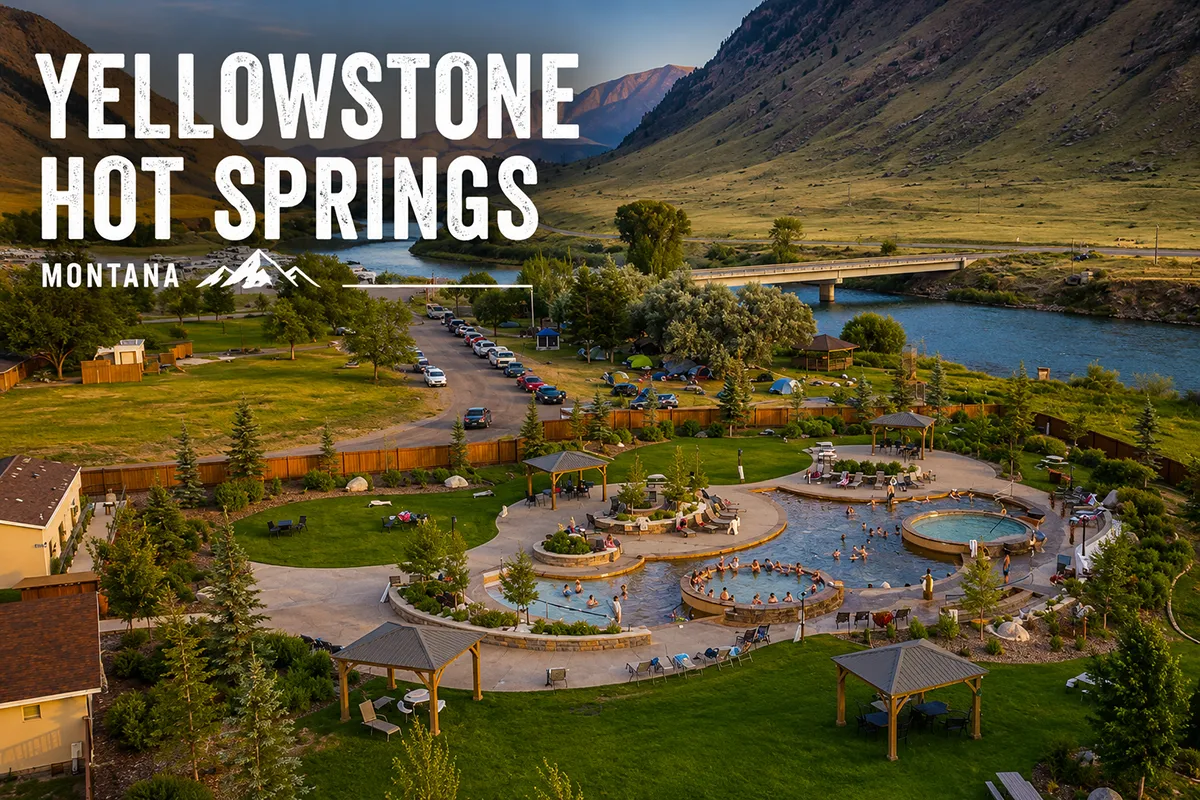
Yellowstone Hot Springs, in Corwin Springs eight miles north of Gardiner, is the most distinctive new hot springs experience in Montana, and it’s the legitimate replacement for the much-loved Boiling River soak that’s been closed inside Yellowstone National Park since 2022.
This guide tells you exactly what’s here, what to expect, and how to plan a visit that doesn’t get cut short by the same mistake I made.
- Yellowstone Hot Springs is a year-round mineral hot springs resort at Corwin Springs, about 6–8 miles north of Gardiner, on US-89 at the south end of Paradise Valley. 100 feet from the Yellowstone River.
- Five outdoor flow-through mineral pools: a 3,750 sq ft main pool (~98–100°F), a hot plunge (103–105°F), a cold plunge (60–68°F), and two parallel Kneipp Walk pools (104°F hot + 64°F cold) — a European naturopathic ritual rare in the U.S.
- No chemicals. 70,000 gallons of mineral water cycle through the pools every 8 hours; source water emerges at ~150–154°F from the historic LaDuke Hot Springs and is piped 1.5 miles to the facility.
- Owned by Royal Teton Ranch, currently operated as Yellowstone Hot Springs. The current resort opened August 15, 2019 after construction began in January 2018, and was significantly renovated in 2025 (freshly resurfaced pools, new waterfall feature).
- Day-use $10 (verify current pricing). Summer hours: Tuesday–Sunday 9am–9pm. Winter: Wednesday–Sunday 9am–9pm.
- Lodging on-site: 5 suites, 4 cabins, 2 vacation homes, 8 full-service RV sites, 27 electric RV sites, 18 tent sites.
- This is the closest legitimate hot springs to Yellowstone’s North Entrance since the Boiling River soak inside the park was destroyed by the June 2022 flood and remains closed.
- For broader context, see our Montana hot springs pillar guide.
Liked this article?
Add Roaming Montana as a preferred source so you see more of our articles and guides on Google.
Why Yellowstone Hot Springs Matters Right Now
If you’re researching hot springs in the Yellowstone area, you’ve probably encountered older articles recommending Boiling River — the spot inside Yellowstone where hot thermal water mixed with the cold Gardner River into natural soaking pools. Boiling River is permanently closed.
The June 2022 floods destroyed the soaking pools, swept away the access path, and altered the river channel itself. The National Park Service has confirmed there’s no plan or timeline to reopen it.
This matters because Yellowstone Hot Springs at Corwin Springs is now the closest legitimate hot springs experience to Yellowstone’s North Entrance.
It’s eight miles north of Gardiner on US-89, accessed via Cinnabar Basin Road and East Gate Road. It’s the answer to the question “where do we soak now that Boiling River is gone.”
Importantly, Yellowstone Hot Springs is not just a Boiling River substitute — it’s a fundamentally different kind of experience. Boiling River was a free, primitive river-mixing soak.
Yellowstone Hot Springs is a developed resort with five distinct pools, mineral-rich flow-through water, on-site lodging, and a café.
Many longtime Boiling River fans actually prefer it: cleaner water, multiple temperature options, no slippery river-rock footing, and amenities you don’t expect at a primitive hot springs.
For travelers building a longer Montana hot springs trip, see our Montana hot springs pillar guide, best natural hot springs in Montana, and Montana hot springs RV resorts hubs.
Where Yellowstone Hot Springs Is Located
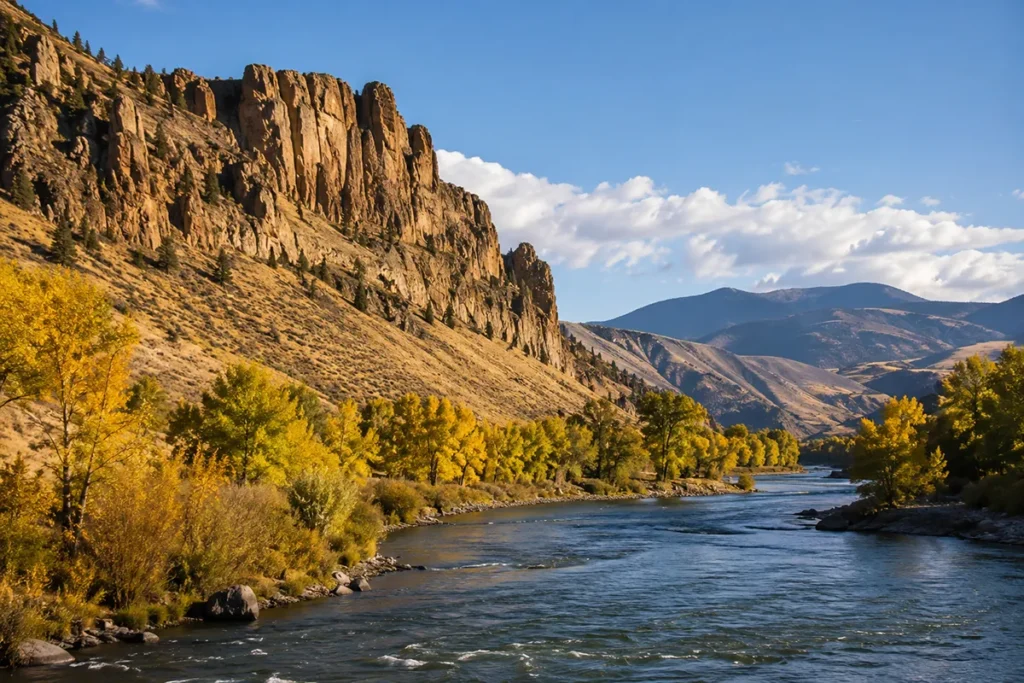
The resort sits in Corwin Springs, a small community at the southern end of Paradise Valley in Park County, Montana. The location is genuinely beautiful — the Absaroka Range rises to the east, the Gallatin Range to the west, and the Yellowstone River runs alongside, just 100 feet from the pool deck.
- Distance from Gardiner: ~6–8 miles north (10 minutes)
- Distance from Yellowstone National Park North Entrance: ~10 minutes
- Distance from Livingston: ~47 miles south (about 30 minutes by US-89)
- Distance from Bozeman: ~70 miles (~1.5 hours)
- Distance from West Yellowstone: ~75 miles (via the park if open, longer if circumnavigating)
- Distance from Cooke City: ~70 miles (via the park’s Northeast Entrance through Lamar Valley)
- Owned by: Royal Teton Ranch
- Property size: 25 acres
Contact:
- Hot Springs: 406-848-4141
- RV / Camp / Cabins: 406-589-7350
- Website: yellowstonehotspringsmt.com
How to Get to Yellowstone Hot Springs
The route is well-marked once you know what you’re looking for, but the final turn-off catches first-time visitors.
From Gardiner (~10 minutes)
This is the most common approach — you’ll likely be coming here from a Yellowstone day trip.
- From Gardiner, head north on US-89 (away from the park)
- After about 7 miles, turn left onto Cinnabar Basin Road
- Continue until you reach East Gate Road — turn right onto East Gate Road before the river
- Follow East Gate Road; the Yellowstone Hot Springs entrance is on your left
From Bozeman (~1.5 hours)
- Take I-90 East for ~23 miles to Exit 333 (Livingston)
- Exit and turn left onto US-89 South
- Drive ~45 miles south on US-89 through Paradise Valley
- Turn right onto Cinnabar Basin Road
- Turn right onto East Gate Road
- The resort entrance is on the left
The drive through Paradise Valley along US-89 is genuinely one of Montana’s best — wide ranchland with the Absarokas rising sharply on the east. Allow extra time for photo stops if it’s your first run.
From Livingston (~30 minutes)
Straight south on US-89 for ~45 miles, then the same Cinnabar Basin Road / East Gate Road sequence.
From West Yellowstone or Cooke City
Both routes go through Yellowstone National Park itself. From West Yellowstone, you’ll exit via the North Entrance through Mammoth Hot Springs and Gardiner.
From Cooke City, you’ll come through Lamar Valley and exit at Gardiner. The park drive adds time but adds substantial wildlife-watching potential — see Lamar Valley and Yellowstone wolf watching for the inside-park experience.
Vehicle and Access Notes
The final paved roads (Cinnabar Basin Road and East Gate Road) are accessible in any standard car year-round. The resort itself has free on-site parking, including accessible spaces. Cell service in Corwin Springs is patchy — don’t depend on real-time GPS for the final turn.
The Five Pools at Yellowstone Hot Springs
The pool inventory is what makes Yellowstone Hot Springs distinctive among Montana resorts. Five outdoor flow-through mineral pools, each with its own role in the soaking experience.
1. The Main Pool — 98–100°F
The signature pool. 3,750 square feet, approximately 3.5 feet deep, with built-in sitting ledges along the perimeter. The main pool is large enough to swim and move around in, but not so deep that you’d dive into it (which is a stated rule).
Some sources cite an average temperature of 98.6°F; in practice it runs in a comfortable 98–100°F range that lets you stay in for extended sessions.
The pool features a zero-entry walk-in area that makes it the most accessible pool on the property for visitors with mobility considerations.
2. The Hot Plunge — 103–105°F
The hotter sibling to the main pool. Smaller and dedicated to traditional hot soaking. This is where most repeat visitors spend their first 10–15 minutes before cycling to other features.
3. The Cold Plunge — 60–68°F
The contrast-therapy element. Air temperature affects the perceived shock significantly — in winter the 60°F water feels almost gentle, while in summer it can take your breath away. Depth is shallow enough to step in carefully.
4 & 5. The Kneipp Walk Pools — 104°F and 64°F (Parallel)
These two parallel shallow pools are the resort’s signature feature, and the most unusual hot springs amenity in the state. We’ll cover the Kneipp Walk in detail below — it’s worth its own section.
Why the Pools Feel Different From Most Hot Springs
Two characteristics set the water apart:
No chemicals. The pools operate on a continuous flow-through system. 70,000 gallons of mineral water cycle through the pools every 8 hours, replacing the entire pool volume multiple times per day.
The pools are also scrubbed three times a week. The result is water that feels like a natural spring — slightly silky, faintly mineral, no chlorine smell — without the cleanliness concerns that come with primitive springs.
Source is hot and consistent. Geothermal water emerges from the LaDuke Hot Springs source at approximately 150–154°F and is pumped 1.5 miles to the facility.
The water is then naturally cooled to deliver the various pool temperatures. Because the source is consistent year-round, the pools don’t fluctuate the way some primitive Montana hot springs do based on river flow or seasonal melt.
Pristine surfaces. The 2025 renovation included fresh resurfacing of all pools and the addition of a new waterfall feature. The pool decking is cleaner and more well-maintained than at most older hot springs resorts in the state.
The Heated Entry Steps
This is the small detail that turns out to matter most in winter. The pool entry steps are heated using the same geothermal energy that feeds the pools — meaning there’s no icy entrance to navigate even when the air temperature is well below freezing.
If you’ve ever stood barefoot on icy concrete trying to get into a hot springs pool in January, you understand why this detail is worth its own line.
The Kneipp Walk Ritual — Montana’s Most Unusual Hot Springs Feature
The Kneipp Walk is the single most distinctive experience at Yellowstone Hot Springs, and one of the only places in the United States where you can do this ritual outside specialty spas.
Who Was Sebastian Kneipp?
The Kneipp Walk is named after Sebastian Kneipp (1821–1897), a Catholic priest from Bavaria who became one of the founders of modern naturopathic medicine.
Kneipp championed hydrotherapy — the systematic use of hot and cold water to stimulate circulation, immune function, and overall wellness. The Kneipp Walk specifically is a ritual he developed: alternating immersion in hot and cold ankle-deep water lined with stones.
In Europe, Kneipp facilities are common in spa towns and wellness retreats. In the U.S., they’re rare to non-existent outside dedicated naturopathic centers. The presence of an authentic Kneipp Walk in rural Montana is genuinely unusual.
How the Walk Works
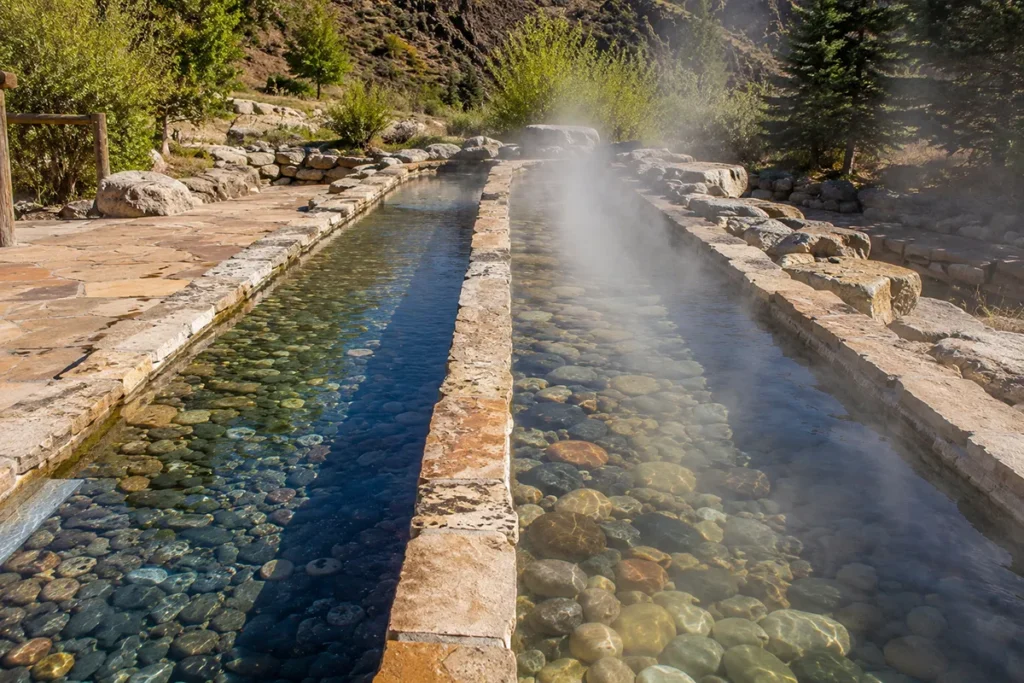
The setup at Yellowstone Hot Springs is two parallel shallow pools, each ankle-deep, separated by a low dividing wall.
The bottoms are lined with river rocks that provide both reflexology-style stimulation and grip. One channel is hot water (~104°F); the other is cold water (~64°F). The 40°F difference is the point.
The Ritual
There’s a specific sequence Kneipp practitioners recommend, and the resort posts guidance for visitors who want to follow it:
- Start with a 3–5 minute soak in the warmer pools (main pool or hot plunge) to relax the body
- Walk slowly through the hot channel, fully wetting feet and ankles
- Walk slowly through the cold channel, fully wetting feet and ankles
- Repeat hot-cold sequence seven times
- Finish with the cold plunge for as long as you can comfortably endure
- End with a soak in the hottest available pool
The reported effect is a tingling, refreshing sensation that radiates from feet upward — a noticeable shift in how the whole body feels. Some visitors report relief from neuropathy and circulation issues; the resort’s marketing leans into the wellness framing.
Whether or not you believe in the specific therapeutic claims, the Kneipp Walk is genuinely a different kind of hot springs experience — more active, more involved, and more memorable than a passive soak. I’d argue it’s worth the trip from Bozeman by itself.
The Water — Source, Minerals, and What Makes It Special
The hot water at Yellowstone Hot Springs originates at LaDuke Hot Springs — a historic geothermal source about 1.5 miles from the current resort facility. Water from LaDuke is piped to the resort, which is how Dr. Frank Corwin’s original 1909 sanitarium was supplied as well.
Mineral Profile
The water is high in lithium content — notable enough that the resort markets it as part of the “Relaxed and Renewed” branding.
Lithium in hot springs water has been associated anecdotally with calming effects on the nervous system, though the science is more debated than the marketing might suggest.
Other minerals present in the LaDuke water include calcium, magnesium, sodium, potassium, sulfate, silica, and trace amounts of other elements typical of geothermal sources.
The water has no detectable sulfur smell — a contrast to some Montana hot springs (notably Lolo Hot Springs) where sulfur is prominent.
The Flow-Through System
The flow-through design is worth understanding because it explains why the water consistently feels “fresh” rather than stagnant.
70,000 gallons of mineral water move through the pool system every 8 hours, meaning the entire pool volume is replaced three times per day. Used water exits the system and eventually returns to the Yellowstone River.
General Manager Erin Kennedy has described the experience this way: a guest could soak in the early afternoon, leave for dinner, and return to find what amounts to entirely different water in the pools. It’s a level of water turnover most public pools don’t approach.
Day-Use Visit: Hours, Pricing, and Policies
Yellowstone Hot Springs is primarily a day-use mineral pool facility (lodging is available — covered below). Most visitors come for a single afternoon or evening soak.
Hours
- Summer: Tuesday–Sunday, 9am–9pm
- Winter: Wednesday–Sunday, 9am–9pm
- Winter Tuesdays: Private rentals available (closed to public)
Closing time is firm. If you want to do the full Kneipp Walk ritual, give yourself at least 2–3 hours.
Pricing
Day pass: approximately $10 per person (per recent visitor reports — verify current pricing at the resort before visiting). The day pass covers all pools and allows in-and-out access during operating hours, so you can soak, leave to explore Yellowstone, and return for an evening session on the same pass.
Reservations
Not required for day-use pools. Walk-in soaking is the standard model. Lodging requires reservations.
Policies
The resort maintains a strict, family-friendly atmosphere:
- Clothing required — no nudity, no overly revealing swimwear
- No alcohol on premises
- No smoking or tobacco
- No glass containers in the pool area
- No pets in the pool area
- No music (Bluetooth speakers prohibited)
- No floating toys (waist floats permitted for children)
- Family-friendly atmosphere — children welcome with parental supervision
The “no music” rule is genuinely enforced and it’s one of the things repeat visitors most appreciate. The pools feel like a quiet wellness retreat rather than a party venue.
Accessibility
The pool area is wheelchair accessible, with accessible parking and a zero-entry walk-in area in the main pool. Changing rooms and shower facilities are also accessible. Visitors with specific mobility needs are encouraged to call ahead at 406-848-4141 to confirm details.
Lodging at Yellowstone Hot Springs
If you’ve come from Bozeman or further, staying overnight is worth considering — both for the convenience of being able to soak morning and evening, and for the lodging quality.
Suites (Added 2023)
5 suites — newly added in 2023. Each is two-bedroom, with a full kitchen, fireplace, and air conditioning.
The finishes are modern lodge décor, and the units accommodate small groups comfortably. These are the resort’s most popular overnight option for families and couples doing extended Yellowstone-area stays.
Cabins
4 cabins — each with a private bathroom, kitchen, smart TVs with Netflix, heat and air conditioning, and Wi-Fi. The cabins are sized for couples or small families and represent a step down in scale (and price) from the suites while still offering full amenities.
Vacation Homes
2 vacation homes — larger units suitable for groups, families, or extended stays.
RV Park
The on-site RV park accommodates a wide range of setups:
- 8 full-service RV sites (water, electric, sewer)
- 27 electric-only RV sites
- 18 tent sites
- RVs up to 40 feet accommodated in select sites
- Newly remodeled shower house
- Coin laundry
- Dump station
- Wi-Fi throughout
- Picnic tables and fire rings
- Portable toilets in addition to the main bathroom facilities
For the broader RV-with-hot-springs landscape, see our best RV parks in Montana and Montana hot springs RV resorts hubs.
Lodging Notes
- RV and camping sites typically operate April through October (weather-dependent)
- Cabins and suites operate year-round
- Booking advance is strongly recommended for summer weekends and any time during Yellowstone’s peak season
The East Gate Cafe
The on-site East Gate Cafe opened to serve the resort’s growing visitor numbers. It’s open Wednesday through Sunday for breakfast and lunch.
Menu highlights:
- Specialty coffee drinks (espresso-based, the local roasters source from regional Montana coffee operations)
- Breakfast sandwiches
- Paninis and salads for lunch
- Ice cream
Practical:
- Drive-thru option for travelers who want to grab and go
- Picnic tables outside for casual dining
- Covered pavilion for weather protection
For dinner or fuller meals, Gardiner (10 minutes south) and Livingston (45 minutes north) both offer better options.
The History — From Dr. Frank Corwin to Today
The site has hosted hot springs operations on and off since the early 1900s, with the modern resort opening as recently as 2019.
The Indigenous Use
Long before European-American settlement, the Crow, Shoshone, and other Indigenous peoples used the hot springs in this region for healing and ceremony. The general respect for the medicinal nature of thermal water predates any of the commercial development by centuries.
Julius J. LaDuke (Late 1800s)
The first commercial development of the area’s geothermal resources traces to Julius J. LaDuke, a French-Canadian immigrant who staked a mining claim along the Yellowstone River.
LaDuke built a series of riverbank hot water plunges — the first mineral hot springs facility near Yellowstone Park — about 30 miles south of Livingston. The source water still feeding Yellowstone Hot Springs today bears his name: LaDuke Hot Springs.
Dr. Frank Corwin (1909)
In 1909, a business consortium including Dr. Frank Corwin built a substantial sanitarium and the Corwin Springs Hotel at the site.
The hotel was significant — a large lodge built specifically around the therapeutic value of the LaDuke waters, drawing visitors for medical treatment and recreation in equal measure.
The 1916 Fire
In 1916, the original Corwin Springs Hotel burned down. The chimneys from the original structure still stand on the property today, giving present-day visitors a tangible link to the early-1900s era. The site continued in limited use through subsequent decades but never returned to its early scale.
The Royal Teton Ranch Era and 2019 Reopening
The property eventually came under the ownership of Royal Teton Ranch. After decades of dormancy as a public hot springs, construction began in January 2018 on a modern resort using the historic LaDuke water source.
The current Yellowstone Hot Springs facility opened to the public on August 15, 2019 — making it one of the newest hot springs destinations in Montana.
Recent Expansion
- 2023: Added 5 modern two-bedroom suites with full kitchens, fireplaces, and air conditioning
- 2025: Major renovation including fresh resurfacing of all pools and the addition of a new waterfall feature
- Capacity: Maximum 275 people, hosting approximately 15,000 visitors per month in summer and 8,000 per month in winter
- Staffing: 40 employees as of recent reports
The resort has grown into a real economic anchor for the Corwin Springs community, and the General Manager Erin Kennedy is a recurring presence both at the resort and in regional travel-press coverage.
When to Visit Yellowstone Hot Springs
Each season offers a meaningfully different experience.
Winter (December–March) — The Visual Peak
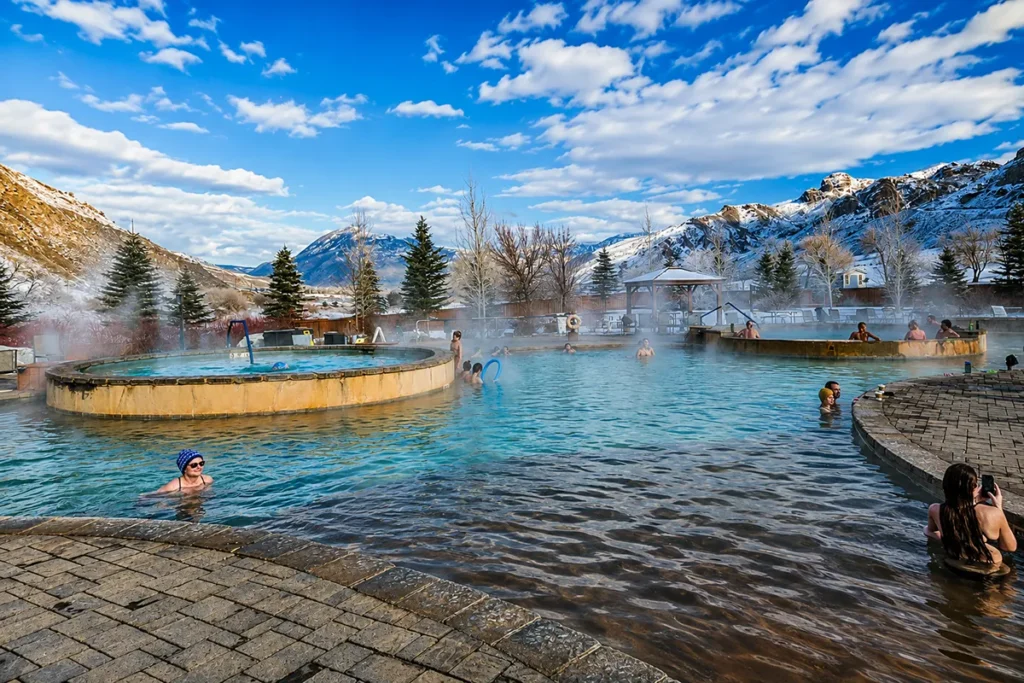
Steam pouring off five outdoor pools with the snow-covered Absarokas as backdrop is among the most photogenic hot springs experiences in Montana.
The heated entry steps make winter entries genuinely comfortable. The 40°F differential at the Kneipp Walk feels milder in winter air, making the ritual easier to complete.
Combine with: A Yellowstone winter wildlife trip — see Yellowstone wolf watching for the cold-season specialty. Pack for serious cold; see our Montana winter clothing guide and Montana winter weather hubs.
Spring (April–May)
Crowds are at their lowest. Yellowstone’s interior roads begin opening in late April/early May. RV and camping sites typically open in April. Spring weather is unpredictable — pack for everything.
Summer (June–August) — Peak Crowds
The resort hosts ~15,000 visitors per month in summer. Mornings (9–11am) and evenings (after 7pm) are dramatically less crowded than midday weekends. Long daylight hours allow extended visits combining park exploration and evening soaks.
For broader summer planning, see best time to visit Montana.
Fall (September–October) — The Sweet Spot
My favorite window. Crowds drop sharply after Labor Day, the cottonwoods along the Yellowstone River turn gold, and the wildlife viewing in Yellowstone’s northern range peaks (the elk rut in September is spectacular).
Air temperatures remain pleasant enough for outdoor soaking without the summer crowds.
What’s Nearby — Building a Trip
The Corwin Springs location pairs naturally with several Yellowstone-area experiences.
Yellowstone National Park — 10 Minutes South
The North Entrance is the obvious anchor. Mammoth Hot Springs (the park’s travertine terraces), the Boiling River area (now closed but the trailhead remains historically significant), the elk herds around Mammoth, and the Roosevelt Arch are all within 30 minutes of the resort.
Lamar Valley — 1.5 Hours East
“America’s Serengeti” — wolves, bison, elk, bears, pronghorn. The drive from Yellowstone Hot Springs to Lamar Valley via the park is one of the great wildlife drives in North America. Early morning departures (4–5am) give the best wildlife viewing windows.
Yellowstone Wolf Watching — Same Trip
The Yellowstone wolf population has been one of the world’s great conservation success stories. Lamar Valley is the heart of wolf-watching, and guided trips from Gardiner are widely available.
Gardiner — 10 Minutes South
The classic Yellowstone gateway town. Restaurants, outfitters, rafting companies, and the historic Roosevelt Arch (the official entrance to Yellowstone NP) are all here. Dinner in Gardiner pairs well with an evening soak return.
Livingston — 45 Minutes North
One of Montana’s most underrated small cities. Art galleries, restaurants, the Yellowstone Gateway Museum, and the broader Paradise Valley extending south make Livingston worth at least a half-day on a longer trip.
Chico Hot Springs Resort — ~28 Miles Northeast
The historic resort in Pray, MT — a classic Montana hot springs destination since 1900. A two-day hot springs trip linking Yellowstone Hot Springs and Chico hits both ends of the Paradise Valley hot springs scene.
Fly Fishing the Yellowstone River
The Yellowstone is one of America’s premier trout rivers, and Paradise Valley is the prime stretch. Multiple guides operate out of Gardiner and Livingston. Combining a half-day float with an evening soak is a Paradise Valley classic.
For broader trip context, see things to do in Montana and Montana trip planning guide.
Practical Tips From the Visits I’ve Made
A few things worth knowing after multiple trips:
Bring sandals or water shoes. The walk from changing rooms to pools can be hot in summer and cold in winter. Foot protection makes the transitions easier.
Time the Kneipp Walk ritual. Doing it properly takes 45 minutes to an hour. Don’t try to fit it into the last 30 minutes before closing.
Visit early or late. 9–11am and after 7pm see meaningfully smaller crowds than 12pm–6pm during summer weekends.
Bring a robe for between pools. The pool deck spaces are short, but on cold mornings or winter days, a quick robe between transitions makes a real difference.
Drink water aggressively. Mineral water soaking dehydrates faster than expected, especially at the resort’s elevation. Refill stations are available.
Don’t dive or jump in. The main pool is shallow (3.5 ft); no diving allowed. The Kneipp Walks are ankle-deep. The cold plunge is shallow. Step in carefully.
Bring binoculars. The wildlife viewing opportunities on the property itself are real — elk, bighorn sheep, bald eagles all use the same canyon. Several visitors have spotted bears and moose during stays.
Stay overnight if coming from far away. A day trip from Bozeman is doable but tight if you want to do both Yellowstone NP and a proper soak. The on-site suites and cabins make 2-day Yellowstone trips much more relaxed.
Practical Info Box
| Detail | Information |
|---|---|
| Location | Corwin Springs, MT — 6–8 miles north of Gardiner on US-89 |
| Address area | East Gate Road, Corwin Springs |
| Phone (Hot Springs) | 406-848-4141 |
| Phone (RV/Camping/Cabins) | 406-589-7350 |
| Website | yellowstonehotspringsmt.com |
| Day Pass | ~$10 (verify current) |
| Pools | 5 outdoor flow-through mineral pools |
| Source Water Temp | ~150–154°F (LaDuke source, pumped 1.5 miles) |
| Pool Temperatures | 60–105°F across five pools |
| Hours (Summer) | Tuesday–Sunday 9am–9pm |
| Hours (Winter) | Wednesday–Sunday 9am–9pm |
| Reservations | Not required for day-use pools |
| Lodging | 5 suites + 4 cabins + 2 vacation homes + RV/tent sites |
| Capacity | 275 maximum |
| Wheelchair Accessible | Yes — zero-entry main pool |
| Pets | Not allowed in pool area |
| Alcohol/Smoking | Strictly prohibited |
| Music | Not permitted (Bluetooth speakers prohibited) |
| Glass | Not permitted |
| Property Size | 25 acres |
| Year Opened (current resort) | August 15, 2019 |
| Most Recent Renovation | 2025 (pool resurfacing + waterfall feature) |
Safety Considerations
The water can scald at the source. Source emerges at ~154°F. Pool water is cooled, but always test the temperature of any pool with your hand before entering.
Heat-related illness is the most common medical issue at any hot springs. Don’t soak more than 20 minutes at a time in hotter pools without a break. Drink water between sessions.
The Kneipp Walk has slippery surfaces. The river rocks lining the bottom provide texture but can shift. Walk slowly and use the dividing wall for support if needed.
Wildlife. The property genuinely sees regular elk, bighorn sheep, and occasional bear activity. Stay aware on the walk to and from your vehicle, particularly at dawn and dusk. See our Montana bear guide for broader context.
Winter driving. US-89 between Livingston and Gardiner can be challenging in winter storms. Check road conditions before driving down. Cinnabar Basin Road and East Gate Road are paved but can be icy.
No lifeguards. Adults are responsible for their own safety and supervising any children in their party.
How Yellowstone Hot Springs Compares to Other Montana Hot Springs
The choice between Yellowstone Hot Springs and other Montana hot springs depends on what you’re optimizing for.
- Want the closest legitimate soak to Yellowstone NP? Yellowstone Hot Springs wins by a wide margin — nothing else is this close to the North Entrance.
- Want historic atmosphere in the same Paradise Valley region? Chico Hot Springs Resort, 28 miles northeast. Operating since 1900, two outdoor pools, famous restaurant.
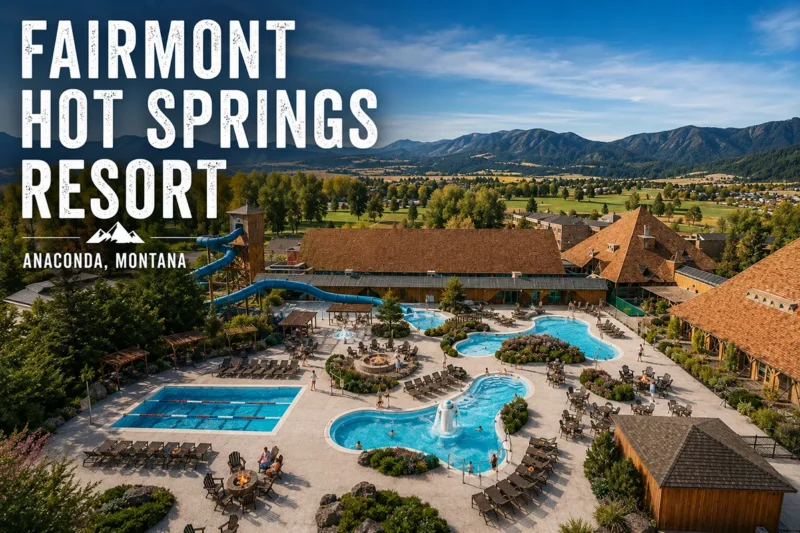
- Want full-service family resort with waterslide and golf? Fairmont Hot Springs Resort between Butte and Anaconda.
- Want a Bozeman-convenient option? Bozeman Hot Springs — 12 pools, easy day-use access.
- Want live music and a single community pool? Norris Hot Springs — 35 miles west of Bozeman.
- Want a high-elevation alpine soak? Elkhorn Hot Springs — Pioneer Mountains, southwest Montana.
- Want a developed pool experience in northwest Montana? Quinn’s Hot Springs Resort or Lolo Hot Springs.
- Want Helena convenience? Broadwater Hot Springs.
- Want a historic hotel atmosphere? Symes Hot Springs Hotel in the town of Hot Springs.
For the complete landscape, see our Montana hot springs pillar guide.
A Final Honest Assessment
Yellowstone Hot Springs occupies a specific niche in Montana’s hot springs landscape: a modern, mid-scale, mineral-focused resort with genuinely unusual features (the Kneipp Walk being the most distinctive), located strategically near America’s most-visited national park.
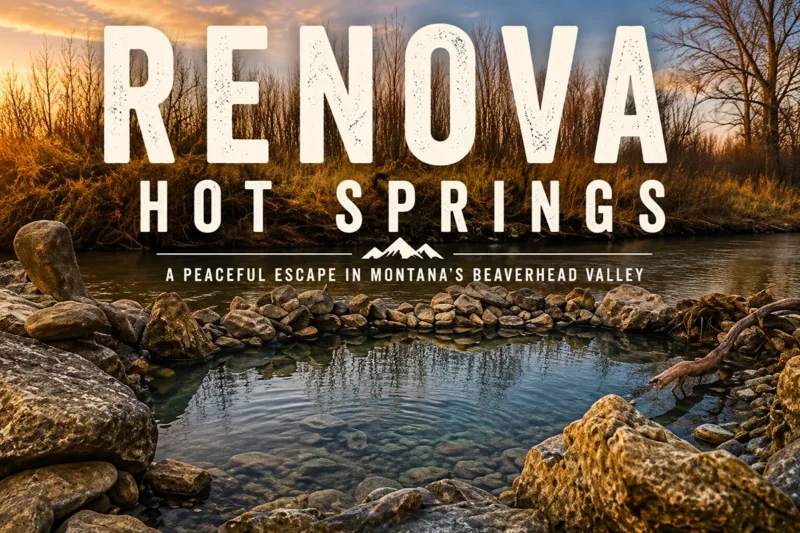
It’s not the most historic Montana hot springs — that’s Chico or Symes. It’s not the largest — that’s Fairmont. It’s not the wildest — primitive options like Renova (with caveats) or Nimrod (a warm spring) deliver more primitive feel.
But it is the most distinctive new hot springs destination in the state, the best legitimate post-Boiling-River option for travelers approaching Yellowstone from the north, and one of the only places in the U.S. where you can experience an authentic European Kneipp Walk ritual. For travelers building a Yellowstone trip, it’s a near-essential add-on.
If you’re going, plan for at least 2–3 hours on-site, do the Kneipp Walk properly, and consider an overnight stay in one of the suites or cabins. If you’re coming from Bozeman or further, the round trip is most rewarding as part of a 2–3 day Yellowstone-area itinerary rather than a one-day blitz.
For broader planning, the Montana hot springs pillar guide is the place to start mapping out a multi-spring Montana trip.
Frequently Asked Questions
Where exactly is Yellowstone Hot Springs located?
Yellowstone Hot Springs is in Corwin Springs, Montana, on the bank of the Yellowstone River, about 6–8 miles north of Gardiner on US-89. Access is via Cinnabar Basin Road and East Gate Road. The resort sits at the southern end of Paradise Valley, approximately 10 minutes from Yellowstone National Park’s North Entrance. It’s about 47 miles south of Livingston and 70 miles south of Bozeman.
Is Yellowstone Hot Springs the same as Boiling River?
No — they’re entirely separate places, but the question makes sense because of how Boiling River’s closure affected the area. Boiling River was the popular soaking area inside Yellowstone National Park (near the North Entrance) where hot thermal water mixed with the Gardner River. Boiling River was destroyed by the June 2022 flood and remains permanently closed. Yellowstone Hot Springs at Corwin Springs is a developed resort eight miles north — and it’s now the closest legitimate hot springs to Yellowstone’s North Entrance.
How much does Yellowstone Hot Springs cost?
Day-use day pass is approximately $10 per person (verify current pricing at 406-848-4141 before visiting). The day pass covers all pools and allows in-and-out access during operating hours, so you can leave and return on the same pass. Overnight lodging is priced separately.
What are the pool temperatures at Yellowstone Hot Springs?
Five pools across a wide temperature range:
Main pool: 98–100°F (3,750 sq ft, ~3.5 ft deep)
Hot plunge: 103–105°F
Cold plunge: 60–68°F
Kneipp Walk hot channel: 104°F (ankle-deep)
Kneipp Walk cold channel: 64°F (ankle-deep)
Source water emerges at approximately 150–154°F from the LaDuke Hot Springs source 1.5 miles away.
Do I need reservations to visit Yellowstone Hot Springs?
Not for day-use pools. Walk-in soaking is the standard. Reservations are required for lodging (suites, cabins, RV sites, tent sites).
What is the Kneipp Walk at Yellowstone Hot Springs?
The Kneipp Walk is two parallel ankle-deep channels lined with river rocks — one hot (104°F), one cold (64°F). Named after Sebastian Kneipp, a 19th-century Bavarian Catholic priest who pioneered modern naturopathic medicine. The standard ritual is to soak 3–5 minutes in the warm pools, then alternate hot and cold channels seven times, then take a cold plunge, then return to the hottest pool. The reported effect is improved circulation and a tingling, refreshing sensation. Kneipp Walks are common in Europe but rare in the United States — Yellowstone Hot Springs is one of the only places to do this in North America.
What are the hours at Yellowstone Hot Springs?
Summer: Tuesday–Sunday, 9am–9pm. Winter: Wednesday–Sunday, 9am–9pm. Tuesdays in winter are reserved for private rentals. The resort is closed Mondays year-round and Tuesdays in winter (except for private bookings).
Is Yellowstone Hot Springs family-friendly?
Yes. The facility maintains a strict family-friendly atmosphere: no alcohol, no smoking, no music, no glass, no pets, clothing required, and a generally quiet environment. Children are welcome with parental supervision. Waist floats are permitted for kids; floating toys are not.
Where can I stay at Yellowstone Hot Springs?
The resort offers several lodging options: 5 modern two-bedroom suites (added 2023 — full kitchens, fireplaces, A/C), 4 cabins (kitchens, smart TVs, Netflix, heat/AC, Wi-Fi), 2 vacation homes, and an RV park with 8 full-service sites, 27 electric-only sites, and 18 tent sites. Cabins and suites operate year-round; RV/tent sites typically operate April through October.
What’s the best time to visit Yellowstone Hot Springs?
Winter (December–March) offers the most photogenic experience — steaming pools against snow-covered Absarokas. Fall (September–October) is the sweet spot for fewer crowds and golden cottonwood color along the river. Summer has the longest hours and is most family-convenient but also brings the largest crowds. Visit weekday mornings (9–11am) or evenings (after 7pm) to avoid peak weekend crowds.
Is there food at Yellowstone Hot Springs?
Yes — the on-site East Gate Cafe serves breakfast and lunch Wednesday through Sunday: specialty coffee, breakfast sandwiches, paninis, salads, and ice cream. A drive-thru option is available. For dinner or fuller meals, head to Gardiner (10 minutes south).
Can I combine Yellowstone Hot Springs with a Yellowstone National Park trip?
Yes — this is the most common itinerary. The park’s North Entrance is 10 minutes from the resort. Many visitors spend the morning in the park (Mammoth Hot Springs, the elk herds, or driving toward Lamar Valley for wolf watching), then return to Yellowstone Hot Springs for an evening soak. Your day pass allows in-and-out access, so this pattern works on a single fee.
How does Yellowstone Hot Springs compare to Chico Hot Springs?
Both are in Paradise Valley, about 28 miles apart. Chico Hot Springs Resort is the historic option — operating since 1900, with two outdoor pools, a renowned restaurant and saloon, and full lodge atmosphere. Yellowstone Hot Springs is the modern option — five pools with broader temperature variety, the unique Kneipp Walk, and a much newer (2019) facility built on a historic 1909 site. They serve different purposes: Chico for atmosphere and dining, Yellowstone Hot Springs for the multi-pool wellness experience and the Yellowstone NP proximity. A two-day Paradise Valley hot springs trip linking both is one of the best Montana hot springs itineraries available.