There’s a moment every May in Miles City where the entire town reorients itself around horses. The streets close. The bars stay open. Every flatbed truck in the county turns up with a bucking horse in the back.
And in a packed stockyard arena on the edge of town, you can stand at the rail and watch the largest sale of bucking stock anywhere in the world go down in front of you. People come from Australia, Brazil, Mexico, and every Western state in the U.S. for this weekend.
I went to my first Bucking Horse Sale on a friend’s recommendation and stayed three days. I have not missed one since.
Welcome to Southeast Montana — the part of the state that’s still doing the things it’s always done, mostly because the rest of the country never figured out to come watch.
TL;DR
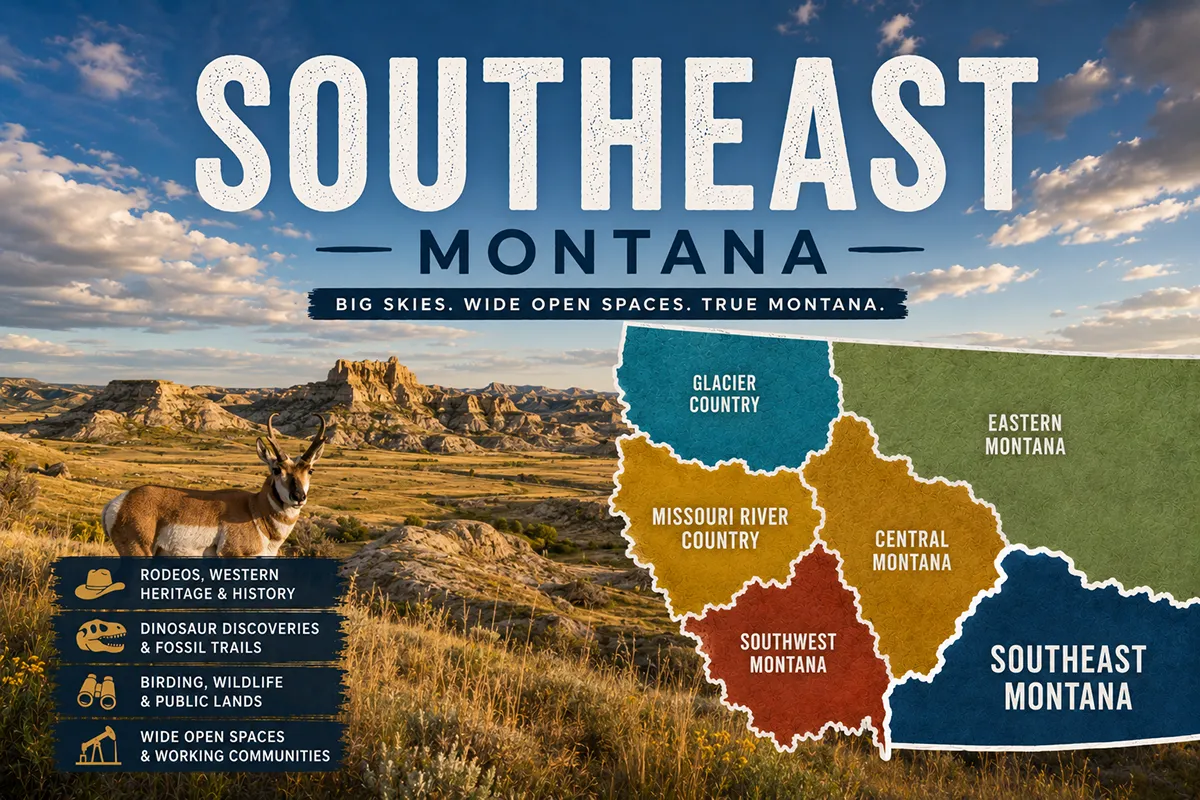
Southeast Montana is officially the sixth of Montana’s tourism regions — and locally, it’s still called Custer Country, after the historical name that’s been used since 1939. It runs from Billings (Montana’s largest city) east to the North Dakota border, and south to the Wyoming line. The region’s headline experiences are the Little Bighorn Battlefield, the Miles City Bucking Horse Sale, the Makoshika and Medicine Rocks badland state parks, the Pompeys Pillar Lewis & Clark site, Crow Fair, and some of the most genuine ranching country left in the American West. Best time: May–September, with mid-May (the Stampede) and September (cooler, golden) as standouts. This is not the prettiest region in Montana. It’s the most honest one.
Liked this article?
Add Roaming Montana as a preferred source so you see more of our articles and guides on Google.
What Is Southeast Montana?
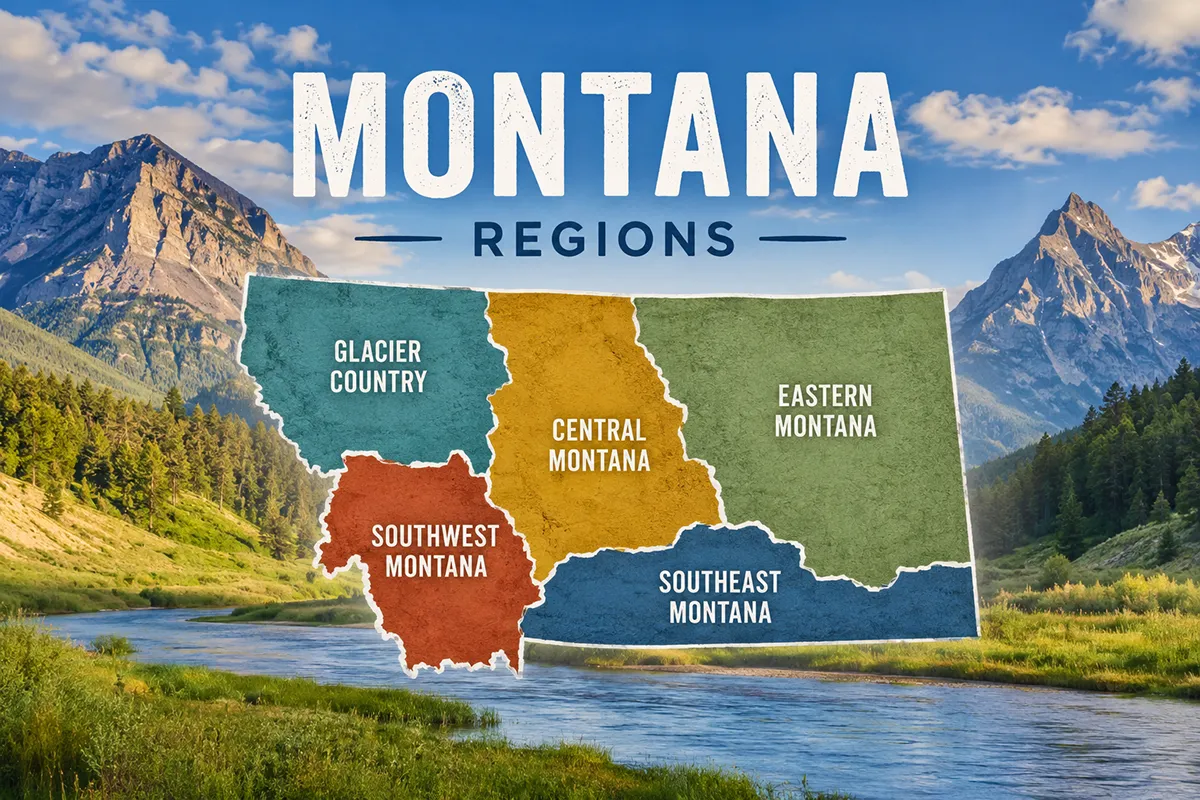
Southeast Montana is one of Montana’s six official tourism regions, established by the Montana Legislature in 1986–87 along with the state lodging tax. Its tourism marketing organization brands it as “Southeast Montana” today, but the historical and locally preferred name is “Custer Country,” which has been in use since 1939 when the Custer Country Travel Association was founded — making it one of the oldest regional tourism brands in the western U.S.
Geographically, the region covers 13 counties: Big Horn, Carbon, Carter, Custer, Dawson (partial), Fallon, Garfield (partial), Powder River, Prairie, Rosebud, Stillwater (partial), Treasure, and Yellowstone. [Verify county composition with current Visit Montana tourism region map.]
It runs from the Wyoming border in the south to the Missouri River in the north, and from the Yellowstone Country boundary near Big Timber east to the North Dakota line.
The region contains:
- Yellowstone County (containing Billings, Montana’s largest city)
- The Crow Indian Reservation (largest reservation in Montana, ~2.3 million acres)
- The Northern Cheyenne Indian Reservation (~445,000 acres)
- Custer Gallatin National Forest (eastern districts)
- The Pryor Mountains (home to one of the few wild horse herds in the U.S.)
- The Tongue, Powder, Bighorn, and Yellowstone Rivers
- Makoshika State Park (the largest state park in Montana)
- Little Bighorn Battlefield National Monument
- Pompeys Pillar National Monument
Two things to know about the name: First, “Custer Country” isn’t a celebration of George Armstrong Custer — it’s a geographic descriptor referring to the county and the battlefield, and the brand predates modern reckoning with that history.
The region’s tourism office today emphasizes the Crow and Northern Cheyenne perspective at Little Bighorn alongside the Custer narrative. Second, the Yellowstone region boundary doesn’t include Billings even though Billings sits in Yellowstone County — Billings is in Southeast Montana / Custer Country for tourism purposes.
This trips up first-timers constantly. (I covered the same confusion in the Yellowstone Country guide.)
The Towns of Southeast Montana
Where you base shapes your trip. Here’s the honest breakdown.
Billings
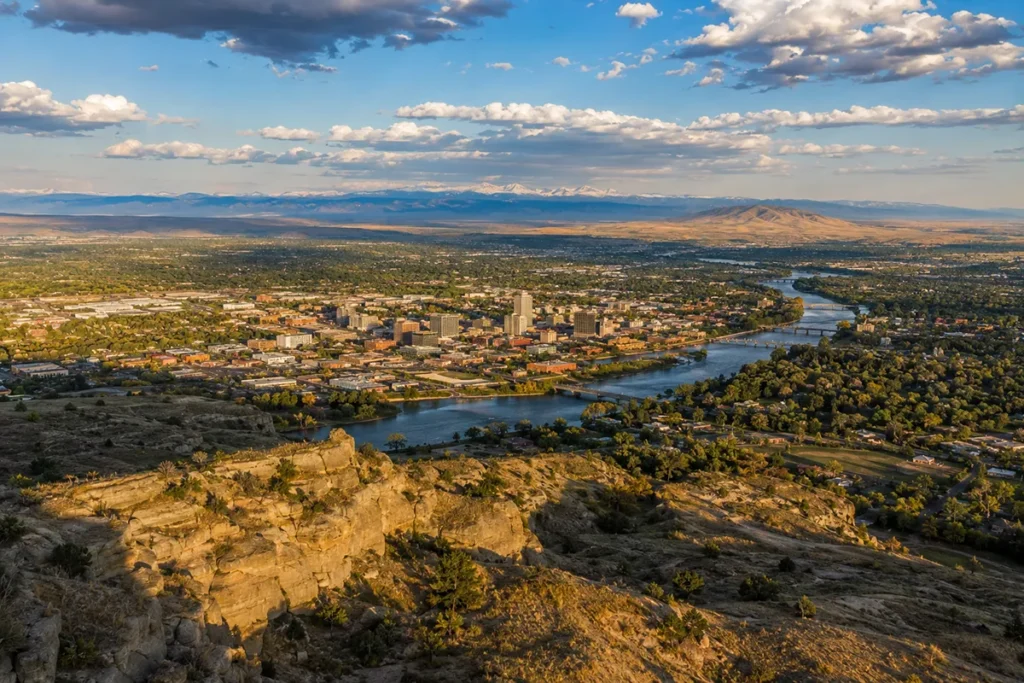
The Magic City. Billings is Montana’s largest city at around 120,000 residents — a sandstone-rim river town that grew up as a railroad terminus in 1882 and has been quietly the economic engine of eastern Montana ever since. It sits at the geographic center of the region and is the closest thing Southeast Montana has to an urban hub.
Billings has the region’s best food scene (multiple great steakhouses), the most museums (Western Heritage Center, Yellowstone Art Museum, Yellowstone County Museum), the most breweries, a year-round symphony, and the only major commercial airport east of Bozeman — Billings Logan International (BIL). ZooMontana sits on the west edge of town.
The famous Rimrocks — the sandstone cliffs ringing the city — are accessible by trail. Pictograph Cave State Park is 5 miles southeast (see attractions below).
Base in Billings if: You’re flying in via BIL, you want a real city base with food and breweries, you’re using it as a hub to spoke out to multiple regional attractions, you’re doing a longer Montana road trip and need an eastern anchor.
➡️ Billings RV parks | ZooMontana
Miles City
Cowboy country, capital. Miles City is a town of about 8,400 in the heart of Custer County, founded in 1876 as a supply post for the U.S. Army during the campaigns following Little Bighorn.
The downtown is one of my favorites in the state — wide brick streets, the Range Riders Museum, working saddle shops, real-deal bars on Main Street.
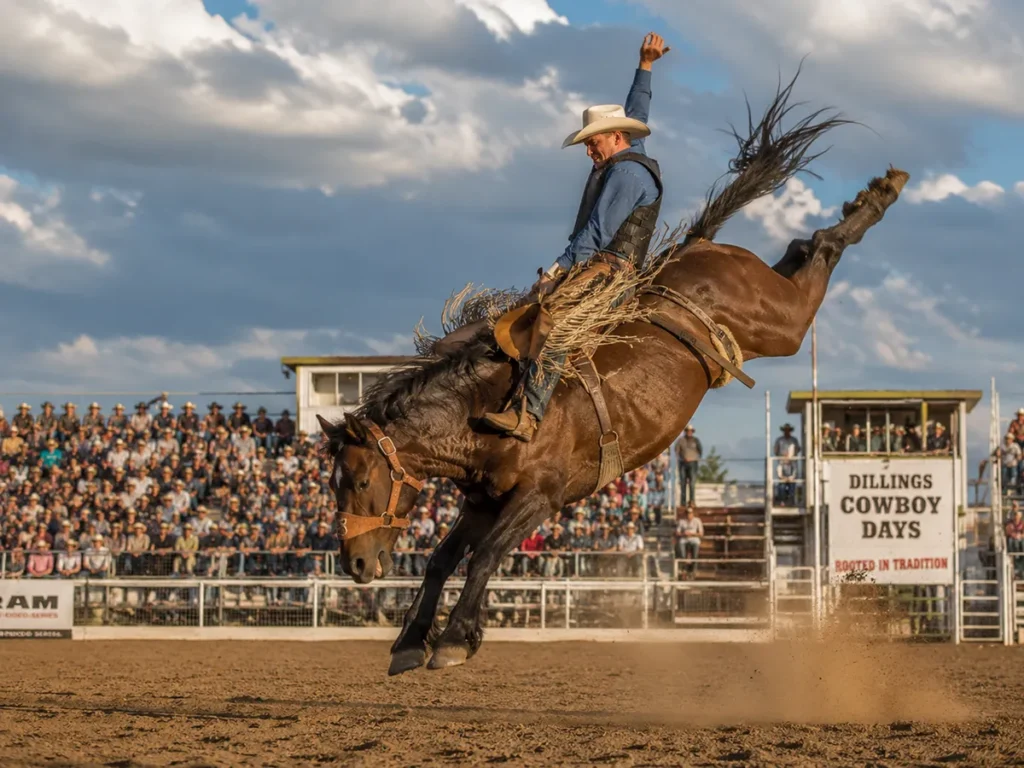
Miles City is the spiritual home of working cowboy culture in the eastern Plains. The Miles City Bucking Horse Sale (third weekend in May) is the largest bucking-stock sale in the world and the unofficial annual reunion of the region’s ranch community.
The Range Riders Museum is the best small museum in eastern Montana — 12 buildings, 30,000+ artifacts, world-class collection of Plains Indian and pioneer material.
Base in Miles City if: Real cowboy culture is your interest, your visit aligns with the Bucking Horse Sale, you’re driving I-94 across eastern Montana.
➡️ Top things to do in Miles City
Glendive
The Makoshika gateway. Glendive sits on the Yellowstone River at the eastern edge of the state, with a population around 4,700.
It’s the gateway to Makoshika State Park (Montana’s largest state park, 11,538 acres of badlands and active dinosaur fossil sites) and home to the Frontier Gateway Museum and the Glendive Dinosaur and Fossil Museum (~20,000 sq ft, one of the largest dinosaur museums between Bozeman and the Black Hills).
The Yellowstone River runs right through town, with paddlefish fishing in spring drawing anglers from across the region.
Base in Glendive if: Makoshika is your priority, you’re interested in dinosaurs, you’re driving I-94.
Hardin
The Little Bighorn base. Hardin is the seat of Big Horn County and the closest meaningful town to Little Bighorn Battlefield National Monument (about 15 miles southeast).
The Big Horn County Historical Museum at the eastern edge of town has a sprawling outdoor complex of 24 relocated and restored historic structures — one of the best small history museums in the state. Hardin sits at the northern edge of the Crow Indian Reservation.
Base in Hardin if: Little Bighorn is your primary destination, or you’re attending Crow Fair in August (see below).
Ekalaka
Dinosaur country, deeply remote. Ekalaka is one of the smallest county seats in the country (population ~330) and sits in the far southeast corner of the state.
The Carter County Museum is, despite the town’s size, one of the best paleontology museums in Montana — Ekalaka is in active T. rex country and the museum has a full skull cast plus extensive original specimens. The annual Dino Shindig every July brings paleontologists from around the world.
Base in Ekalaka if: You’re a dinosaur traveler and want the off-the-beaten-path Hell Creek Formation experience. There’s one motel; book ahead.
Lame Deer
The Northern Cheyenne capital. Lame Deer is the seat of the Northern Cheyenne Indian Reservation. Chief Dull Knife College has a small but excellent cultural center.
The Cheyenne Indian Memorial Museum documents the tribe’s history including the famous 1879 Fort Robinson breakout and return to Montana. Visitors are welcome to attend public events; respect requested at sacred sites.
Other Towns Worth Knowing
- Forsyth — between Miles City and Billings on I-94; historic Western downtown; Rosebud County Courthouse is one of the prettiest small-town courthouses in Montana
- Baker — Fallon County seat, gateway to Medicine Rocks State Park (see attractions)
- Broadus — Powder River County seat; the Powder River Historical Museum has an exceptional pioneer collection
- Terry — small Prairie County town with the unexpectedly excellent Prairie County Museum and the Evelyn Cameron Heritage Center (Cameron was a turn-of-the-century English photographer who documented eastern Montana ranch life)
- Wibaux — far-eastern town with the historic Pierre Wibaux Mansion
- Columbus — gateway to the Stillwater River and the Beartooth Front
- Laurel — refinery town west of Billings with the Yellowstone County Veteran’s Park
- Big Timber — at the western edge of the region, gateway to the Crazy Mountains and the Boulder River
- Absarokee — Stillwater Valley, gateway to the Beartooth Wilderness from the east
- Red Lodge — at the foot of the Beartooth Highway; historic mining town; Red Lodge Mountain Ski Area
Little Bighorn Battlefield National Monument
The most important historical site in Montana, and one of the most consequential in the American West. On June 25–26, 1876, combined forces of Lakota, Cheyenne, and Arapaho warriors led by Sitting Bull, Crazy Horse, Gall, and others defeated the U.S. 7th Cavalry under Lt. Col. George Armstrong Custer. Custer and five of the regiment’s twelve companies were annihilated.
The battlefield is preserved as a National Monument and includes:
- Last Stand Hill — where Custer and the remaining men fell; marked by white headstones
- Indian Memorial — dedicated in 2003; honors the Native warriors and their families
- Reno-Benteen Defense Site — separate location 4 miles south, where the other 7 companies dug in and survived
- Custer National Cemetery — Civil War and later military burials
- Visitor Center — exhibits, ranger talks, films
- Tour Road — 4.5-mile self-guided drive with interpretive stops
My honest advice: Allow at least half a day. Time your visit for a morning ranger talk if possible — the interpretation has improved enormously over the past two decades and now centers Native American perspectives alongside the military narrative. Apsaalooke Tours (run by the Crow Tribe) offers guided experiences from a Crow perspective.
Best season: Late May through October. The site is open year-round but weather can be brutal in winter and the tour road can ice over.
➡️ Key Montana historical events
Pompeys Pillar National Monument
This is the most overlooked major site in Montana, and I will die on this hill.
Pompeys Pillar is a 150-foot sandstone outcrop on the Yellowstone River about 28 miles east of Billings. On July 25, 1806, William Clark carved his name and the date into the rock as he passed through during the Lewis and Clark Expedition.
The signature is still there. It is the only physical, on-site evidence of the Lewis and Clark Expedition that remains in its original location, anywhere along the 8,000-mile trail.
A small visitor center, a boardwalk and staircase up to Clark’s signature, picnic grounds along the river, and interpretive trails make for a half-day visit. The annual Clark Days in late July includes living-history demonstrations.
If you’re in Billings, go. It’s 35 minutes.
Makoshika State Park
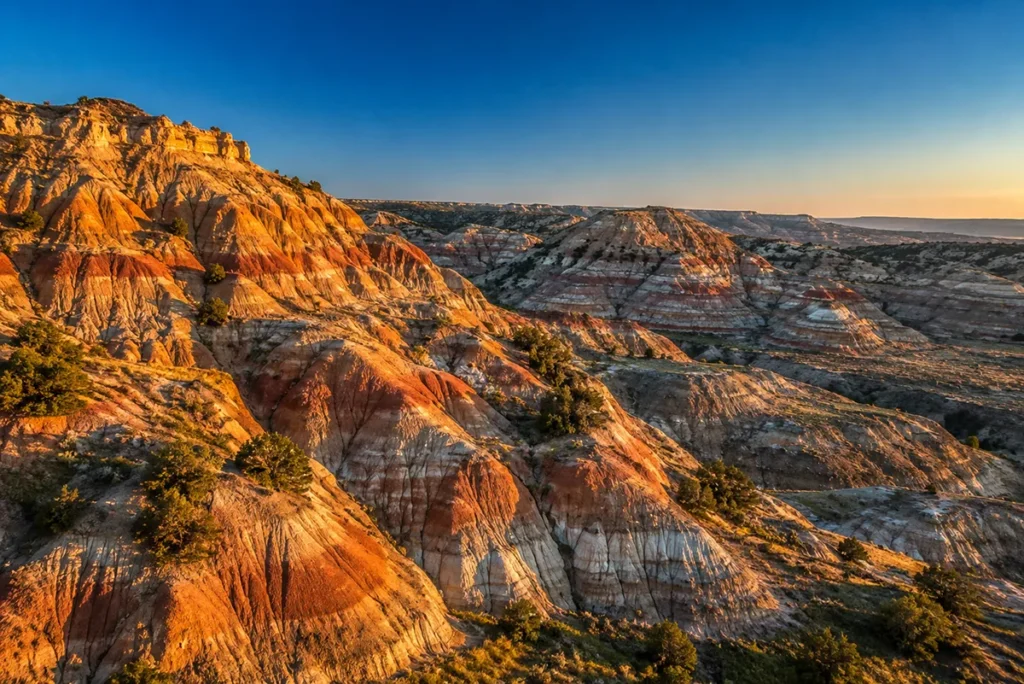
Makoshika State Park is Montana’s largest state park at 11,538 acres of dramatic badlands at the edge of Glendive. The Lakota name means “land of bad spirits” or “bad land” — apt for the eroded, treeless, fossil-rich terrain.
The park sits on the Hell Creek Formation (the same 67-million-year-old rock layer that’s produced more T. rex skeletons than anywhere else on Earth).
Active fossil sites are managed by the Glendive Dinosaur and Fossil Museum and other research groups. You cannot collect fossils, but you can see them weathering out of the cliffs.
What to do:
- Drive the 15-mile scenic loop
- Hike the Cap Rock Trail (easy, 0.6 mile, sandstone cap rock formations)
- Diane Gabriel Trail (moderate, 1.5 miles, more dramatic views)
- Disc golf course (18 holes through the badlands)
- Outdoor amphitheater for summer programs
- Visitor center with a triceratops skull on display
Plan a full day. Hot in summer (90°F+ regularly), so go early or late.
Medicine Rocks State Park
About 25 miles north of Ekalaka sits Medicine Rocks State Park — 320 acres of bizarre, wind-eroded sandstone formations rising from the prairie like a child’s castle made of melted candle wax.
The Lakota and other Plains tribes considered the formations sacred (the name reflects the site’s spiritual significance). Petroglyphs are visible on some formations.
The park is mostly undeveloped — primitive camping, a few picnic tables, the formations themselves. It’s the kind of place where you wander and find yourself alone for an hour. Astrophotographers love it.
Pictograph Cave State Park
A small but extraordinary archaeological site 5 miles southeast of Billings. Pictograph Cave State Park contains three caves with rock art dating back roughly 2,000 years and evidence of human use going back closer to 4,500 years. Over 100 pictographs are visible (though many have faded — bring a flashlight and have patience).
The site played a major role in U.S. archaeology — excavations here in the late 1930s established a new understanding of Plains Indian cultural sequences. Small visitor center, short paved trails. Easily combined with a half-day in Billings.
Crow Fair
The largest Native American gathering in the Northern Plains. Held every third weekend in August on the Crow Indian Reservation just south of Hardin, Crow Fair is often called the “Teepee Capital of the World” — for the week of the fair, the camp grounds along the Little Bighorn River fill with 1,000+ teepees, making it the largest concentration of teepees on Earth.
The event includes:
- Daily grand entry parades with 1,000+ riders in full regalia
- Powwow dance competitions
- Rodeo (the Crow Rodeo, one of the most prestigious all-Indian rodeos)
- Horse races
- Food vendors (the fry bread is non-negotiable)
Open to the public. Respectful behavior expected. Photography is generally fine at grand entries and rodeos but not during competition dancing or at private camp areas without permission. If you have any interest in living Native American culture, this is one of the most extraordinary events in the U.S.
Miles City Bucking Horse Sale
The world’s largest sale of bucking stock, held the third weekend in May since 1951. Roughly 600 horses are bucked over three days in front of stock contractors, rodeo committees, and an arena full of paying spectators. Combine with:
- MCCHS Bucking Horse Sale Parade (Saturday morning)
- Street dances (Friday and Saturday nights)
- Range Riders rodeo events
- Cowboy poetry and music at various downtown venues
The whole town leans in. Book lodging months ahead — every motel within 60 miles fills.
Other Major Attractions
- Pryor Mountains Wild Horse Range — one of the few federally protected wild horse herds in the U.S.; accessed from Lovell, WY or via the Pryor Mountains south of Billings; expect rough roads
- Bighorn Canyon National Recreation Area — 71-mile canyon on the Bighorn River; technically straddles MT-WY but accessed from Fort Smith, MT; serious fly fishing tailwater
- Tongue River Reservoir State Park — quiet camping/fishing reservoir near Decker
- Bighorn County Historical Museum — Hardin; 24 historic structures in a sprawling outdoor complex
- Western Heritage Center — Billings; small but well-curated regional history museum
- Yellowstone Art Museum — Billings; the best modern art museum in eastern Montana
- Beartooth Highway (eastern approach from Red Lodge) — see Yellowstone Country guide for full coverage
A 5-Day Southeast Montana Itinerary
What I’d recommend for a first visit:
- Day 1: Fly into Billings (BIL). Sunset on the Rimrocks. Dinner downtown.
- Day 2: Pompeys Pillar morning. Pictograph Cave afternoon. Dinner in Billings.
- Day 3: Drive to Hardin via Little Bighorn Battlefield (morning ranger talk). Big Horn County Historical Museum afternoon. Overnight Hardin.
- Day 4: Drive east to Miles City. Range Riders Museum afternoon. Steak dinner on Main Street.
- Day 5: Drive to Glendive. Makoshika State Park half-day. Glendive Dinosaur Museum. Fly out via Billings or continue into North Dakota.
For a longer trip: add Ekalaka (Carter County Museum + Medicine Rocks) and Pryor Mountains Wild Horse Range (full day).
Practical Info Box: Southeast Montana at a Glance
| Item | Details |
|---|---|
| Major airport | Billings Logan International (BIL) — the busiest airport in eastern Montana |
| Best season overall | May through September |
| Best for cowboy culture | Mid-May (Bucking Horse Sale), late August (Crow Fair) |
| Counties included | 13 (verify with Visit Montana) |
| Major rivers | Yellowstone, Bighorn, Tongue, Powder, Little Bighorn |
| Largest state park | Makoshika (11,538 acres) |
| Largest reservation | Crow Indian Reservation (~2.3 million acres) |
| Bear country? | Limited; grizzlies in far western mountains; mostly black bear country on the plains |
| Snakes? | Yes — prairie rattlesnakes are common; watch where you step in rocky areas |
| Cell service | Good in Billings/Miles City/Glendive; spotty everywhere else |
| Time zone | Mountain Time (MST/MDT) |
➡️ Airports overview | Cell coverage in Montana | Bear safety | Rattlesnakes
What I Wish I’d Known Before My First Trip
A few things that would have saved me real time.
The Bucking Horse Sale fills every hotel within 60 miles. Same for Crow Fair. Book months ahead or plan to camp.
Little Bighorn deserves more than 90 minutes. Most tour buses give it that. The site is much richer with a half-day and a ranger talk.
Pompeys Pillar is a 35-minute side trip from Billings. Most visitors miss it entirely. Don’t be most visitors.
Heat is the real weather threat in summer. Eastern Montana regularly hits 95°F+ in July and August, with limited tree cover. Hydrate aggressively. Bring sunscreen. Hike Makoshika in the early morning.
Storms come in fast. Thunderstorms over the plains can be dramatic. Hail is real. Check radar before you head into a state park.
Prairie rattlesnakes are common. Especially in Makoshika, Medicine Rocks, and around any rocky outcrop. Stay on trails. Don’t reach into crevices. They want to avoid you.
Wildlife on roads at dusk is constant. Especially mule deer, white-tailed deer, and antelope. Slow down at dawn and dusk.
Powwow and Crow Fair etiquette matters. Stand for grand entries. Ask permission before photographing competitive dancers. Don’t enter family camps uninvited. Buy fry bread from the vendors who actually live there.
This region’s lodging is cheap. Outside of major event weekends, you can stay comfortably in Miles City, Glendive, or Hardin for half what you’d pay in Bozeman.
The food is honest and good. Don’t expect avocado toast. Do expect chicken-fried steak, real burgers, fry bread, and steakhouses that are still cutting steaks in-house.
➡️ More: How to visit Montana on a budget | Best steakhouses in Montana | Montana night sky
Where to Stay (Quick Reference)
| Stay style | Best location |
|---|---|
| Most amenities | Billings (largest selection) |
| Historic downtown | Miles City (Olive Hotel, Bridger Inn area) |
| Battlefield-adjacent | Hardin, Crow Agency |
| Badlands base | Glendive (Makoshika) |
| Remote dinosaur experience | Ekalaka |
| Ranch experience | Throughout — Powder River, Custer, Carter counties |
| Off-grid camping | Makoshika, Medicine Rocks, Tongue River Reservoir |
➡️ Billings RV parks | Best RV parks in Montana | Hidden gem RV parks
How Southeast Montana Compares to the Other Five Regions
| Factor | Southeast Montana | Missouri River Country | Central Montana | Glacier Country | Yellowstone Country | Southwest Montana |
|---|---|---|---|---|---|---|
| Major national park | None | None | None | Glacier | Yellowstone | None |
| Headline feature | Little Bighorn + badlands | Fort Peck + dinosaurs | Rocky Mountain Front | Glacier peaks | Yellowstone Plateau | Mining/hot springs |
| Crowds | Low | Lowest | Very low | Heavy | Heavy | Low |
| Cowboy/Ranch culture | Strongest in state | Strong | Strong | Limited | Limited | Strong |
| Native cultural heritage | Strongest (Crow, N. Cheyenne) | Strong (Fort Peck) | Strong (Blackfeet) | Strong (CSKT, Blackfeet) | Limited | Limited |
| Best for | Cowboy + history + dinosaurs | Off-grid + aurora | 2nd-trip Montana | First-timers | First-timers + wildlife | Repeat visitors |
| Best season | May–Sept | Late May–Sept | May–Sept | Mid-July–mid-Sept | May–Sept | Jun–Sept |
| Affordability | Affordable | Cheapest | Affordable | Most expensive | Expensive | Affordable |
➡️ Sister guides: Glacier Country | Yellowstone Country | Southwest Montana | Central Montana | Missouri River Country
Should You Visit Southeast Montana?
If you’ve never been to Montana, this isn’t your first trip. The mountain regions will give you a more iconic first impression.
But if you’ve been a few times — or if you came to the West to experience Plains culture rather than mountain culture, cowboy tradition rather than ski-town polish, Native American history rather than fur-trade kitsch — Southeast Montana is where to come.
This is the region that doesn’t perform. It is what it is. The May Bucking Horse Sale is the same one it was in 1951. Little Bighorn is still where Custer fell.
Crow Fair is still the largest gathering of its kind in the Northern Plains. Pompeys Pillar still has Clark’s signature on it. Makoshika is still mostly empty.
What changes is whether or not the country pays attention. Out here, the country mostly hasn’t. That’s a good thing.
Save this guide for your trip planning or pin it for later. Got a question about Southeast Montana? Drop it in the comments — I read and answer every one.
You’ve now made it through all six regions. If you want to plan a multi-region Montana trip, the parent Montana Regions guide has drive times, suggested itineraries by length, and decision frameworks for picking the right combination.
➡️ Back to the main Montana Regions guide
Written by Sarah Bennett. I’ve been to seven Bucking Horse Sales, missed two for weather and one for stubbornness. The Olive Hotel in Miles City still has the best lobby in Montana and the bar will still pour you a real drink at noon on a Tuesday.